
In this article you will find a map of the Syrian Arab Republic, located in the Middle East, on the eastern edge of the Mediterranean Sea. It is bordered: to the north by Turkey; to the east and southeast by Iraq; to the south and southwest by Jordan, to the southwest by Israel; and to the west by Lebanon and the Mediterranean Sea. Syria lies at the heart of a region shaken by serious political turmoil since the end of World War II.
Syria has also played a major role in the many political conflicts that have torn this part of the world apart. Its strategic position and military power give it a decisive political weight in the Middle East—a striking contrast with its small area (185,180 square kilometers) and its economic potential.
But since 2011, the country has suffered attacks from the Islamic State and has lost part of its territory and much of its influence. Since Russia and the International Coalition entered the fight against the Islamic State, the Syrian regime has gradually been regaining territory. The maps here are therefore based on the internationally recognized borders of the country.
Table of contents
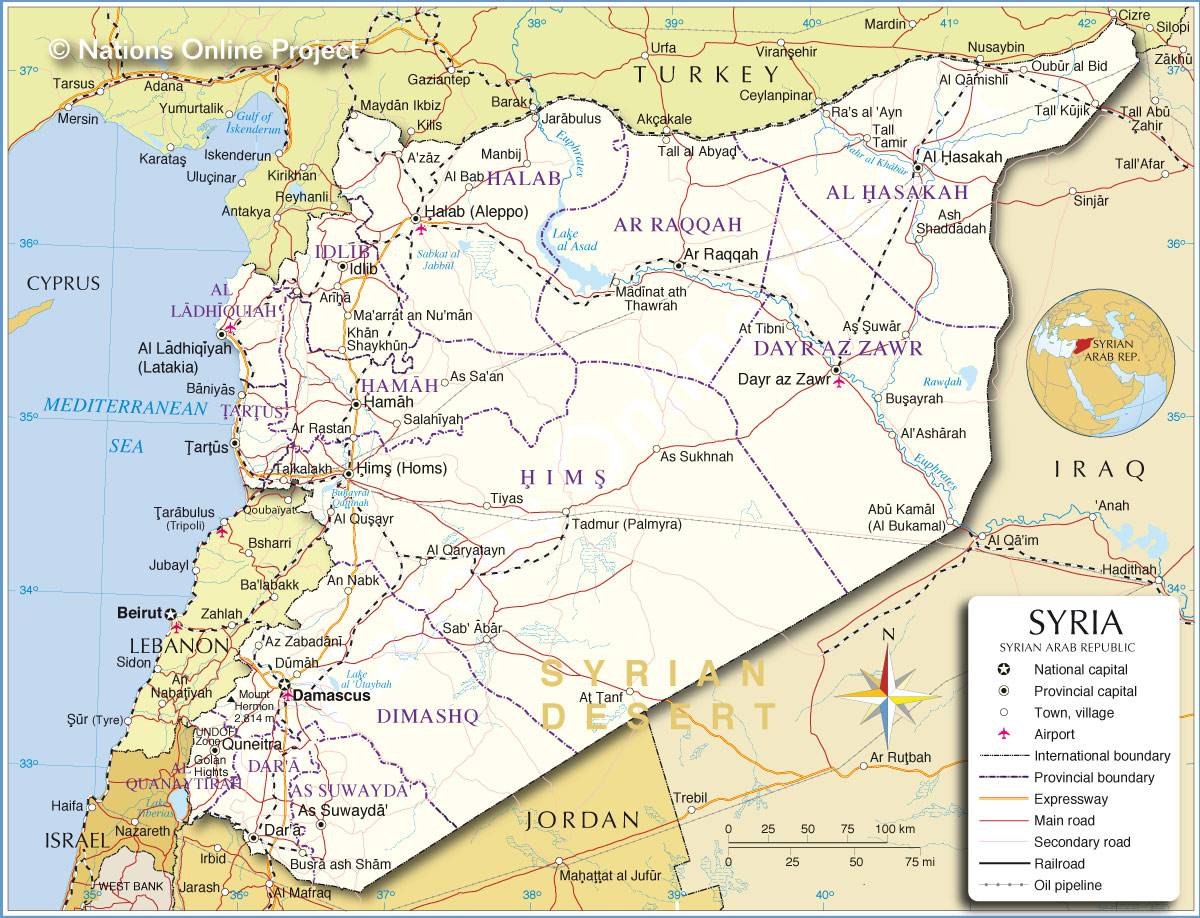
Geographical map of Syria – Credit Nation Online
Geography with the map of Syria
Syria’s topography, climate and vegetation are extremely varied. In the west and southwest, its borders are dominated by mountain ranges that separate the narrow coastal plain from the interior, as you can see on the map of Syria.
The Anti-Lebanon, the country’s highest mountain massif, rises on both sides of the Lebanese border and receives abundant snowfall in winter due to its high altitude. These mountains then give way, to the east, to a plateau that extends over almost all of the remaining Syrian territory.
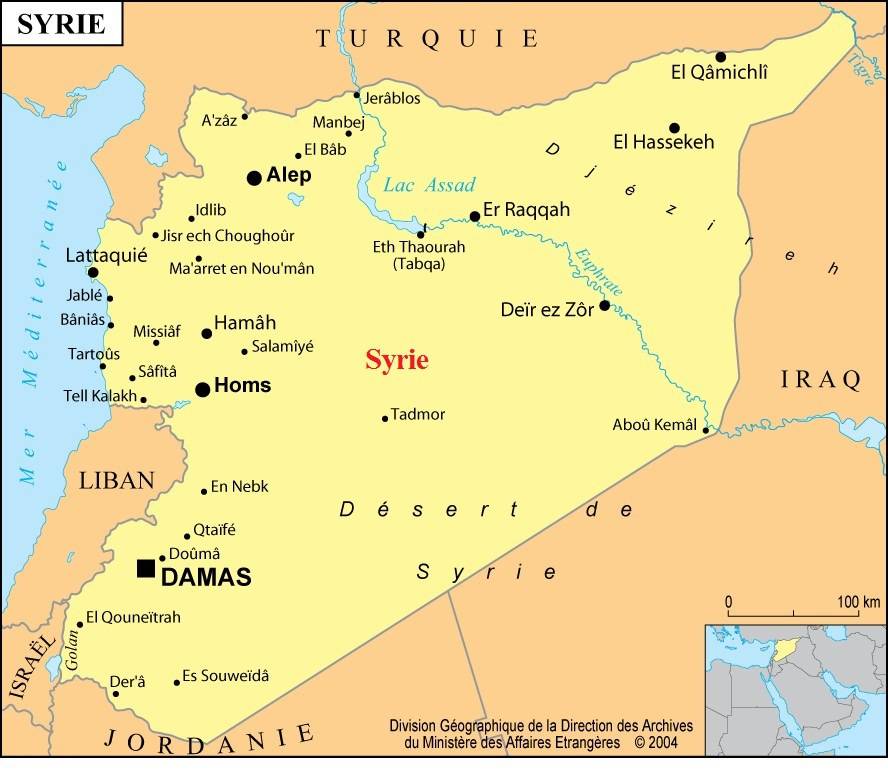
Map of Syria’s cities
The coastal plain has a climate characterized by hot, humid summers and mild, humid winters. Rainfall is sufficient for land to be cultivated without irrigation. The climate inland is quite different: winters are cold, especially in the north, and summers are terribly hot, especially in the east.
The interior of the country is largely desert or semi-desert, as the map of Syria shows. Because of the dryness of Syrian territory, no major river rises there. The sources of the two main rivers that cross the country are located, respectively, in Turkey and Lebanon. Both play an essential role in irrigating farmland.
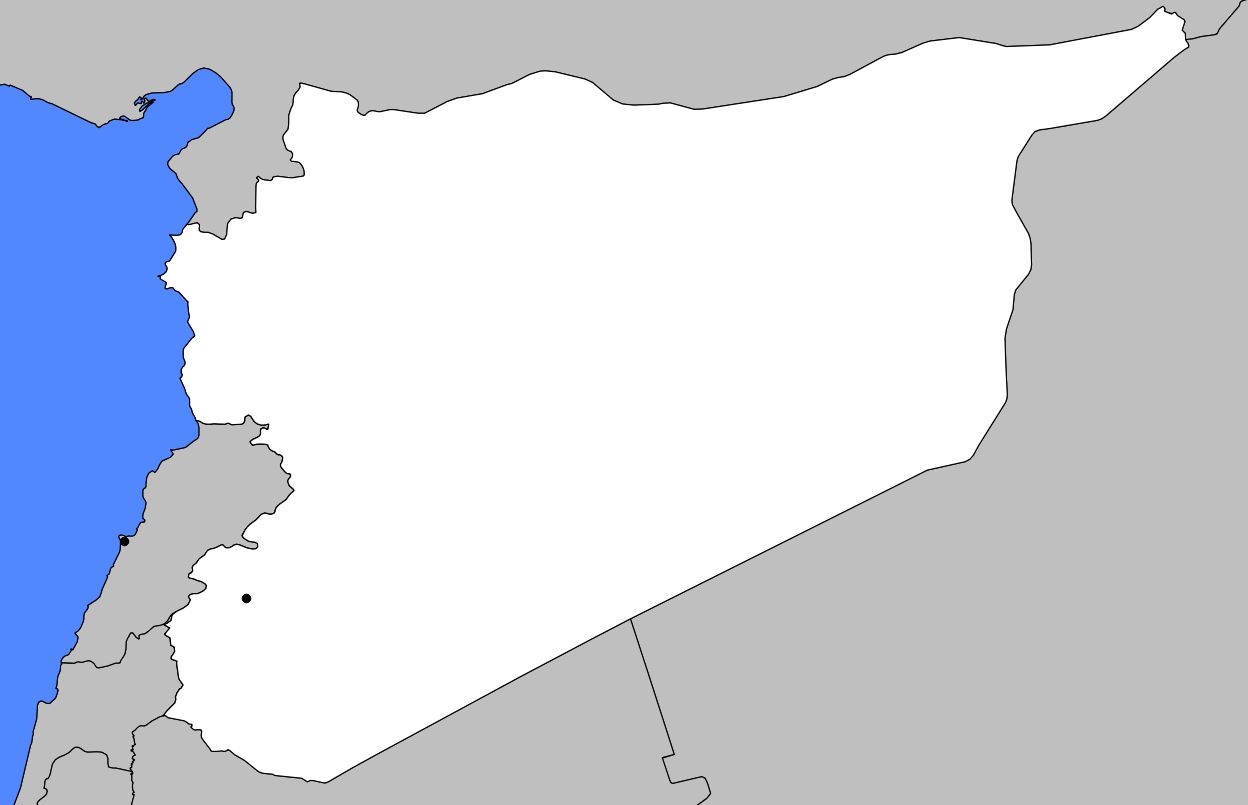
Blank map of Syria
In 1973, a huge dam was built on the Euphrates to bring a new portion of territory under cultivation and to supply the country with hydroelectric power.
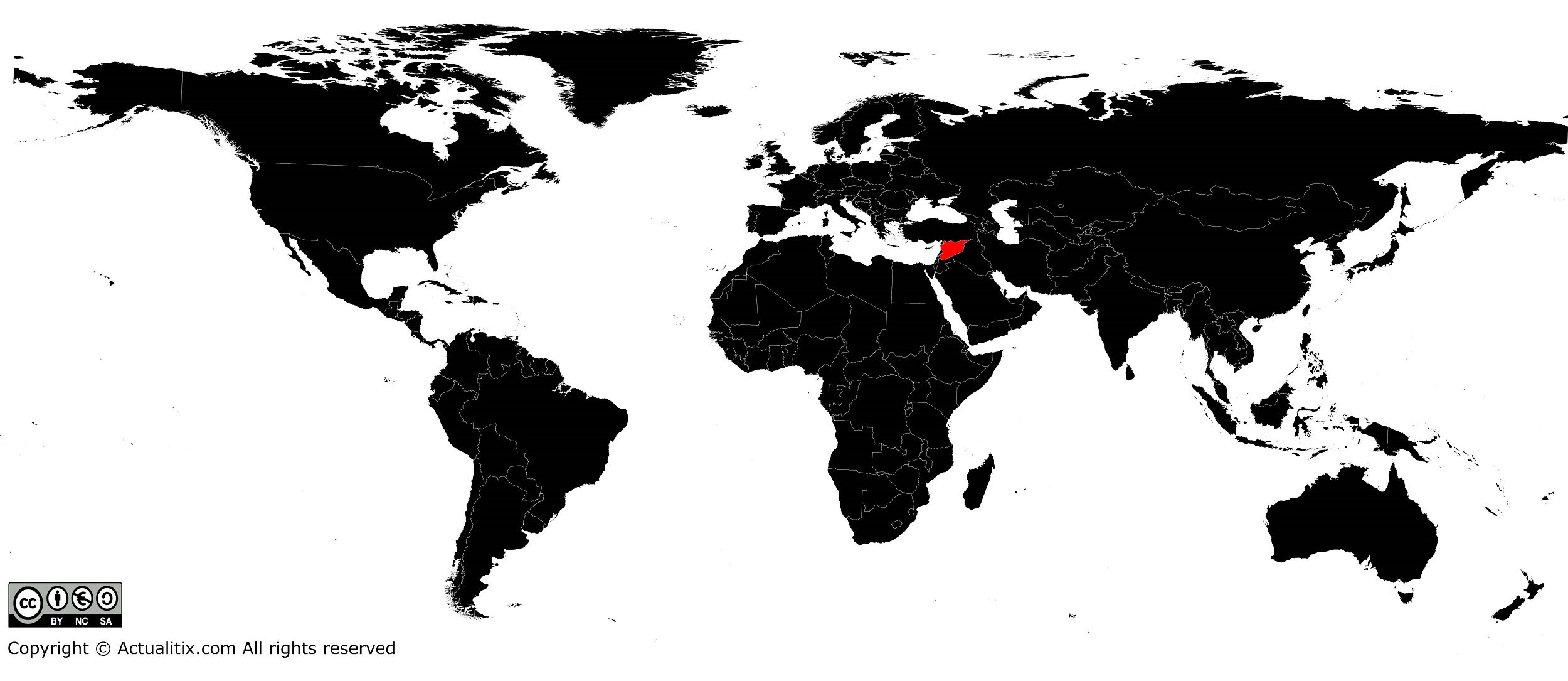
Syria on a world map
Population
Population distribution is closely tied to the availability of water sources. Most of Syria’s population—estimated at nearly 18 million inhabitants in 2016 (hard to verify given the context)—lives in the coastal plain: between the port sites of Latakia and Tartous on the one hand, and between Damascus, the capital (visible on the map of Syria), and Aleppo, the country’s second city, on the other.
The population is therefore distributed along a north–south axis. Few Syrians have settled in the wetter regions that run along the country’s northern and western borders.
You can discover all the maps available for the different countries of the world on this page.