
Discover a map of Canada. From east to west, Canada stretches from the Atlantic Ocean to the Pacific Ocean. To the north, it extends from the U.S. border to the glaciers of the Arctic Ocean.
This vast nation is marked by major geographic and climatic contrasts.
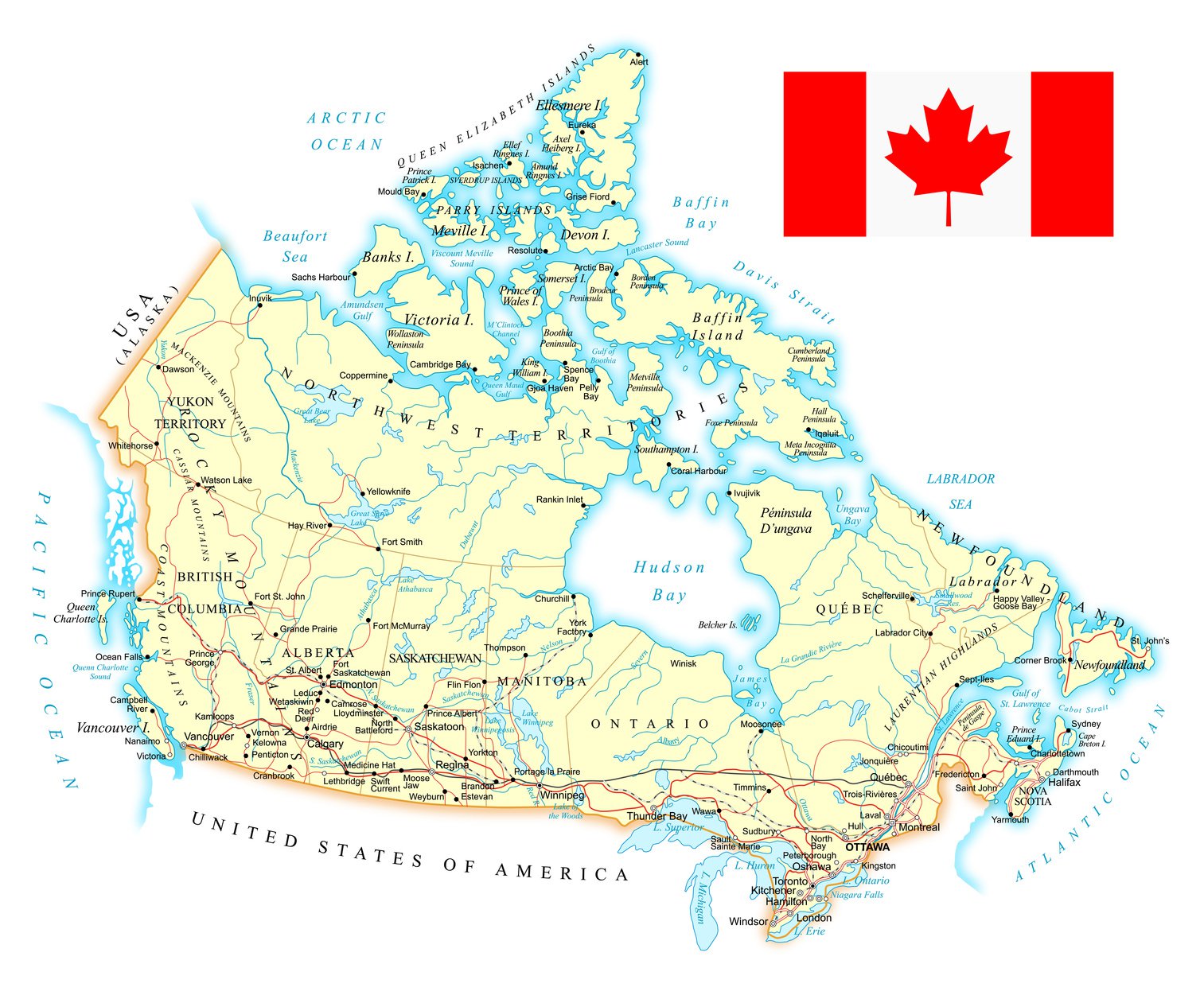
Map of Canada – © dikobrazik – stock.adobe.com
Although its area (10 million square kilometers) makes it the second-largest country in the world, its population density is low: 2.7 people per square kilometer. Even though northern and southern Canada are 4,800 kilometers apart, more than 30 million inhabitants are concentrated along its southern border which, for 300 kilometers, runs alongside 12 U.S. states.
Article outline
Natural environment in Canada
The immense Canadian Shield is made up of very hard ancient rocks dating back to Precambrian times. It forms the foundation of nearly half of Canada. From the Gulf of Amundsen, it extends south and east to Hudson Bay (which you can see on the map of Canada), in the Atlantic Ocean. In doing so, it includes all of Labrador as well as part of Quebec and Ontario. The sedimentary rocks that make up the subsoil of the rest of the country rest on this ancient base.
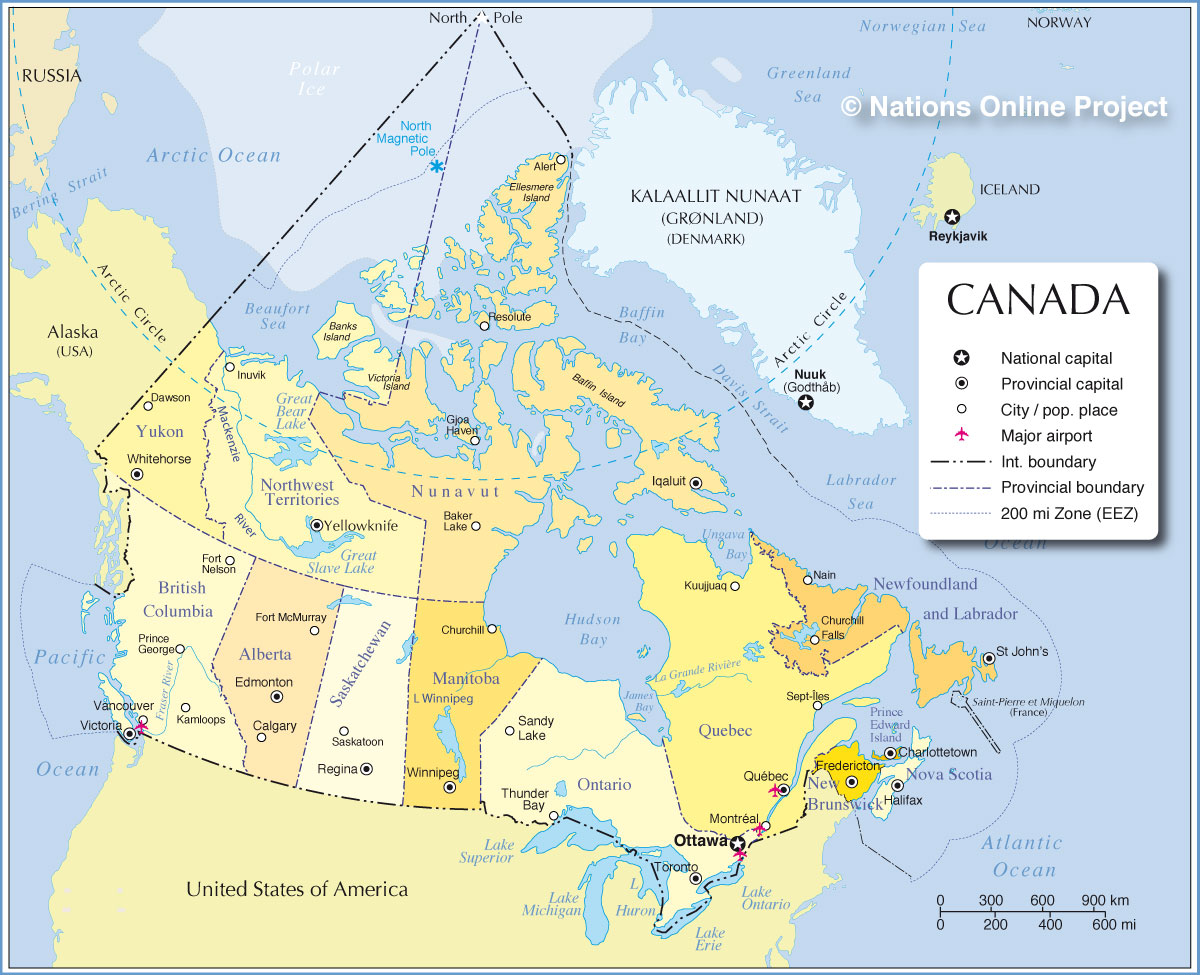
Map of Canada’s regions – Credit: Nations Online
For the record, during the Paleozoic era (570 to 225 million years ago) and the Mesozoic era (225 to 65 million years ago), seas flooded the depressions of the Canadian Shield and deposited many layers of sediment which, after several million years, eventually solidified.
These sedimentary deposits were then uplifted and fragmented following intense geological activity. Marine micro-organisms present in these sediments later formed deposits of oil and natural gas trapped in rock folds.
Dinosaurs were also buried during these uplift and fragmentation movements of the Earth’s crust, and their bodies later fossilized.
Map of Canada: regions
Canada can also be divided into several major topographic regions.
Appalachian Region
The Appalachian Region is the easternmost area on the map of Canada. It includes the Atlantic provinces as well as the Gaspé Peninsula in Quebec. It is the northern extension of the American Appalachian range.
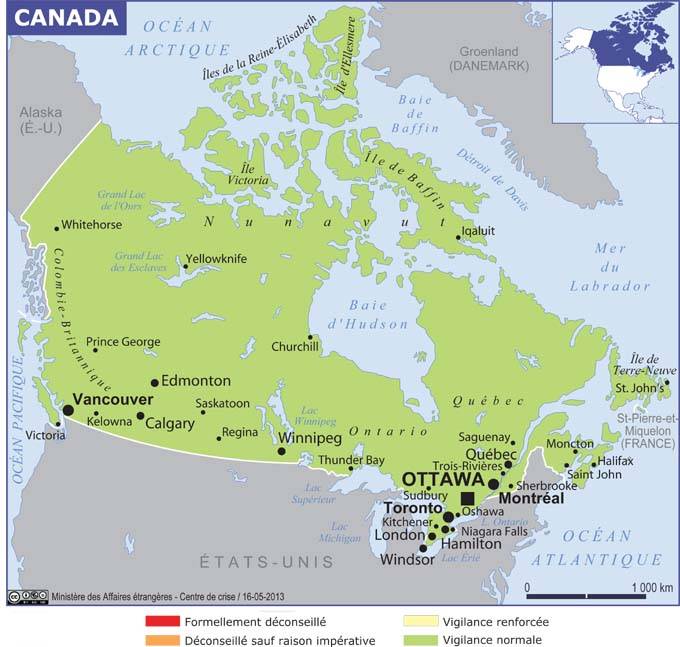
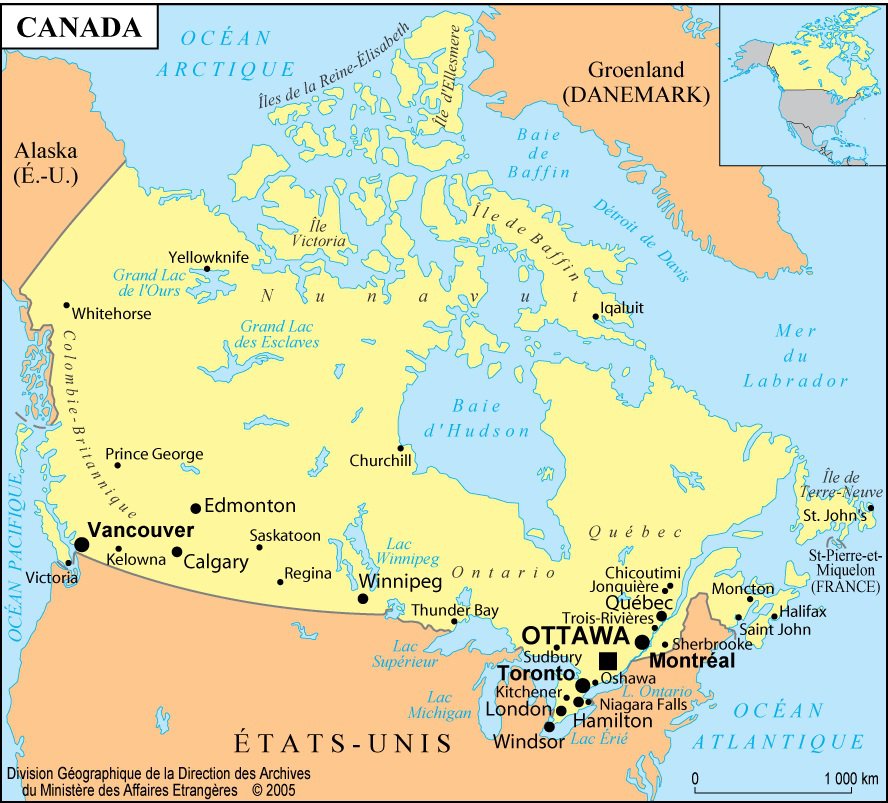
Map of cities in Canada – Credit: Ministry of Foreign Affairs
In this region, many waterways wind between wooded hills dotted with countless lakes. The subsoil contains several deposits of metallic and non-metallic minerals (coal, gypsum).
Off the coasts, the icy waters of the Labrador Current, particularly rich in marine micro-organisms, meet the warmer waters of the Gulf Stream. Thanks to the proximity of the continental shelf, these ocean currents have created one of the best fishing grounds in the world.
In the Arctic Ocean, the archipelago north of the Canadian mainland is very mountainous.
It is home to the Inuit Mountains, named after the Inuit peoples who live there. The climate is extremely harsh, which has slowed exploration. Its economic potential is therefore difficult to estimate.
Great Lakes Region
The Great Lakes and St. Lawrence Lowlands region can be found on the map of Canada between the Canadian Shield and the Appalachians, west of the Atlantic Ocean. Throughout this area, the Mesozoic limestone and shale bedrock is topped by major glacial deposits. These sediments mark the location of former glacial lakes that dried up around 11,000 years ago.
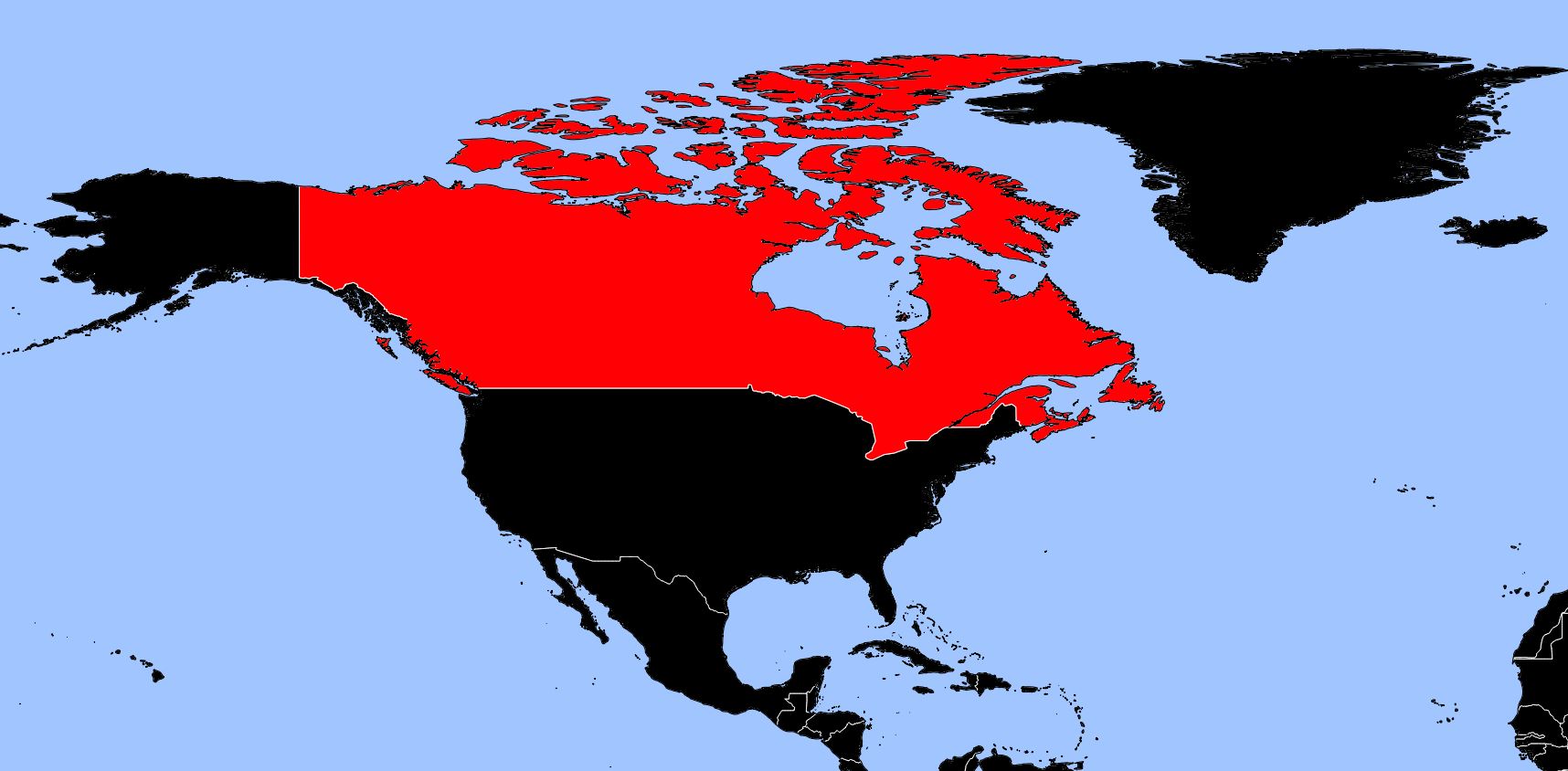
Canada on a map of North America – Credit Actualitix
This region includes the Point Pelee lands along the shores of Lake Erie, in Ontario. Thanks to fertile soils and abundant building materials, it has the highest population density in Canada and has also become its economic center.
The Canadian Shield forms a projection, known as the Frontenac Axis, and splits the St. Lawrence Lowlands in two to form the Adirondack Mountains in the United States, as well as a multitude of islands along the famous St. Lawrence River, which is easy to identify on the map of Canada. In this region, Precambrian rocks rise above surrounding sedimentary rocks. Although rocky outcrops and marshes are numerous, the landscape is enhanced by vast forests and beautiful lakes. The Shield covers nearly half of the national territory and contains abundant mineral, forest and hydroelectric resources.
Interior Plains Region
The Interior Plains (or Lowlands) region stretches on the map of Canada between the Canadian Shield and the western mountain chains, from the U.S. border to the Arctic Ocean. The landscape is gently rolling, as the region’s subsoil is made up of thick layers of nearly horizontal sedimentary rocks whose elevation increases gradually as you move west. The grain fields typical of the center and east of this region then give way to cattle ranches in the west, or to immense forests in the north. Near Alberta, these sedimentary rocks contain oil, natural gas and coal, while in Saskatchewan they are particularly rich in potash.
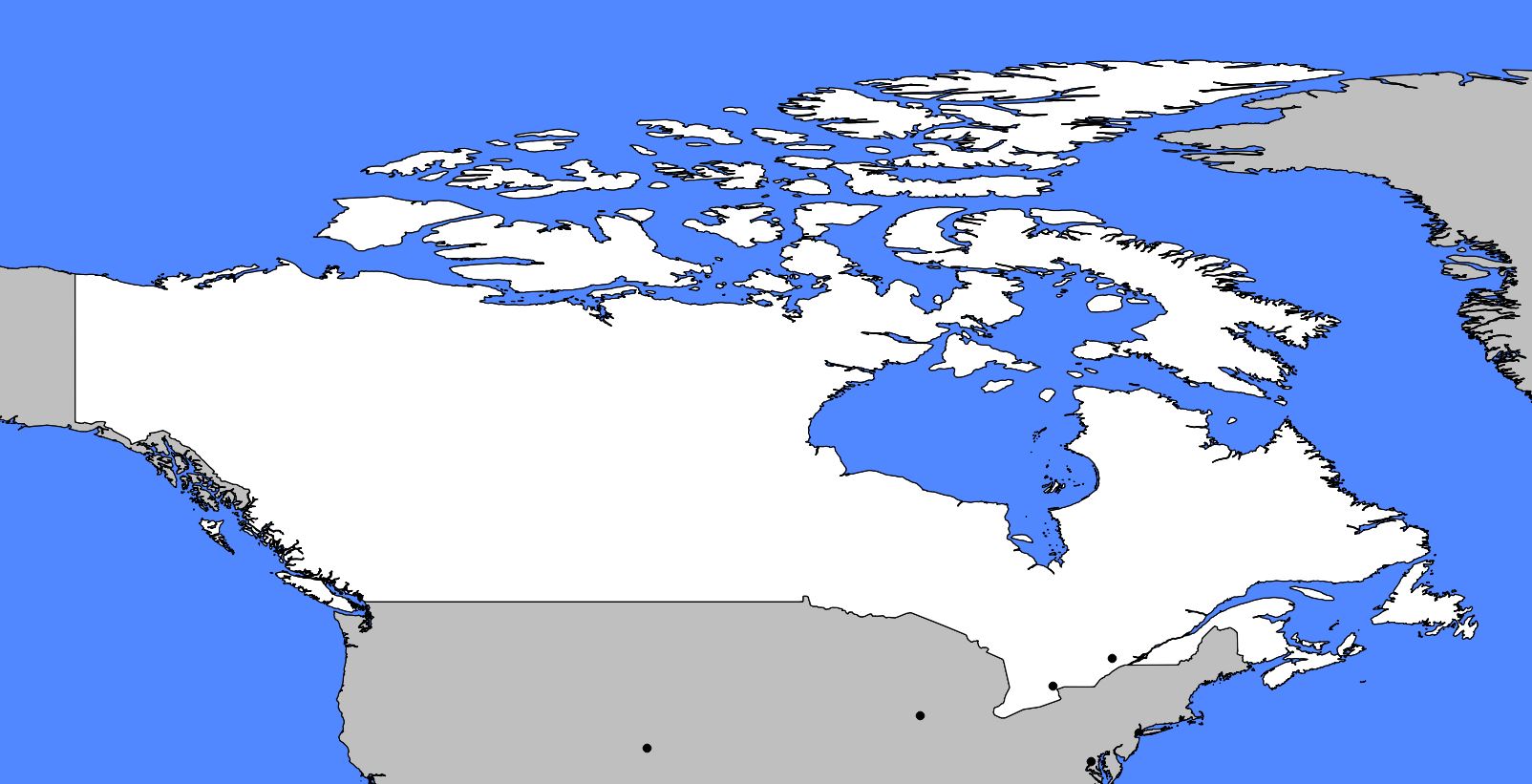
Blank map of Canada – Credit Actualitix
The Shield is bordered by several lowland areas: the Hudson Bay lowlands and the Arctic Archipelago plains. In both cases, the sedimentary rocks are similar to those found in the Great Lakes region, in southern Ontario. Although several deposits of salt and hydrocarbons have been identified, the harsh climate has prevented their exploitation.
The Rockies, a broad section of the mountain system of the western hemisphere, represent Canada’s last region. They form the eastern edge of the Cordillera, a series of mountain ranges stretching almost parallel to the Pacific coastline. Very steep, the Rockies greatly slowed the settlement of western Canada. They constitute an almost impassable natural barrier that still poses serious challenges today.
There are only three natural passes: Yellowhead, Kicking Horse and Crowsnest. They make it possible to transport goods from the Great Plains to the markets of the Pacific coast. Further west, the Columbia and Skeena Mountains, the interior plateaus, and the deep gorges of the Fraser and Thompson rivers also hinder the movement of goods. The foot of the immense coastal range is then washed by the Pacific Ocean. The coastline is therefore highly indented and characterized by the presence of many often-steep cliffs.
Vancouver Island and the Queen Charlotte Islands archipelago are also very mountainous and result from the uplift and folding of another portion of the Earth’s crust. The country’s highest point, Mount Logan, is located in the Saint Elias Mountains at the border of Canada and Alaska. It reaches 6,000 meters in altitude. You can find it on the relief map of Canada. The Cordillera includes some of the wettest and driest regions in all of Canada.
For instance, Esteban Point records annual rainfall of more than 300 centimeters, while the Kamloops area, in south-central British Columbia, is extremely arid. This mountainous area nevertheless plays an essential economic role thanks to its considerable mining, agricultural and forest potential. It also contains many waterways and benefits from proximity to the ocean.
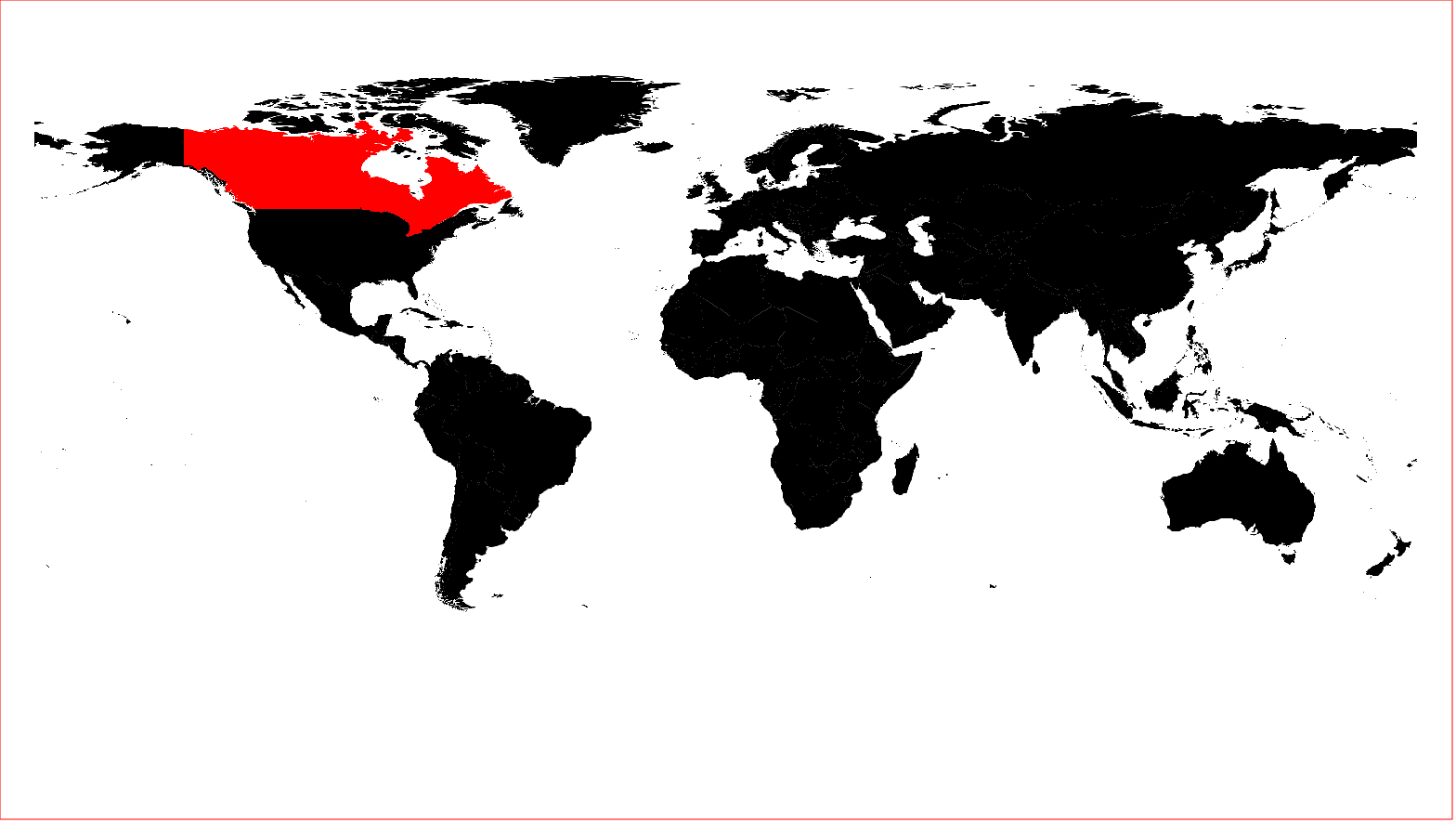
Where is Canada on a map?
Rivers and lakes in Canada
Lakes and rivers represent more than 8% of the total area and play a significant economic role. In fact, most major cities were built near a lake or a river.
In Canada, there are two continental divides. The Rockies separate waterways flowing west from those flowing east. The second divide is less visible. It is another mountain chain that runs more or less along the 49th parallel, from the Rockies to the Great Lakes region. It separates waterways flowing north—emptying into the Arctic Ocean or Hudson Bay—from those flowing east or south into the Atlantic Ocean or the Gulf of Mexico.
In the west of the map of Canada, the Fraser and the Thompson both drain southern British Columbia before emptying into the Strait of Georgia (between Vancouver Island and the mainland) and the Pacific Ocean. Canada’s longest river, the Mackenzie, drains the Peace and Slave rivers, crosses Lake Athabasca and Great Slave Lake, then empties into the Beaufort Sea and the Arctic Ocean.
The Saskatchewan River is formed by the union of the North Saskatchewan and the South Saskatchewan.
Canada map
It rises in the Rockies and then reaches Lake Winnipeg in Manitoba. The latter also receives the waters of the Red River and the Assiniboine. The Nelson, for its part, is an outlet of Lake Winnipeg flowing toward Hudson Bay. Many rivers whose sources are in Manitoba, northern Ontario and north-western Quebec also flow into Hudson Bay and James Bay. Nearly all other Canadian rivers cross the Great Lakes region or join the St. Lawrence system before emptying into the Atlantic Ocean.
The Great Lakes region contains the largest reserve of fresh water on the planet. Starting from Duluth in the United States, these lakes follow one another over a distance of 3,700 kilometers, all the way to Belle Isle in the province of Newfoundland.
With the exception of Lake Michigan, which lies entirely within U.S. territory, all the other lakes straddle the border between the United States and Canada, and they are easy to identify on the map of Canada. They played a decisive economic role and historically facilitated access to the Interior Plains by enabling international and domestic transport of raw materials, agricultural products and finished goods.
Climate in Canada
The vastness of the territory (which you can see on the map of Canada, especially the one showing its location) explains the importance of climatic contrasts. Although temperatures remain relatively cool across Canada, regional variations deserve consideration. The provinces along the Atlantic Ocean as well as the plains of Ontario and Quebec have a cool continental climate characterized by warm summers and harsh winters. Proximity to the ocean, however, moderates the climate of Nova Scotia, Prince Edward Island and Newfoundland: summers are cooler and winters much less severe. You can also find this contrast on the map of Canada below (climate map).
Precipitation is generally moderate and evenly distributed throughout the year. The areas corresponding to the limits of the Canadian Shield are characterized by a cool continental climate—that is, harsh winters and warm summers.
However, in the Prairie provinces, precipitation and snowfall are much less abundant than in the north of the Shield. This directly affects their agricultural and economic development.
In the Rockies, climatic conditions are very varied and are closely linked to altitude and to how exposed slopes are to winds.
The Pacific coast records abundant snowfall and rainfall, mostly in winter, when winds blow from sea to land. Victoria, the capital of British Columbia, nevertheless benefits from a relatively dry climate and mild winters. On the Pacific coast, summers are generally mild.
The Arctic Archipelago and the coasts along the Arctic Ocean have a very harsh Arctic climate. Since this entire area lies within the Arctic Circle, the sun never rises during the six months of winter and never sets during the six months of summer. The ground is permanently frozen and summers are extremely short and cool.
Map of Canada: cities
Although the Canadian economy is largely dominated by agriculture, forestry and mining, Canada is a highly urbanized nation: nearly 80% of the population is concentrated in large urban areas, towns and villages. Toronto, in Ontario, with 2.6 million inhabitants, is Canada’s largest city. It is followed by Montreal, in Quebec (1.6 million inhabitants) and Ottawa, in Ontario (600,000 inhabitants). Ottawa is the capital, as you can see on the map of Canada.
Canada’s main cities differ greatly from one another, but the three largest share some common features. Montreal is the largest French-speaking city outside France and lies at the junction of the St. Lawrence and the Ottawa River. It was founded in the 17th century, at the same time as the city of Quebec. These are the country’s two oldest cities. You can easily find them on the map of Canada.
Montreal is a major financial and industrial center. It also has a very active port. Apart from the high towers in the business district, the city’s architecture is typically French. Some buildings in the old town date back to the 19th century and are part of Montreal’s cultural and architectural heritage.
Although this city is more than 1,500 kilometers from the Atlantic Ocean, at the far eastern end of the St. Lawrence Seaway, it hosts the main port site of eastern Canada. The port of Sept-Îles, also on the St. Lawrence, handles significant freight traffic, but more than 4,000 ships annually unload their cargo in the port of Montreal. Most of Canada’s European exports and imports also pass through this port. In winter, the use of icebreakers allows ships to continue operating during this season.
The St. Lawrence Seaway was opened in 1959 thanks to the combined efforts of Canada and the United States. At the time, it was thought that the major cities of the Great Lakes region would benefit from this new transport route. However, high transport taxes and harsh winters explain why these cities still make extensive use of the road and rail network.
Unlike Montreal, Toronto has no particular architectural heritage. It mainly features high towers housing offices. Toronto is one of the few cities in North America whose population is concentrated largely in the business district or nearby.
Among the country’s largest cities by size are: Vancouver (British Columbia); Edmonton and Calgary (Alberta); Winnipeg (Manitoba); Hamilton (Ontario) and Quebec City (Quebec). Thanks to the renovation of its architectural heritage, Quebec City can boast of being one of the most beautiful cities in Canada. You can very easily locate these cities on the map of Canada.