
Discover a map of Russia. The country has held the status of an independent nation since the dissolution of the Soviet Union in 1991. It was formerly known as the USSR (Union of Soviet Socialist Republics).
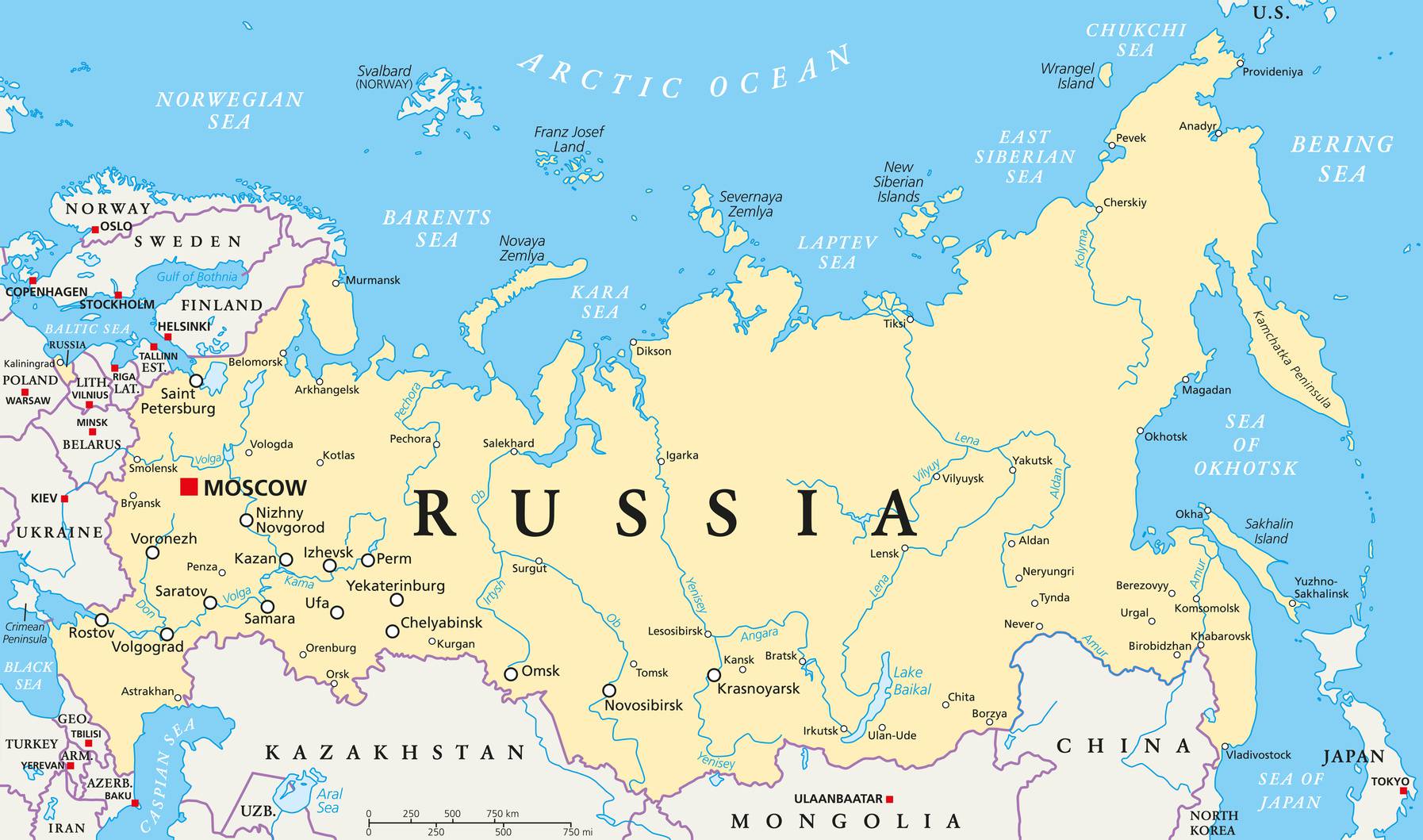
Map of Russia – © Peter Hermes Furian – stock.adobe.com
It covers an area of more than 17 million square kilometers. Russia stretches across half of the Northern Hemisphere. Its landscape is characterized by a low-altitude plain. Two great plains are separated by the Ural Mountains, which form the traditional barrier between Europe and Asia. By contrast, eastern Siberia is a plateau made up of hills and mountains. Volcanoes can even be found on the Kamchatka Peninsula and in the Kuril Islands.
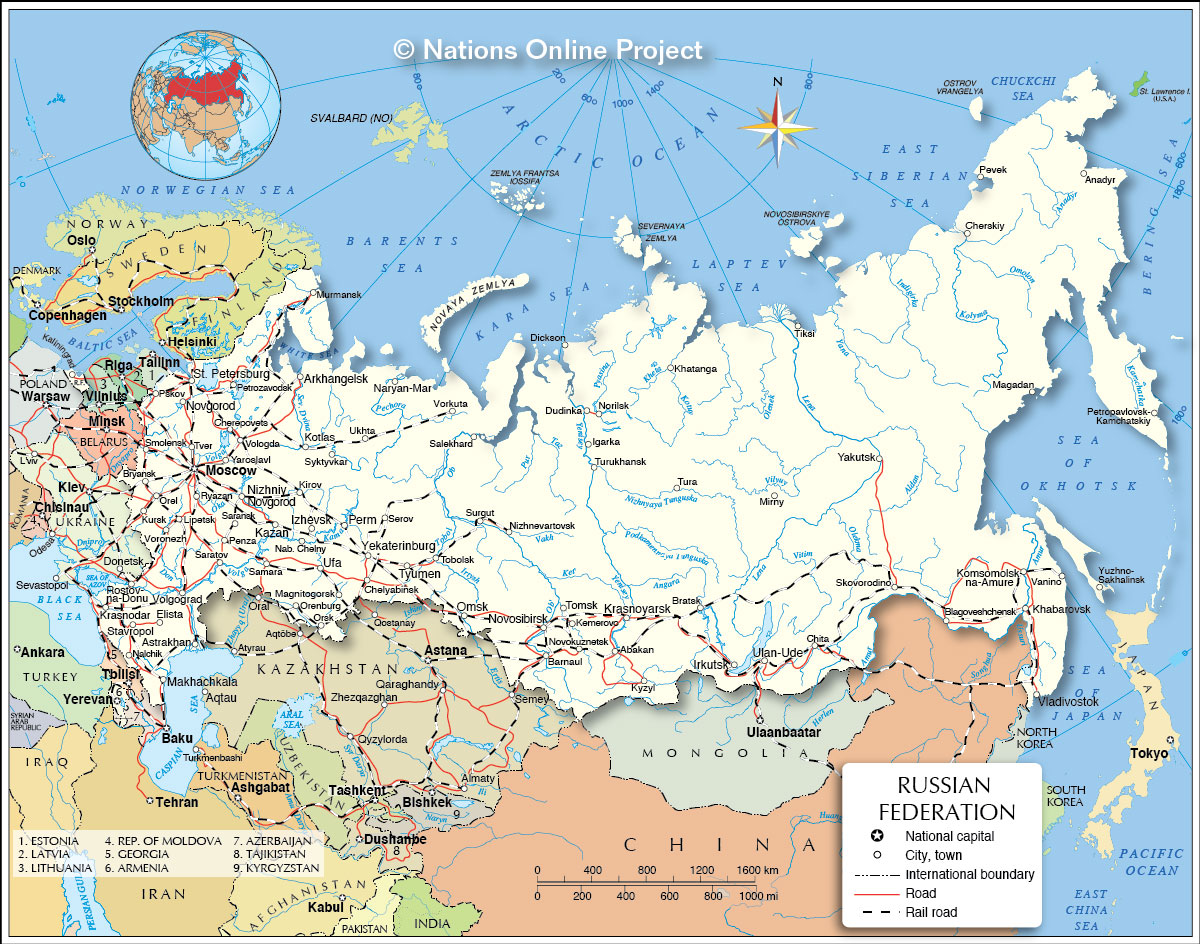
Russia map – Credit: Nations Online
More than 80% of inhabitants are of Russian origin. But there are also 75 other ethnic groups. Nearly three quarters of the population live in urban areas. The main cities are: St. Petersburg, Nizhny Novgorod and Moscow, which is also the capital.
Article outline
Map of Russia: relief
As you can see on the map of Russia, the country has the longest borders in the world. To the west, it is bordered by Norway, Finland, the Gulf of Finland, Estonia, Latvia and Belarus. To the south-west, Russia borders Ukraine, and to the south it touches the Sea of Azov, the Black Sea, Georgia, Azerbaijan, the Caspian Sea, Kazakhstan, Mongolia, China and North Korea. To the north and east, it is bordered by various parts of the Pacific Ocean and the Arctic Ocean.
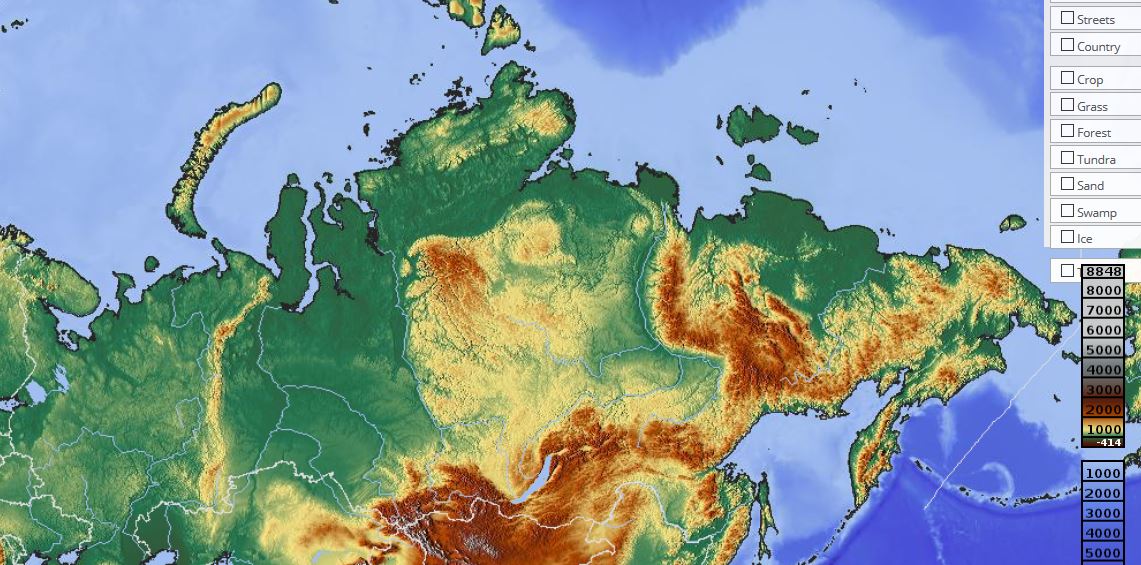
Relief map of Russia – Image extracted from maps-for-free
Physical features
Russia is made up of two stable blocks: the European and Siberian platforms. The weld that unifies these two platforms is the Ural Mountains chain, dating back 250 million years. Around these platforms, there are younger mountain systems.
You can see on the map of Russia (the relief one) that the highest peaks, outside the Urals, are found on the Kola Peninsula (at 900 m altitude). Everywhere else, the region consists mainly of plains and peat bogs, except for the Valdai Hills, whose altitude is 347 m; the Central Russian Uplands and the ridge running from Moscow to Smolensk (these two regions reaching 300 m altitude), and the heights near the Volga.
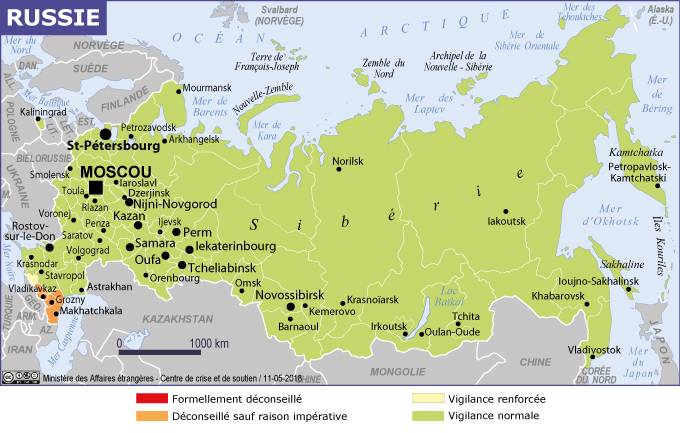
Map of Russia’s cities – Credit: Ministry of Foreign Affairs
On the southern edge of the Crimean Peninsula in Ukraine, you encounter the beginning of a long series of mountain ranges that extend into eastern Siberia and south-eastern Russia. The Crimean Mountains are separated from the Greater Caucasus by the peninsula and the Kerch Strait in Ukraine. The Greater Caucasus is bordered to the north by the vast Stavropol Uplands. A large part of the mountains in this chain are made of volcanic materials, including Mount Elbrus (rising to 5,633 m), which is the highest peak in Europe.
The Ural Mountains are the remnants of much higher ranges. The mountains are higher in the northern Urals. Those in the center are the lowest, and all means of transport pass through this region, including the Trans-Siberian Railway. The mountains of the southern Urals have a moderate altitude, but are very extensive. For more than 200 million years, the once very imposing Ural Mountains have been eroded by the Volga/Kama and Ob river systems.
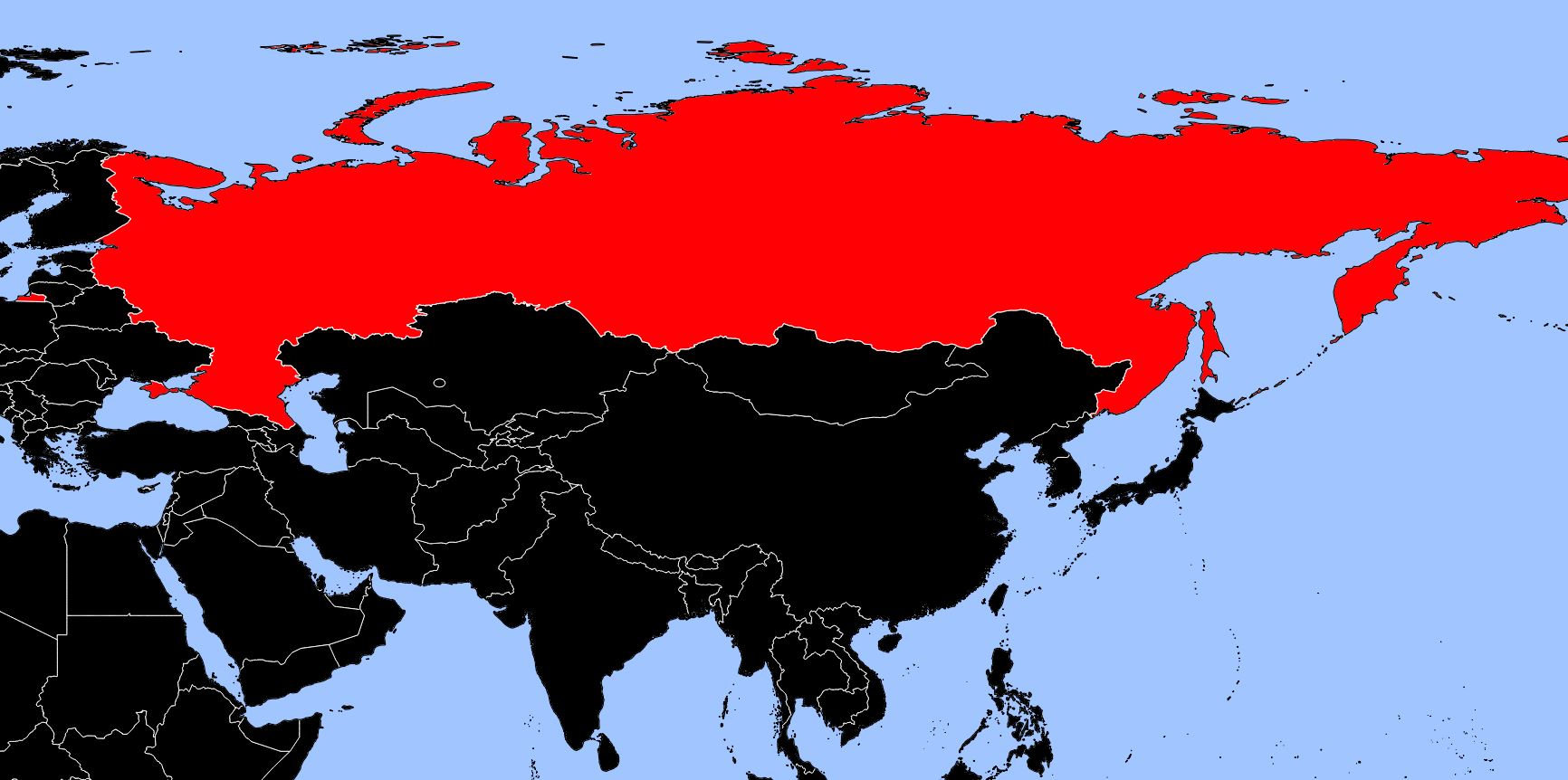
Russia on a map of Asia – Credit Actualitix
Over 1,600 kilometers from the Urals eastward toward the Yenisei, and over 1,900 kilometers from north to south, the West Siberian Plain never exceeds an altitude of 180 m above sea level. The Ob River and its tributaries flow slowly into the Arctic Ocean. In spring, when southern tributaries rise due to snowmelt floods, the Ob, the main river, is still frozen downstream. Very major floods are then responsible for the creation of one of the largest marshland areas in the world: the Vasyugan Swamp.
Relief features in Eastern Russia
To the east of the Yenisei River lies the Central Siberian Plateau, from which flow down the tributaries of the Lena and the Yenisei. To the south, the mountain arc continues to the Altai range, where the source of the Ob is located. The two branches of the Altai form the Tom River valley, one of the tributaries of the Ob. In this valley (the Kuznetsk Basin), very high-quality coal deposits have been discovered. To the east, the Altai joins the Sayan range.
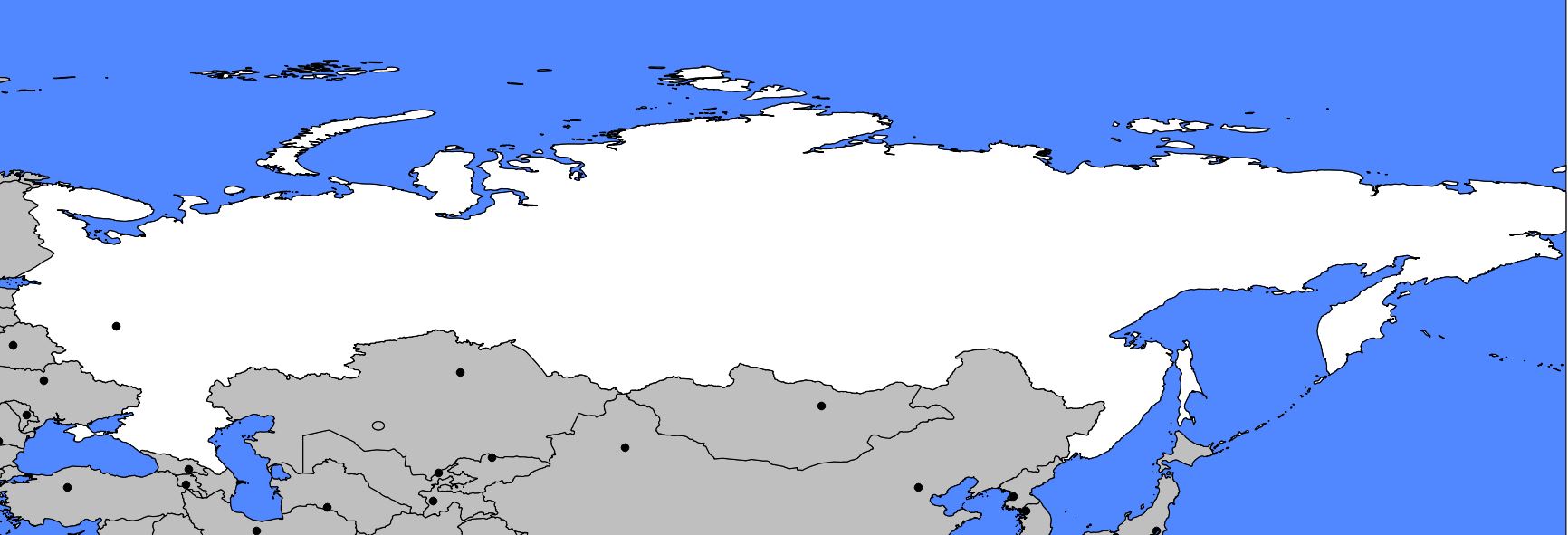
Blank map of Russia – Credit Actualitix
Beyond the Sayan Mountains lies Lake Baikal (which you can observe on the map of Russia), in a valley created by a rift that is still active. The surface area of Lake Baikal is not very large, but it is the deepest lake in the world. Lake Baikal sinks a little more with each earthquake and, in several million years, it will become a new ocean. It contains one fifth of the world’s freshwater reserves.
Lake Baikal formed on a tectonic fault. To the west, you encounter the pre-Baikal highlands. To the east, you find Transbaikalia. Along the coastline of the Sea of Okhotsk, there is a whole series of mountain ranges. The Kamchatka Peninsula is one of the most volcanic regions on Earth. This is also true of the Kuril Islands. Far inland, along the banks of the Lena, lies the Verkhoyansk Range, which then joins the Chersky Range.
In eastern Siberia, the plains are more scattered. The Lena River creates the Central Yakutian Lowland in its middle course near Yakutsk. Along the Amur lies the fertile Zeya–Bureya Plain and, along the Ussuri River, a tributary of the Amur, lie the Ussuri Lowlands.
Main rivers and lakes
Russia has 100,000 rivers, including some of the longest in the world. The Volga, one of the five largest, is perhaps the most famous, but it is also the shortest (you can easily see it on the map of Russia). The other four are in Asia: the Ob–Irtysh, the Amur, the Lena and the Yenisei. All of them, except the Amur, flow north to the Arctic Ocean. “Mother Volga” flows south and empties into the largest “lake” in the world: the Caspian Sea, an inland salt sea. 336 rivers flow into Lake Baikal.
Karelia, south of the Valdai Hills, is also called the land of lakes. The largest are Lake Onega and Lake Ladoga. Large lakes are also found in Central Asia.
Climate and vegetation
Because of its size, Russia is characterized by both a certain monotony and great diversity. The climates of western Russia and eastern Russia are continental, with the exception of the tundra in the far south-east of the country. The map of Russia makes it possible to observe this phenomenon (climate map). There are wide temperature differences. In winter, temperatures become colder from south to north and from west to east. Summers can be warm and humid, even in Siberia.
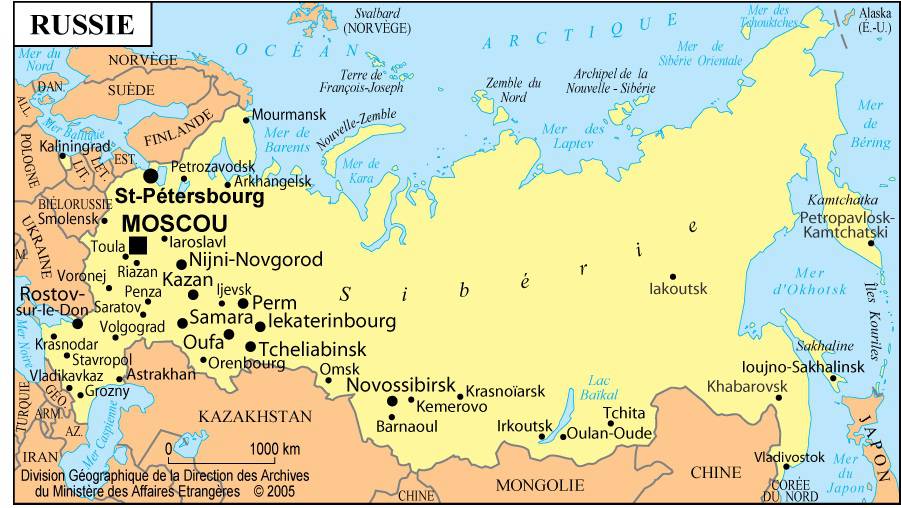
Russia map – Credit: Ministry of Foreign Affairs
Russia has little precipitation; it is higher in summer (July and August). The interior lands of the central part are the driest regions.
From north to south, the East European Plain is successively covered by tundra, taiga (coniferous forest), mixed forest, deciduous forest, steppe (grassy plain) and finally by a semi-desert zone (near the Caspian Sea). These vegetation changes reflect different climatic zones. Siberia is mainly made up of taiga. Soils are varied.
Additional information to the map of Russia
In this section you will find additional information to add to what is shown on the map of Russia:
Inhabitants and culture
One thing that is difficult to observe on a map of Russia is the population, estimated at 149 million inhabitants in 1995, while it was only 146 million in 2016. Of the 15 former republics of the Soviet Union, Russia has the greatest ethnic diversity, with 75 different nationalities. Russians represent 82% of the total, and only three other ethnic groups (Tatars, Ukrainians and Chuvash) represent more than 1% each. Among language groups, there are Caucasian languages.
The overall growth rate of the Russian population has been declining sharply compared with previous decades. This is explained by the significant drop in the Russian birth rate. The share of minority populations continues to grow, especially within Muslim communities.
Settlement patterns
The Russian population is mostly urban. A large number of inhabitants lived in the European part where, from 1960 to 1990, the rural population decreased by 30%. The result of this rural exodus is the existence of around one hundred cities with more than 100,000 inhabitants and 13 metropolitan areas with more than one million inhabitants. Moscow and St. Petersburg are by far the two largest cities. You can observe the map of Russia showing the main cities.
Other major centers of settlement include: the banks of the Volga, the industrial and coal basin of Donetsk, the mining and industrial centers of the Ural Mountains, and a number of cities located along the Trans-Siberian Railway. There are also ports and mining centers in the far north of the country, tourist towns on the Black Sea coast, and administrative centers.
Most inhabitants of rural areas live in large villages associated with state collective farms founded during the Soviet era. These continue to live according to the Russian traditions of communal farming.
The Russian language
Russian is the language of Great Russia. The roots of the Russian language go back 3,000 to 4,000 years.
Russian was extremely influenced by Greek (through Byzantine) and by the language of the Orthodox Church. Russian was also shaped by 300 years of Mongol and Tatar occupation. Over the years, the language was marked by Polish, German, French, Italian and Latin. Since the Second World War, Russian has borrowed many American terms.
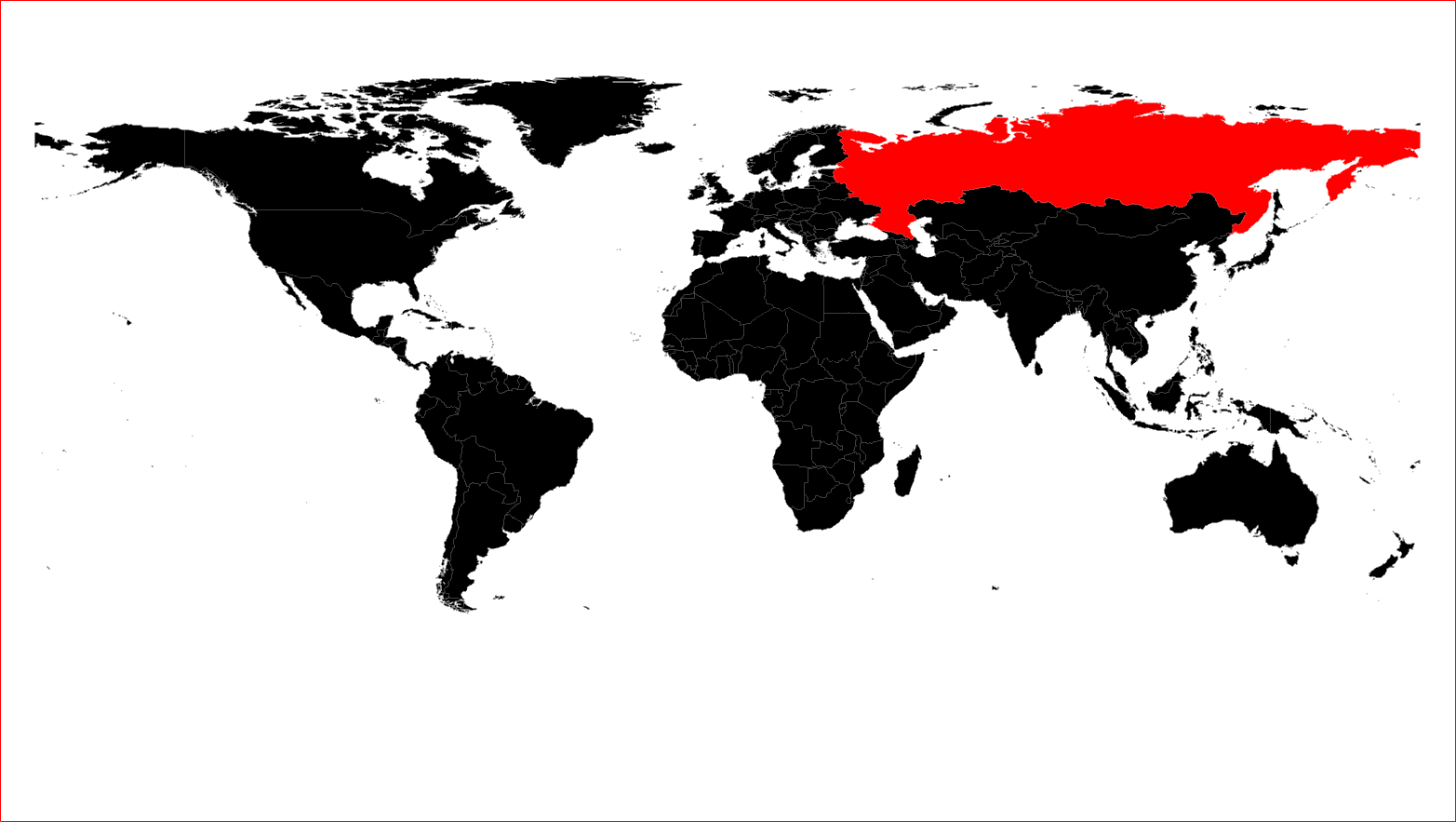
Where is Russia on a map? – Credit: Actualitix
Energy
Russia has the largest coal reserves of all the former Soviet republics. It is also one of the world’s leading producers of oil and natural gas. Extensive pipeline networks connect production areas to all regions of Russia and to European countries.
Most of these resources are converted into electricity. Nevertheless, one third of the energy consumed in Russia comes from hydroelectric power. The largest power plants are located on the Volga, Ob, Yenisei and Angara rivers. High-voltage lines make it possible to transmit electricity from Siberia to other Russian regions and to Europe.
Logging
Russia has the world’s largest forest reserves. It produces timber, pulp and paper, as well as raw materials for industry. The country produces one fifth of the world’s softwood. Since the Second World War, logging has grown significantly east of the Urals.
Transportation
The immensity of Russian territory requires an efficient transport network. Railways remain the main means of transport. They carry half of freight and one third of passengers. The rail system is denser in the central European zone and less developed in Siberia and the Asian region. You can observe the map of Russia showing major roads and transport routes.
Except for highways linking the main cities in the European region, the road network is underdeveloped. It carries only 2% of freight. Inland waterways, on the other hand, transport far more goods. The great Siberian region, extending north of the Trans-Siberian line and the Baikal–Amur Mainline, depends on river transport.
Arctic ports serve maritime transport during part of the year. Air routes transport 20% of passengers. Aeroflot is the largest airline in the world. Only a very small percentage of domestic freight is transported by air.