
In this article you can discover a map of Ukraine. At the end of 1991, the Soviet Union was rapidly dissolved. Each republic was determined to follow its own path. On December 1st, Ukrainians voted overwhelmingly for independence. As a result, the territories known since December 30, 1922 as the Ukrainian Soviet Socialist Republic simply became Ukraine.
For the first time in centuries, the Ukrainian population was freed from any Russian or Soviet control and finally became free to lead and plan its national destiny.
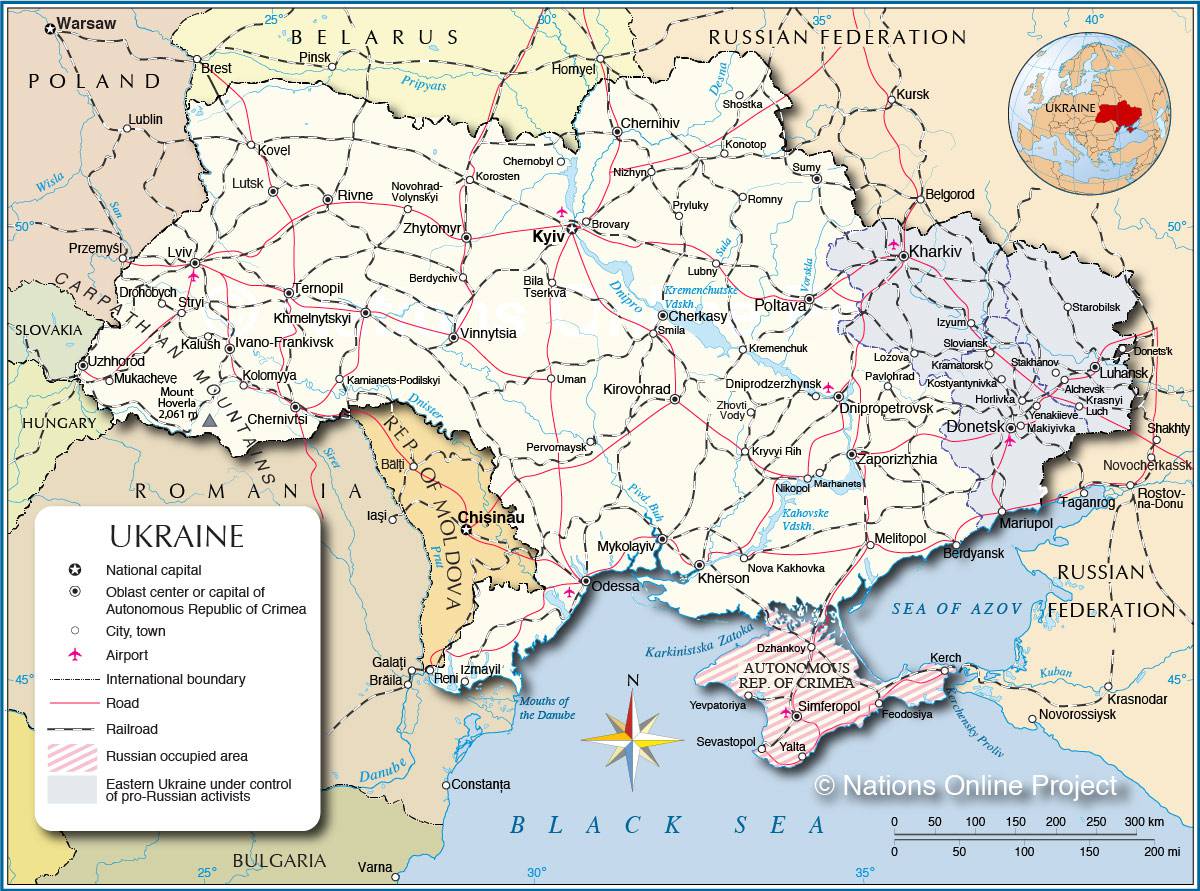
Map of Ukraine – Credit Nation Online
Article outline
Geography with the map of Ukraine
By voting in favor of independence, Ukraine immediately became the largest country in Europe and one of the most populous. Its area is more than 603,700 square kilometers and its population exceeds 45 million inhabitants. As its name suggests, this country forms a kind of bridge between Europe and Asia. In fact, “Ukraine” means “border country”.
As you can see on the map of Ukraine, the country is bordered: to the north by Belarus; to the north and east by Russia; to the south by the Black Sea, Moldova and Romania; to the west by Poland, Slovakia and Hungary. Its capital is the historic city of Kyiv. Its population exceeds 2.8 million inhabitants. Chernobyl is located about 130 kilometers north of Kyiv. It was in this region that, in April 1986, the world’s most serious nuclear accident occurred.
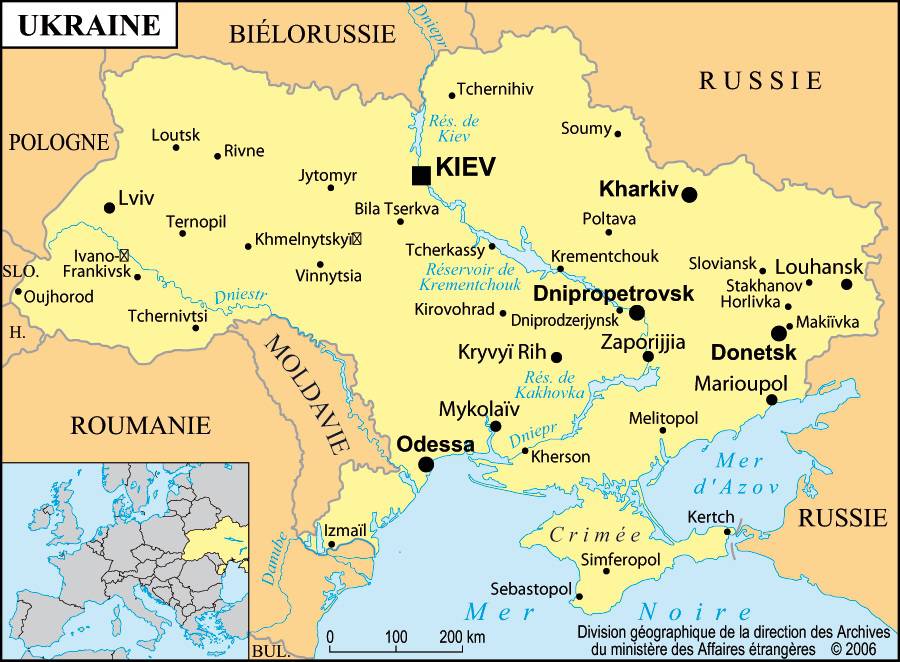
Map of cities in Ukraine
Relief of the country
Geographically, Ukraine is part of the vast East European Plain. It has only two mountainous regions, as you can see on the relief map of Ukraine: the Carpathian Mountains to the west, and the Crimean Mountains to the south. Together, they represent only 5% of the total area. Although the plains are, here and there, interrupted by upland regions such as the Dnieper Upland (between the Dnieper and Southern Bug rivers), Ukraine’s average altitude is 175 meters above sea level. Many rivers, gorges and ravines cut through these upland areas. North-eastern Ukraine belongs to the Russian Uplands, where average elevations reach 236 meters.
To the west, the Ukrainian Carpathian massif is made up of several parallel mountain chains. It stretches for more than 240 kilometers. Here you find Mount Hoverla which, at 2,061 meters, is the country’s highest peak. The largest forested areas are located near the Carpathians. In the mountains, roads and railways are built through passes.
To the south, the Crimean Mountains stretch for more than 145 kilometers. They consist of three mountain ridges separated by several valleys and form the southern coastline of the Crimean Peninsula.
After independence, this region continued to be the subject of controversy between Ukraine and Russia, and it remains a current issue since it was taken over by Russia. You can see it in the south of the country on the map of Ukraine; it provides direct access to the sea, which explains its strategic importance.
Blank map of Ukraine
The plains run along the coastline of the Black Sea and the Sea of Azov. The Polesye region (or Pripyat Marshes) occupies the north of the country. This vast waterlogged area is the largest marsh in all of Europe. It lies in the dense forests of the Dnieper and Pripyat basins. Forest resources are substantial enough to supply industries specializing in construction timber. The wildlife is also very diverse, consisting of: moose, wolves, bears, lynx, wild boar, beavers, martens, mouflon, weasels, badgers, as well as many species of fish and birds.
Watercourses
There are more than 23,000 watercourses in Ukraine (you can also notice many routes on the map of Ukraine). The Dnieper crosses the country over a distance of 1,204 kilometers. The other main rivers are: the Dniester, the Donets, the Bug and the Danube. The Danube rises in Germany. It flows east through Austria and Hungary and then empties into the Black Sea. In Ukraine, most rivers flow south and empty either into the Sea of Azov or the Black Sea.
Only a small number of waterways flow north into the Baltic Sea. Rivers play an essential role in transport and hydroelectric power. They also serve as drinking water reserves.
The construction of hydroelectric dams led to the formation of artificial lakes in a country that had only a few rare large natural lakes. Lake Svityaz, one of Ukraine’s largest natural lakes, has an area of only 28 square kilometers. Two broad sections of the Dnieper form two very large water reservoirs.
Climate of Ukraine
Ukraine has a temperate continental climate. Average temperatures in January are low: about -3°C (26°F) in the south-west and -8°C (18°F) in the north-east. In July, average temperatures reach about 23°C (73°F) in the south-west and 19°C (66°F) in the north-east.
The southern coast of Crimea, between the Black Sea and the Sea of Azov, has a warm Mediterranean-type climate. Odesa and Yalta are the two best-known seaside resorts on the Black Sea.
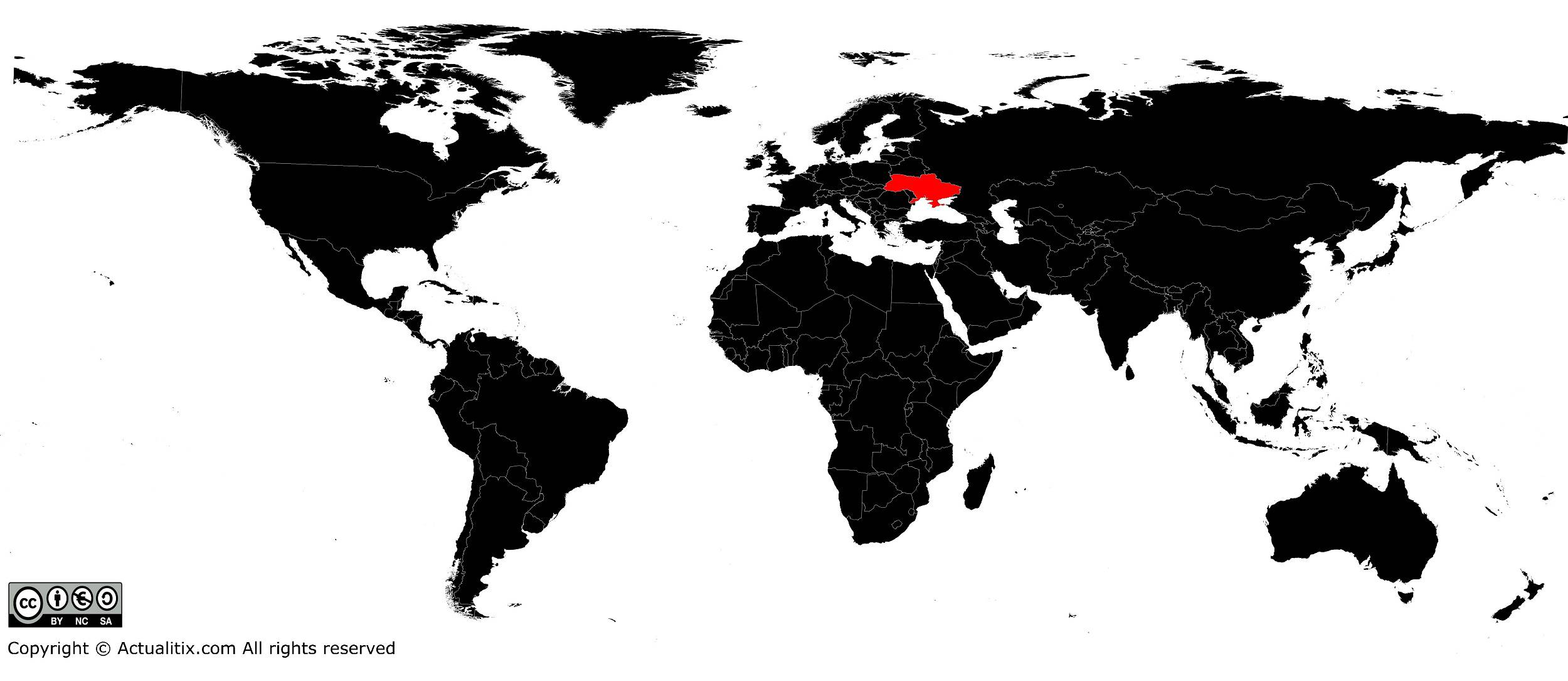
Ukraine on a map of the world
Vegetation
The steppe and grassland region, located in the south of Ukraine, is part of the great Eurasian Steppe, the largest grassland area on the planet. Its Ukrainian extension covers about 40% of Ukraine and is covered with chernozem. These are the most fertile soils in the world. More than three quarters of the steppe is cultivated. Vast areas are irrigated because of occasional periods of drought.
For most of the 20th century, the country paid particular attention to preserving fauna and flora. In Ukraine, several forest and steppe regions are part of natural parks, and there are also several wildlife reserves. The Askaniya-Nova reserve is the most important. Created in 1921 to protect the steppe’s natural vegetation, it covers 10,500 hectares.
More than 40 different animal species have been introduced there as part of a program intended to preserve endangered species. In the south, the Black Sea Nature Reserve covers 36,600 hectares. Waterfowl are its main attraction. The Nikitsky Botanical Garden, near the city of Yalta (see the map of Ukraine), is famous worldwide for the beauty of its flora.