
Discover a map of Tunisia, the smallest country in North Africa. It is located in the easternmost part of the Maghreb (nicknamed the northern tip of Africa) and forms what is known as a “buffer state” between Algeria and Libya.
In the past, Tunisia was home to the ancient city of Carthage. As the province of Ifriqiyah, it also held a strategic position within the Turkish and Arab empires of North Africa. Tunisia became a French protectorate in 1881 and gained independence in 1956.
Article outline
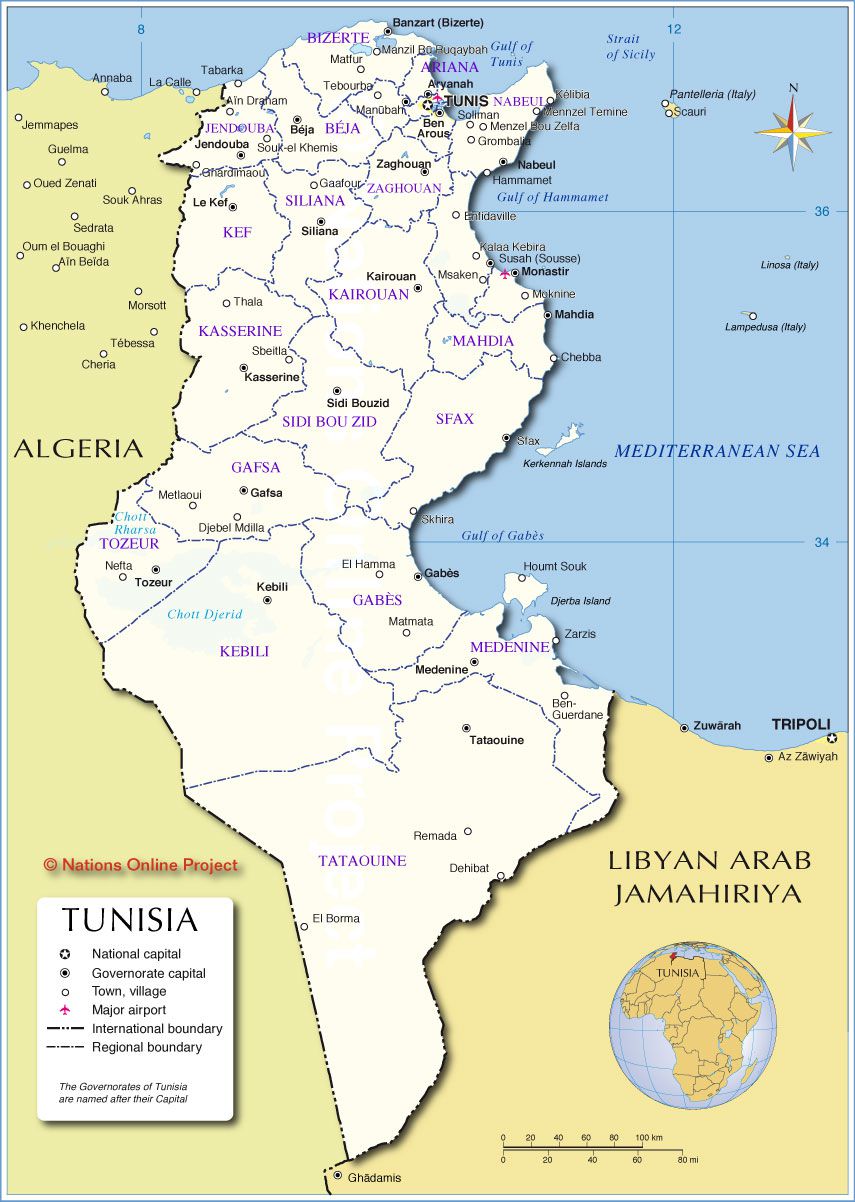
Tunisia map – Credit: Nations Online
Since 1957, Tunisia has been a constitutional republic. It has pursued its national destiny independently from the Arab nations of North Africa and the Middle East.
Map of Tunisia: Country and Population
Tunisia covers an area of 163,610 square kilometers (63,170 square miles). In the north of the country, the Atlas Mountains split to form two different mountain ranges. The Northern Tell massif is the lower of the two, with elevations ranging from about 300 to 900 meters.
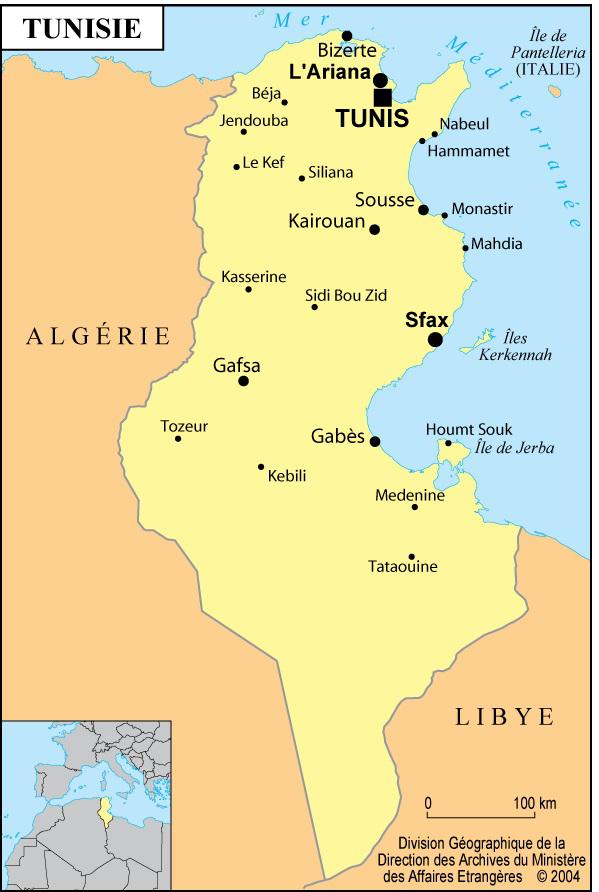
Tunisia map – Credit: Ministry of Foreign Affairs
It runs along the coastline and stretches almost as far as the city of Tunis, as you can see on the map of Tunisia. The Tell highlands extend the Saharan heights of the Atlas in Algeria and are both larger and more rugged. Near the Algerian border, Djebel Chambi reaches an altitude of 1,544 meters.
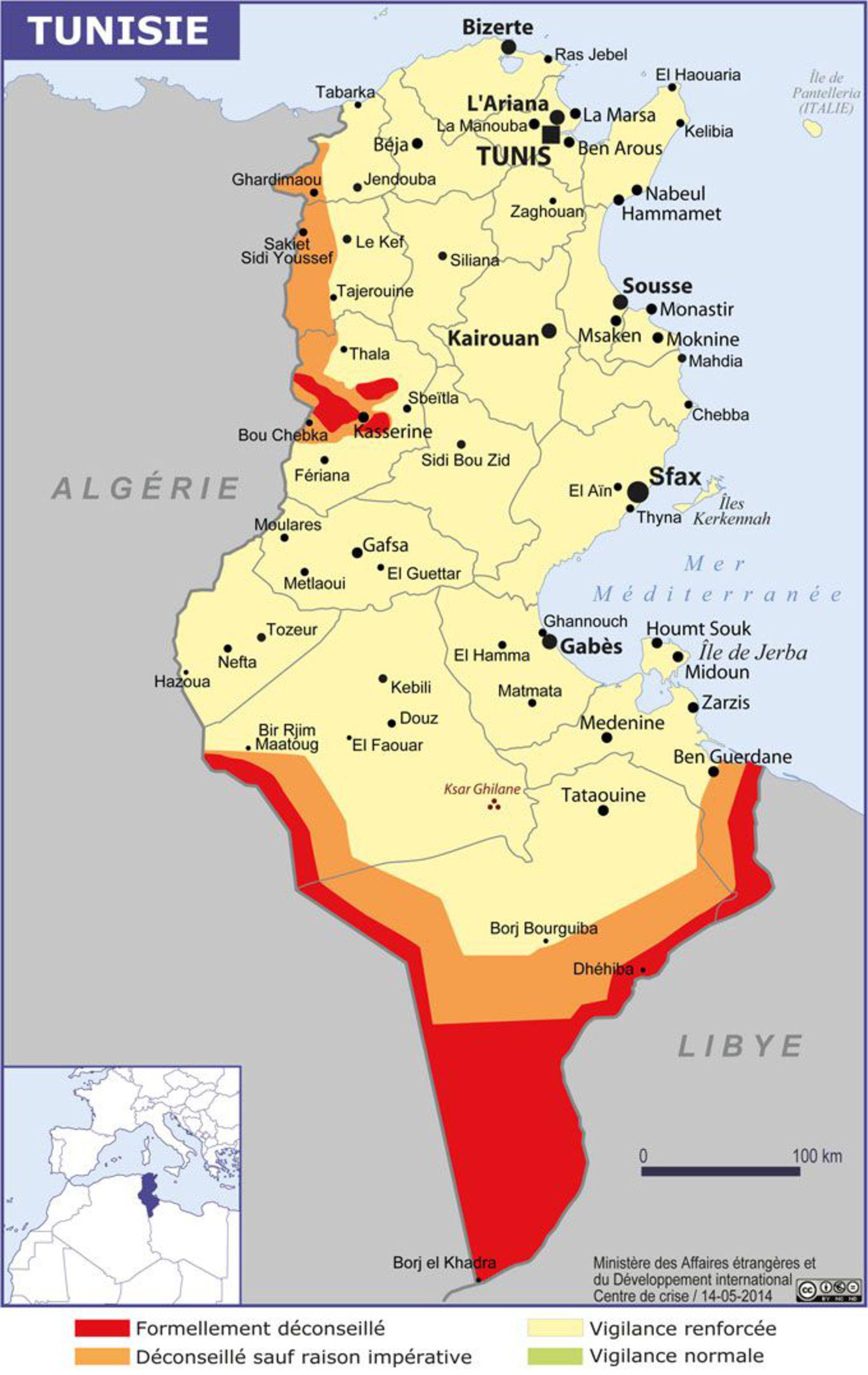
Map of dangerous areas in Tunisia – Credit: Ministry of Foreign Affairs
These two mountain ranges are separated by the valley carved by the Medjerda River, which then flows into the Gulf of Tunis. It is the only Tunisian river whose flow remains high throughout the year. You can discover the relief on the map of Tunisia below.
Northern Region of Tunisia
Northern Tunisia is characterized by a Mediterranean climate. Average rainfall ranges from 40 to 100 centimeters and is mainly recorded during the winter months, when temperatures remain mild. Summers are hot and dry. Cork oak and holm oak forests cover the wettest and most remote slopes of the Northern Tell massif. Below are the main cities on the map of Tunisia.
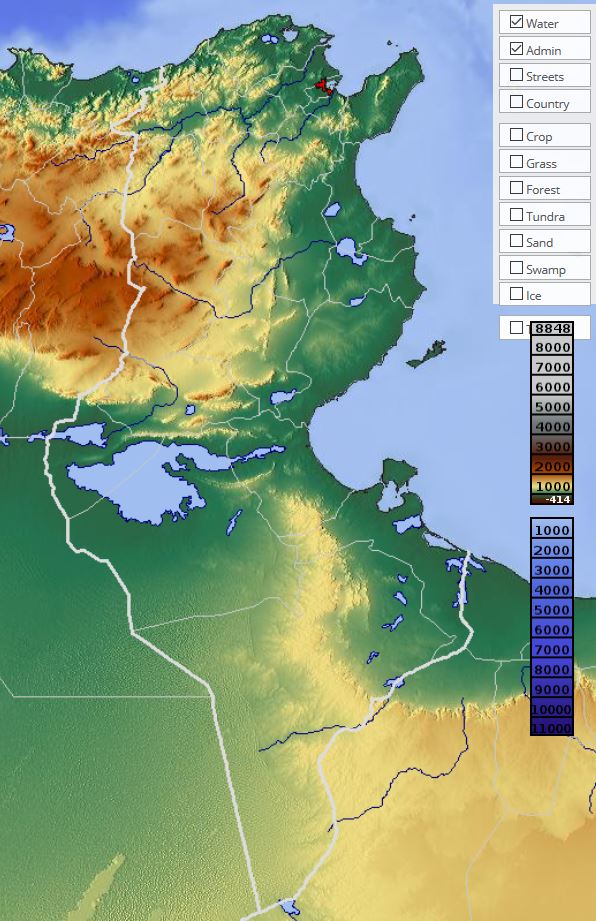
Relief map of Tunisia – Image extracted from maps-for-free
Excessive clearing—marked by the intensive cutting of trees for fuel and the uncontrolled establishment of grazing land—together with low rainfall explains why vegetation is generally made up almost exclusively of shrubs, bushes, and grasses. In Tunis, annual rainfall in the driest years does not exceed 57.2 centimeters, and the average temperature is about 18°C (64°F).
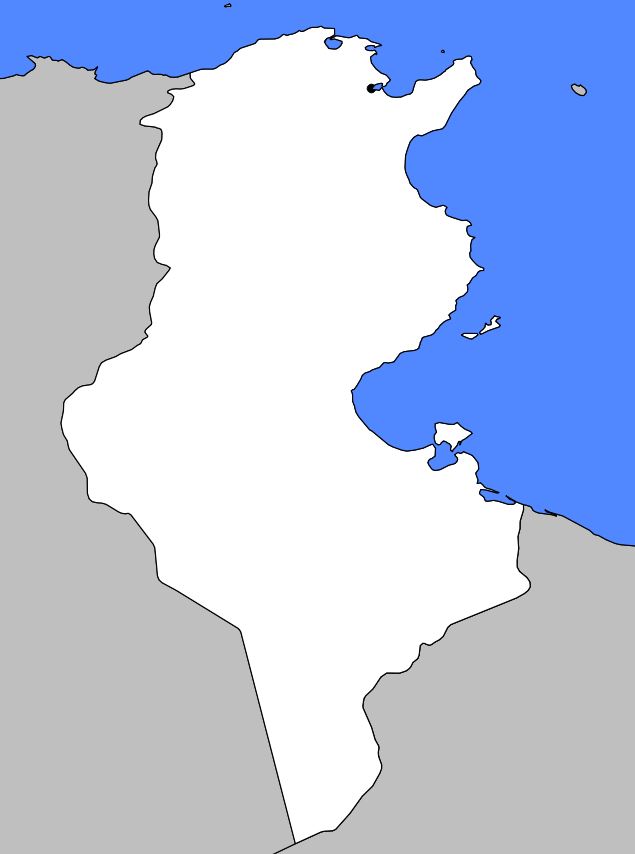
Blank map of Tunisia – Credit: Actualitix
Central Region of Tunisia
Central Tunisia consists of a vast plateau whose altitude gradually decreases as you move eastward (see the relief map of Tunisia), from the Tell highlands down to the coastal plain. The “high steppes” are made up of large alluvial basins interrupted by low mountains. The “low steppes” lie on a plateau whose perfectly flat surface is covered with gravel. The island of Djerba is located in the Gulf of Gabès near Zarzis.
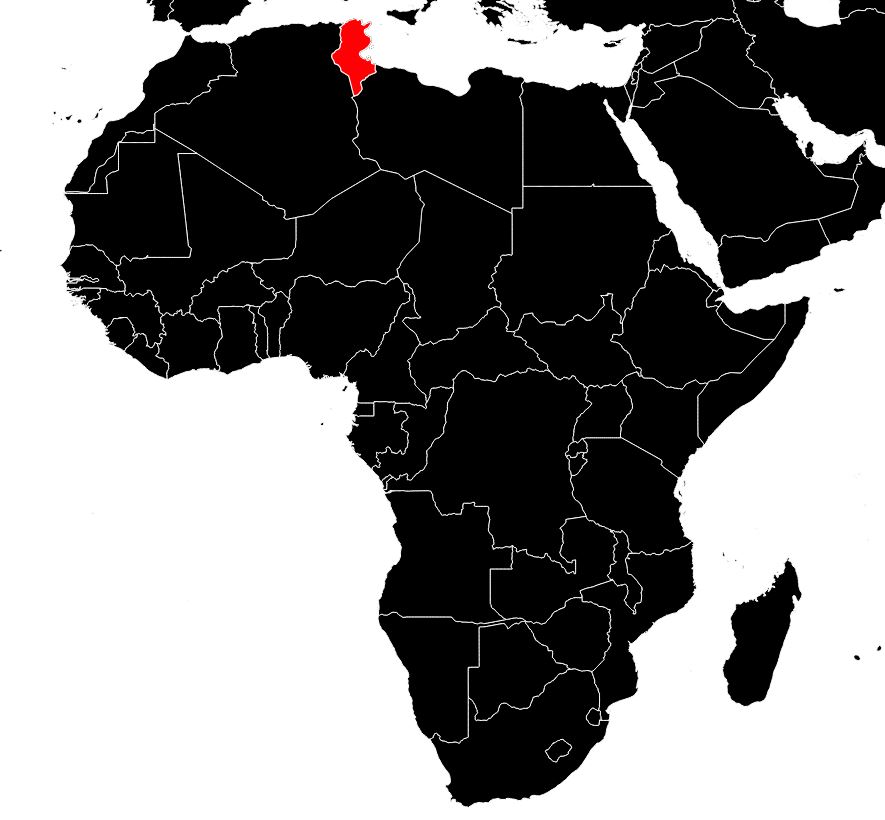
Tunisia on a map of Africa – Credit: Actualitix
Average annual rainfall is between 20 and 40 centimeters, and rain falls mainly in winter. Showers lead to the formation of wadis (temporary watercourses) that flow and form saltwater lakes (sebkhas) on the surface of the coastal plain; the water then eventually evaporates. The steppes are characterized by sparse, drought-resistant vegetation.
South of the steppes lies a vast depression that contains three seasonal salt lakes (chotts). The largest is called Chott el Djerid (or Chott al Jarid). Chott el Gharsa lies 23 meters below sea level, and Chott el Fedjadj is even smaller. In winter, rains form small channels that flow into the chotts. As the water evaporates, it leaves a thick layer of salt on their surface.
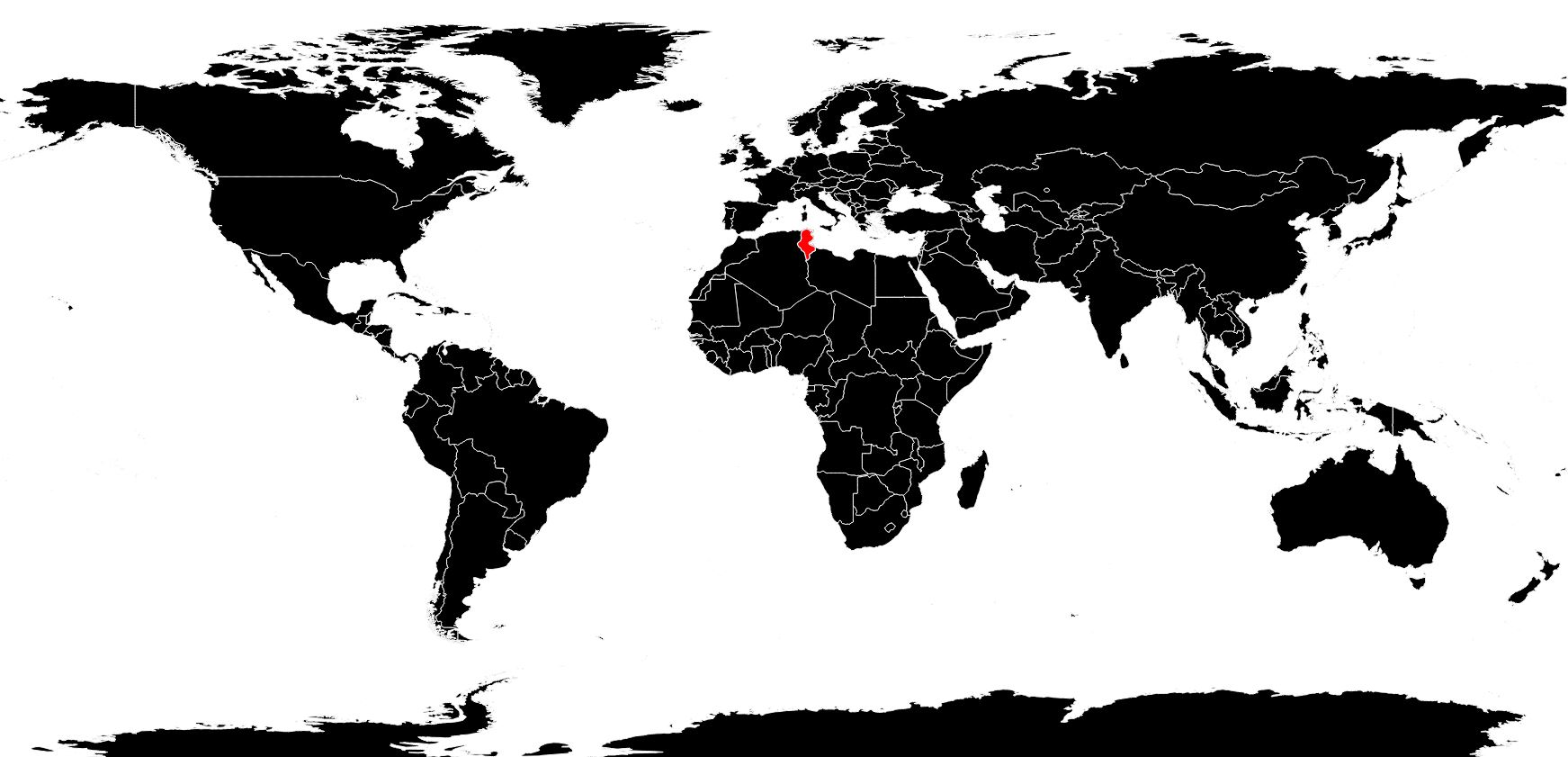
Tunisia on a world map – Credit: Actualitix
Southern Region of Tunisia
Tunisia extends southward toward the Sahara (which can be seen on the map of Tunisia), where the Ksour Mountains, with their flattened summits, separate the coastal plain of Djeffara from a lowland region partially covered by the sand dunes of Algeria’s Grand Erg Oriental. The climate in this region is arid, and annual rainfall is under 20 centimeters.
Isolated oases are nevertheless permanently inhabited thanks to the presence of an underground water table. Everywhere else, you find only vast barren regions where vegetation is intermittent. The lowest annual rainfall in Babis reaches only 18.5 centimeters, and the temperature averages 19.3°C.