
In this article you will find a map of Egypt. The country is located in the northeast of the African continent and extends into the Sinai Peninsula. Its area covers 1,011,500 square kilometers, including the 60,710 square kilometers of Sinai. The Nile Delta, one of the most fertile regions on the planet, is home to almost the entire population.
Table of contents
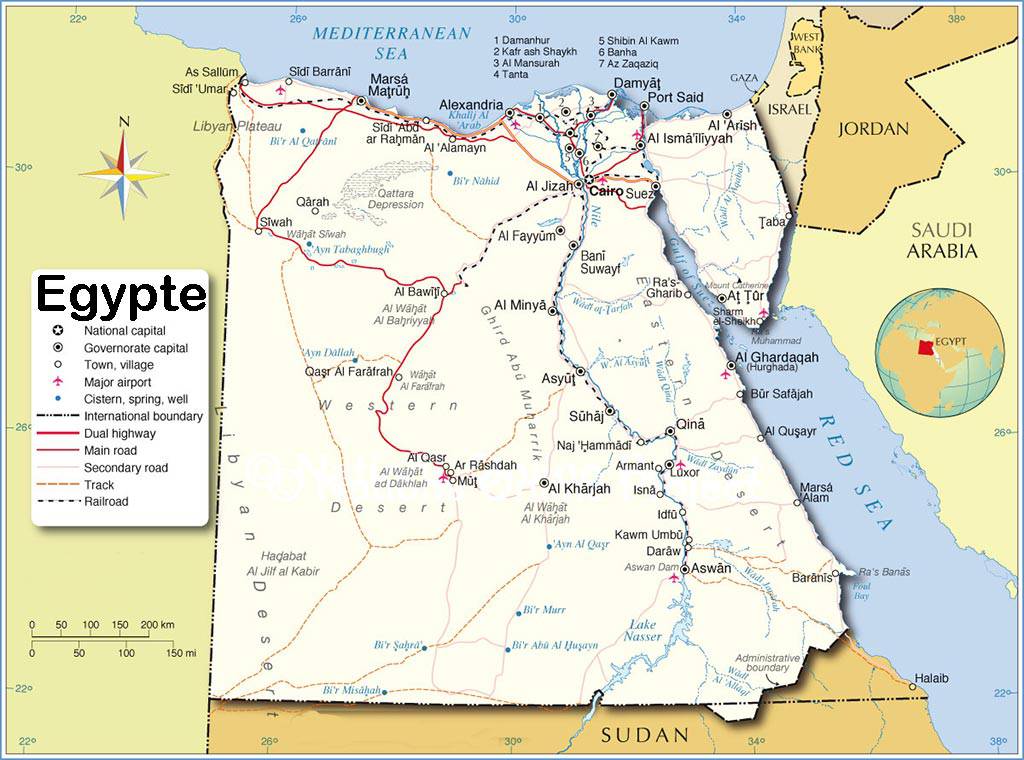
Map of Egypt
Egypt is bordered by Sudan to the south, Libya to the west, the Mediterranean Sea to the north, and the Red Sea and the Gulf of Aqaba to the east. The gulf and the Suez Canal separate Sinai from the African continent. In the north, Egypt’s Sinai border was set by a peace treaty signed with Israel in 1979. However, the return of Sinai to Egypt only became effective in 1982.
Geography with the map of Egypt
The Nile rises in East Africa, flows northward, crosses Sudan and enters Egypt near Wadi Halfa. It measures 6,650 kilometers and flows through Egypt for nearly 1,545 kilometers. The Nile is famous for its seasonal floods caused by heavy summer rains. It is clearly visible on the map of Egypt.
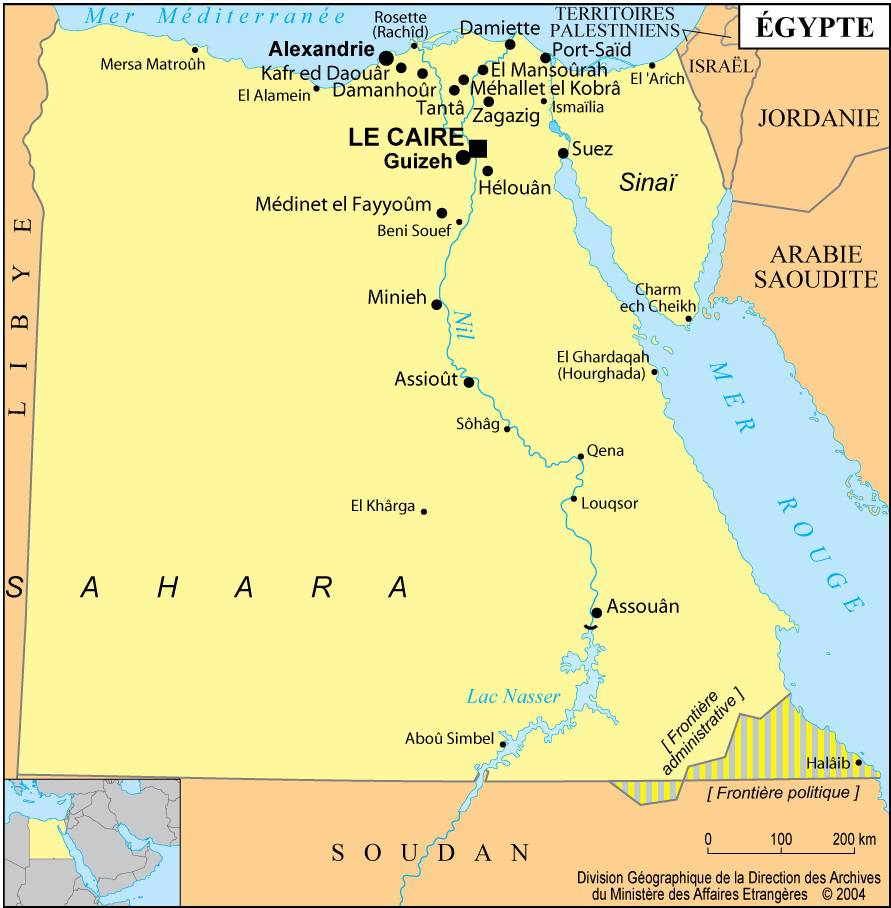
Map of the cities of Egypt
The Upper Nile flows through a narrow valley, rarely more than 3 kilometers wide, where several cataracts follow one another. The most famous is undoubtedly that of Aswan. In 1902, the Egyptians built a dam there to regulate the Nile’s flow and promote irrigation. Upstream, the Nile’s course is marked by four other cataracts across Sudanese territory.
The Aswan High Dam lies slightly upstream from the old 1902 dam. Its construction began in January 1960 and was completed in July 1970 with the creation of Lake Nasser, the largest artificial lake in the world.
This reservoir stretches for about 560 kilometers and is roughly 10 kilometers wide. It allows regulation of the Nile’s flow beyond seasonal floods. The dam also powers a major hydroelectric station.
The Nile is omnipresent
The Nile Valley then widens considerably between Aswan and Cairo (see location on the map of Egypt) forming a plain 10 to 15 kilometers wide. Cairo lies at the entrance of the Nile Delta, where the river splits into the Rosetta branch to the east and the Damietta branch to the west. This vast delta, covering 22,000 square kilometers, is formed by nine branches. To the north, several shallow lakes formed as the delta advanced into the Mediterranean. The largest is Lake Manzala, located between Damietta and Port Said.
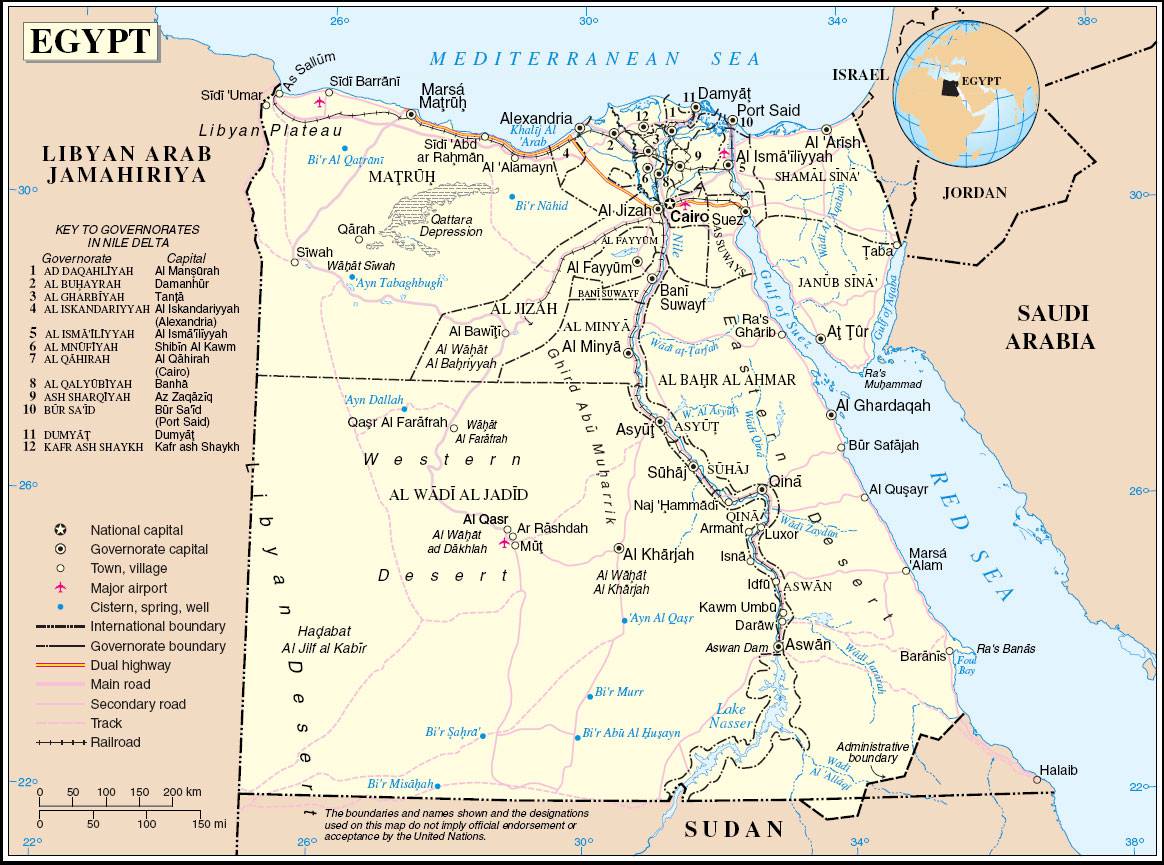
Detailed map of Egypt – Credit Nations Online
Immediately west of the Nile lies the Western Desert, one of the driest areas on Earth. This low, fairly flat plateau along the coast gives way southwestward to a mountainous massif exceeding 1,000 meters in altitude.
As seen on the map of Egypt, the Libyan Desert alternates between dunes and vast stretches of shifting sands. Wind erosion has formed several depressions. The oases of Bahariya, Dakhla, Farafra and Siwa, as well as the vast Kharga oasis, all rely on underground water for agriculture.
The Bahr Youssef, a branch of the Nile, irrigates the city of El Fayoum. Northwest of Cairo, in the Wadi el Natrun region and in the Qattara Depression, waters are saline. The Qattara Depression lies near Siwa, on the edge of the Libyan Plateau, 133 meters below sea level.
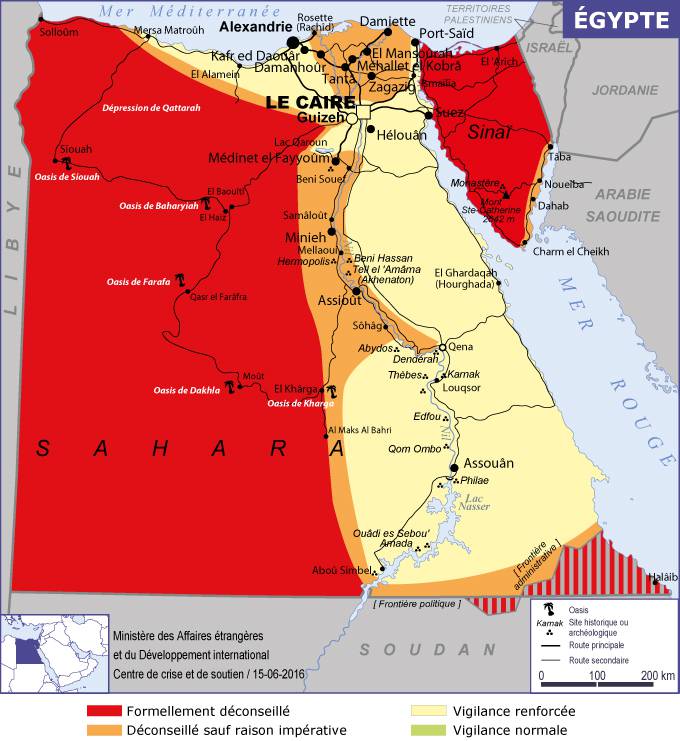
Map of dangerous areas of Egypt
The Eastern Desert lies between the Nile Valley and the Red Sea. It rises gradually into a rugged plateau reaching about 1,000 meters. Its slopes form a high mountain chain along the Red Sea. Egypt’s highest peak is Mount Catherine in southern Sinai, rising to 2,638 meters. Northward it gives way to the Sinai Desert, stretching to the Suez Canal and the Israeli border.

Blank map of Egypt
Climate in Egypt
Egypt has a very arid climate. The highest annual rainfall is recorded in Alexandria but does not exceed 18.8 centimeters. In some Mediterranean coastal areas, rainfall reaches only 6.4 centimeters, for example in Port Said. Rain falls mainly in winter and is almost nonexistent in summer. The average annual temperature rarely drops below 20°C and rises to around 27°C in summer.
Cairo (see its position on the map of Egypt), the capital, receives less than 2.5 centimeters of rain annually and the average temperature remains above 22°C. In spring and summer, morning mists form over the Nile Valley, slightly humidifying the air. Elsewhere, rainfall remains extremely low.
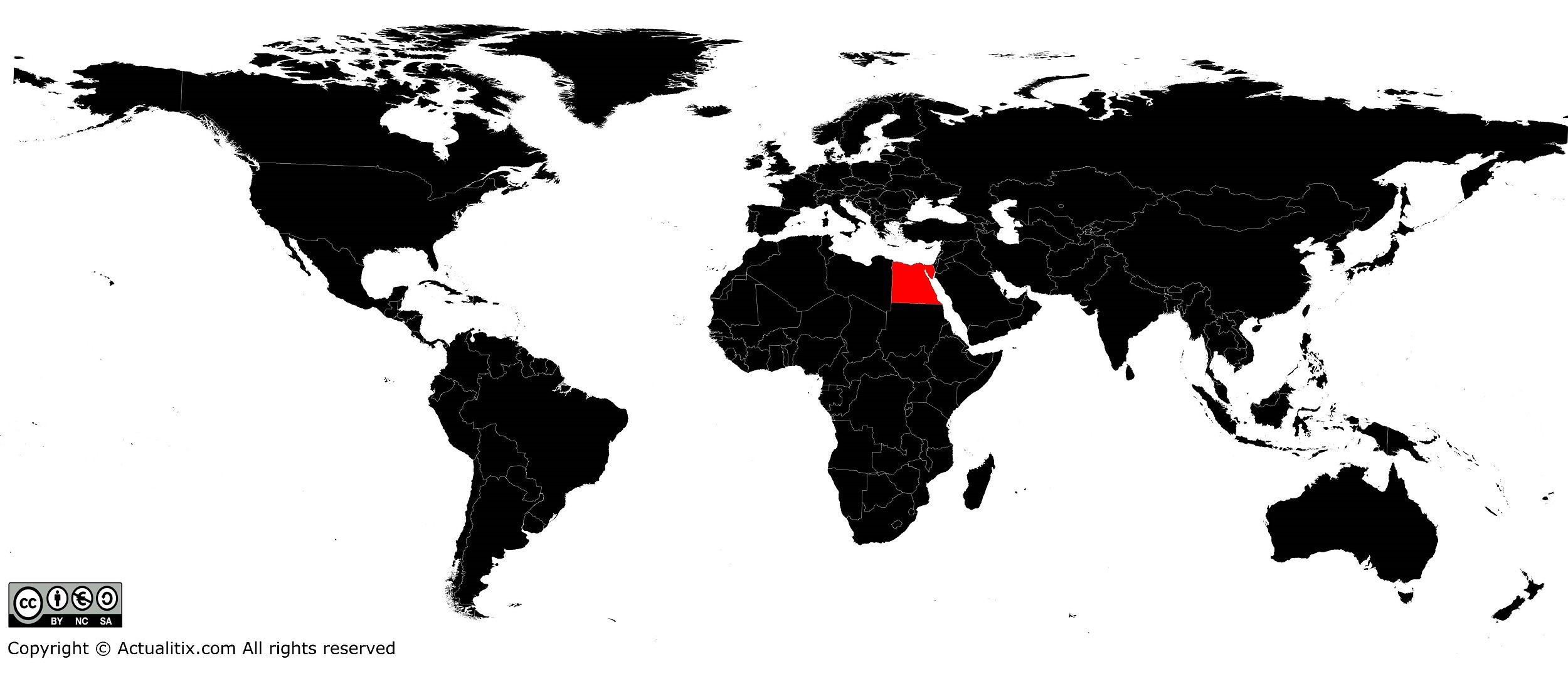
Egypt on a world map
The climate remains hot and dry for most of the year, and drought periods may last several consecutive years. In the Aswan region, rainfall is almost nonexistent (0.5 centimeters annually) and temperatures average around 27°C, reaching 34°C in summer.
In summer, hot and dry winds sweep across Egypt from the Sahara to the Mediterranean coast. The khamsin, a wind similar to the sirocco, often brings destructive sandstorms that damage crops and may persist for several days. Egypt has no forests and only sparse grazing lands. Desert areas support very limited vegetation, mainly shrubs and drought-resistant species.
You can discover all available maps of different countries of the world on this page.