
You will find a map of India. It is worth noting that nearly one-sixth of the world’s population lives in India. It is the most populous democracy in the world. Diverse populations live together there , the major religions are practiced there, and dozens of languages are spoken.
Society is divided into thousands of castes and encompasses the main ethnic groups. Indian civilization dates back more than 4,000 years, with periods of unparalleled prosperity in world history.
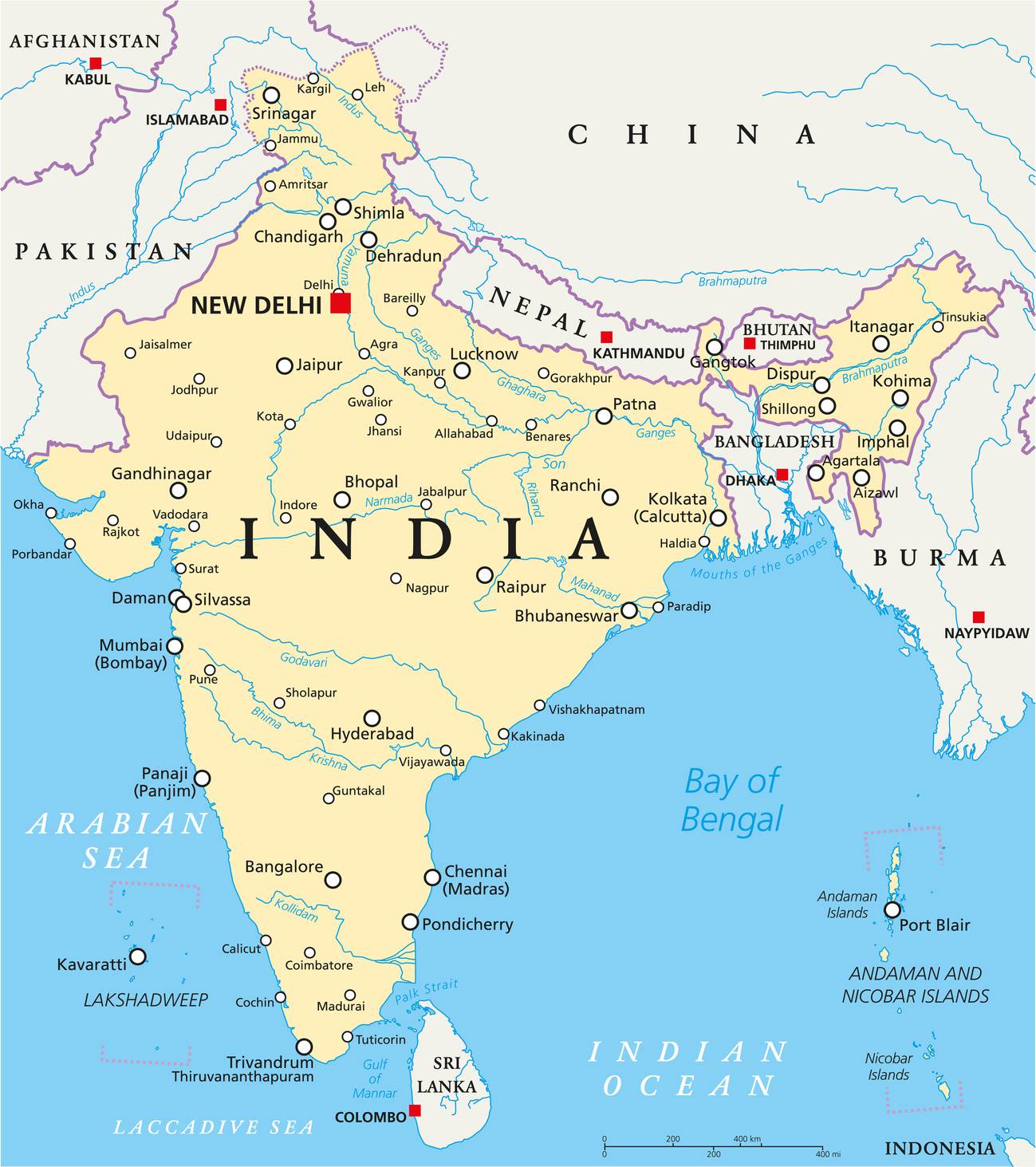
Map of India – © Peter Hermes Furian – stock.adobe.com
Discover the country
Since its independence in 1947, India has played a leading role in international affairs. However, the standard of living for the majority of the population remains very low. Millions of Indians suffer from malnutrition, live in dilapidated housing, and severely lack educational, medical, and sanitary services.
The Indian nation (also called Bharat in Hindi) is smaller than the British-ruled Indian Empire once was. Burma (today Myanmar), a mainly Buddhist region located to the east of the country as you can see on the map of India, was administratively separated from the rest of India in 1937. When the British declared India’s independence ten years later, two Muslim-majority regions—one in the northwest (West Pakistan) and the other, smaller, in the northeast (East Pakistan)—broke away from the predominantly Hindu nation to form Pakistan.
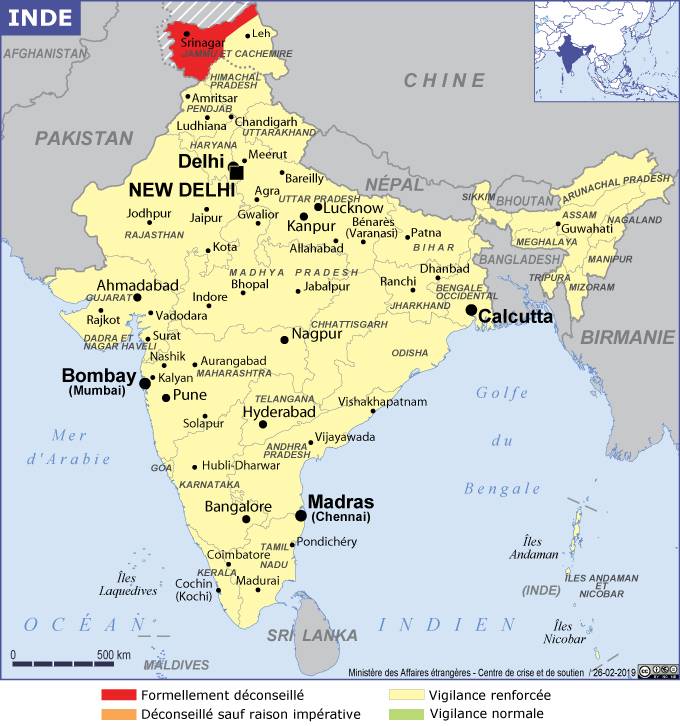
India map – Credit: Ministry of Foreign Affairs
In 1971, East Pakistan separated from the rest of the country: Bangladesh was born. India’s other neighbors are, to the north, the People’s Republic of China, and the kingdoms of Nepal and Bhutan. The island of Sri Lanka lies off the southern coastline.
Geography with the map of India
India’s area (including the Jammu and Kashmir region) is 3.3 million square kilometers. As you can see on the map of India, most of the country consists of a peninsula extending into the Indian Ocean between the Arabian Sea to the west and the Bay of Bengal to the east.
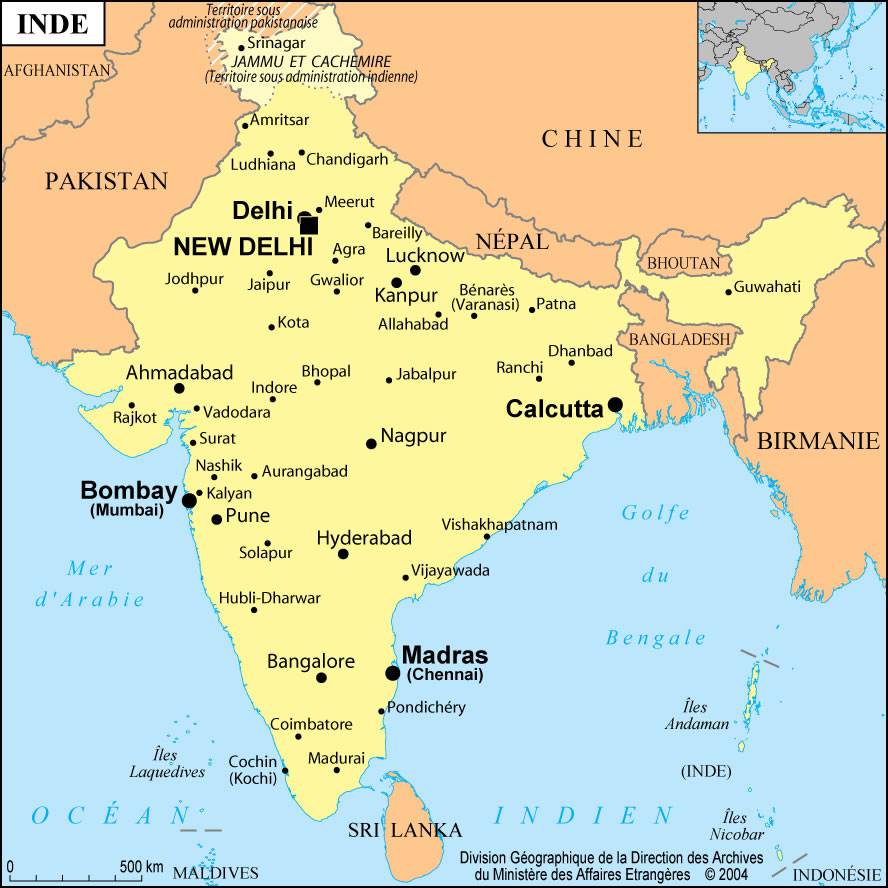
Map of cities in India
Himalayas
The northern mountain massif consists of three parallel ranges. The highest forms the Himalayas proper, with peaks exceeding 7,600 meters. With the exception of the polar circles, India is the most significant region in terms of glaciers and snow-covered massifs. You can easily see their location on the map of India.
Lower-altitude mountain ranges extend from both ends of the Himalayas. One, to the east, follows the Burmese border and reaches the Bay of Bengal; the other, to the west, crosses Pakistan and reaches the Arabian Sea.
The Ganges Plain
With an area of 700,000 square kilometers—easily identifiable on the map of India—the Ganges Plain can vary in width by several hundred kilometers. It is the world’s most important river system in terms of alluvium. This deep river, with enormous sediment deposits, is one of the main sources of soil fertilization. In addition, the quality of its waters and the flat terrain make it an excellent tool for irrigation.
Rising south of the Himalayas, the Ganges flows south-southeast and empties into the Bay of Bengal. Its main tributary, the Yamuna, joins it at Allahabad, downstream from New Delhi, the country’s capital. Further on, north of Goalundo Ghat in Bangladesh, the Brahmaputra flows into the Ganges.
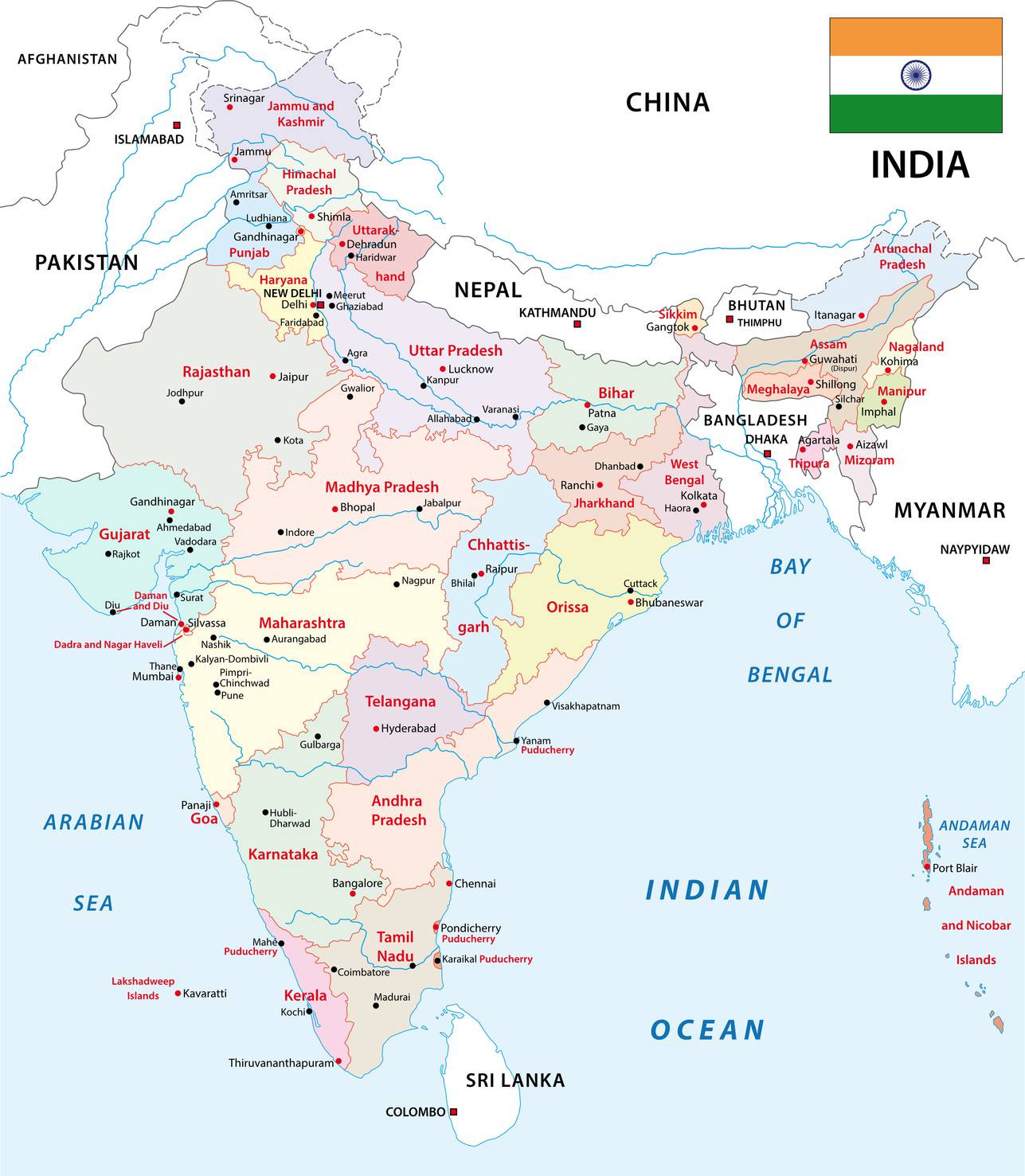
Map of regions in India – © lesniewski – stock.adobe.com
The Indus and its tributaries flow through the western and southwestern parts of the country. The northern part of this region, spanning India and Pakistan, is traditionally called the Punjab, or “Land of the Five Rivers.” These five rivers are the five tributaries of the Indus: the Jhelum, Chenab, Ravi, Sutlej, and Beas. Also located along the Indo-Pakistani border is the Thar Desert.
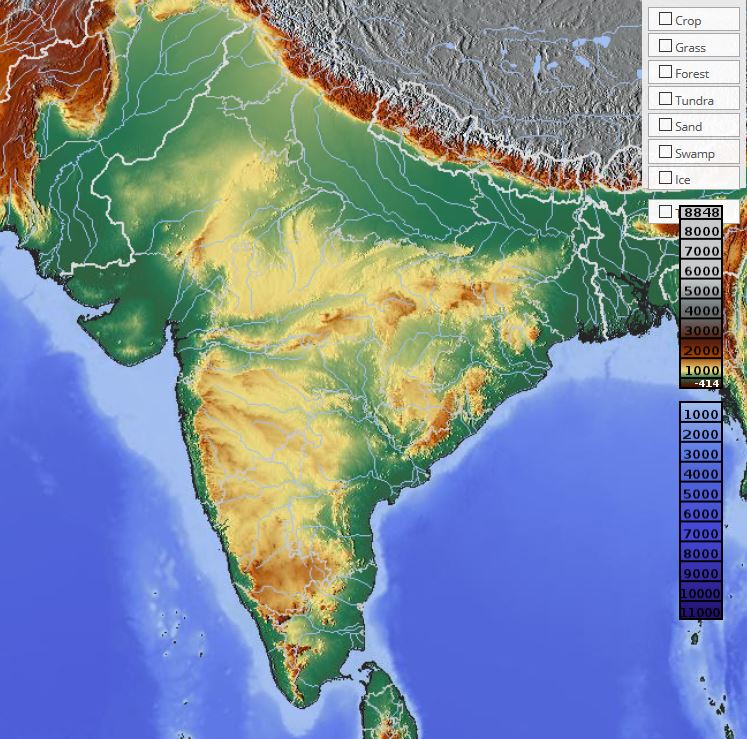
Relief map of India – Image extracted from maps-for-free
The Deccan
The so-called Indian plateau is in reality a far more complex geographic area than its name suggests. Most of the Deccan’s 1.9 million square kilometers are relatively flat. The few uplifts rise between 300 and 600 meters above sea level. This area nevertheless includes many hills and some significant escarpments. Located in the Western Ghats, Anamudi (2,695 m) is the highest peak on the Indian peninsula.
The coastal plains bordering the Deccan are relatively narrow (10–130 km). The eastern plain is watered by many deltas, including, from north to south, those of the Mahanadi, Godavari, Krishna, and Kaveri.
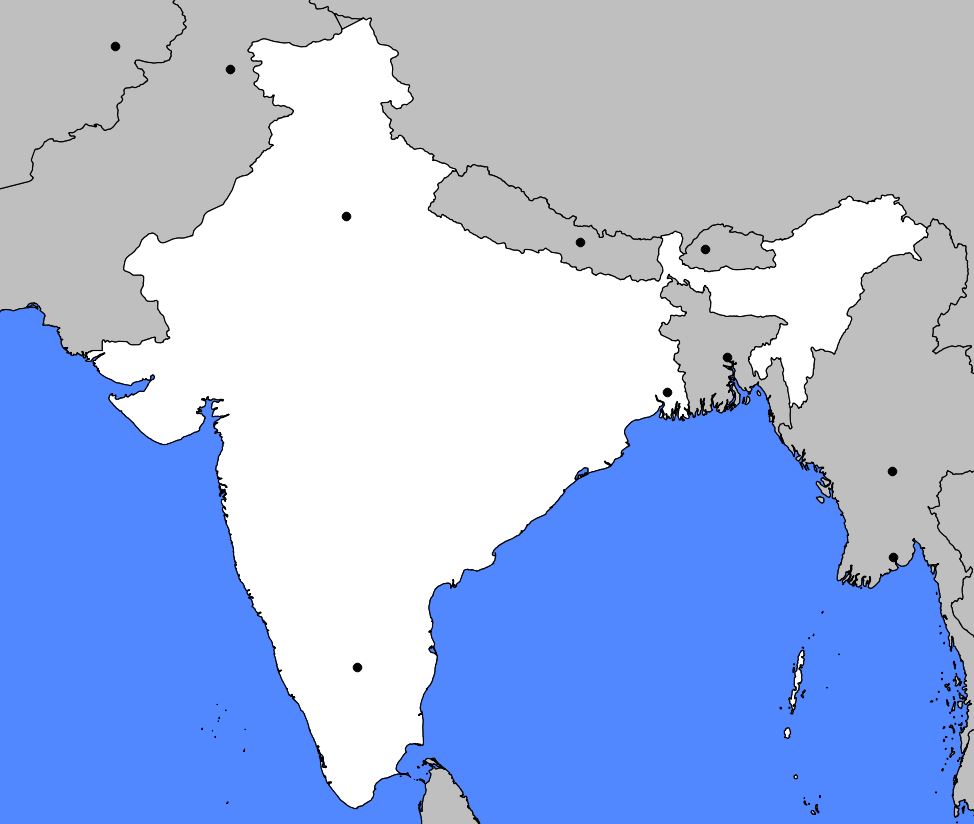
Blank map of India
India abounds in non-energy mineral resources and has some coal deposits. Its oil and gas reserves, however, are limited. The main deposits are located south of the Ganges Plain, led by the Chota Nagpur Plateau. This region contains the country’s main coal sources as well as a large share of reserves of iron ore, copper, bauxite, limestone, mica, and chromite. With 100 billion tons of coal, the country ranks fifth worldwide.
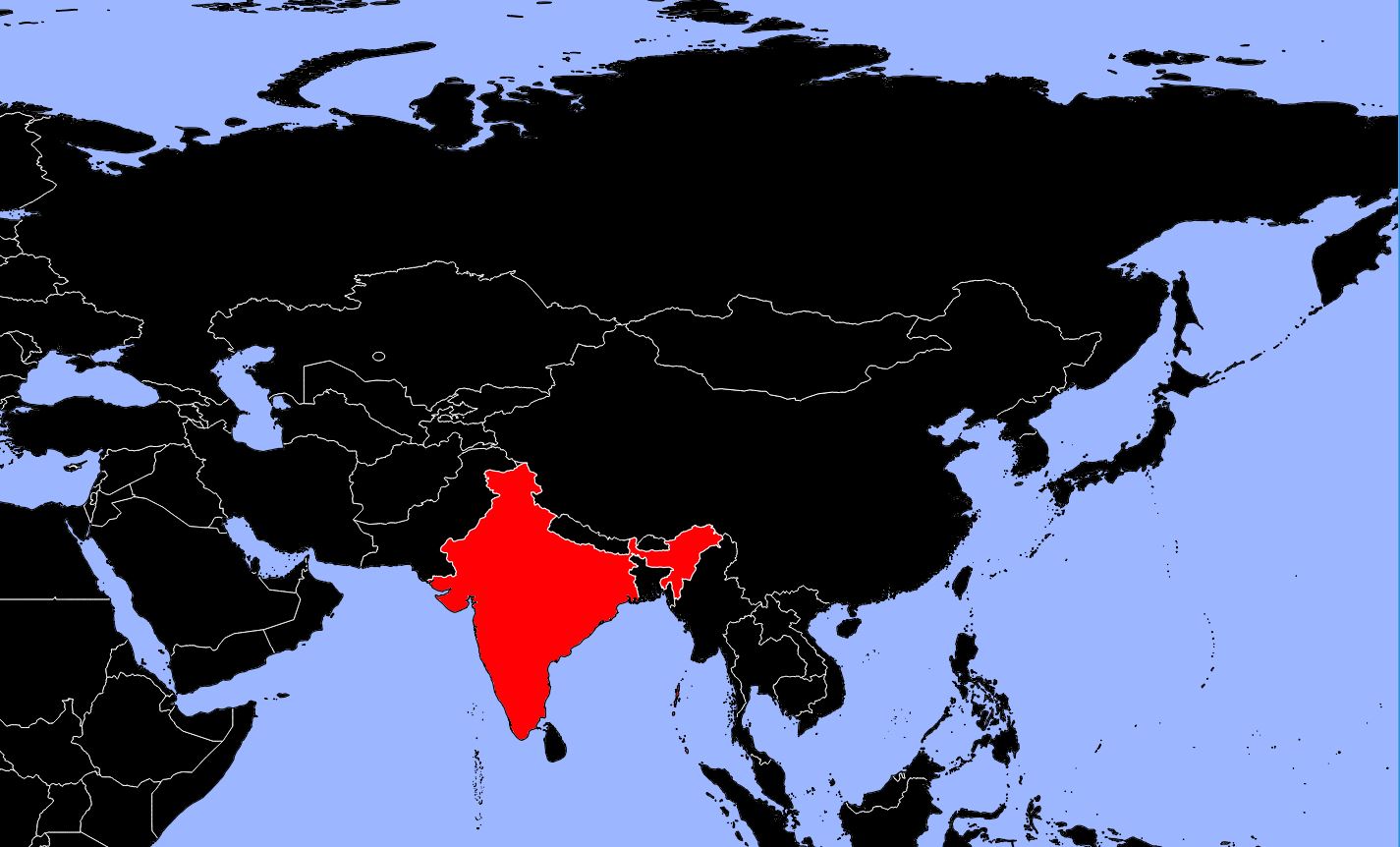
India on a map of Asia – Credit Actualitix
Climate in India
In general, India’s climate is governed by the monsoon. Most of the country has three seasons: the hot season, the wet season, and the temperate season. During the hot season, which begins in March and ends in mid-June, temperatures are very high. They are accompanied by intermittent winds and dust storms.
The wet season, the monsoon, is characterized by strong, humid south-southwesterly winds that usually bring torrents of rain falling daily in the late afternoon. This season can begin as early as May in the south of the country.
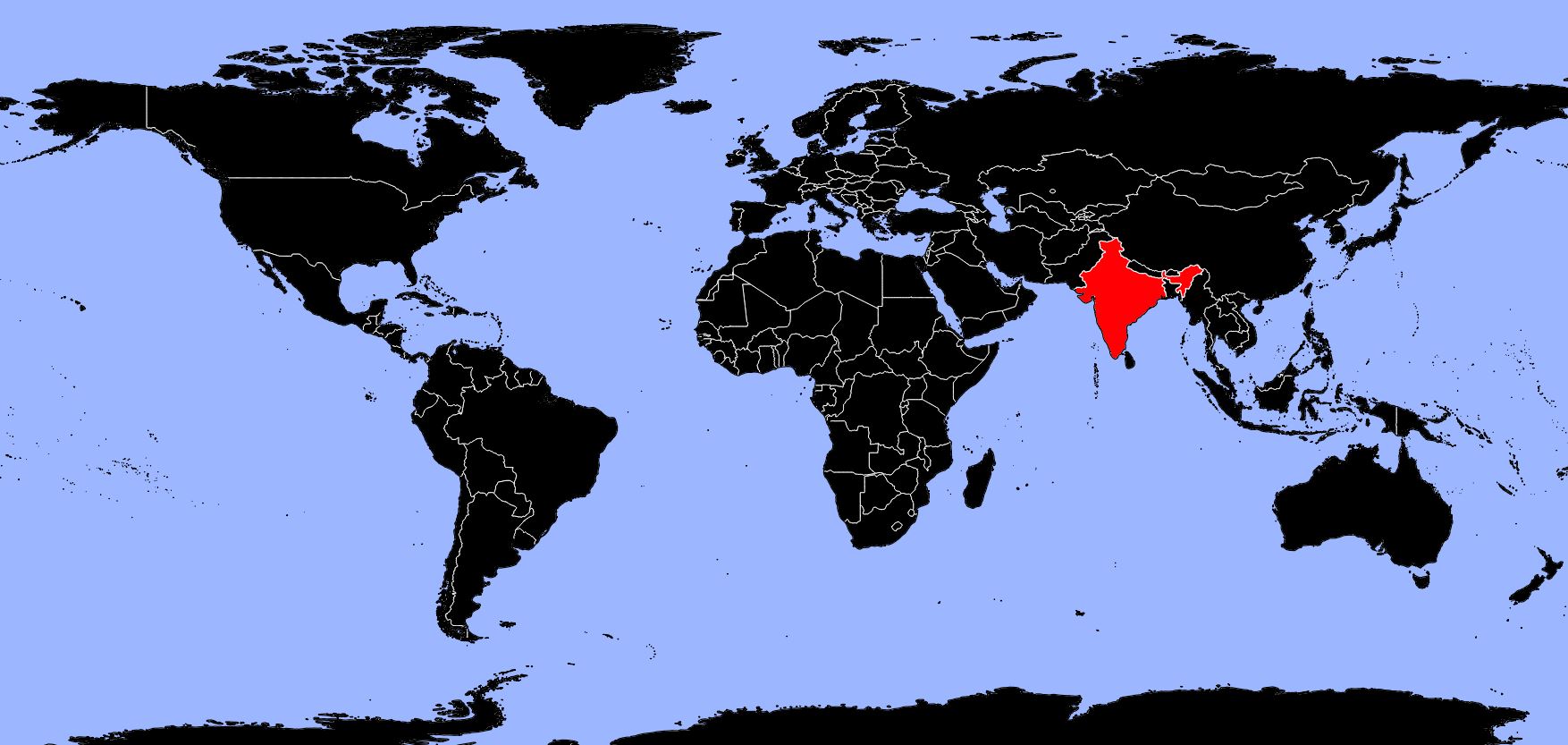
India on a world map – Credit Actualitix
Annual rainfall can vary greatly. In Cherrapunji, on the Shillong Plateau north of Bangladesh, about 1,143 cm of rain falls per year. This area is the second wettest in the world after Mount Waialeale in Hawaii (1,168 cm per year). The western part of the Thar Desert, however, records only 10 cm of rain per year. It is one of the driest regions in the country.
Like precipitation, temperatures can vary widely. As you might expect when looking at the map of India (in terms of relief), stations located in the Himalayan mountains—Darjeeling and Simla, for example—record notably low averages, with annual means of 12° and 14°C. On the Ganges Plain, the average temperature in Delhi and Allahabad is 26°C.