
You will discover the map of Bolivia. The Republic of Bolivia, in South America, possesses many natural resources. However, the mountains and tropical forests that cover its territory, as well as the absence of a coastal zone, make their exploitation and transport to international markets difficult.
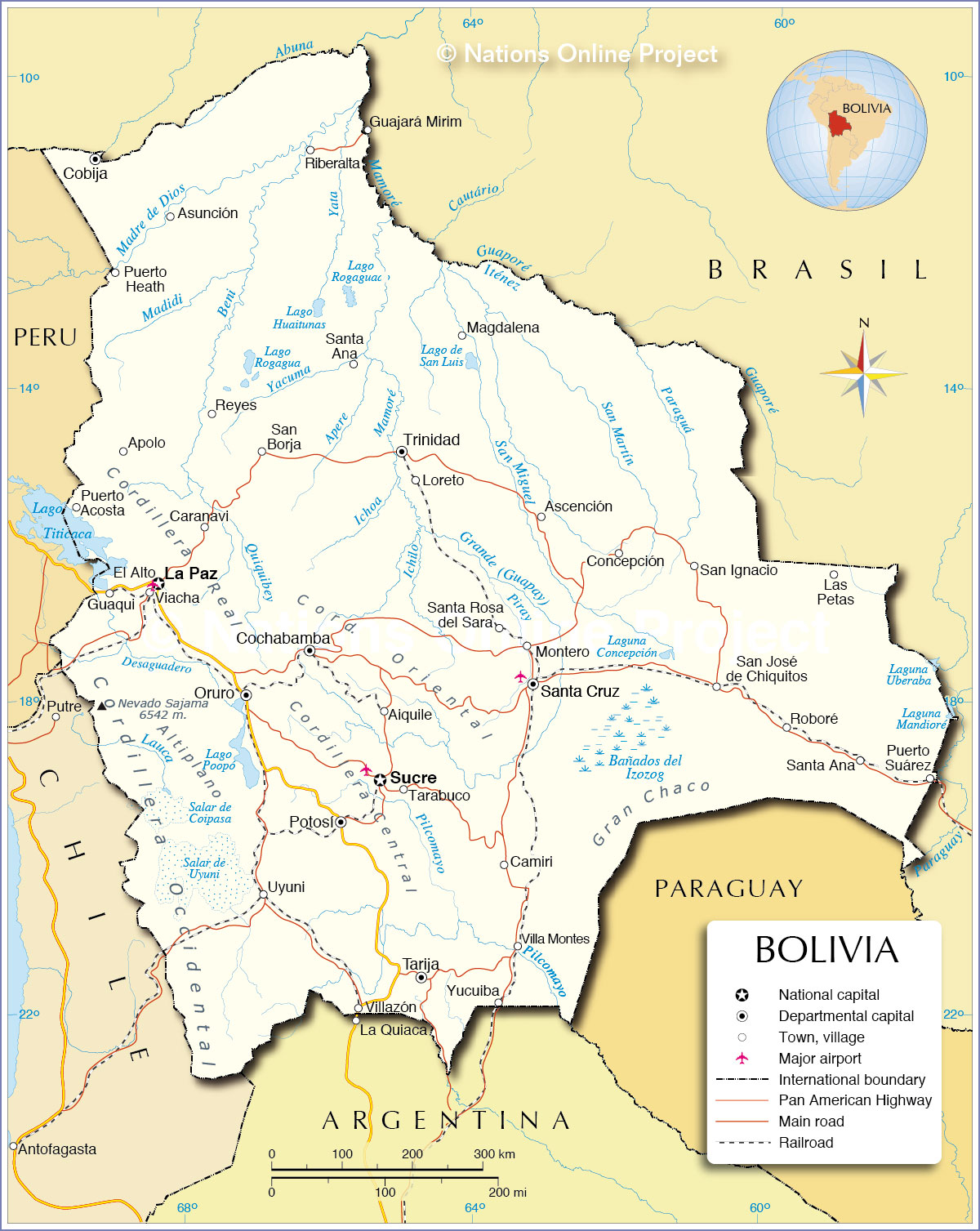
Map of Bolivia – Credit: Nations Online Project
Moreover, mineral extraction is extremely difficult at 4,000 – 4,500 meters above sea level. Mahogany, rubber trees, cinchona and other precious woods grow in abundance, but in inaccessible humid tropical forests.
When looking at a geographical map of Latin America, Bolivia seems small, but its area is still 1,098,580 square kilometers. Most of its population lives at 3,700 meters above sea level or higher. Bolivia had 10 million inhabitants in 2015.
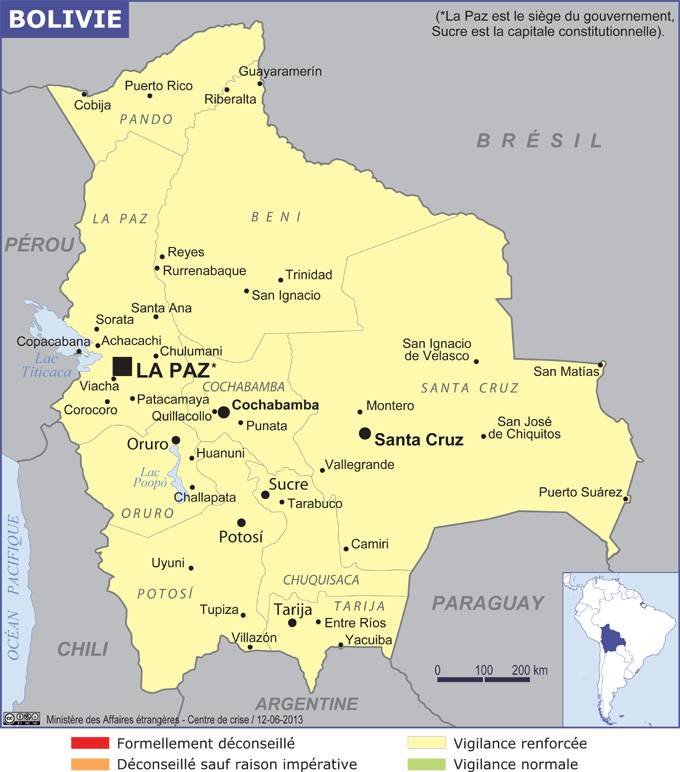
Map of the cities of Bolivia – Credit: Ministry of Foreign Affairs
Table of contents
Geography on the map of Bolivia
80% of the Bolivian population lives in the western part of the country. In this region, the Andes mountain range extends from north to south in two parallel mountain chains visible on the map of Bolivia: the Cordillera Occidental to the west and the Cordillera Real (eastern) to the east. Snow-covered peaks reaching 6,350 meters (visible on the relief map of Bolivia) rise in the west and deprive the country of easy access to the Pacific Ocean. Some volcanoes are still active. The eastern mountain chain is more fragmented and provides access to mountains, foothills and plains.
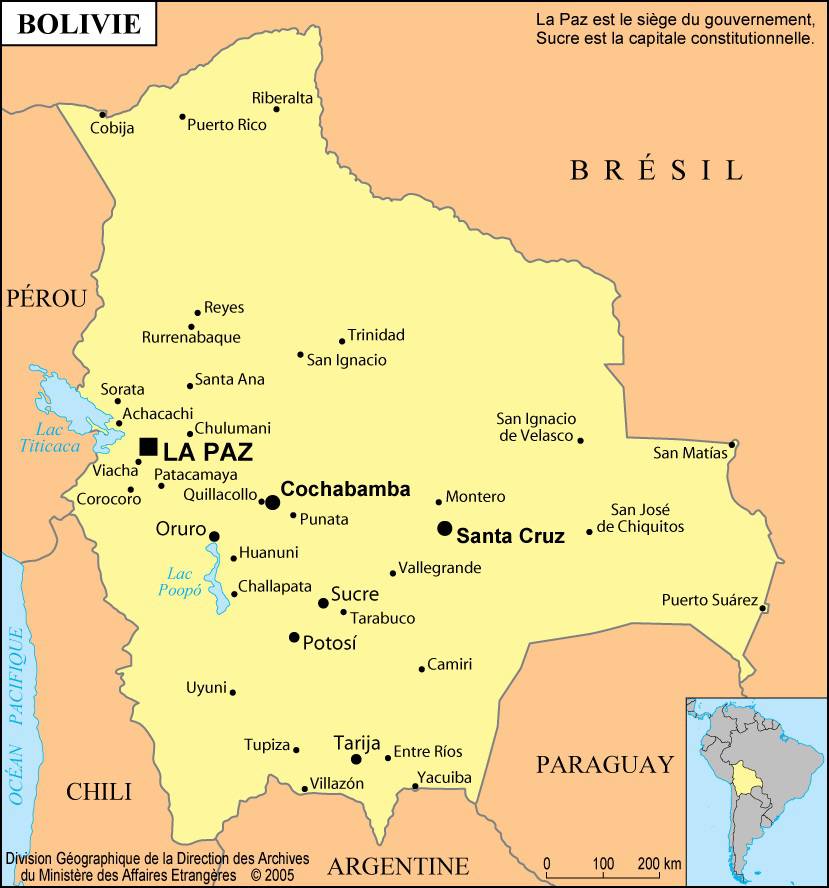
Bolivia map – Credit: Ministry of Foreign Affairs
The high plateaus of the Altiplano, between the two mountain chains, reach an altitude of 4,000 meters. With a length of nearly 800 kilometers and a width ranging from 65 to 100 kilometers, they are the largest plateaus in the Andes. Lake Titicaca, shared between Bolivia and Peru, lies at 3,810 meters above sea level (see the map of Bolivia). It is the largest navigable body of water in the world. Its waters flow through the Desaguadero into Lake Poopó, where they evaporate, which explains the high salt content of this lake.
The northern and eastern slopes of the Andes are cut by fertile cultivated valleys called yungas. Tropical and semi-tropical plains, representing nearly 60% of this region, form a vast crescent around the Andes. The northeastern plains are drained by tributaries of the Amazon, while those in the south, part of the Gran Chaco, are drained toward the Atlantic by the Paraguay-Paraná river system.
Climate and vegetation
Bolivia lies within the tropics, but its climate varies considerably with altitude. The peaks are icy and covered with perpetual snow; the Altiplano and adjacent slopes (at 3,000 to 4,200 m altitude) enjoy a cool climate with average temperatures around 10°C. The western part of the Altiplano has a dry climate, while the area influenced by Lake Titicaca is more humid. The yungas are warmer as they descend toward the plains, which benefit from tropical heat (average temperatures around 25°C).
Blank map of Bolivia – Credit Actualitix
The tropical plains of the northeast, like the rest of the Amazon basin, receive heavy rainfall and are covered by dense rainforest. This region is sparsely populated due to harmful insects, tropical diseases and poor soils. However, some indigenous people survive here by hunting and growing cassava in small clearings. These inhabitants also collect rubber, Brazil nuts and cinchona bark.
The Gran Chaco, in the southeast, is a plain covered with savannas where cattle are raised. Although water can be drawn from deep underground for irrigation, transport facilities are limited for bringing agricultural products to markets.
The regions
The yungas region, by contrast, is well irrigated (as seen on the map of Bolivia). A wide variety of crops grow in its humid valleys. At the valley bottom, where temperatures are warmest, sugar cane, vanilla, bananas and other tropical fruits are produced. Slightly higher on the slopes, farmers harvest coffee, cocoa and coca. Between 1,200 and 2,400 meters in altitude, maize, alfalfa and temperate-climate fruits abound, while wheat, rye and oats grow at higher elevations.
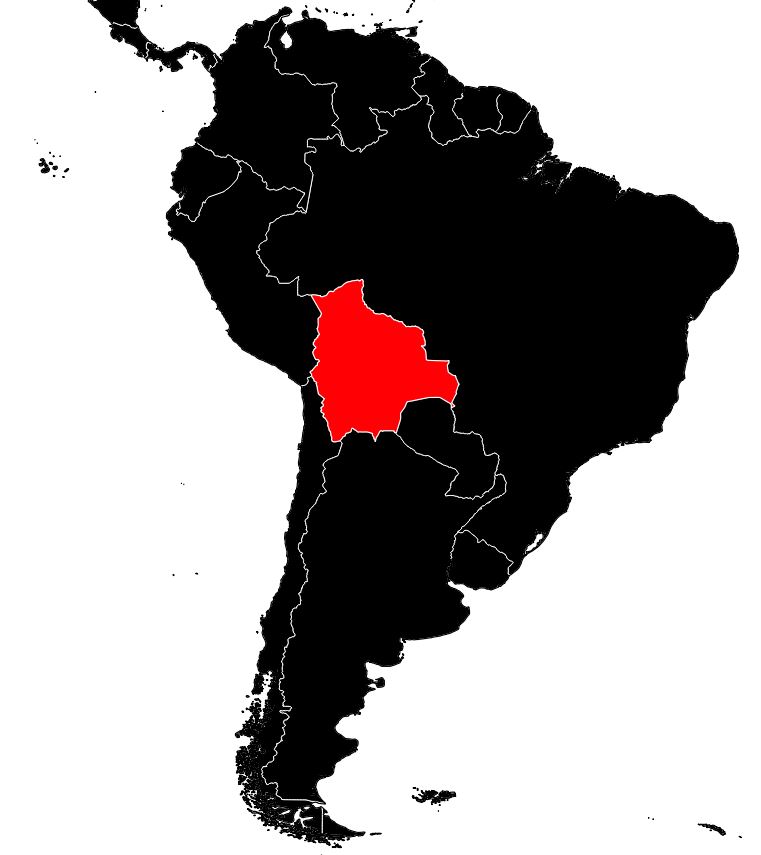
Bolivia on a map of South America – Credit Actualitix
The sale of these products must at least cover transport costs, sometimes by freight train, to the markets of mining towns and cities. Among these products are chocolate, coffee, brandy made from sugar cane, coca leaves and chicha, a beer made from maize.
The high peaks of the Cordillera Real prevent rain-bearing eastern winds from crossing the mountains and protect the Altiplano and the Cordillera Occidental from humidity. These regions are drier in the south than in the north and are mainly covered with tufts of grass (ichu), shrubs (tola), moss (llareta) and reeds from shallow lake waters.
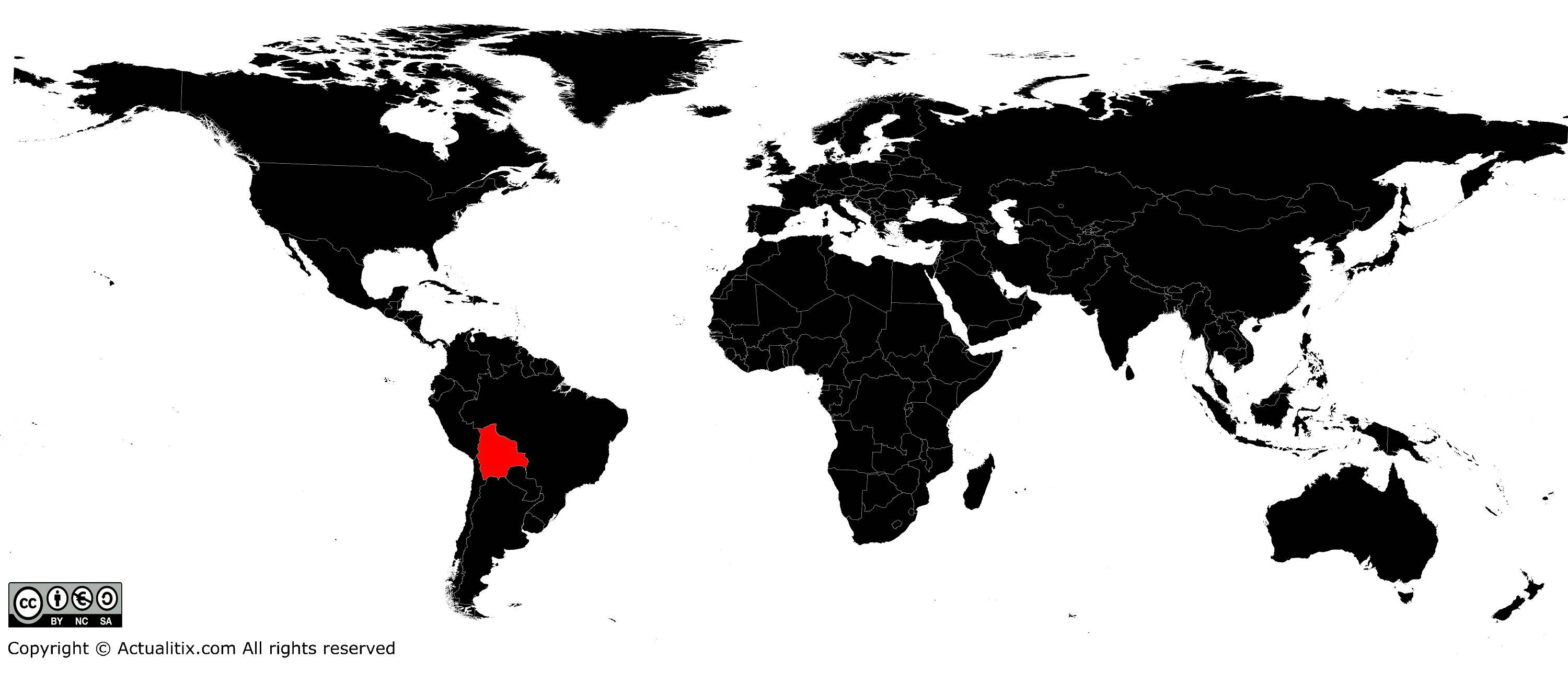
Bolivia on a world map – Credit Actualitix.com
You can discover all the available maps for the different countries of the world on this page.