
Discover a map of the Netherlands. Although it is one of the smallest countries in Europe, the Kingdom of the Netherlands has played a major role in the continent’s history. In the past, the country was a great maritime power that competed commercially with England across all the world’s oceans.
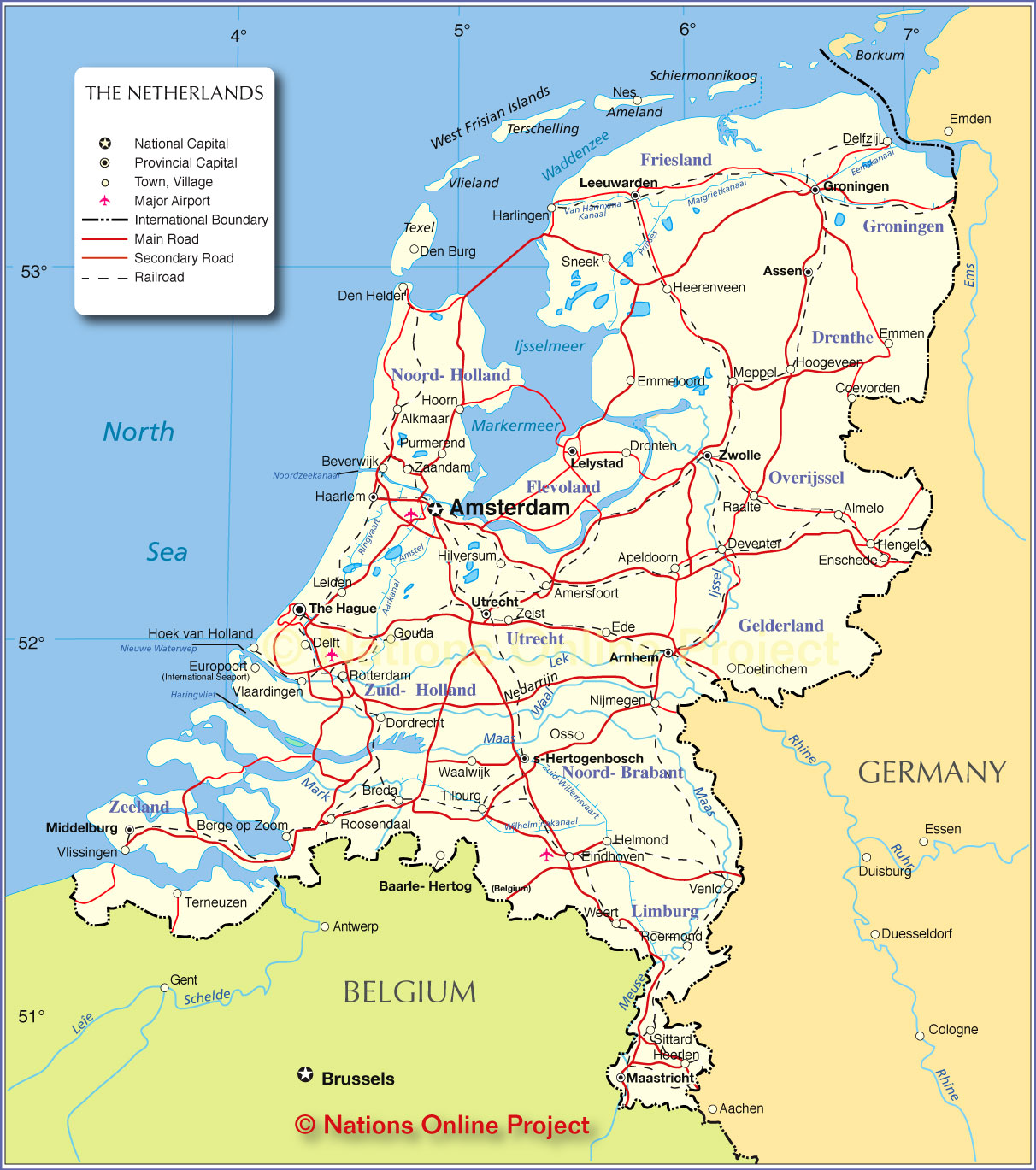
Map of the Netherlands – Credit : Nations Online
The Dutch notably established colonies on several continents. Today, the Netherlands is no longer a colonial power, but the country still plays an important role in the European business world and its geographical position is essential.
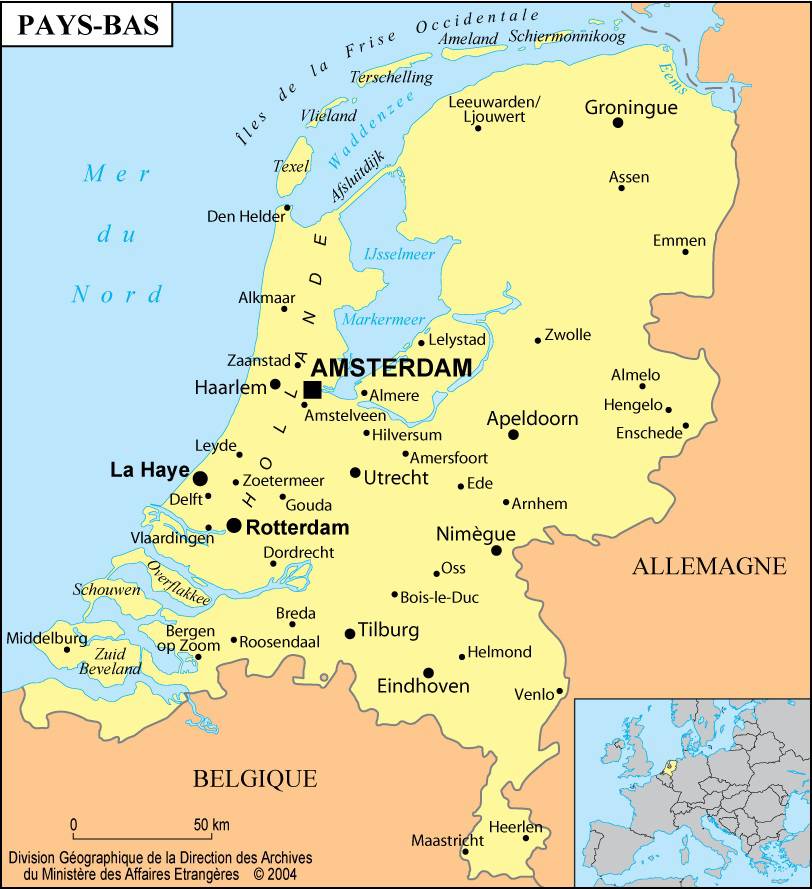
Netherlands map – Credit : Ministry of Foreign Affairs
Table of contents
Map of the Netherlands: relief and regions
The Netherlands covers a total area of 37,330 square kilometers. The country shares borders (as seen on the map of the Netherlands) with Germany to the east and Belgium to the south, and is bordered by the North Sea to the west and north. This region forms the western part of the Great North European Plain. A few hills can be found in the extreme south of the country. The West Frisian Islands are also part of the territory.
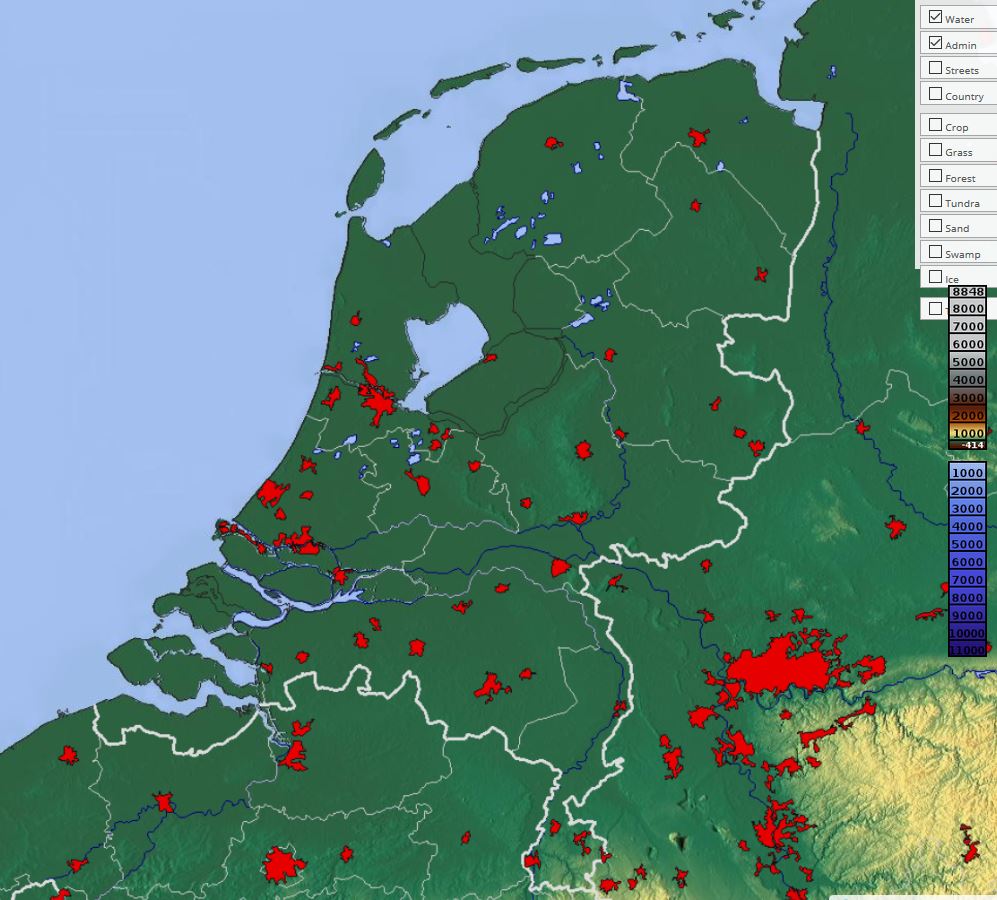
Relief map of the Netherlands – Image from maps-for-free
The Netherlands is divided into 12 provinces.
Over the past centuries, the country’s surface area has increased significantly due to the creation of polders. A polder is a piece of land reclaimed from the sea by building dikes and then draining it. Five polders have been created, covering an area of 2,500 square kilometers. Along the west coast, many sea inlets penetrate inland. Below you can find the map of the Netherlands showing the country’s regions.
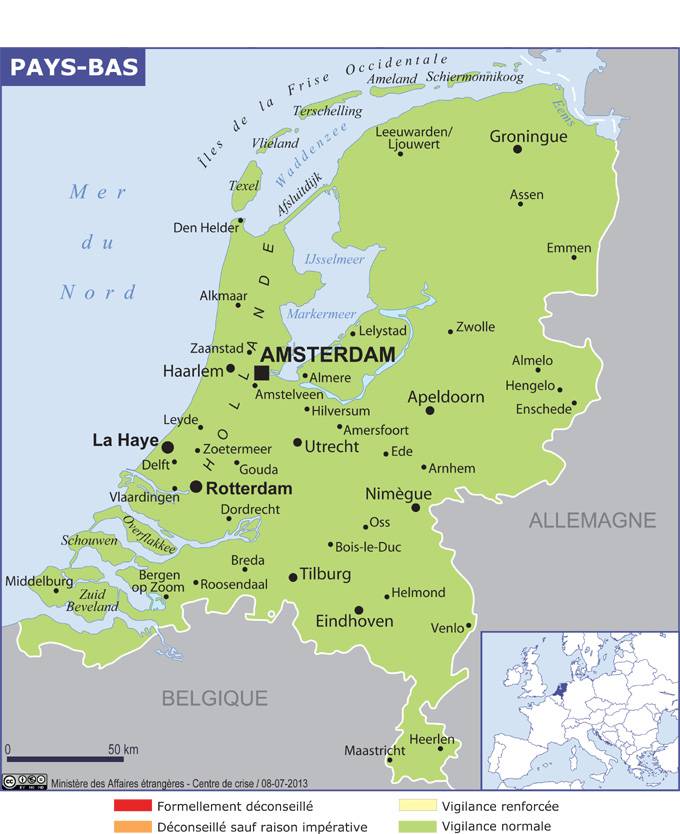
Map of the cities of the Netherlands – Credit : Ministry of Foreign Affairs
To prevent flooding during high tides, a series of dams had to be built. Without dams and large rows of sand dunes along the coast, nearly one third of the Netherlands would be underwater. Regions that were originally submerged have clay soils suitable for cereal farming.
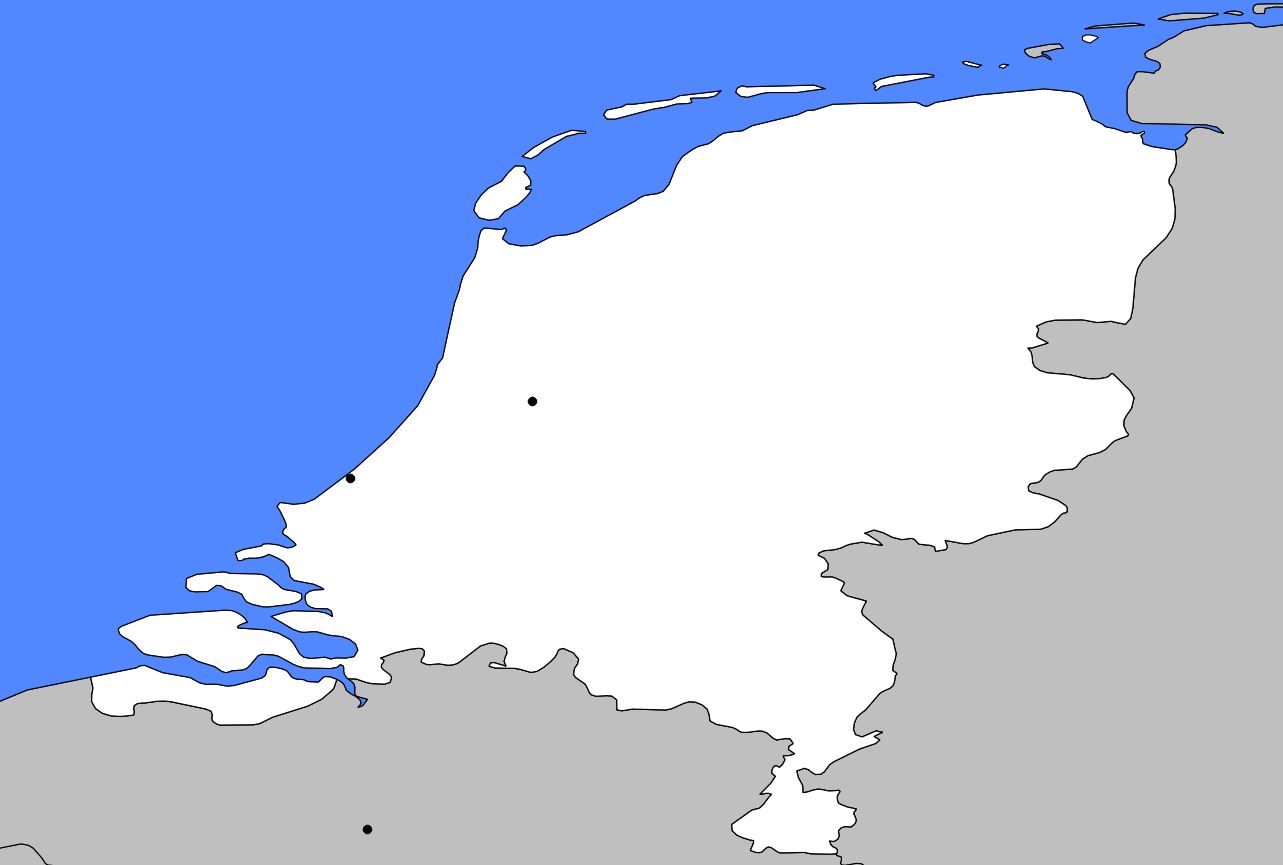
Blank map of the Netherlands – Credit Actualitix
The country is crossed by two main rivers, the Maas and the Rhine, which can easily be identified on the map of the Netherlands. The Maas rises in France, where the river is called the Meuse, and passes through Belgium before entering Dutch territory in the far south. It then flows north and west before emptying into the North Sea. The Rhine flows from Germany westward and also empties into the sea.
Climate in the Netherlands
The Netherlands has a maritime climate. Prevailing westerly winds bring much humidity, mainly in the form of precipitation. Winters are generally mild and summers cool due to the influence of the sea. One winter issue is fog. The coastline is exposed to strong gusts of wind that can cause considerable damage. The city of Utrecht, located inland, has a typical climate, with average temperatures of 2.3°C in January and 16.6°C in July.
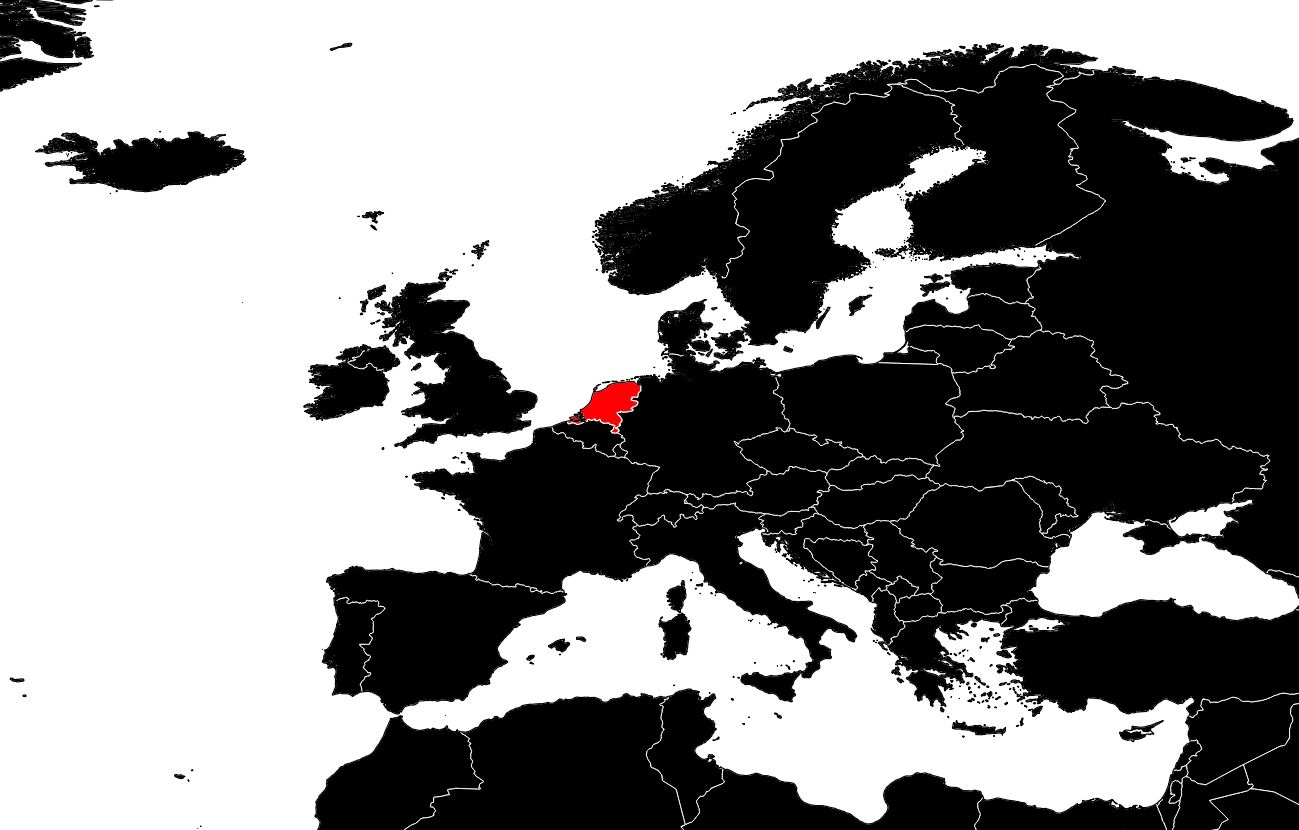
Netherlands on a map of Europe – Credit Actualitix
This type of climate is often variable. In Utrecht, summer temperatures can reach 35°C and winter temperatures can drop to -20.5°C. The average annual rainfall is 74 cm.
Population
The Netherlands has about 17 million inhabitants. Their language, Dutch, has many similarities with German and English and originates mainly from the Frankish dialect. Many foreigners have settled in the country. In 1949, after the independence of former Dutch colonies in the Indies, especially Indonesia, many natives from those countries chose to settle in the Netherlands.
Netherlands on a world map – Credit Actualitix
Likewise, residents of the former colony of Suriname arrived in the Netherlands after independence in 1975. In addition to these migrants, many foreign workers (especially Turkish and Moroccan) chose to remain in the Netherlands as permanent residents. About 4% of the population is foreign.
Cities
The largest metropolis is Rotterdam. The capital is Amsterdam. The seat of government is in The Hague. Other main cities include Utrecht, Eindhoven and Arnhem. You can find the country’s major cities on the map of the Netherlands.
The Netherlands has one of the highest population densities in Europe, with more than 425 inhabitants per square kilometer. However, the birth rate is low and the population grows at only 0.4% per year.
Religion
The most widespread religion is Catholicism, with more than 5 million followers, mainly in the southern provinces of North Brabant and Limburg. Protestants number about 4 million, mostly belonging to the Reformed Church of Holland, living mainly in the north and west. There are also about 4.5 million atheists in the Netherlands.
Transport on the map of the Netherlands
Cycling is both a sport, a leisure activity and a means of transport. The country’s flat terrain encourages bicycle use. Many people commute to school or work by bike. Cycling is also a competitive sport in which the Dutch achieve strong international results.
The highway network is excellent. The country has more than 2,250 kilometers (1,400 miles) of four-lane roads connected to German and Belgian highways. Below you can find a map of the Netherlands showing the road network.
The railway system is very well organized, and fast train services connect all major cities. There is also a network of inland waterways and maritime routes. Rotterdam handles more freight than any other port in the world. Located at the mouth of the Rhine, it provides access to Germany, France and Switzerland.
An inland waterway network of more than 3,730 kilometers (2,320 miles) of canals, in addition to existing rivers, connects to Belgian and German river systems. The main international airport, Schiphol, is located near Amsterdam. It is also home to the headquarters of Royal Dutch Airlines (KLM), one of the world’s largest airlines.