
Discover a map of Italy. The country is a peninsula in Southern Europe that extends into the Mediterranean Sea. Its shape resembles a boot. To the north, the upper part of the boot corresponds to part of the Alps and the Po Plain.
To the south-east lies the small rugged Gargano peninsula. The regions corresponding respectively to the heel, the sole and the toes are distinct. Sicily, the country’s largest island, lies to the south-west.
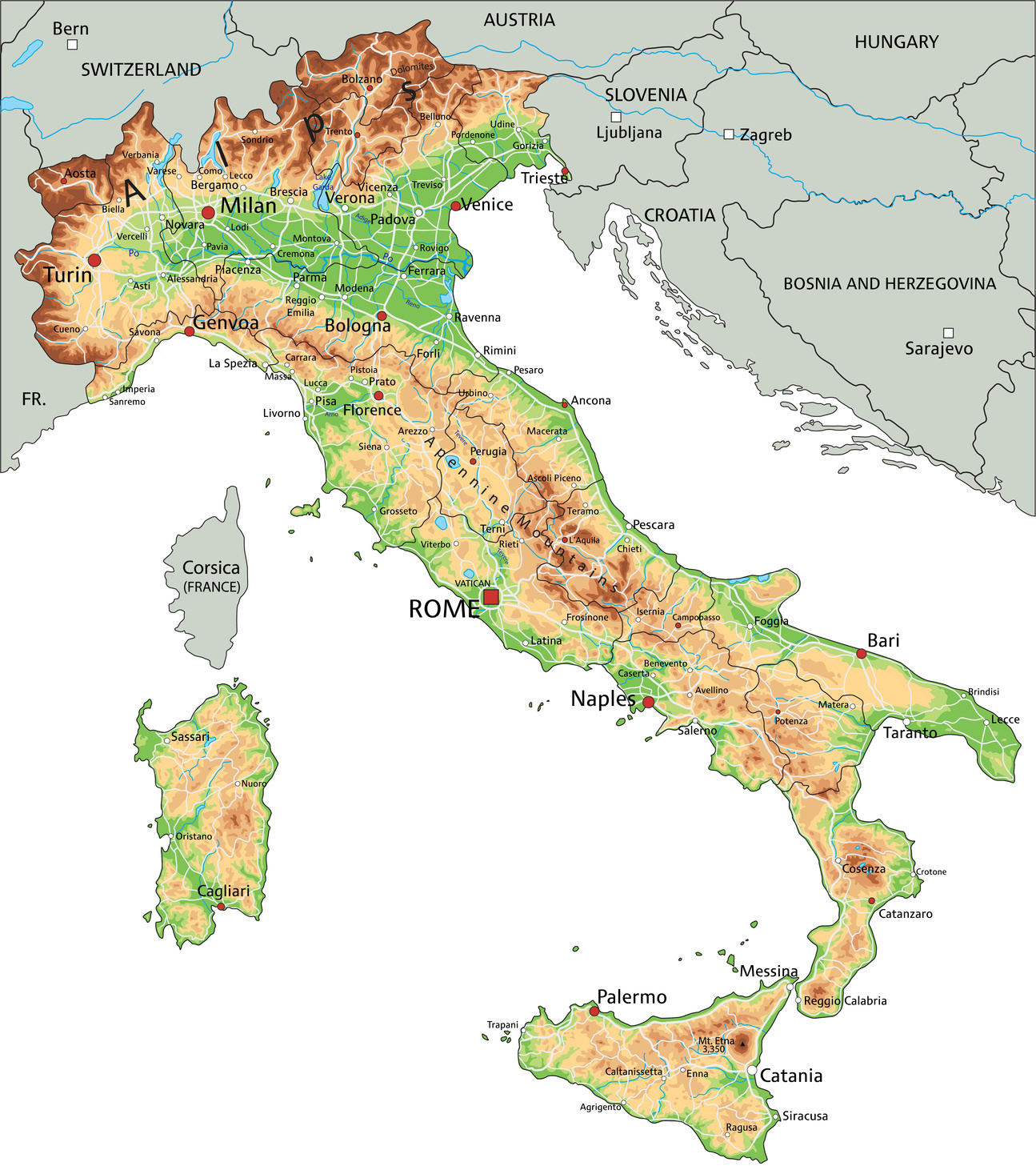
Map of Italy – © pbardocz – stock.adobe.com
Italy’s second island, Sardinia (which you can see on the map of Italy), is in the Tyrrhenian Sea off Rome. The other important island in the Tyrrhenian Sea is Elba. A group of smaller islands, the Pontine Islands, lies off Naples. The Lipari or Aeolian Islands are to the north-east of Sicily. As for the Aegadian Islands, they are to the north-west of Sicily.
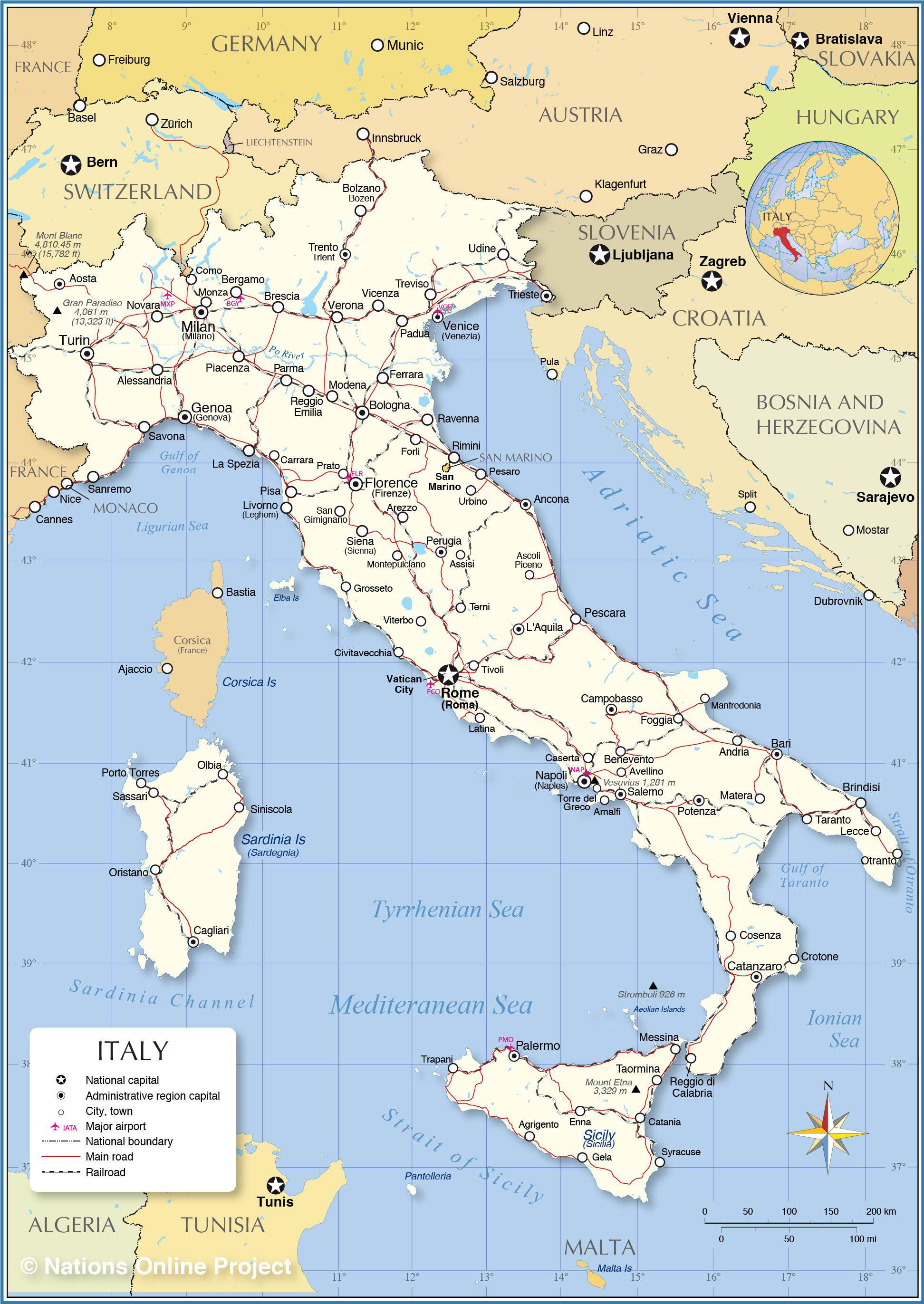
Italy map – Credit: Nations Online
Map of Italy: relief
Italy stretches from north-west to south-east over more than 1,080 km. The widest part is in the north: it measures 560 km from east to west. The rest of the peninsula is between 160 and 240 km wide. The country’s total area is 301,230 square kilometers. Italy is a mountainous region dominated by two main ranges as you can see on the map of Italy (relief): the Alps in the north and the Apennines along the peninsula. The Alps, Europe’s highest mountain chain, start on the north-west coast of Italy and curve to the borders of Austria and Slovenia to the east. The Ligurian Alps are located west of the port of Genoa.
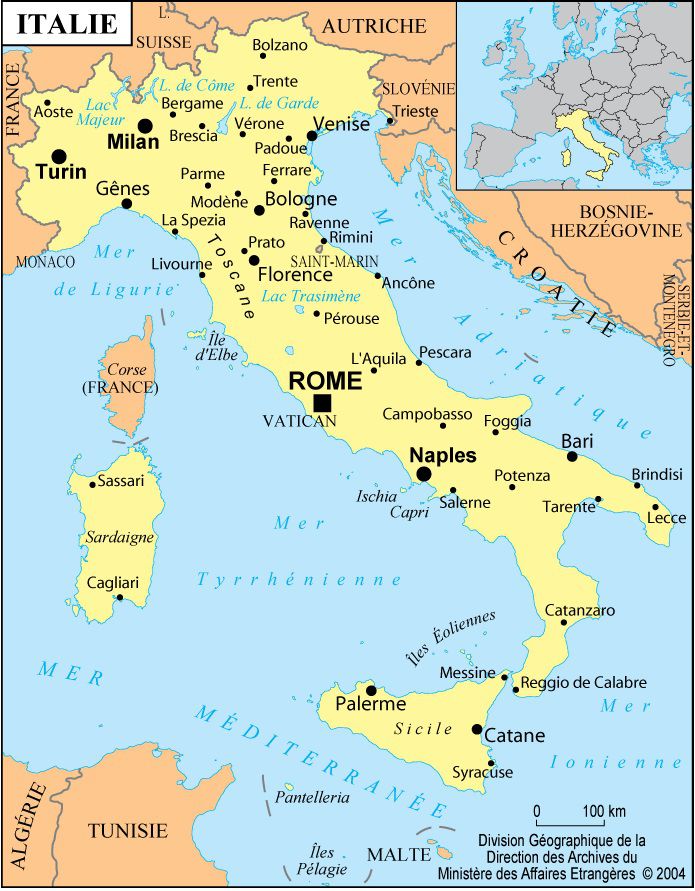
Another map of Italy – Credit: Ministry of Foreign Affairs
High peaks and steep-sided valleys sometimes give way to passes that allow Italy to be in direct contact with its northern neighbors. Roads and tunnels have been dug. The Alps attract tourists all year round.
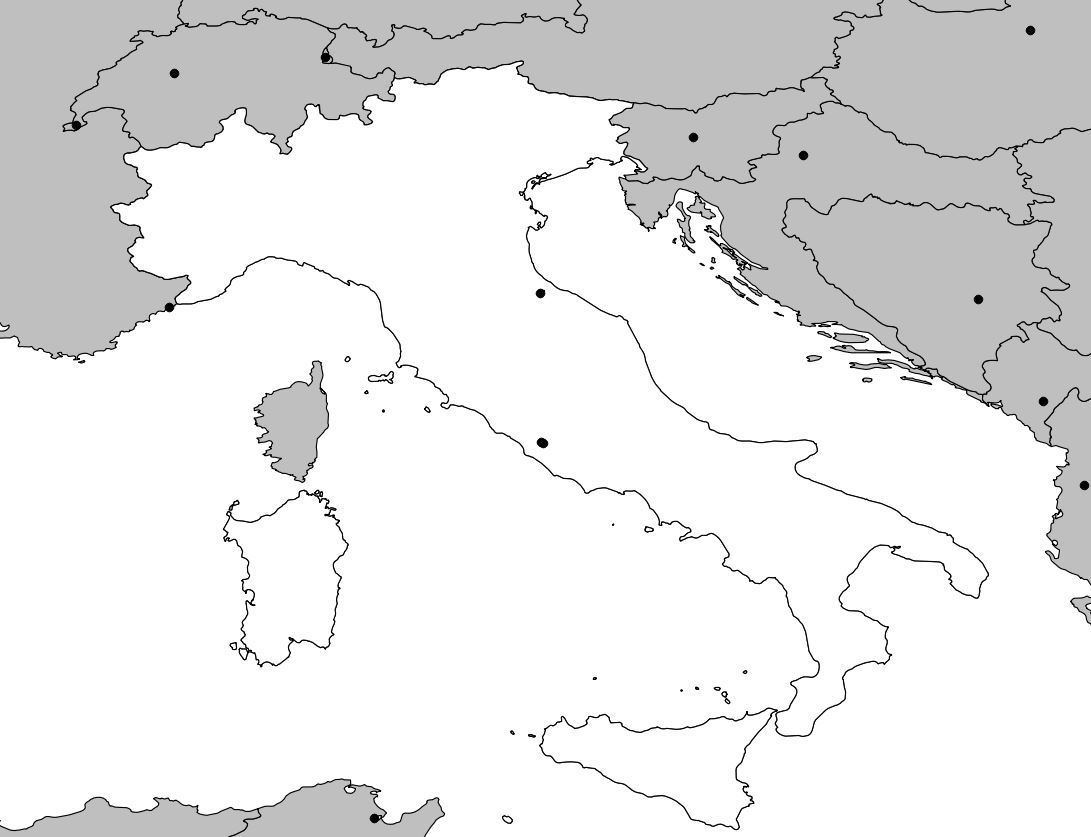
Blank map of Italy – Credit Actualitix
The Apennine chain is the continuation of the Ligurian Alps. It is the backbone of the peninsula. The Apennines extend from northern Italy to Sicily. In the northern part, they run along the east coast, then in the center of the peninsula they shift toward the western seaboard.
Italy is dotted with lower-altitude mountains that you can find on the map of Italy. Many of them are of volcanic origin. There are many extinct volcanoes. Two of Europe’s still-active volcanoes are in Italy: Mount Vesuvius near Naples and Mount Etna in Sicily.
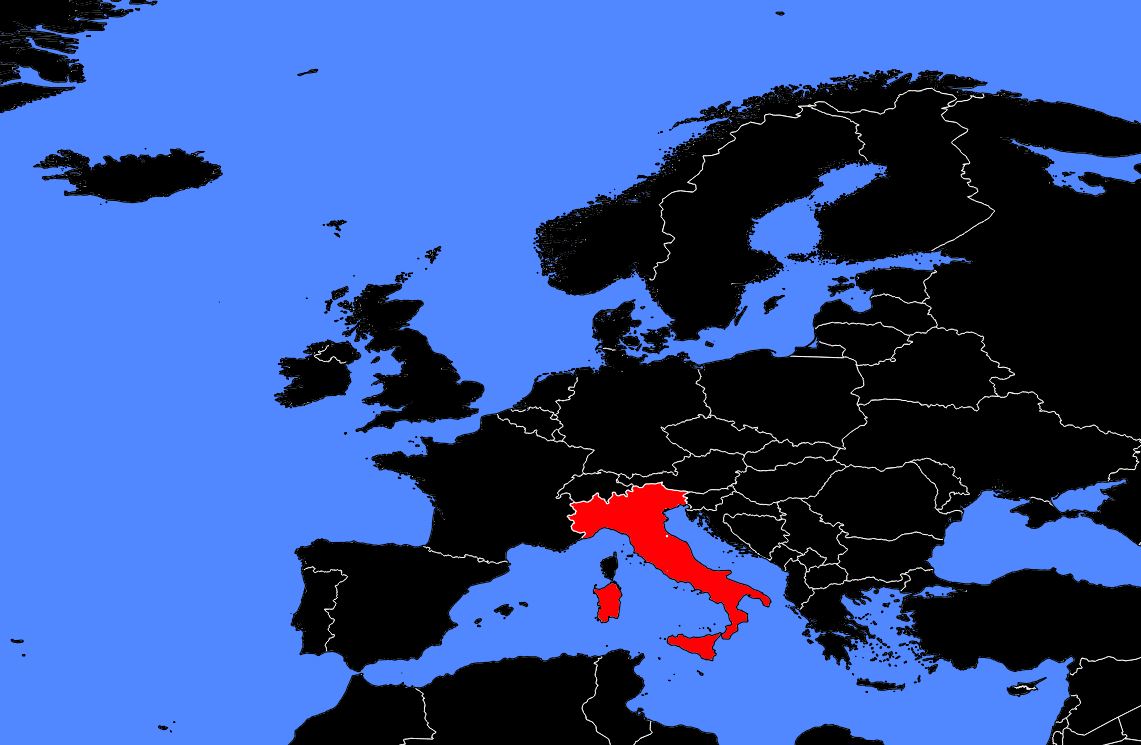
Italy on a map of Europe – Credit Actualitix
Major regions in Italy
Italians divide the country into four main regions that can easily be spotted on a map of Italy: the north, the center, the south and the islands. The Alps form the north-western borders while the Apennines form the country’s southern backbone. To the east, northern Italy opens onto the Adriatic Sea. To the west, the country is bordered by the Ligurian Sea.
The north is characterized by rich, fertile soils and a climate suitable for farming. This area is home to the majority of the population. It is also the country’s industrial and agricultural heartland.
Central Italy lies north of the capital. This area is mainly made up of low-lying land. It too plays an important role in industry and agriculture.
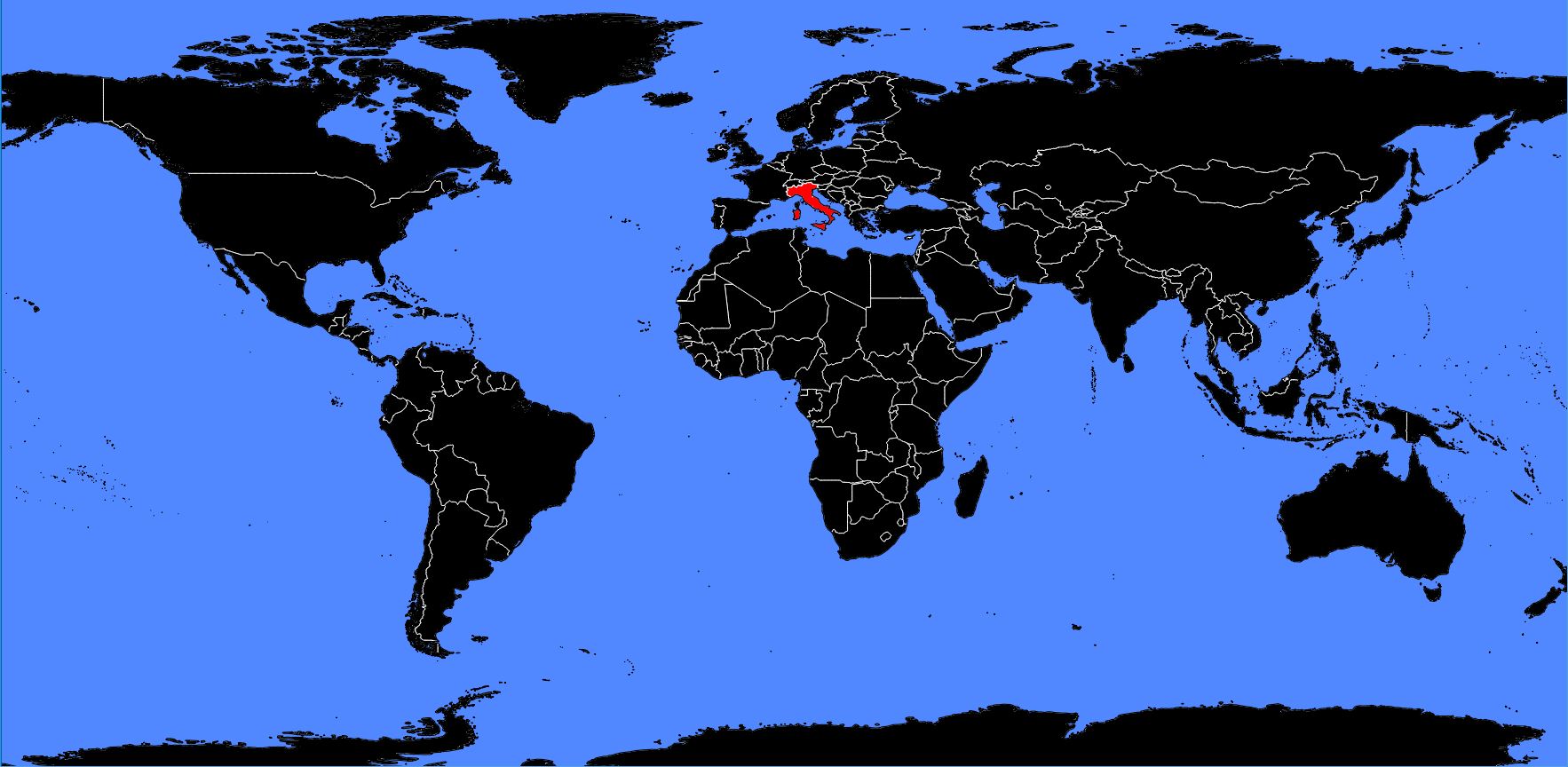
Italy on a map of the world – Credit Actualitix
Southern Italy includes the southern part of the peninsula. Most of the region is unsuitable for agriculture. The only cultivated areas are, on the one hand, Naples and its surroundings and, on the other hand, Apulia, the coastal section corresponding to the heel of the boot.
Italy’s fourth region is made up of Sicily, Sardinia and the smaller Mediterranean islands.
Climate in Italy
Italy’s climate is Mediterranean, meaning winters are cool and rainy and summers are hot and dry. Find below a map of Italy showing climate.
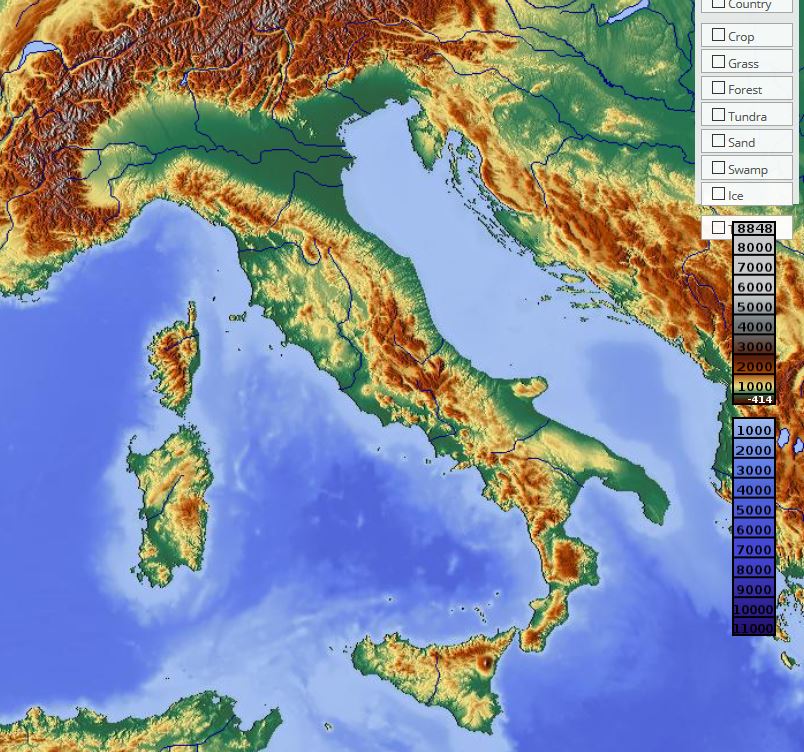
Map of Italy’s relief – Image extracted from maps-for-free
The climate in the north is very different from that in the south. Winters are cold. Snowfall is heavy in the Alpine region. It rains a lot and there is fog. Summers are not as hot as in the southern region, and summer thunderstorms favor agricultural yields.
Learn more about the population
The Italian people are one of the most homogeneous European nations, both linguistically and religiously.
Two minority groups live in northern Italy. The first, the Valdôtains, have two official languages: Italian and French. They live in the Aosta Valley in the north-west of the country. The second group speaks Romansh or Ladin, which resembles Italian. These people live in the north-east of Italy.
Nearly 95% of the population speaks Italian. Only a few dialects such as Sicilian and Sardinian may be incomprehensible to the average Italian speaker.
Television and radio helped unify the country by using Italian. Rome is not only the capital of Italy, but also the headquarters of the television and radio networks.
Cities on the map of Italy
Until 1900, Italy’s three main cities—Rome, Milan and Naples—had 500,000 inhabitants each. Most of the Italian population then lived in small towns or in the countryside. Farmers represented 50% of the population and industries were concentrated in the north-west of the country. See the map of Italy below showing the country’s main cities.
Since the beginning of the century, the urban population has increased markedly. Rome, the country’s leading city, had nearly 3 million inhabitants in 1990, Milan 1.5 million, and Naples around 1.2 million.
Since the end of the 19th century, Italians have emigrated a great deal. Up until the 1920s, the American continent was the preferred destination. After the Second World War, many Italians settled in Australia. Hundreds of thousands of Italians currently live in Switzerland, France and Germany.
Religion in Italy
The vast majority of the population is Catholic. Rome is the seat of the Roman Catholic Church. This is where the Pope resides. For centuries, the city has attracted many pilgrims who come to visit Vatican City. They come to pray at St. Peter’s Basilica, located near the Papal Palace. Pilgrims also visit, among other places, Assisi, the birthplace of St. Francis.
In 1870, the newly established Italian state took over the administration of Rome and its surroundings. These were the last remnants of the Pope’s domains. The Pope of the time, Pius IX, refused to recognize the Italian state, and for half a century his successors considered themselves prisoners in the Papal Palace. In 1929, the Italian government and the Church reached an agreement: the Lateran Treaties. The Pope became the head of state of an independent territory with an area of 44 ha.
This territory corresponds to Vatican City. The walled area contains museums, the Vatican Gardens, a library, a radio station and a railway station. A set of buildings houses the headquarters of the Roman Catholic Church.
Transportation in Italy
The Italian rail network is owned by the state. It is better equipped in the north of the country, but lines serve the east and west coasts all along the peninsula. The Simplon Tunnel, one of the longest in the world, connects Italy to Switzerland. Other lines cross the Alps to link the country to France, Austria and Slovenia. Below you can find the map of Italy showing roads.
The construction of the first highway in the north of the country dates back to the 1920s. Today, Germany and Italy each have one of the best highway networks in the world.
Motorists can drive hundreds of kilometers without stopping, except at borders. Two tunnels dug under the Alps, the Great St Bernard and the Mont Blanc, connect Italy to the rest of Europe. Highways (see the map of Italy showing highways), called autostrade, are sometimes tolled. They link the country’s main cities and have contributed to the growth of tourism.
Tourism in Italy
For centuries, Italy has attracted thousands of people from all walks of life. Some tourists come to visit Rome and its holy places. Others are art lovers. Visitors also come to enjoy the beauty of the landscapes. The revenue generated by tourism is important to the country’s economy.
It helps finance imports. In addition, sectors linked to tourism (restaurants, hotels, shops and transportation) create new jobs. Most tourists come from Germany, Switzerland, Austria, France, Great Britain and the United States.