
Discover a map of Afghanistan. The country is a mountainous state in southwestern Asia, bordered by Turkmenistan, Uzbekistan, Tajikistan, Iran, and Pakistan. The Wakhan Corridor, in the northeast of the country, connects it to China. Pakistan cuts off southern Afghanistan from access to the Arabian Sea.
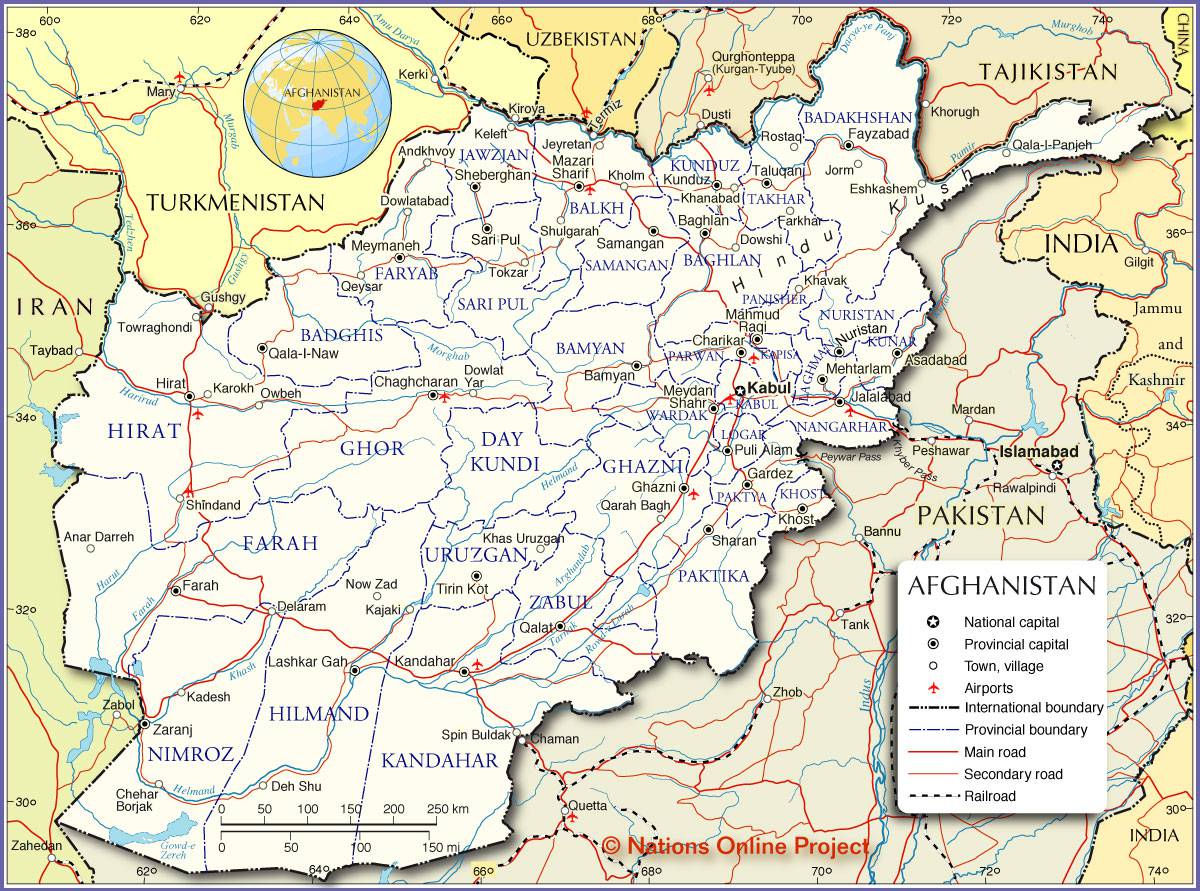
Map of Afghanistan – Credit Nations Online
Afghanistan has always been regarded as a crossroads between East and West. Isolated and landlocked, it long held on to a traditional way of life, but since the second half of the 20th century it has begun to westernize.
Its area is 647,500 square kilometers and its population was estimated in early 2015 at 32 million inhabitants. Kabul, the capital, is also the country’s largest city, with more than 3.5 million inhabitants.
Geography and climate on the map of Afghanistan
Mountains cover three quarters of Afghanistan. The major Hindu Kush range begins in the Pamir massif in the northeast and stretches westward across the country. In the Wakhan Corridor, Nowshak Peak rises to 7,485 meters above sea level. River valleys and vast plains extend from the mountainous central regions to the deserts of the west. The map of Afghanistan below gives a clear idea of the country’s relief.
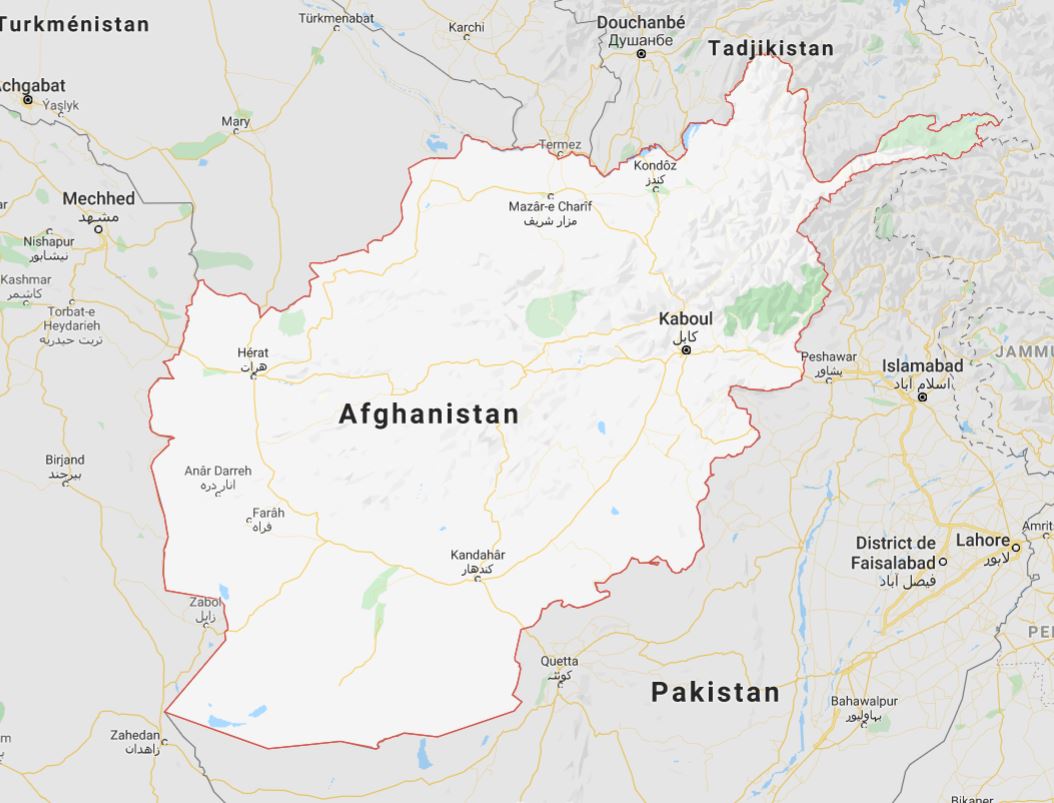
Afghanistan map – Credit Google Maps
Rivers are fed by melting snow and mountain glaciers. The Amu Darya, which flows along the country’s northern border, is the most important river, but the Helmand, in the southwest, is the longest. The Kabul River irrigates fertile valleys and basins around Kabul and Jalalabad.
Low precipitation falls in winter and spring. In winter, temperatures are very low (well below 0°C) at high altitude and milder in the plains. In summer, temperatures are very hot in desert regions swept by westerly winds carrying huge clouds of dust and sand. These regions receive very little rainfall (less than 10 cm per year). At higher elevations, about 100 cm of precipitation falls per year, mainly as snow (see the relief on the map of Afghanistan).
Fauna and flora
Afghanistan’s flora is very diverse. In the south, deserts are covered with steppe. In the north, vegetation becomes richer and almost lush. Conifers, wild walnut trees, oaks, alders, hazel trees, and wild peach trees grow in the country. Pistachio trees north of the Hindu Kush produce fruit for export.
Blank map of Afghanistan
Afghanistan is home to more than a hundred species of mammals, some of which are endangered, such as the leopard, snow leopard, gazelle, markhor goat, and Bactrian deer. Wolves, foxes, hyenas, and jackals also live in this subtropical temperate zone.
Wild boars, hares, jerboas, hedgehogs, shrews, bats, and other rodents are also found. Ibex, wild goats, and sheep are raised on mountain pastures. More than 380 bird species have been recorded in the country. Unfortunately, since there is no hunting legislation, some species, such as the Siberian crane, are becoming rarer. Snakes, lizards, salamanders, and frogs abound. There is also a wide variety of freshwater fish in the country’s streams, rivers, and lakes.
Desertification, caused by certain human factors, is very advanced in Afghanistan.
On the one hand, many poor Afghans clear brush and cut down trees indiscriminately to use as fuel. On the other hand, intensive irrigation practices that are poorly adapted have loaded soils with salt. Archaeological research has shown that these arid, sandy, rocky lands were once rich and fertile.
Population on the map of Afghanistan
The Afghan population is made up of Pashtuns, Tajiks, Uzbeks, Hazaras, Turkmen, and Aimaqs. The Pashtuns, who make up about 50% of Afghans, claim a link to the Hebrews. The Uzbeks and Turkmen are descended from the Turks and cultivate the plains north of the Hindu Kush. The Tajiks, who live near the Iranian border, are descended from the Persians. The Hazaras, a Mongol people who remained after Genghis Khan’s invasion, live in the mountainous central regions (see the map of Afghanistan).
Islam, the official religion, shapes Afghan life. Religious codes dictate behavior and settle disputes. The population is 99% Muslim, including 84% Sunni. Most Hazaras are Shiite, and a few Hindus, Sikhs, Jews, and Zoroastrians also live in the country.
The official languages of Afghanistan are Pashto and Dari, spoken by about 80% of the population.
Pashto is the mother tongue of the Pashtuns, while Dari is a dialect derived from Persian. Turkmen and Uzbek are spoken in the north of the country. In the mountainous valleys of the east, the Kafir or Nuristani tribes speak various dialects.
Few Afghans (19%) live in urban areas, as you can see on the map of Afghanistan for cities. The population is mainly made up of farmers or nomads. Farmers live in villages and cultivate land irrigated by rivers. In summer, semi-nomadic farmers graze their herds in alpine pastures and return to their villages in autumn. Nomads, mainly Pashtuns, move constantly with their families, possessions, and animals.
Transport and communication
Afghanistan lacked railways in the early 1980s but had 17,700 km of roads and highways. The most important roads connect Kabul to Shir Khan in the north and to Peshawar in Pakistan to the east. A road network also links Kabul with Kandahar (the country’s second largest city), Herat, and Mazar-e Sharif.
Means of transport range from the most rudimentary to the most modern. Transport by donkey or camel is still widely practiced. Airports have nevertheless been built in Kabul, Kandahar, Shindand, and Bagram, near Kabul.