
Discover a map of Saudi Arabia. The Kingdom of Saudi Arabia occupies four-fifths of the Arabian Peninsula. The government estimates the kingdom’s area at about 2,149,690 square kilometers. Saudi Arabia is separated from Egypt, Sudan and Ethiopia by the Red Sea to the west; from Iran by the Persian Gulf to the east; and from Bahrain by the Gulf of Bahrain, also to the east.
The country shares land borders with seven other Arab countries: Jordan, Iraq and Kuwait to the north; the Republic of Yemen and Oman to the south; and the United Arab Emirates and Qatar to the east.
Table of contents
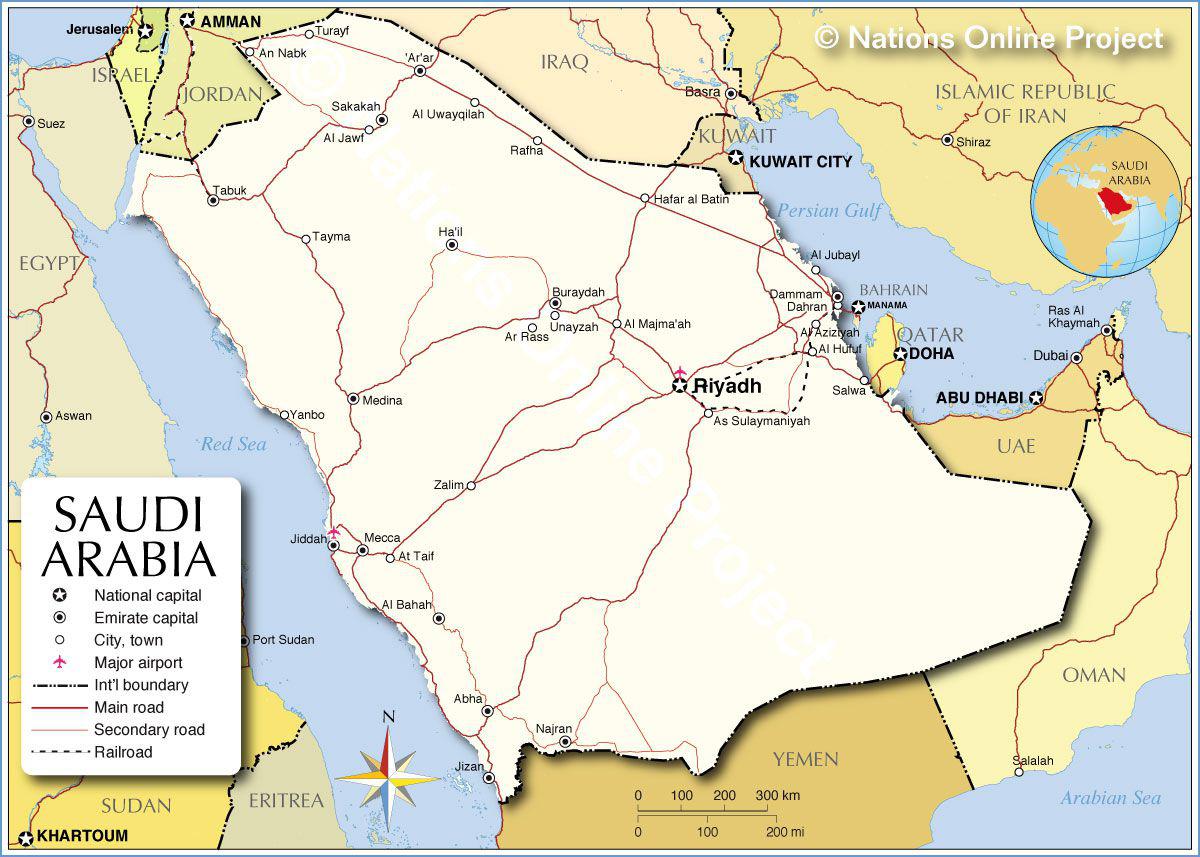
Map of Saudi Arabia – Credit: Nation Online
Terrain and climate
The Arabian Peninsula is an ancient sloping plateau. The highest parts lie along the western and southern edges, while the lowest are in the east. In the past, the peninsula was attached to Africa, but it slowly drifted away as it rotated counterclockwise. You can see the map of Saudi Arabia on the relief map below.
Along the Red Sea, you find a narrow coastal plain. It is bordered to the east by steep mountain walls. These reach 1,800 m in altitude in the Hejaz region in the northwest and 3,000 m in the Asir region in the southwest. There are many oases in the Jabal region. Riyadh, the country’s capital, is located in one of these oases. Other important oases include Buraydah, Unayzah and Al Kharj.
North of Najd lies the An Nafud Desert, an extension of the Syrian Desert. This region, covered with grass and steppe vegetation, is roamed by nomadic or semi-nomadic herding populations. South of Najd, stretching in a broad semicircle, the Ad Dahna Desert then connects to the vast sandy expanse of the Rub’ al Khali, the “Empty Quarter”, one of the most impenetrable deserts in the world. Most of the totally arid Rub’ al Khali is uninhabited, even by nomads.
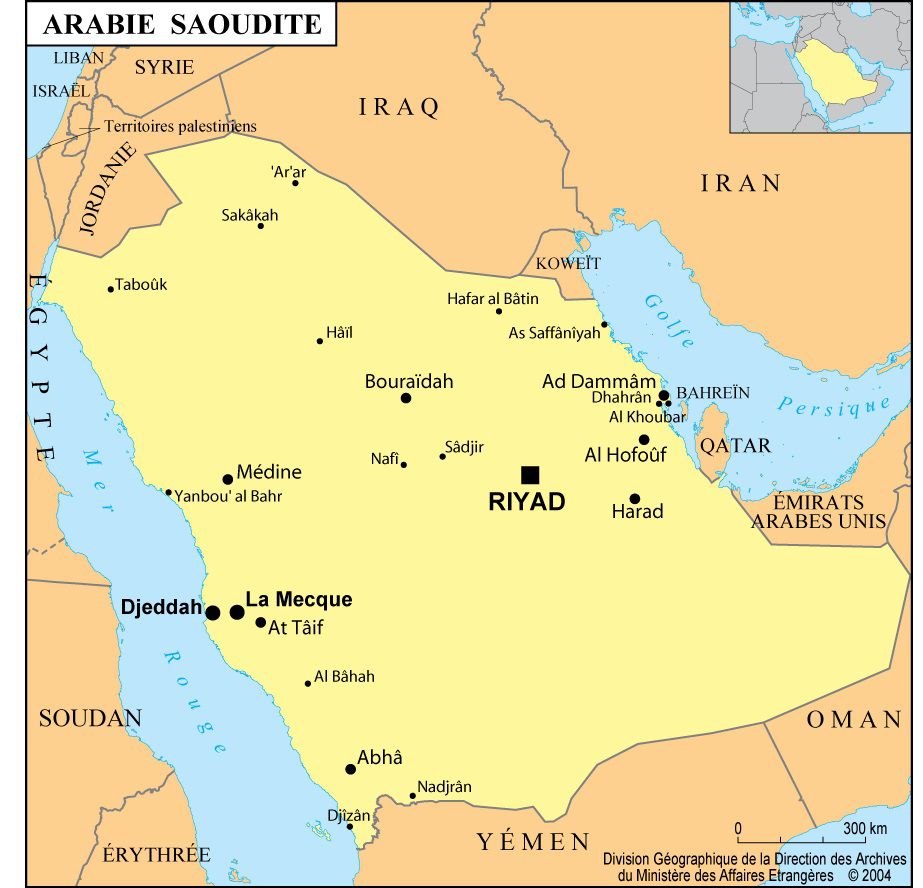
Saudi Arabia map – Credit: Ministry of Foreign Affairs
Eastern Saudi Arabia consists of a long, wide coastal plain covered with sand and gravel. This is where the country’s largest and most fertile oasis is located, around Al Hufuf. The Persian Gulf, unlike the Red Sea, is shallow and contains many reefs and sandbanks.
Almost all of Saudi Arabia has a desert climate. Rainfall is nearly nonexistent, and daytime temperatures are extremely high for many months of the year. See the map of Saudi Arabia.
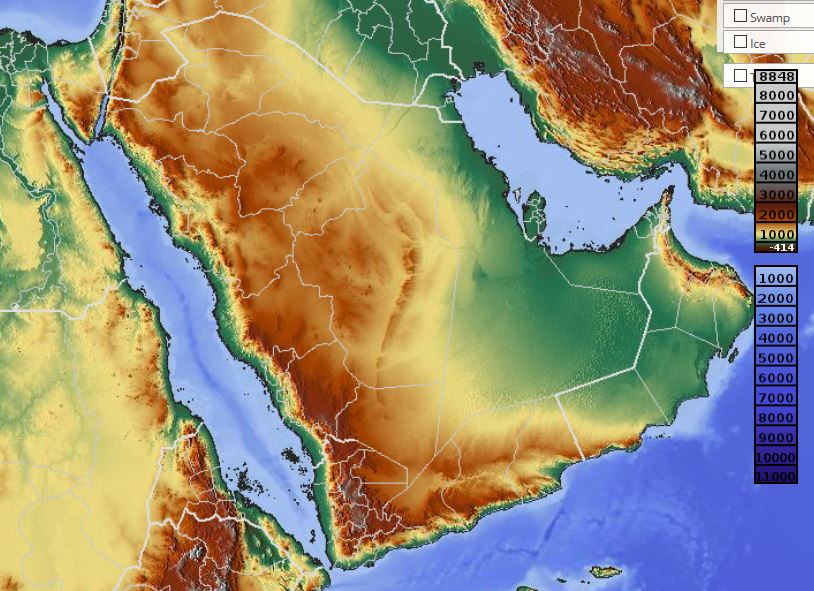
Relief map of Saudi Arabia – Image extracted from maps-for-free
The north receives less than 25 centimeters of rain each year. In the south, it rains even less. Only the Asir mountain region, located in the southwest of the peninsula, receives a significant amount of rain thanks to Indian Ocean monsoons. Temperature ranges are wide, especially inland. Maximum temperatures often reach 54°C. In winter, temperatures are mild during the day (20°C) but often fall below freezing at night. Coastal regions are famous for their oppressive humidity and heat.
Because of its extreme aridity, Saudi Arabia has no permanent rivers or lakes and therefore depends entirely on surface water. Fortunately, artesian wells and springs are numerous in the eastern part of the Al Hasa region.
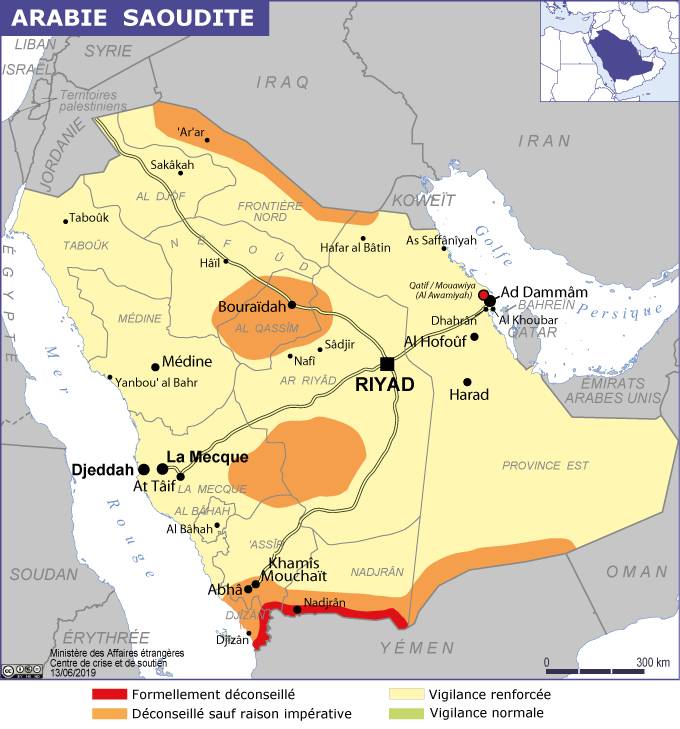
Map of cities in Saudi Arabia – Credit: Ministry of Foreign Affairs
People and cities on the map of Saudi Arabia
Saudi Arabia’s exact population is not known, but it was estimated at around 31,000,000 inhabitants in 2015.
In the early 1970s, one quarter of the population lived in urban areas. By the early 1990s, this was true of more than 75%. Riyadh, the capital, was only a small village when the kingdom was created in 1932. Today it is home to around 1.3 million inhabitants.

Blank map of Saudi Arabia – Credit Actualitix
Tribes play a crucial role in the life of the kingdom. Belonging to a tribe is a guiding principle that allows individuals to identify culturally and socially. You can see the layout of the country’s cities on the map of Saudi Arabia.
Most of the population is sedentary, and probably always has been. Nomadism is in decline, although many Saudis still raise camels, goats and sheep. Often, part of the tribe tends the livestock while the other cultivates.
Culturally, Saudi Arabia’s indigenous population is relatively homogeneous. Almost all Saudis born in the country are Muslims and speak Arabic. Islam has an important status. Saudi Arabia is the birthplace of the Prophet Muhammad and the guardian of the two holiest places in Islam, Mecca and Medina. Every year, millions of Muslims from all over the world make a pilgrimage to Mecca.
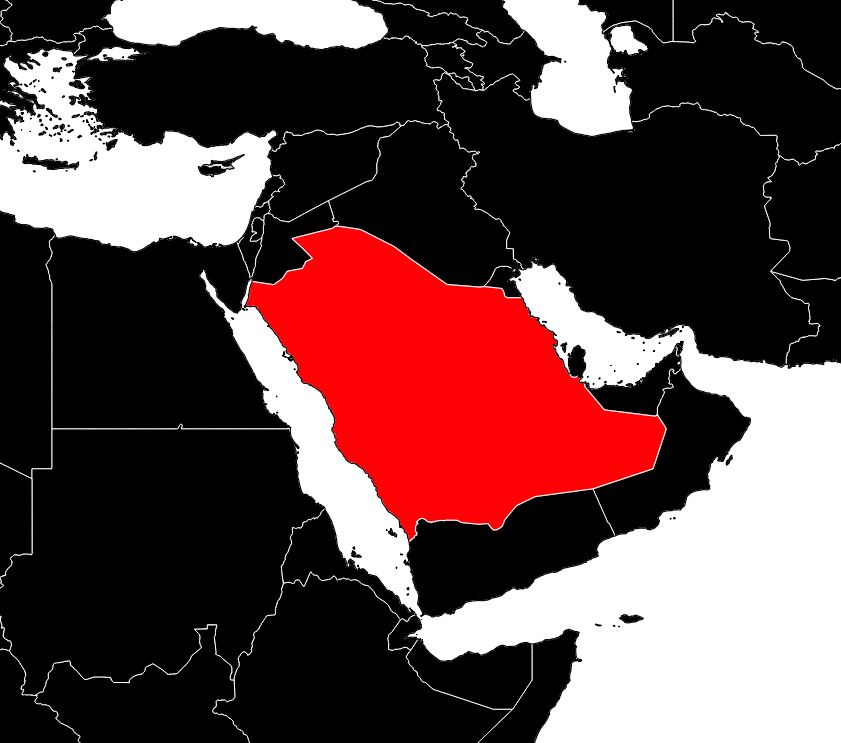
Saudi Arabia on a map of the Middle East – Credit Actualitix
Most Saudis follow the precepts of Muhammad ibn ‘Abd al-Wahhab, an 18th-century Muslim reformer who advocated a strict and puritanical Islam. For this reason, Saudi Arabia is one of the most conservative Islamic states. However, not all Saudis belong to this movement. A large majority of the population is Sunni, but the number of Shi’ite Muslims is estimated at more than 500,000.
Most of them live in eastern Saudi Arabia near the oases of Al Hasa and Al Qatif (see on the map of Saudi Arabia). About one third of Saudis living in the Eastern Province are Shi’ite. Relations between Sunnis and Shi’ites have often been tense. Historically, Shi’ites were excluded from important positions through outright discrimination. The Saudi government is concerned about Shi’ite discontent, especially since the Iranian revolution of 1979, as Iran is a Shi’ite country.
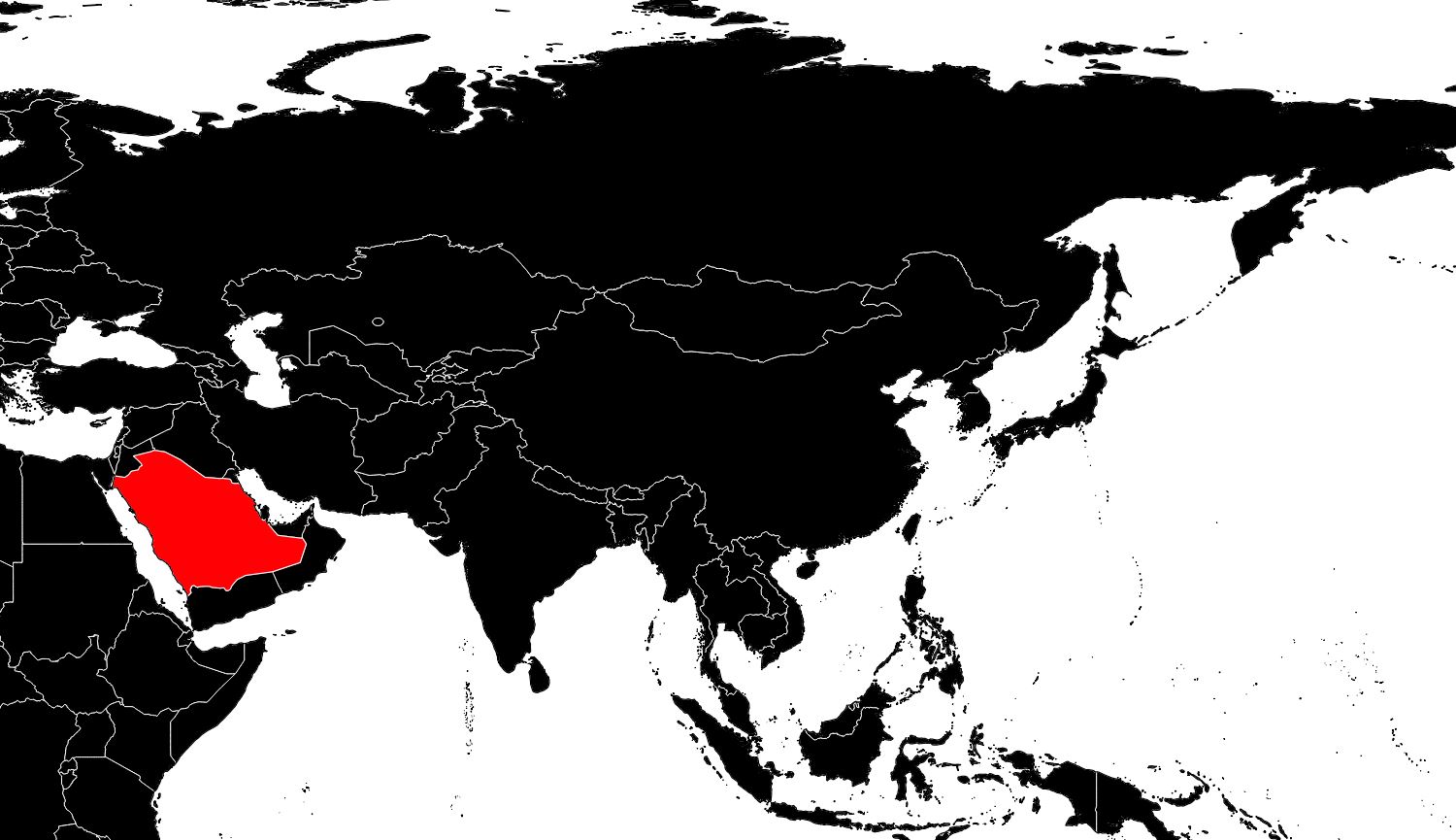
Saudi Arabia on a map of Asia – Credit Actualitix
Saudi Arabia includes a foreign population. There are no precise statistics. Nevertheless, it is estimated that the number of foreigners living in the country exceeds 5 million. Many foreign Muslims settled in the region after their pilgrimage to Mecca. This city therefore has large Indian and Indonesian communities.
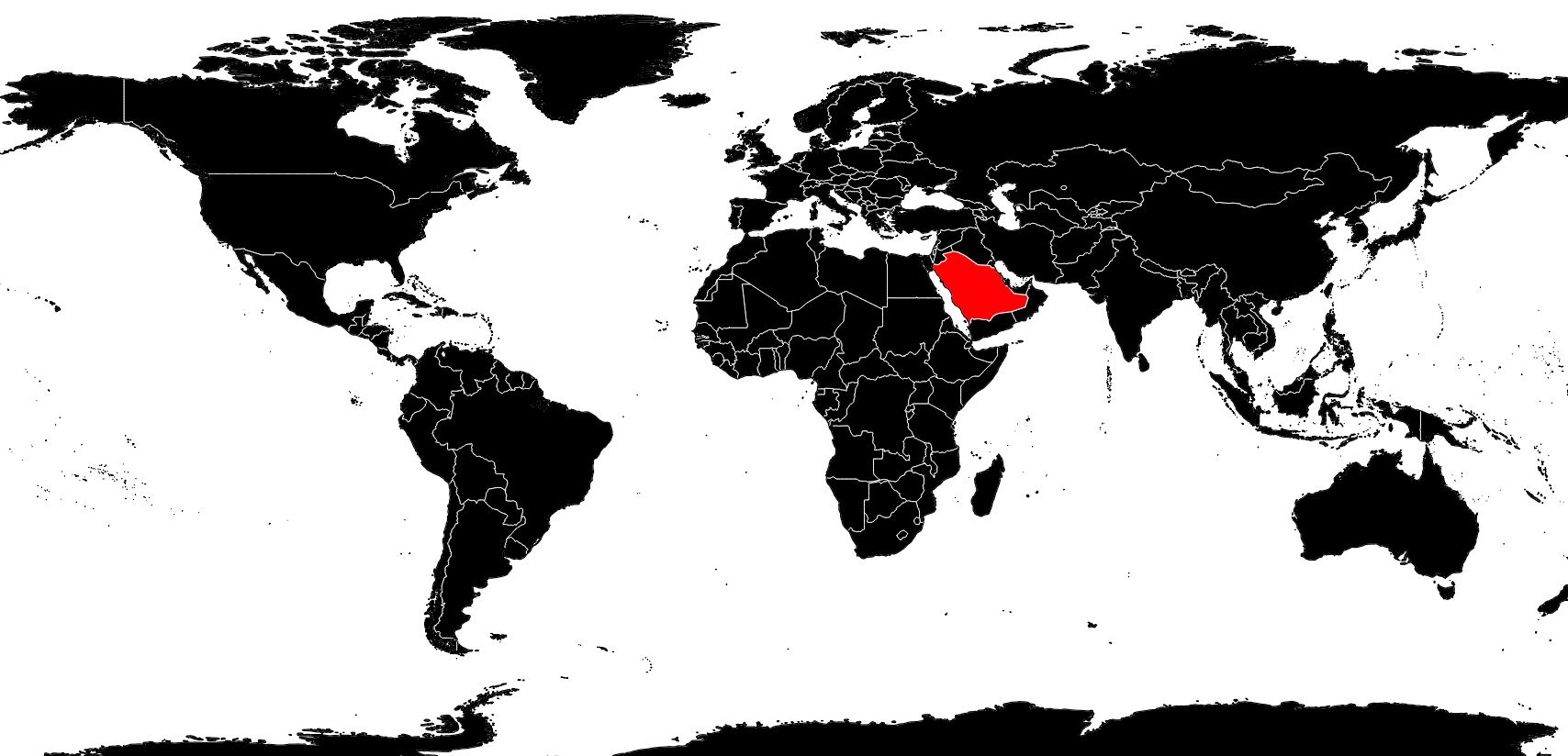
Saudi Arabia on a world map – Credit Actualitix
Transport in Saudi Arabia
Until the mid-1960s, the only paved roads were in the Jeddah–Mecca–Medina region. Since then, the government has focused its efforts on building a highway network, and the kingdom now has around 64,000 km (40,000 miles) of roads. There are five main ports: Jeddah, Yanbu and Jizan on the Red Sea; Dammam and Jubail on the Persian Gulf.
Air transport grew rapidly because of the country’s vast area. There are 24 airports, including the international terminals of Jeddah, Dhahran and Riyadh. Rail transport is virtually nonexistent. The main line connects Dammam, on the Gulf, to Riyadh. A causeway links the island of Bahrain to Saudi Arabia.