
In this article you will find a map of Pakistan. Modern Pakistan was created from the British Indian Empire following the partition of 1947 and the war against India in 1971. East Pakistan subsequently became Bangladesh.
Pakistan is one of the most important Islamic nations in the world. It is essentially the last remaining legacy of the Mughal Empire of Islamic rulers, which the British took control of during the 18th and 19th centuries.
Table of contents
Geography with the map of Pakistan
As can be seen on the map of Pakistan, the country is divided into three main natural regions: the northern highlands, the Indus River plain, and the Balochistan plateau. The Karakoram range and the Pakistani Himalayas are among the most significant mountain masses in the world.
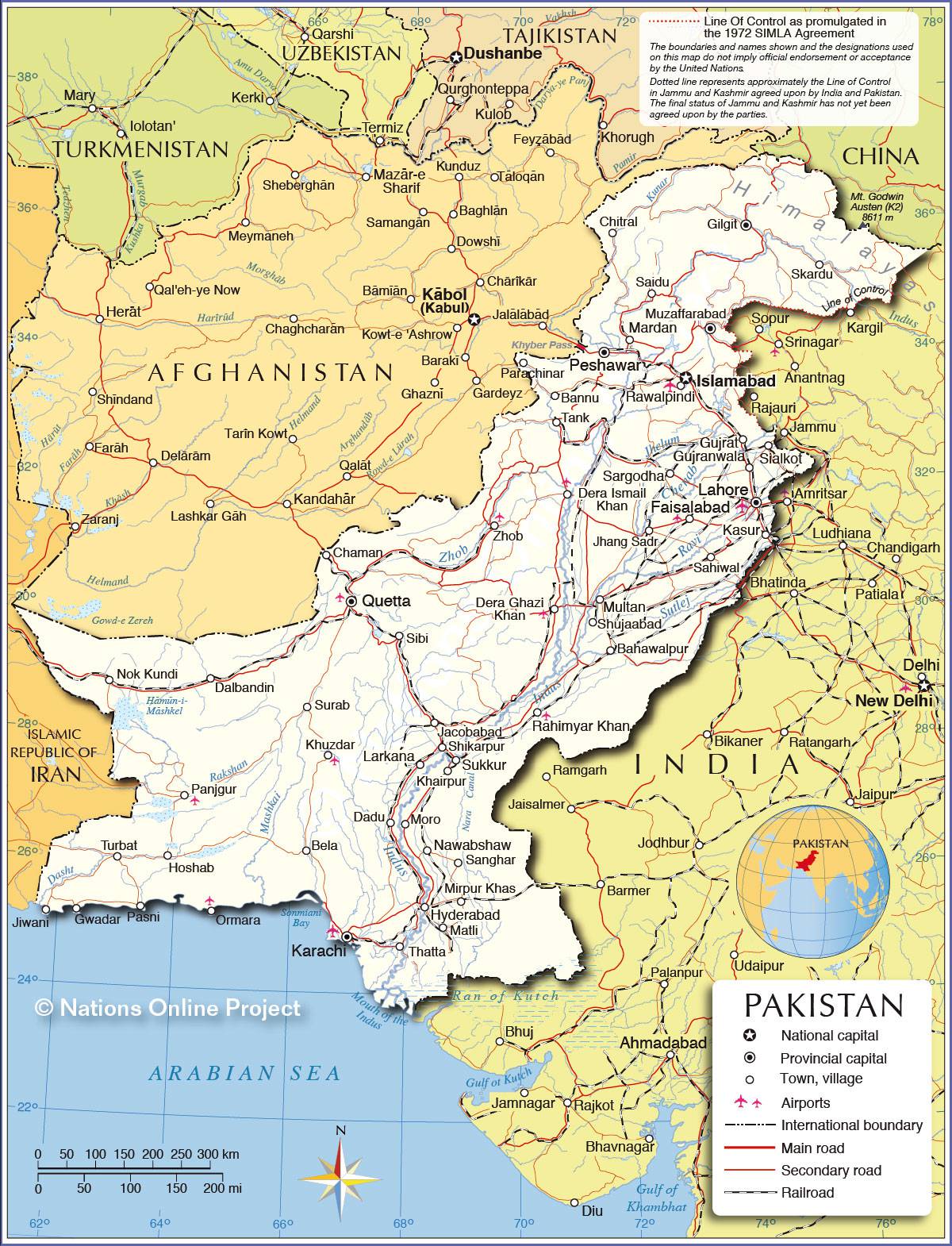
Pakistan map – Credit Nation Online
Climate
Pakistan lies in a warm temperate zone that is generally arid, with very hot summers and cool to cold winters. In winter, winds blow from the northeast and from the southwest in summer, bringing the monsoon. The cold season, from December to February, is often characterized by very cool temperatures. The hot and dry season, from March to May-June, includes daily temperatures reaching 41° to 46°C. Heat waves with temperatures of 50°C or more are not uncommon.
Annual rainfall is less than 13 cm per year in northwestern Balochistan near Iran and Afghanistan, and in most of the Sind region near India. Rainfall can reach 102 cm per year at the foothills of the Himalayas (see their location on the map of Pakistan).
Natural flora
Pakistan’s flora consists of forests, shrublands, and grasslands. You can explore the map of Pakistan, especially the geographical one.
Fauna
Human population growth has led to a decline in wildlife. Among the rarest animals are the snow leopard, the common leopard, Marco Polo sheep, the onager, the Balochistan bear, and the blind Indus dolphin. More than 600 species of birds can also be found.
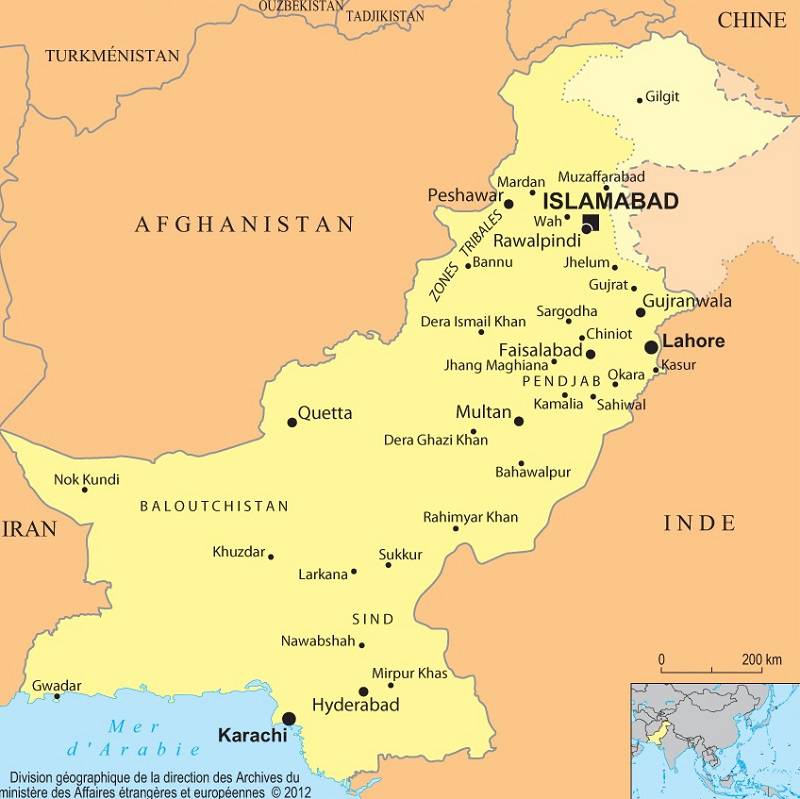
Map of cities of Pakistan
Population and culture
At the beginning of 2016, Pakistan had nearly 193 million inhabitants. Four-fifths of the population live in the valleys of Punjab and Sind. You can notice the location of major cities on the map of Pakistan.
Pakistan is divided into four provinces (Punjab, Sind, Balochistan, and the northwestern territories), made up of different linguistic groups, and also includes the small Pakistani regions of Jammu and Kashmir, Gilgit, and Baltistan in the northern mountains. Balochistan is the largest province, but Punjab is the most populated. Along the Afghan border are several regions: Bajaur, Mohmand, Khyber, Orakzai, Kurram, and North and South Waziristan.
The main ethnic groups are the Balochi-Brahui, Pashtun, Punjabi, and Sindhi. Each group is divided into sub-tribes. There are also many mountain tribes, as well as Muhajirs (who migrated following the 1947 partition) and Bihari refugees from Bangladesh. The coexistence of these various ethnic groups has often resulted in episodes of violence.
Learn more
The Pakistani people are mainly composed of a mix of Indo-Iranian ancestry. They are often taller and have lighter skin than their Indian neighbors. Although Islam, the official religion, is egalitarian, a caste and class system still exists.

Blank map of Pakistan
Most rural inhabitants live in brick houses, although the use of concrete and baked bricks is becoming increasingly common. The traditional clothing for both men and women is the Shalwar Kameez, consisting of very loose cotton trousers and a long shirt worn over them. Women generally wear a long scarf (dupatta) wrapped around the head and shoulders.
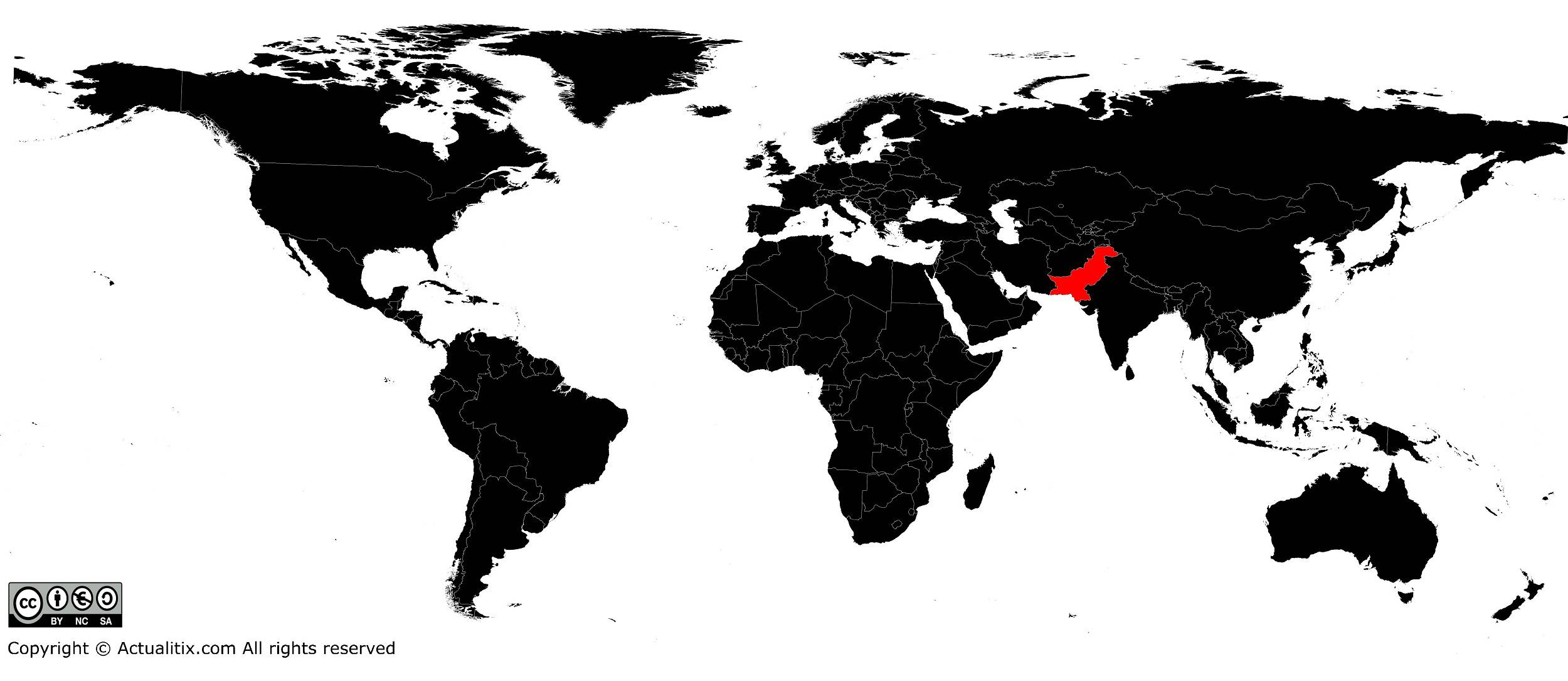
Pakistan on a world map
In more traditional cities, a mesh square shaped like a tent (burqa or chadri) is fixed at eye level to cover the entire body. Women tend to be secluded according to customs, although some choose to wear the Indian sari, which covers slightly less of the body. In cities and among educated people, many Western customs have been adopted. Nevertheless, young people are raised to respect their parents and ancestors. Marriages are often arranged in advance.
You can discover all the available maps for the different countries of the world on this page.