
A buffer state between the Latin and Germanic civilizations, as shown on the map of Belgium, the country stretches from the North Sea to the south of the delta formed by the Rhine, the Meuse and the Scheldt. Belgium and the Netherlands occupy a strategic position on Europe’s trade routes, which helped Belgium become a commercial and industrial crossroads.
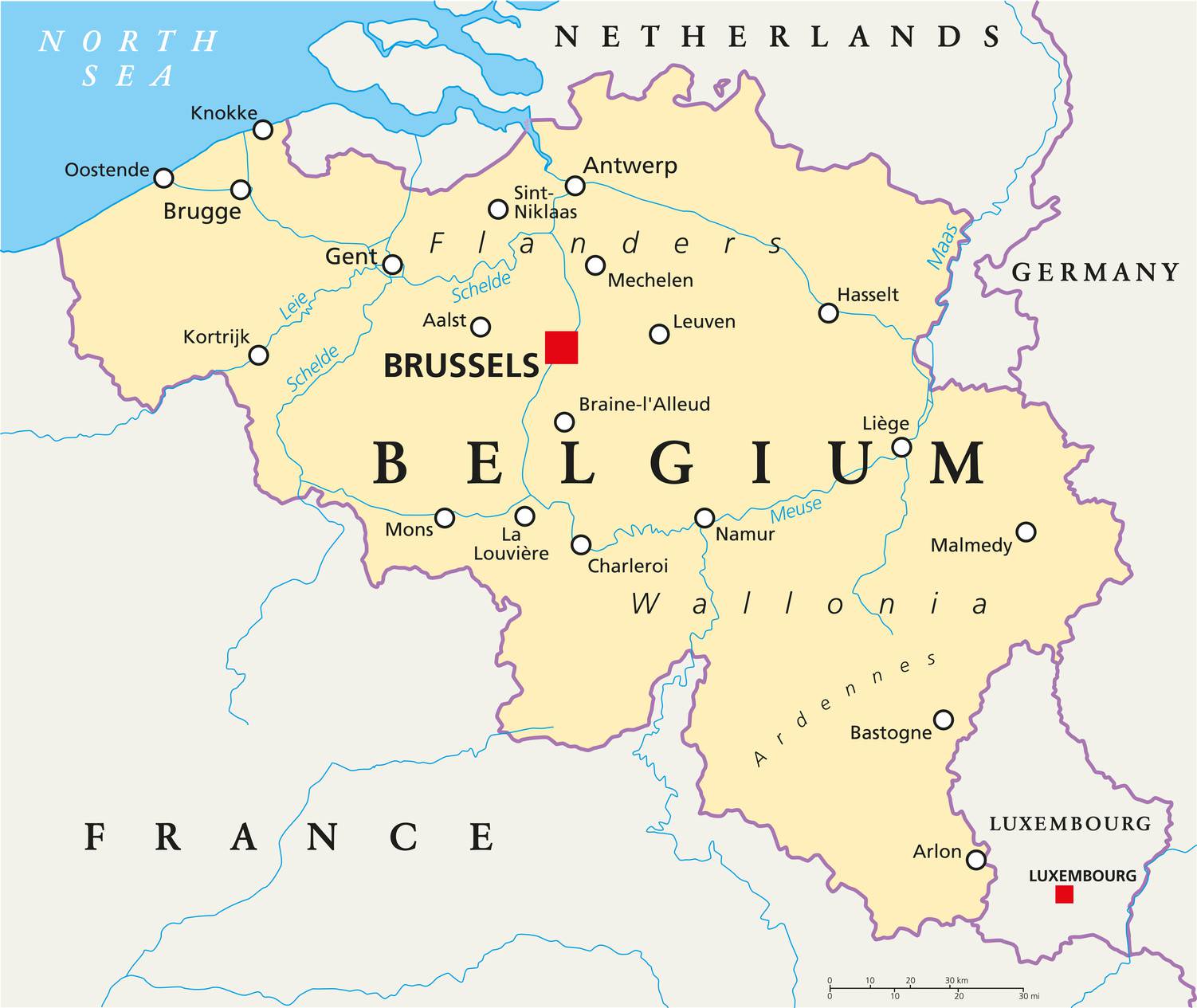
Map of Belgium – © Peter Hermes Furian – stock.adobe.com
With an area of 30,510 square kilometers, it is bordered by the North Sea to the northwest, the Netherlands to the north and northeast, Germany to the east, Luxembourg to the southeast, and France to the south and southwest. The country’s length, from the North Sea to the German-Luxembourg border, is about 290 km. Its width ranges from 56 kilometers in the west to 225 kilometers in the east.
Table of contents
Geography with the map of Belgium
As can be seen on the map of Belgium, the country is divided by the valley of the Meuse and the Sambre into two regions. In the northwest, the coastal plain is an extension of the North Sea continental shelf. Polders and drained marshlands border the dunes that line the coastline.
Flanders, in the west of the country as shown on the map of Belgium, is a sandy plain with little forest cover. A layer of clay rich in alluvium covers the river valleys. The rolling plateau in the northwest of Belgium is covered with humus. In the southeast lie the Ardennes, a forested plateau rising from 370 to 460 meters. Belgian Lorraine is located in the extreme southeast of the country.
Belgium enjoys a temperate climate characterized by a system of high and low pressure brought from the Atlantic Ocean by prevailing westerly winds. In the inland plains, temperatures range from -1°C to 6°C in winter and from 12°C to 23°C in summer. Along the coast, average summer temperatures are slightly lower. Summers and winters are cooler in the forests of the Ardennes plateau.
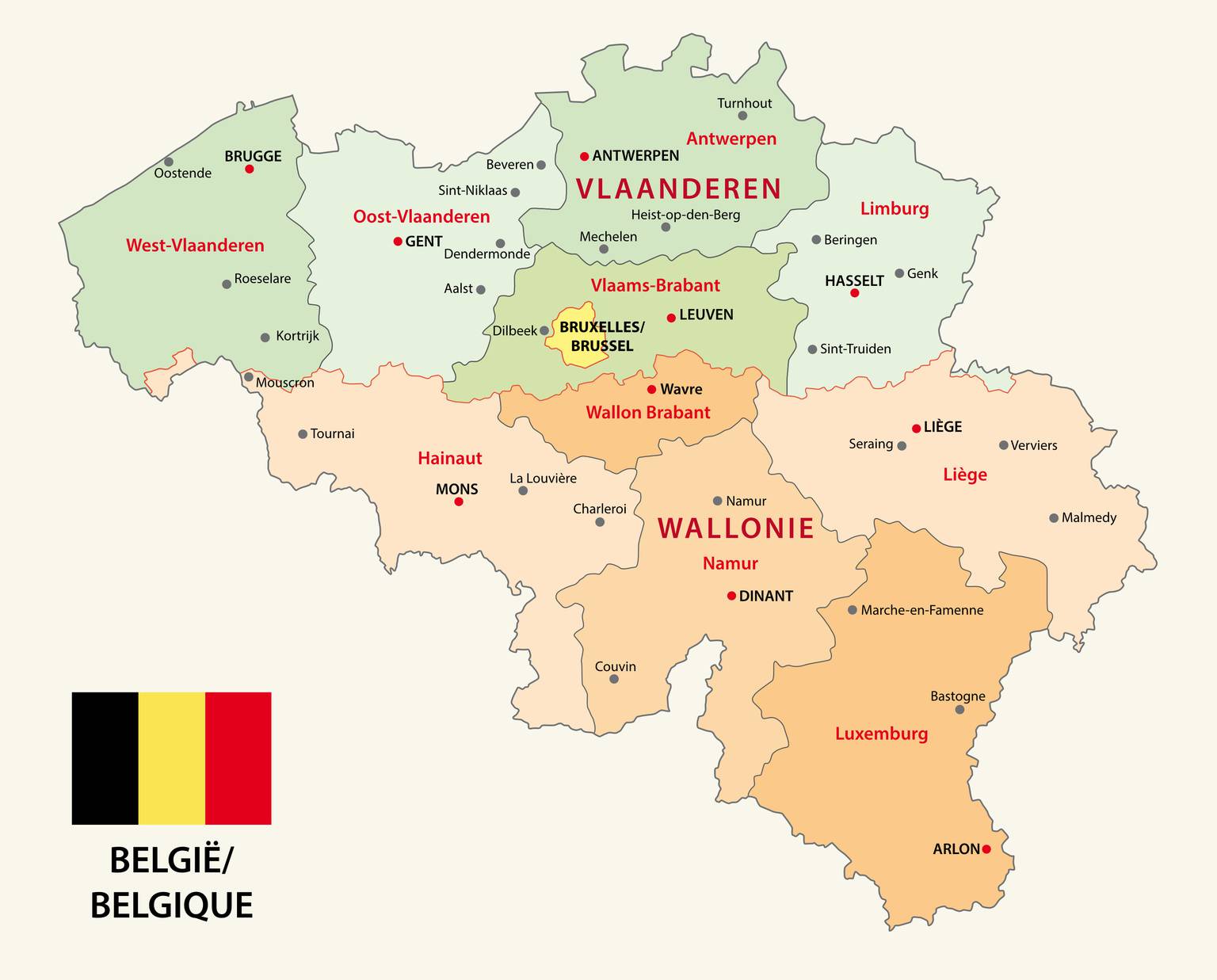
Map of the regions of Belgium – © lesniewski – stock.adobe.com
In winter, dry and icy air from Eurasia and warm, humid air from the North Sea sometimes reach Belgium. The clash of these two air masses produces cyclonic storms accompanied by rain and snow.
Precipitation is regular throughout the year; spring is generally the driest season. Average rainfall ranges between 76 cm in the coastal plains and 100 cm on the Ardennes plateau.
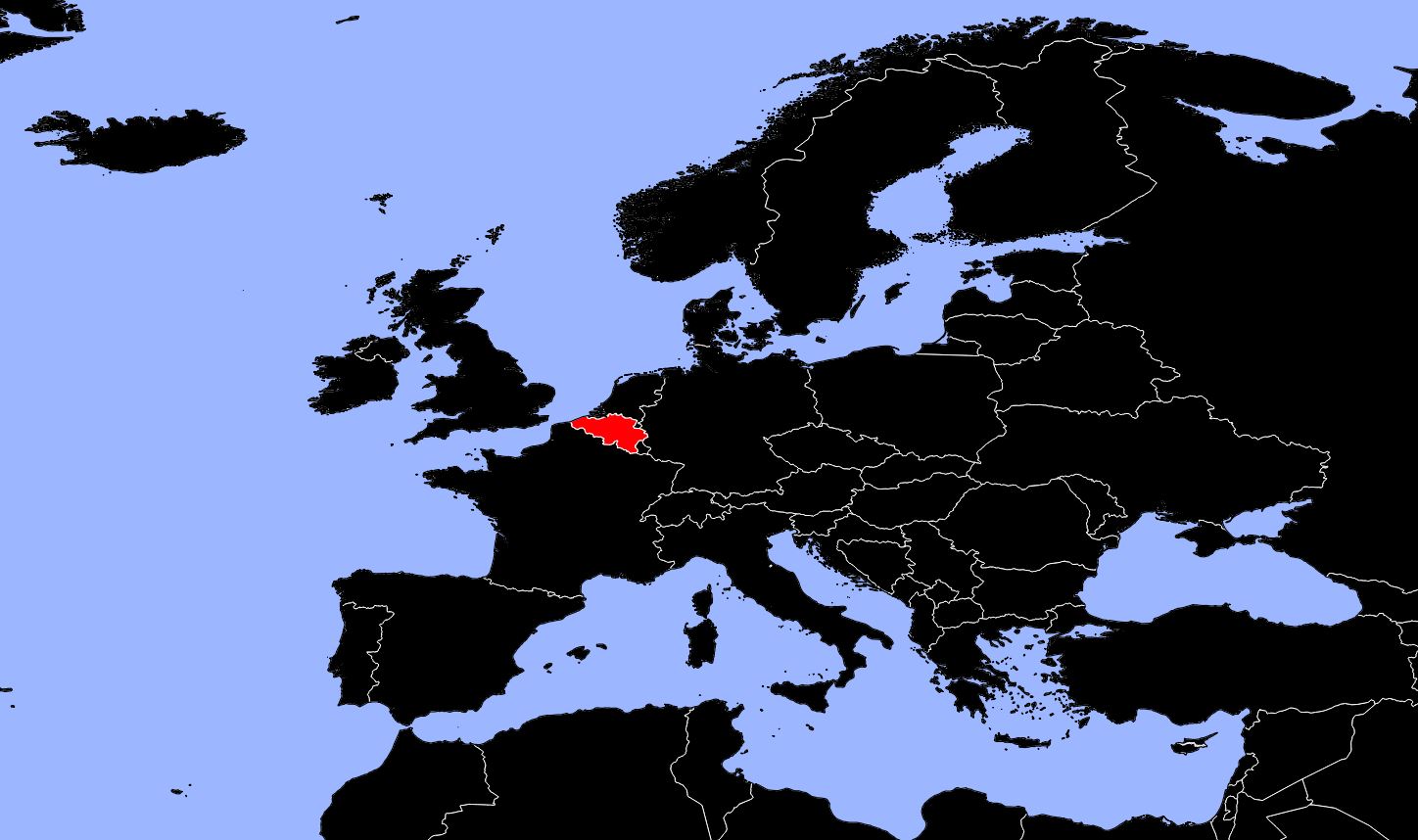
Belgium on a map of Europe – Credit Actualitix
Population of Belgium
Belgium has 11,290,000 inhabitants (2015 estimate), with a population density of 371 inhabitants per square kilometer. Density is higher in the belt crossing northern Belgium from Antwerp to Brussels (see cities on the map of Belgium) and along the Meuse and Sambre valleys. The Ardennes are less populated.
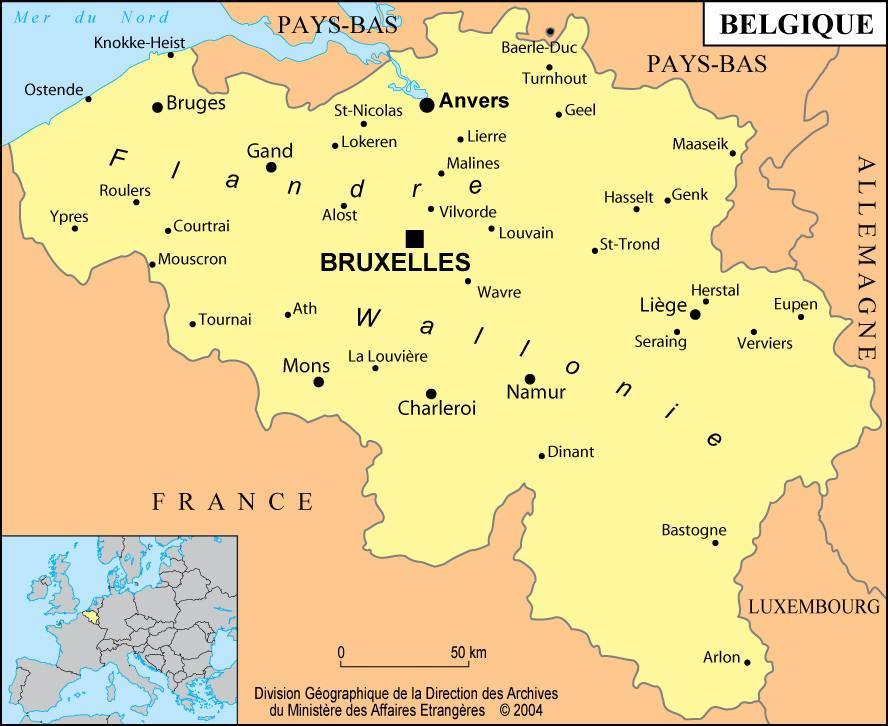
Map of the cities of Belgium – Credit : Ministry of Foreign Affairs
Belgium is highly urbanized. Brussels, the capital, has more than 177,000 inhabitants (2015 estimate). Antwerp, Ghent, Charleroi and Liège are the other major cities of the country.
Belgians who work in the city often live in the countryside. Many workers also own a small farm. Belgium also has many cross-border workers who work in France.
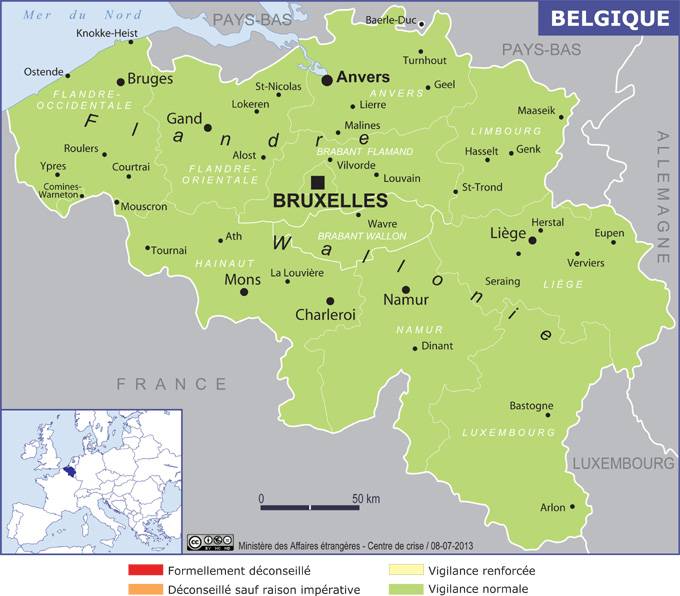
Map of Belgium – Credit : Ministry of Foreign Affairs
Belgium is home to two peoples: the Flemish, a Germanic people who speak Flemish (Dutch) in the north of the country, and the Walloons in the south, who speak French. The provinces of West Flanders, East Flanders, Brabant, Antwerp and Limburg are mainly Flemish.
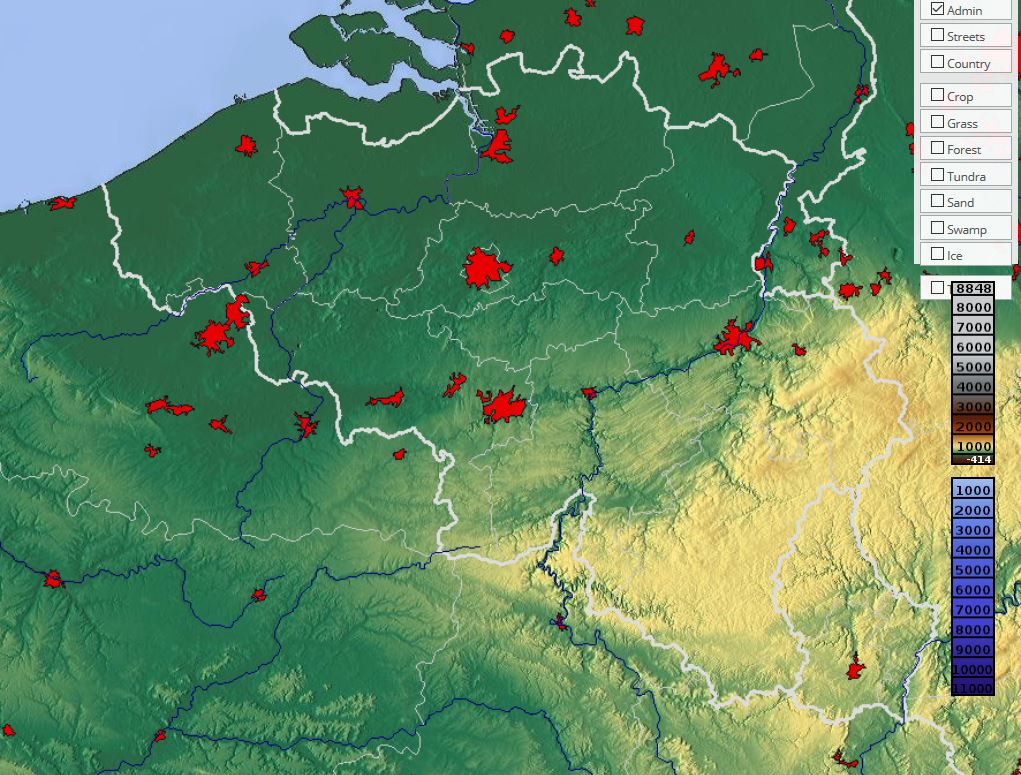
Relief map of Belgium – Image from maps-for-free
The provinces of Hainaut, Namur, Liège and Luxembourg are mainly Walloon. The Brussels region, bilingual, is home to both groups. Some Belgians in the Eupen-Malmedy area speak German. Belgians are predominantly Catholic.
Blank map of Belgium – Credit Actualitix
In previous centuries, the Walloons made up most of the population, but at the beginning of the 20th century French became the dominant language. Today, French, Dutch and German are the three official languages. As Walloons often hold key decision-making positions in economic and political matters, political tensions are constant in Belgium.
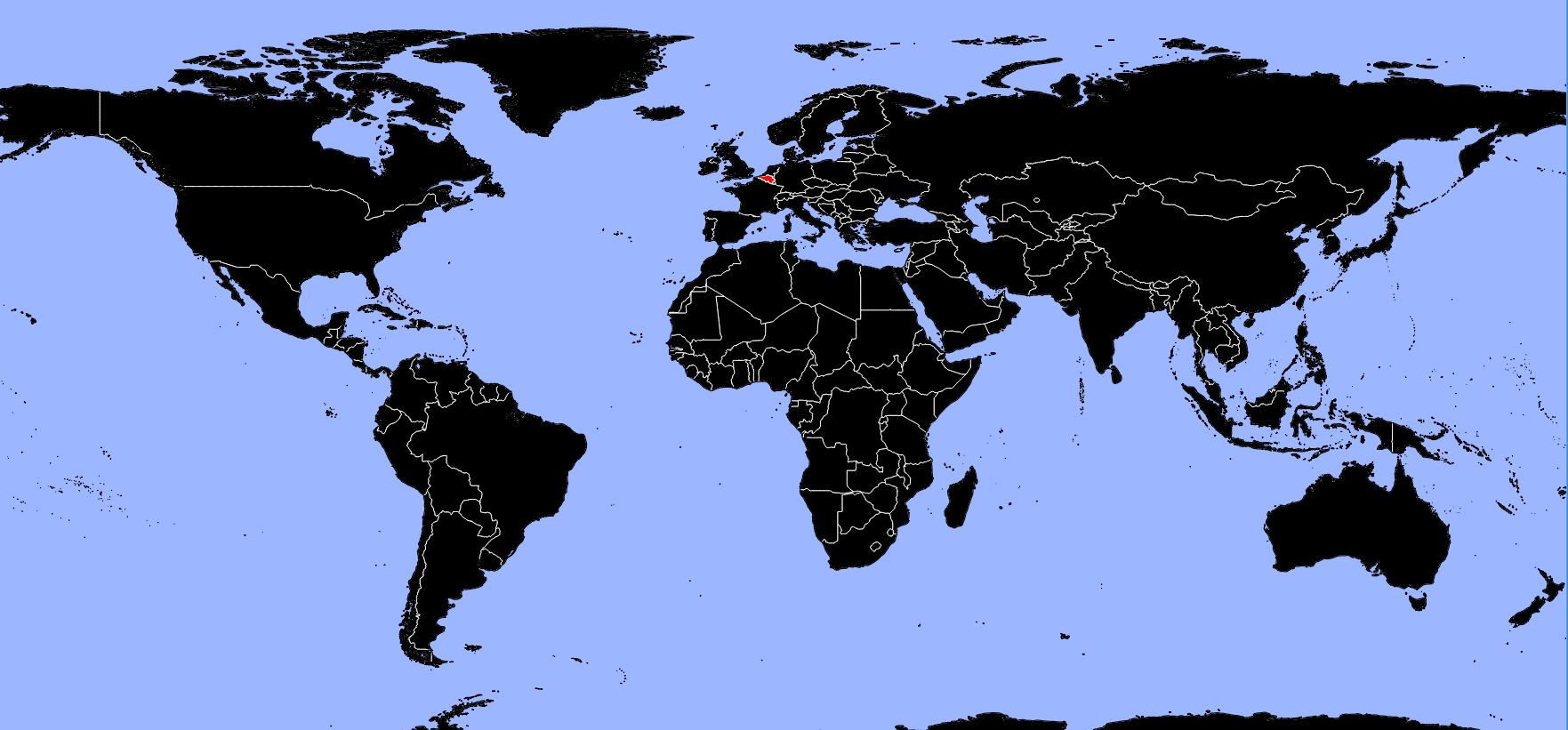
Belgium on a world map – Credit Actualitix