
In this article you will find a map of Vietnam. The Socialist Republic of Vietnam (Viet Nam) brings together the former Democratic Republic of Vietnam (North Vietnam) and the former Republic of Vietnam (South Vietnam).
The country was divided after the defeat of the French by the communist nationalists in 1954. A long civil war ended with the victory of the northern communists in 1975, and the reunification of the country was proclaimed in mid-1976.
Table of contents
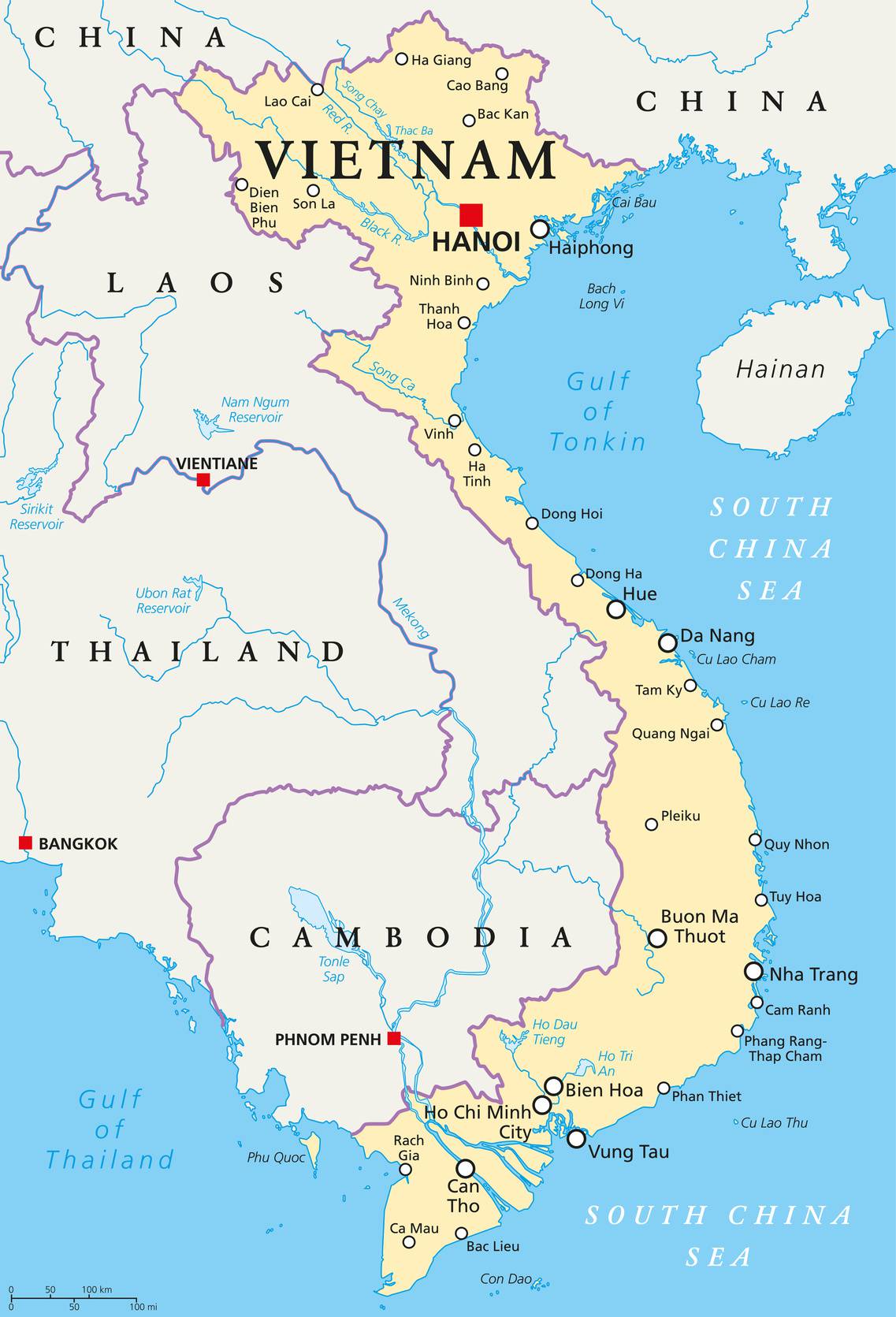
Map of Vietnam – © Peter Hermes Furian – stock.adobe.com
Geography with the map of Vietnam
Vietnam covers an area of 329,560 square kilometers (127,207 square miles) and is located in Southeast Asia. As can be seen on the map of Vietnam, the country has a coastline of about 2,317 kilometers, most of which faces the South China Sea.
The neighboring countries are: China, Cambodia and Laos. The latter two formed, together with Vietnam, the former French Indochina.
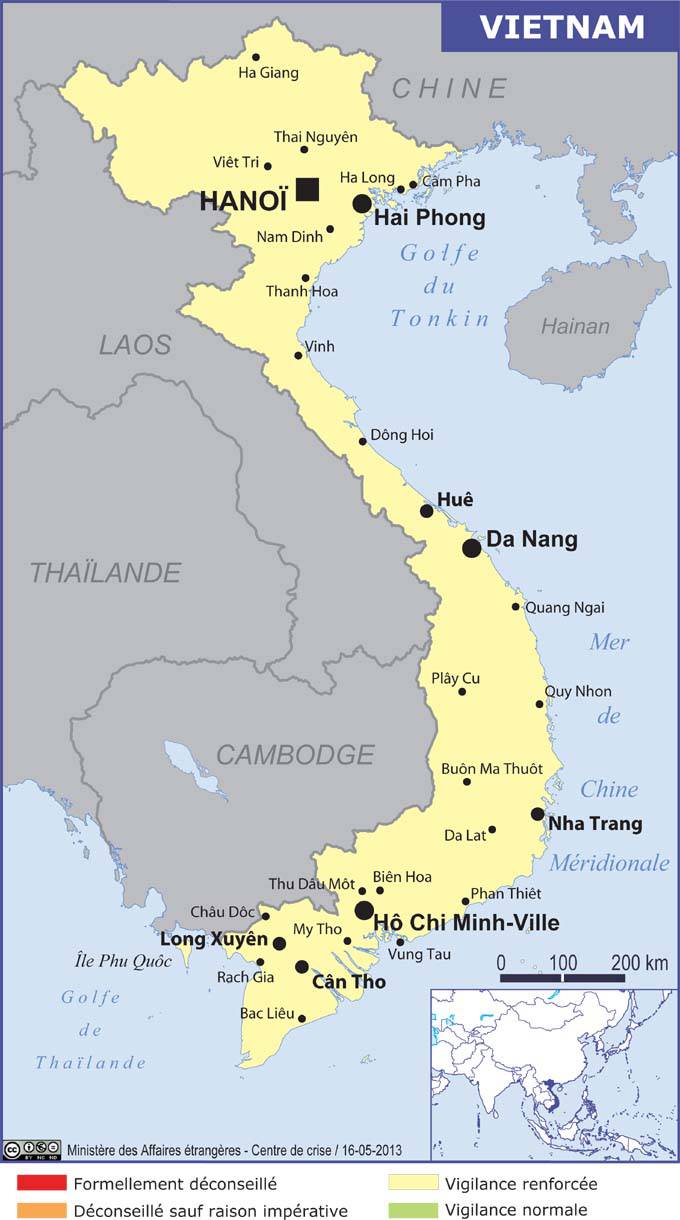
Vietnam map – Credit: Ministry of Foreign Affairs
The north of the country is relatively mountainous, as can be seen on the map of Vietnam, especially in the far north and northwest. The Red River (Song Hong), about 1,167 kilometers long, rises in China’s Yunnan province and is the main river in the north of the country. The most important lowland region lies in a delta formed by the alluvial deposits of the Red River where it enters the Gulf of Tonkin. The river flows through Hanoi, the capital.
For more than 2,000 years, the plains of Tonkin, considered the cradle of Vietnamese civilization, have been the site of major efforts to control water level variations through the construction of dikes and canals.
Relief map of Austria – Image from maps-for-free
The greater southern part of the country consists of even broader plains than those in the north, formed by the Mekong River (Song Cuu Long) and its various tributaries. North of Ho Chi Minh City (formerly Saigon), the landscape, with its forested mountains, becomes more varied and hilly.
Other reliefs of Vietnam
The width of central Vietnam varies, but at its narrowest point it is only about 56 kilometers wide. A narrow strip of land forms its coastline, while elsewhere it consists of wide coastal plains.
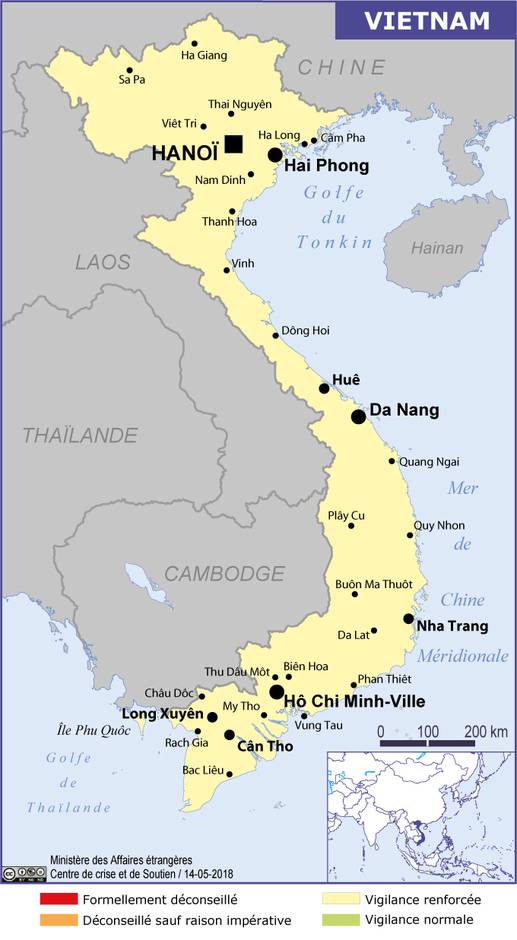
Map of cities of Vietnam – Credit: Ministry of Foreign Affairs
Most of western Vietnam is occupied by the Annamite Cordillera, a high mountain range stretching from north to south and forming the backbone of the country. In addition to the two main rivers, many waterways cross the mountainous regions before flowing east into the South China Sea. The country also includes six archipelagos, 14 mountain ranges and three large lakes.
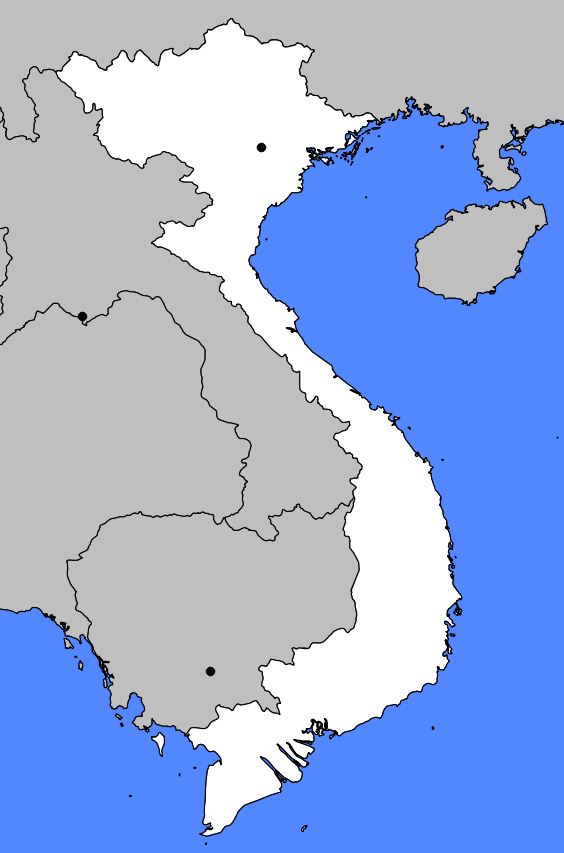
Blank map of Vietnam – Credit Actualitix
Climate in Vietnam
This is not always obvious from the map of Vietnam, but the country’s climate is mainly tropical, although it can be considered subtropical in the north. Differences in temperature, rainfall and humidity are due to altitude variations. In the north, the hot and humid rainy season lasts five months, from May to September.
During the rest of the year, rainfall is scarce and temperatures relatively high. From December to April, the central regions and coastal lowlands are affected by long periods of fog and drizzle, with overcast skies.
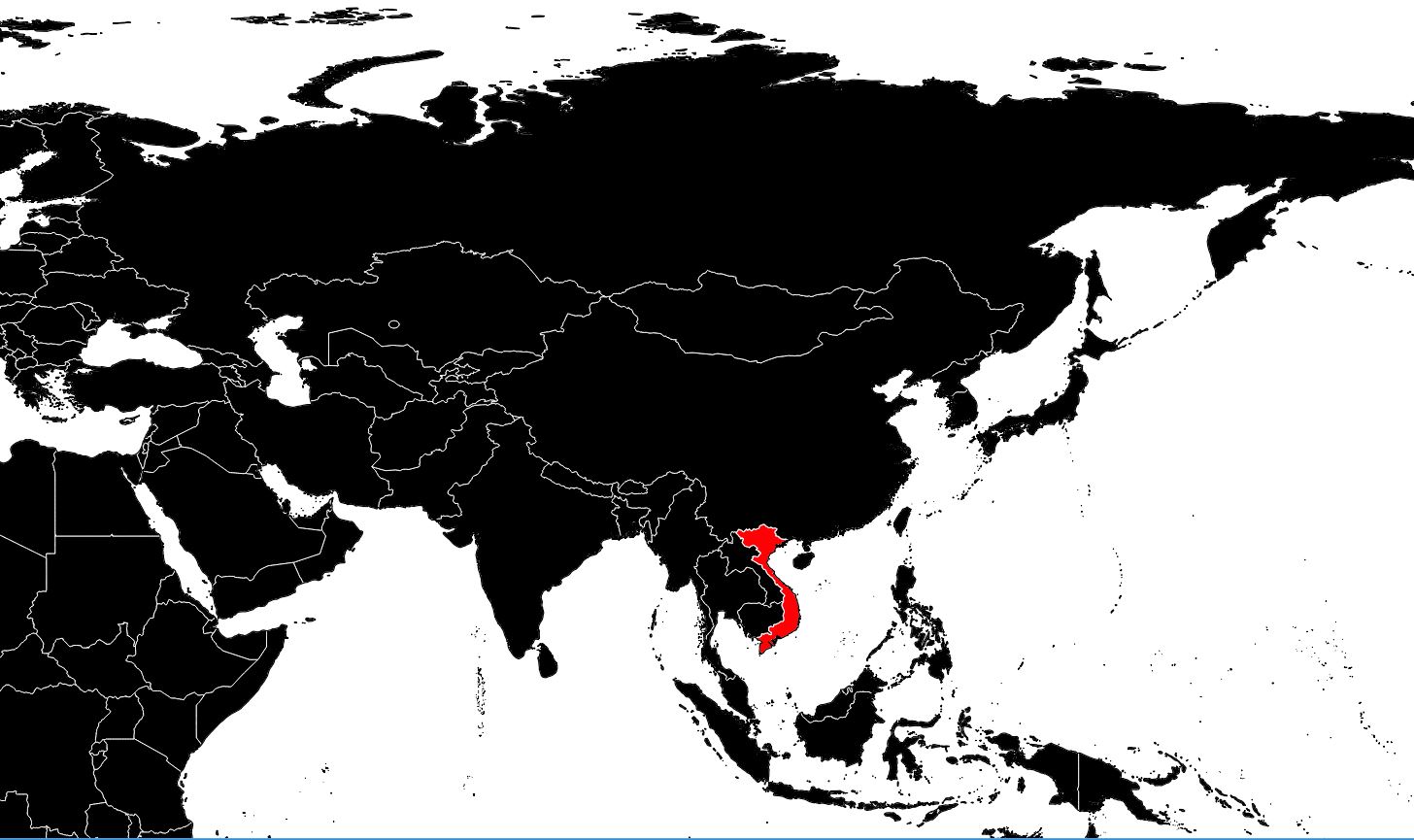
Vietnam on a map of Asia – Credit Actualitix
Southern Vietnam has a climate dominated by monsoons and is characterized by heavy rainfall caused by sudden changes in wind direction. The rainy period there is shorter than in the north.
In the north, the heaviest rainfall occurs in July and August, while in the south it peaks in June and September. The average annual rainfall in Hanoi is 183 centimeters; it reaches 297 centimeters in Hue and 206 centimeters in Ho Chi Minh City. In the highest regions of the Annamite Cordillera, rainfall can exceed 445 centimeters per year. The region is particularly exposed to typhoons.
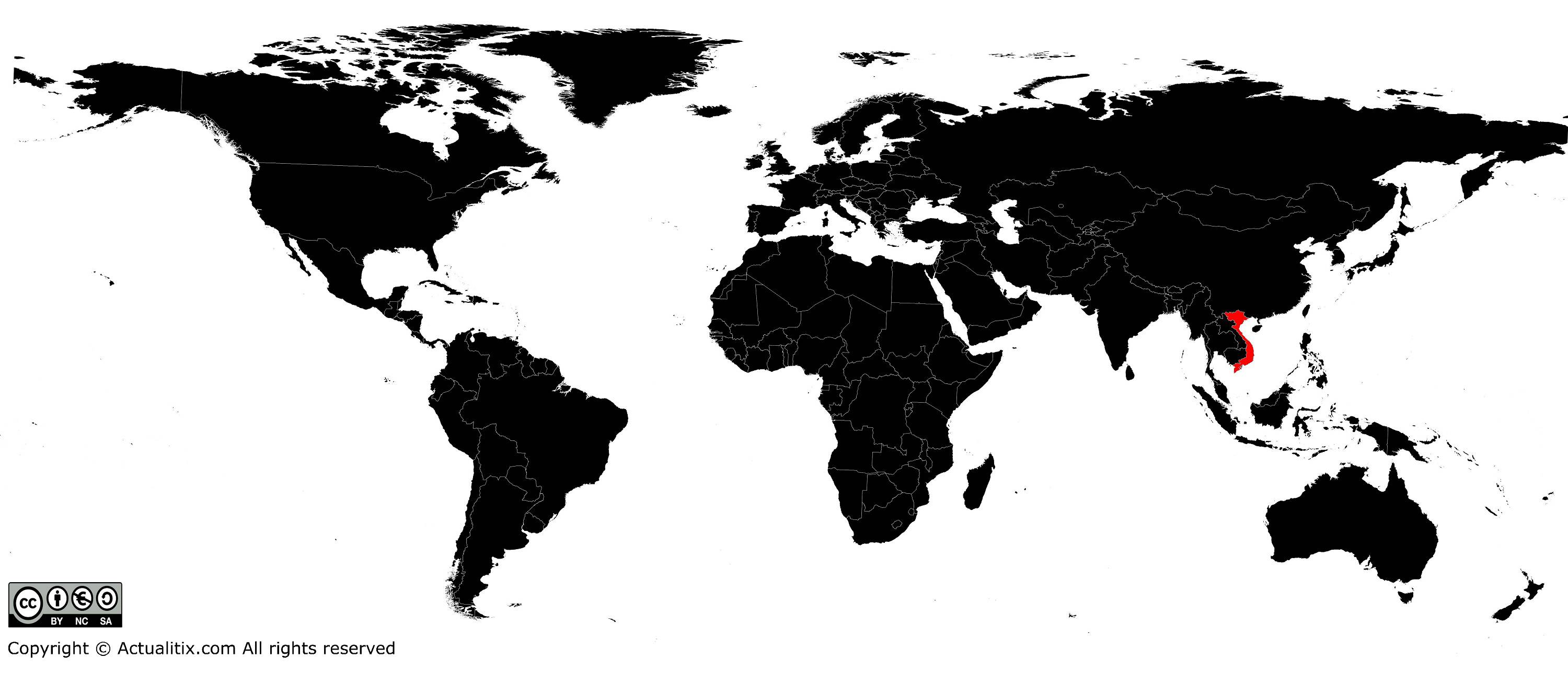
Vietnam on a world map
These typhoons mainly occur from July to November. During the day, temperatures range in the south between 18° and 33°C (64° and 92°F), while the climate is noticeably harsher in the north of the country. Average temperatures reach about 28°C (82°F) in summer and 17°C (63°F) in winter.
You can discover all the available maps for the different countries of the world on this page.