
In this article you will find a map of Colombia. The country lies at the edge of Central America. Its coastline is bordered on one side by the Pacific Ocean and on the other by the Caribbean Sea.
Located near the Isthmus of Panama, which was part of its territory until 1903, this nation occupies a strategic position. It stands at the crossroads of communication routes linking North America, Central America and South America.
Table of Contents
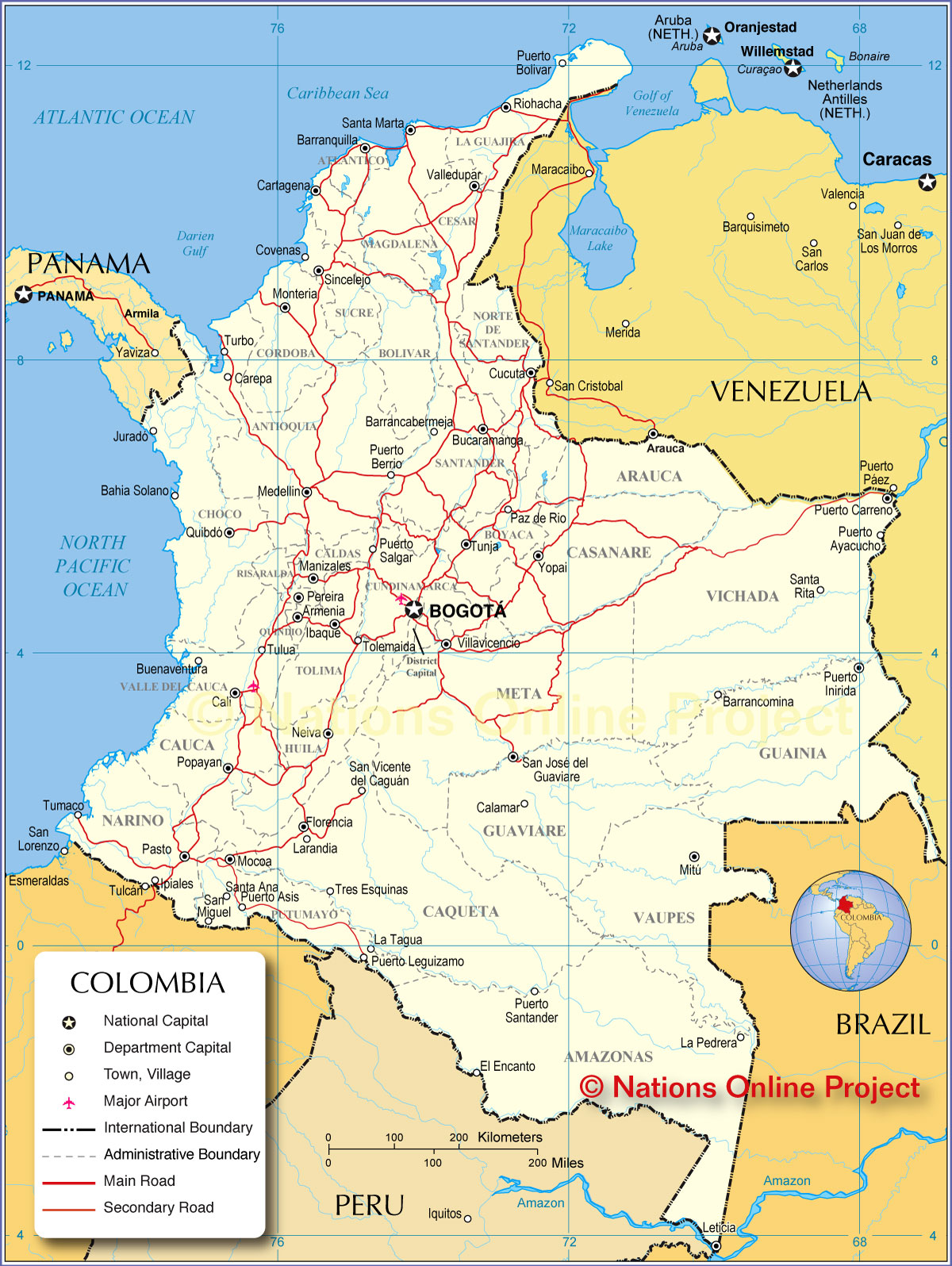
Map of Colombia – Credit: Nations Online
Geography with the map of Colombia
Colombia covers an area of 1,140,000 square kilometers and measures approximately 1,800 kilometers from north to south and nearly 1,370 kilometers from west to east. As shown on the map of Colombia, it is bordered by the Caribbean Sea to the north; by Venezuela and Brazil to the east; by Peru and Ecuador to the south; and by the Pacific Ocean and Panama to the northwest.
At the far southeast, the Amazon River forms for 116 kilometers the border separating Peru from Colombia. The islands of San Andrés and Providencia, an archipelago located 800 kilometers from the mainland, are Colombia’s only dependencies and lie just 160 kilometers off the eastern coast of Nicaragua.
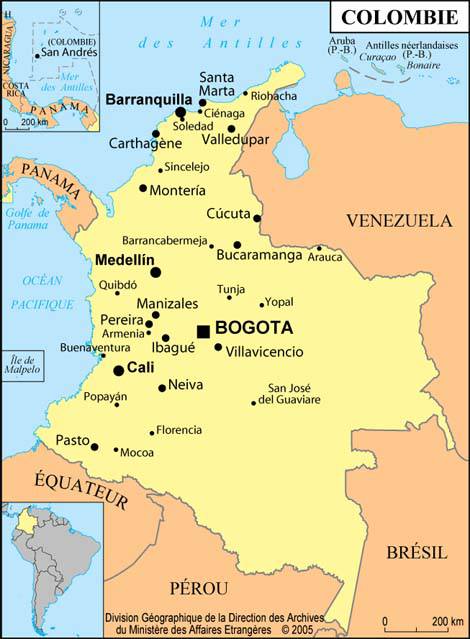
Colombia map
The country
The Andes mountain range separates Colombia’s eastern plains from the Pacific coastal plains in the west and from the Caribbean coastline in the northwest.
Near the Ecuadorian border, the Andes are formed by three large, roughly parallel mountain chains running north to south. The Eastern and Western Cordilleras are separated by the Central Cordillera and by the river valleys of the Cauca and Magdalena.
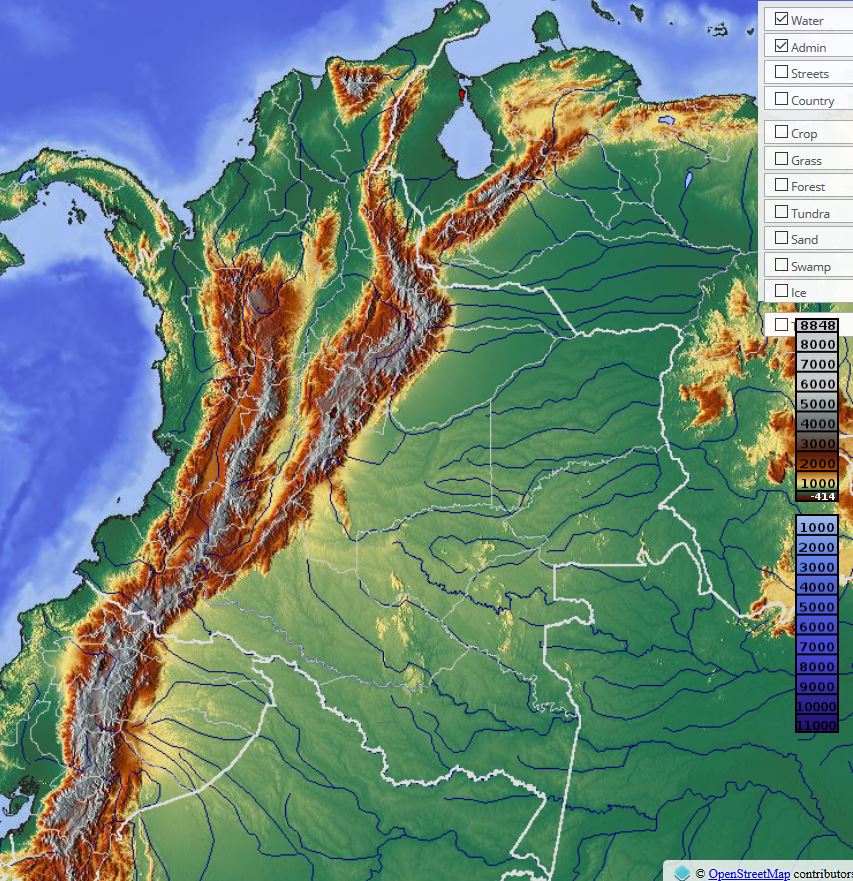
Relief map of Colombia – Image from maps-for-free
The Andes (clearly visible on the map of Colombia) divide the country into five sub-regions: the Andes region, the Pacific plains, the Caribbean coastal plain, the eastern plains (Llanos), and finally the Amazon lowlands.
The rugged terrain of the Andes is often interrupted by long fertile valleys and plateaus. Bogotá (Santa Fe de Bogotá), the capital, is located in the center of the country at an altitude of 2,600 meters on the plateau of the Eastern Cordillera.
The Central Cordillera is by far the highest part of the Colombian Andes. It contains high peaks covered with permanent snow and several extinct volcanoes, although volcanic activity remains strong in the southern part of this region.
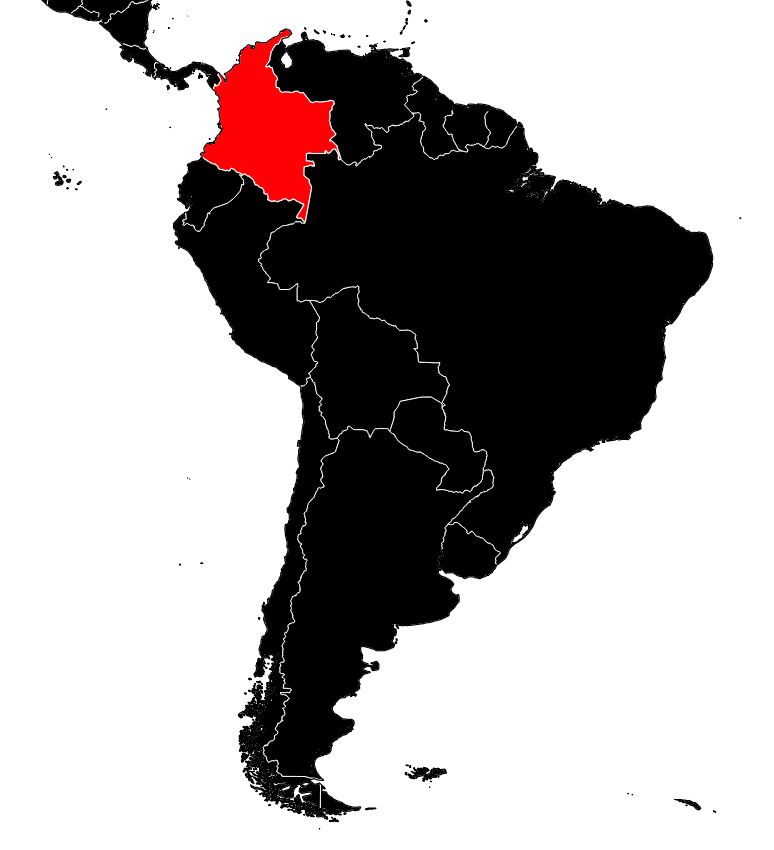
Colombia on a South America map – Credit Actualitix
Despite its central location and rugged landscape, the Andes region has always hosted a large population attracted by its varied terrain and climate zones, although it represents only 20% of the territory.
Other regions
As shown on the map of Colombia, slightly westward the Central Cordillera gives way to a narrow coastal plain along the Pacific Ocean. This relatively recent plain is formed from alluvial deposits from the San Juan River and numerous waterways crossing the western Andes, one of the wettest regions in the world.
This area is dominated by swamps and tropical forests. The coastal plains bordering the Caribbean Sea and the Pacific Ocean are separated by low hills rising between the San Juan and Atrato rivers.
The Caribbean coastal plain formed from sediment carried by the Magdalena, Cauca, Sinú and Atrato rivers. Along the coast, this plain — largely grassland — often experiences periods of drought.
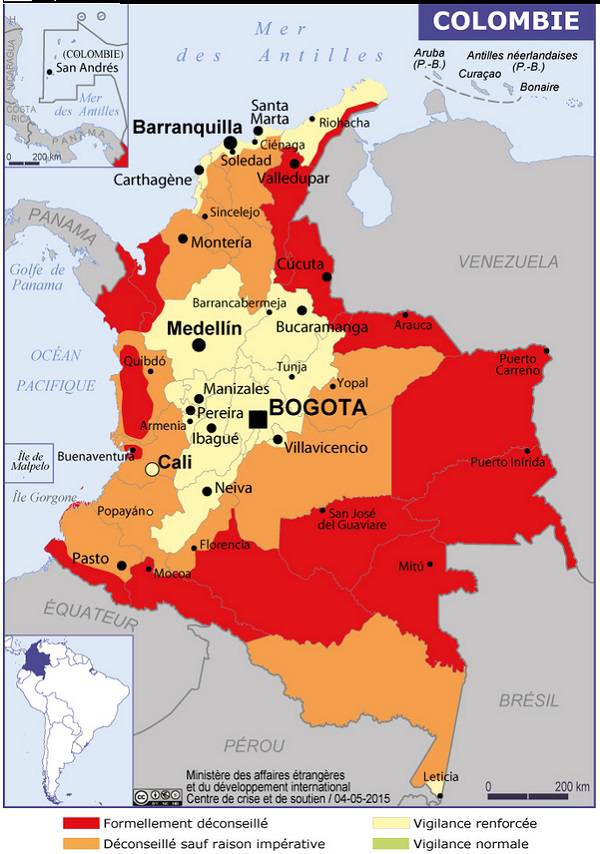
Map of dangerous areas in Colombia
Its southern part, dominated by foothills of the northern Andes, is heavily forested and frequently flooded. East of the Magdalena River delta, the coastal plain gives way to the Sierra Nevada de Santa Marta, an isolated mountain massif containing the country’s highest peaks: Mount Colón and Mount Bolívar, rising to 5,800 and 5,000 meters respectively.
Eastern Colombia consists of a vast inland plain extending into Venezuela and Brazil. Geographers divide this region into two subregions: the Llanos in the north and the Amazon basin south of the Guaviare River.
The Llanos are tropical savannas drained by the Arauca, Meta and Vichada rivers, which flow into the Orinoco River before reaching the Atlantic Ocean. The soil here is poor and the region remains sparsely populated, dominated by cattle ranching. However, the discovery of major oil reserves in 1984 improved the local economy.

Blank map of Colombia
The vast plain south of the Guaviare forms Colombia’s extension of the Amazon basin. The Amazon region has a hot and humid climate similar to the Pacific lowlands.
Until 1950, the Amazon rainforest covered this entire region. Today it forms part of a huge natural reserve, though many areas have been cleared for farming and grazing near the Guaviare, Caquetá and Putumayo rivers.
Climate of Colombia
Colombia has an overall tropical climate. Unlike mid-latitude countries, temperatures show little seasonal variation and instead depend mainly on altitude and latitude.
Colombian lowlands — about 80% of the territory and located within 10° of the equator — maintain high average daytime temperatures above 24°C.
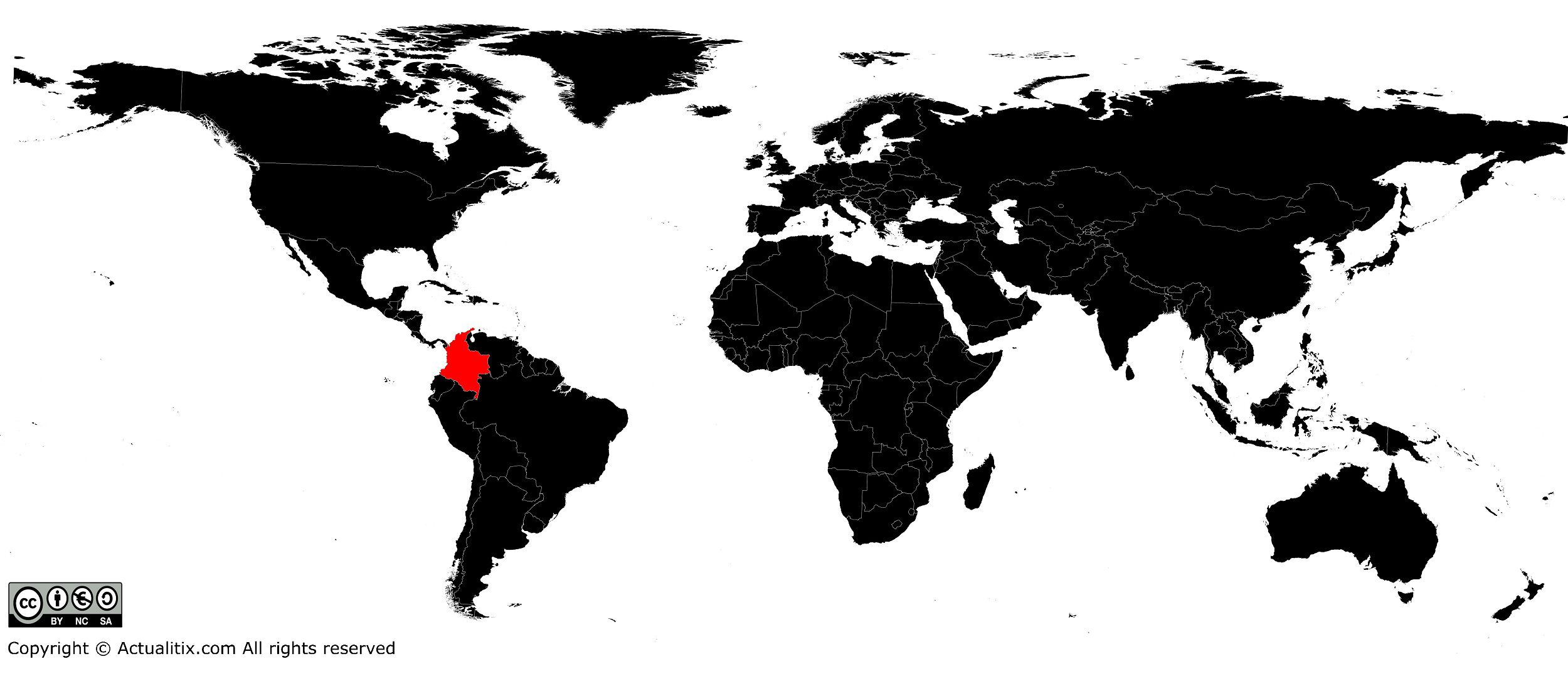
Colombia en un mapa del mundo
Weather patterns are influenced by the Intertropical Convergence Zone, bringing seasonal rainfall. The Andes, Llanos and Caribbean plains experience alternating wet and dry seasons, while the Pacific and Amazon regions receive heavy rainfall year-round.
In the semi-desert Guajira Peninsula in northern South America, annual rainfall is under 30 cm. In contrast, some Pacific regions exceed 990 cm annually, rivaling the wettest areas of India, Hawaii and equatorial Africa. Temperatures decrease with altitude.
The “tierra caliente” (hot zone) lies below 1,000 meters. The “tierra templada” (temperate zone) begins around 2,000 meters, followed by the “tierra fría” (cold zone) near 3,000 meters. Above 4,700 meters lies the “tierra páramo”, marking the start of permanent snow.
Each climate zone supports distinct vegetation and agricultural activities, ranging from rice, cotton, bananas and cocoa in warm lowlands, to coffee and citrus in temperate zones, cereals and dairy farming in cold zones, and limited grain production in the páramo.
You can discover all available maps of countries around the world on this page.”