
As you can see on the map of Switzerland, the country is landlocked and holds a strategic position in the heart of Central Europe. It is bordered: to the north by Germany, to the east by Austria and the small principality of Liechtenstein, to the south by Italy, and to the west by France.
It measures at most 220 kilometers from north to south, and about 360 kilometers from east to west. Its total area is under 41,290 square kilometers.
Article outline
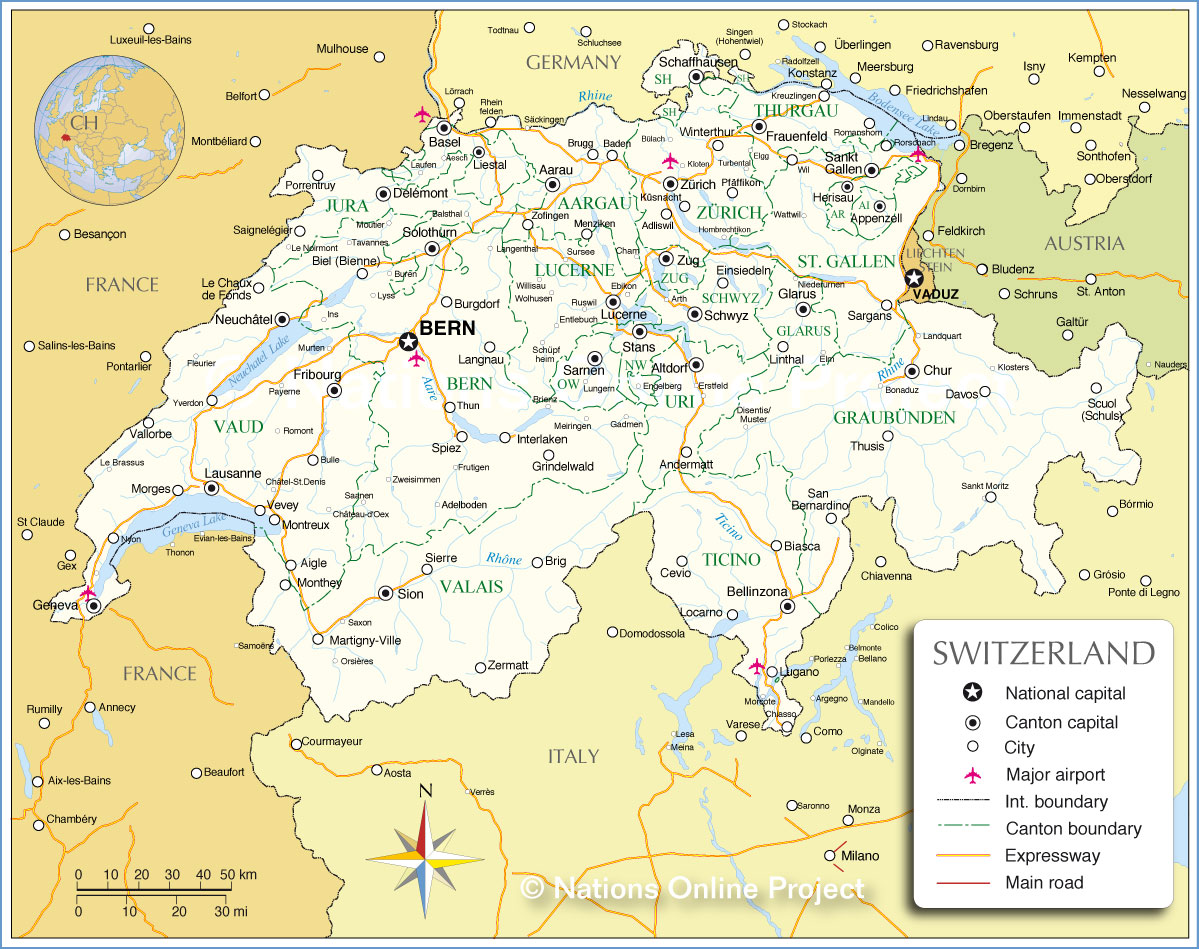
Map of Switzerland – Credit: Nations Online
Map of Switzerland
Here is the first map of Switzerland: a detailed map containing lots of information, such as airports, cities, the names of cantons, mountains, lakes…
Switzerland forms a vast drainage basin where many rivers originate, such as the Inn in the east, as well as the Rhine, the Rhône, and the Ticino, which then flow respectively into the North Sea, the western part of the Mediterranean Sea, and the Adriatic Sea. The rivers of this country, known for the beauty of its landscapes, are almost as famous as its snow-capped mountain peaks.
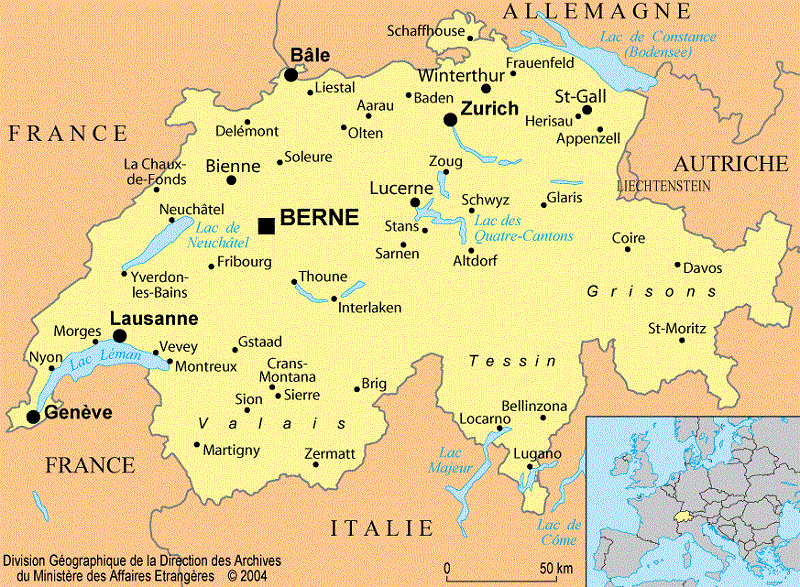
Map of Swiss cities – Credit: Ministry of Foreign Affairs
Swiss lakes are numerous. The most famous among them are Lake Maggiore, as well as Lakes Geneva, Constance, Neuchâtel, Lucerne, and Zurich.
Switzerland, a unified and prosperous country, is nonetheless home to many linguistic and religious groups. This exemplary developed nation also has one of the oldest democracies in the world.
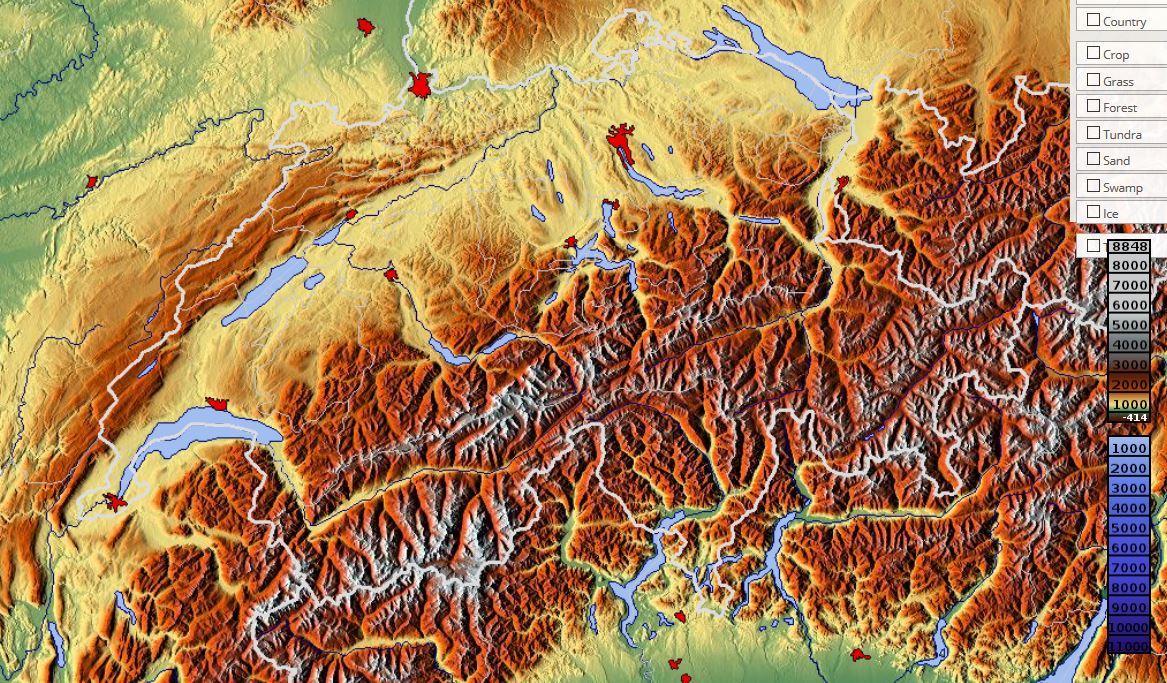
Relief map of Switzerland – Image extracted from maps-for-free
Relief Map of Switzerland
Let’s continue with another map of Switzerland. Here, it’s the relief map of Switzerland, to be precise.
The Alps are the largest mountain range in Switzerland and cover 60% of the territory. This complex mountainous area is formed by the joining of the Bernese, Pennine, Lepontine, and Rhaetian Alps.
The Alps extend west toward France, north toward Germany, east toward Austria, and south toward Italy. Switzerland’s highest peak, the Dufourspitze, rises to an altitude of 4,634 meters. It is part of the Monte Rosa massif, which stands near the Italian border and also includes several other high-altitude summits. The Simplon, Furka, and St. Gotthard passes are the main passes in the Swiss Alps. The two famous Alpine peaks, the Jungfrau and the Matterhorn, stand near Interlaken and Zermatt, respectively.
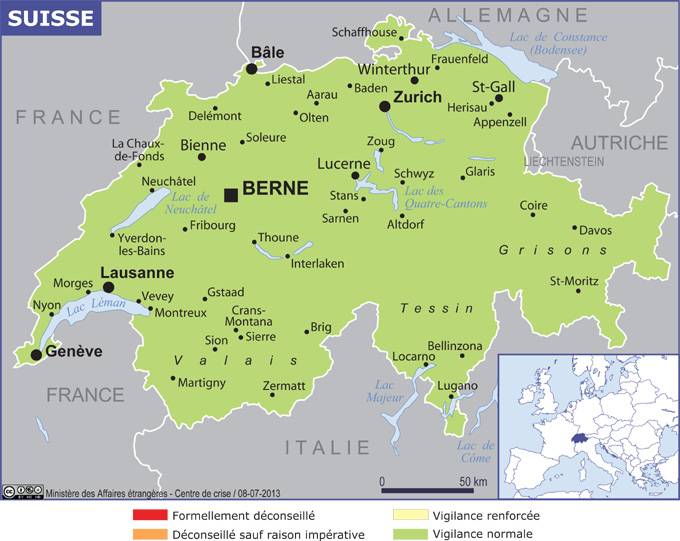
Switzerland map – Credit: Ministry of Foreign Affairs
The Swiss Jura, which stretches along the Franco-Swiss border, accounts for only 10% of the total area. It is made up of a succession of lower, less rugged mountains than the Alps, with elevations ranging between 900 and 1,700 meters. Natural mountain passes are relatively rare there, so the Swiss Jura forms a natural barrier that hinders both settlement in these regions and transportation routes. The Jura’s population, like that of the Alps, is therefore very sparse.
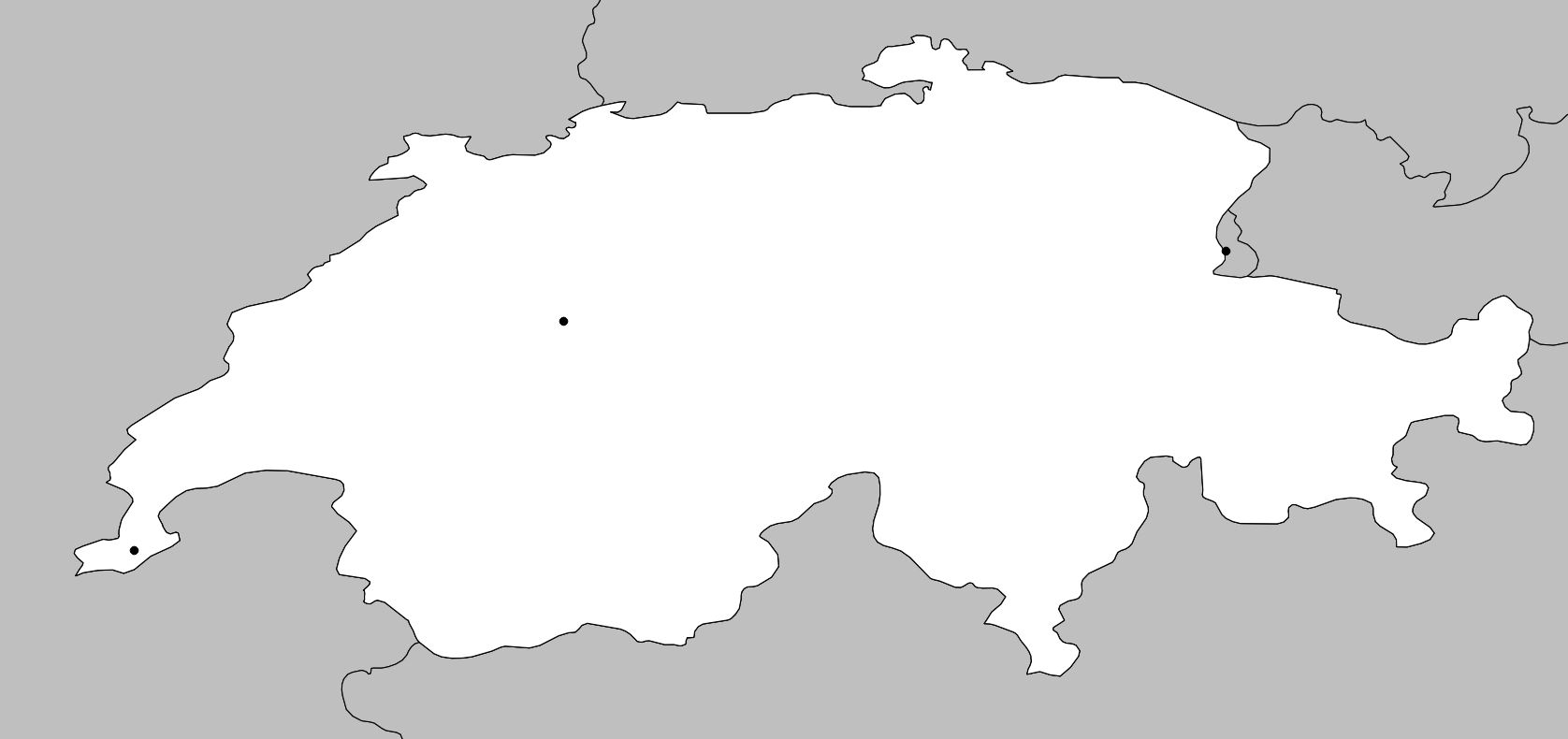
Blank map of Switzerland – Credit: Actualitix
The Mittelland region, or Swiss Plateau, has an average altitude of 460 meters and covers 30% of the territory. Of glacial origin, it formed several thousand years ago and consists mainly of hills and valleys. It stretches from Lake Geneva in the southwest to Lake
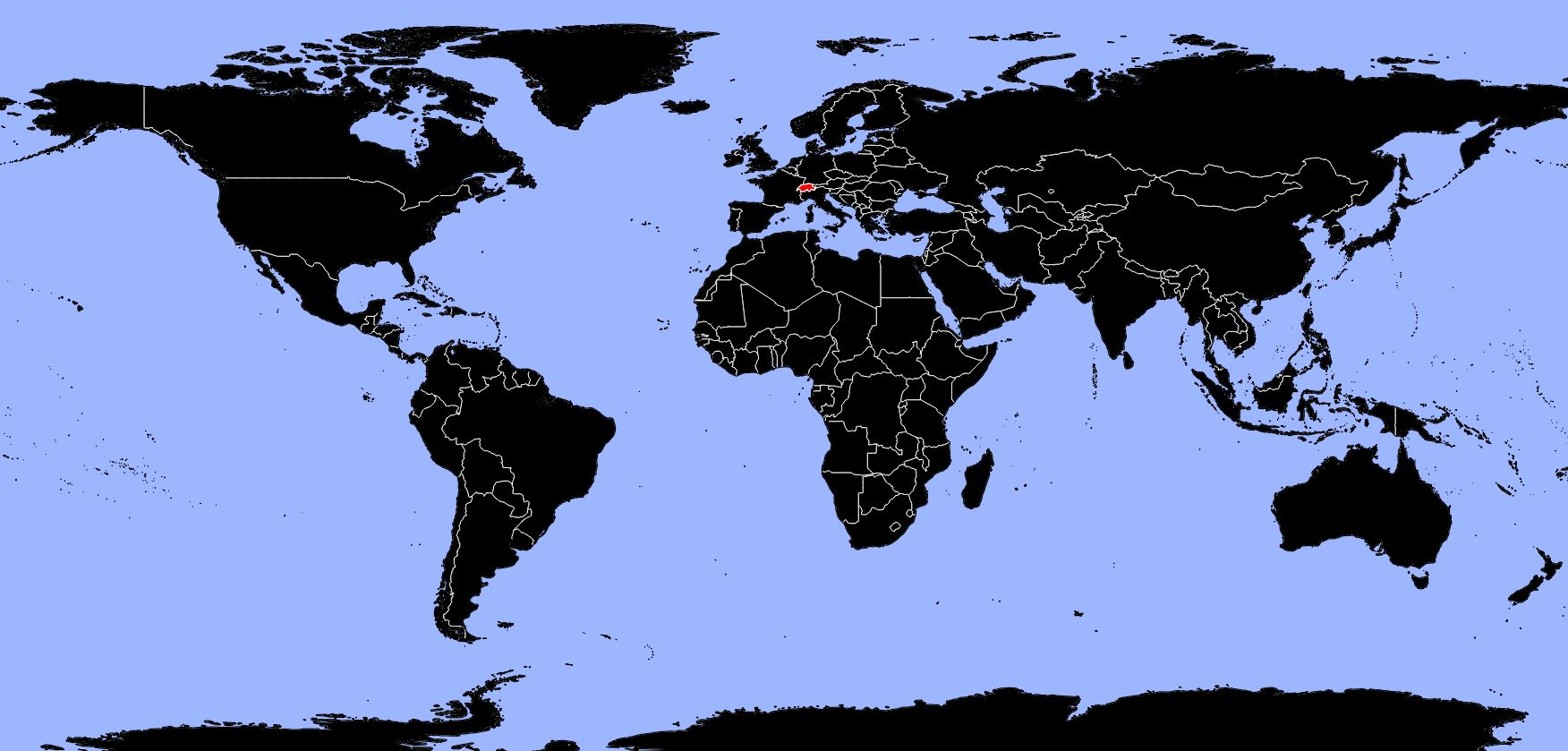
Switzerland on a world map – Credit: Actualitix
Constance in the northeast, which marks the junction of Germany, Austria, and Switzerland. Most major Swiss cities and economic centers are located in the Mittelland region.
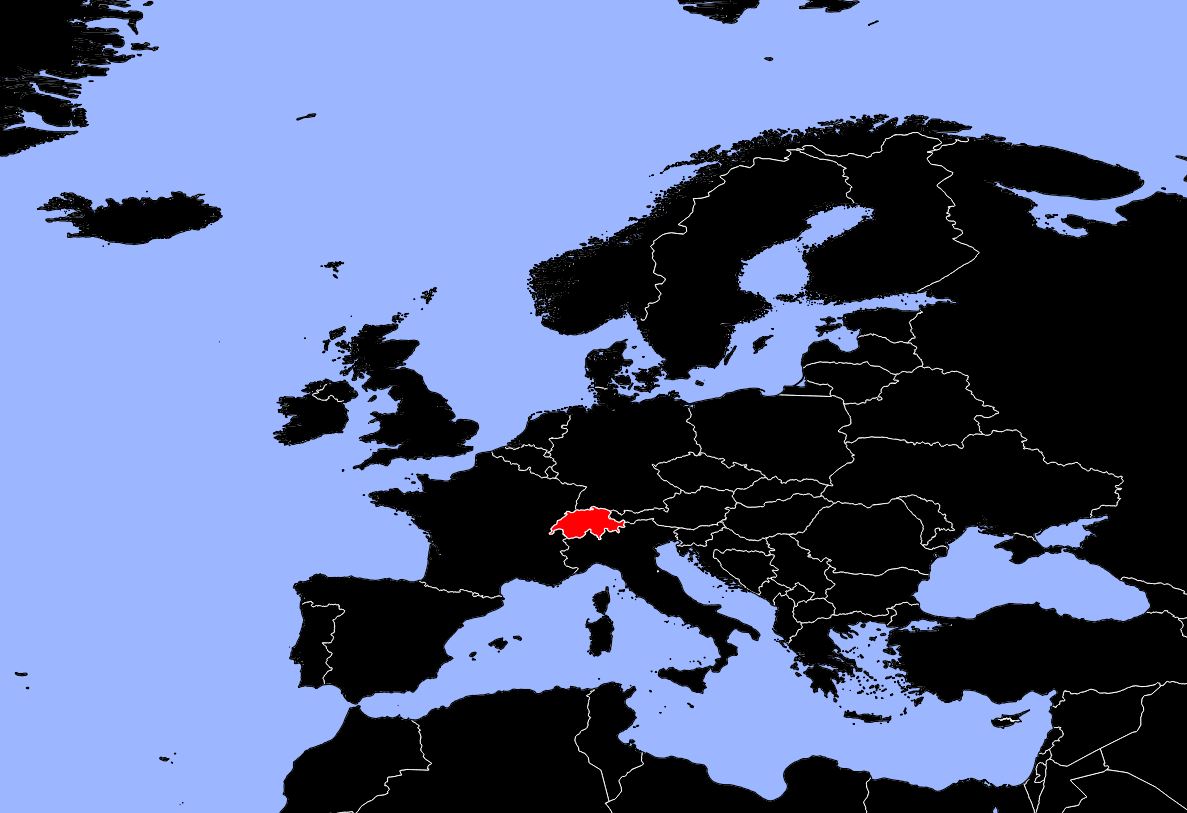
Switzerland on a map of Europe – Credit: Actualitix