
In this article, you will find a map of Brazil. The country is one of the largest tropical countries in the world: it stretches 4,000 kilometers from east to west and 4,300 kilometers from north to south. Countries with a larger surface area are all located in the temperate zone: Russia, Canada, China and the United States. Brazil is also the fifth most populous country in the world. Its total population is indeed over 140 million inhabitants. Population densities are nevertheless very uneven.
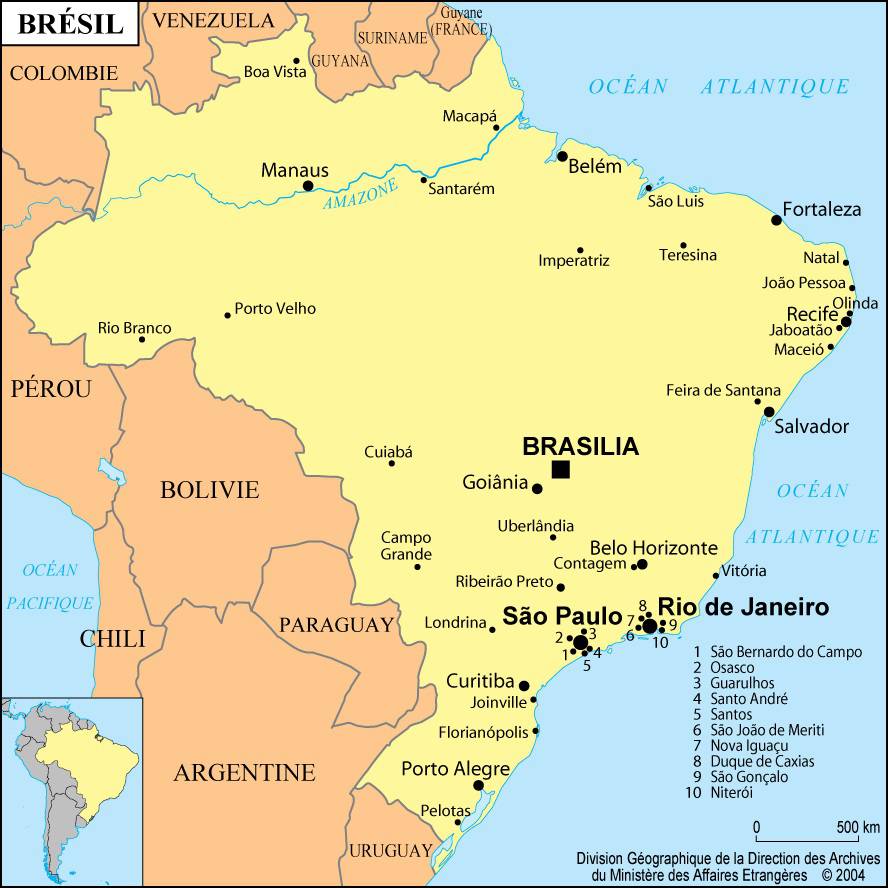
Brazil map – Credit: Ministry of Foreign Affairs
Learn more about Brazil
More than two-thirds of Brazilians live in large cities or villages, and more than 29% of them live in the country’s 10 largest cities, each with a population of over one million inhabitants. These include the metropolitan areas of São Paulo and Rio de Janeiro, which are home to more than 12 million and more than 6 million inhabitants respectively. You can see these cities on the map of Brazil. The rural population is concentrated mainly in the fertile-soil coastal plains along the eastern coastline, as well as in the mountainous highlands in the far south of the country.
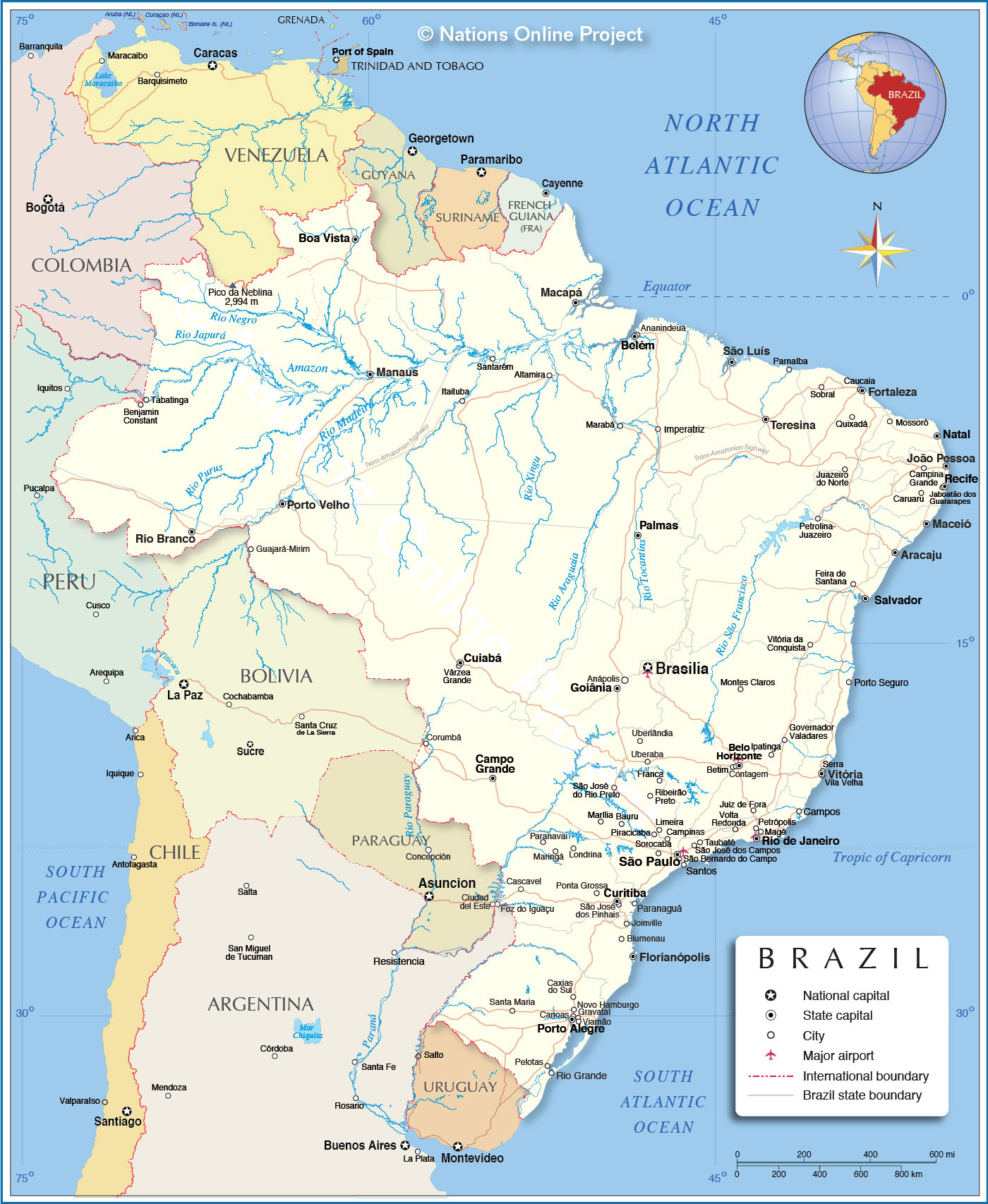
Map of Brazil – Credit: Nations Online
In the rest of the territory, settlement is very uneven. There are, in fact, many small isolated farms responsible for supplying the mines located in the eastern mountain regions. The rest of the population consists mainly of cowboys from the western savannas and small communities living in the jungles of northern Brazil who earn their income from forestry.
The years following the inauguration of Brasília (the inland capital, as shown on the map of Brazil) in 1960 were marked by many socio-economic changes. During this period, even the most remote villages acquired new schools and medical centers.
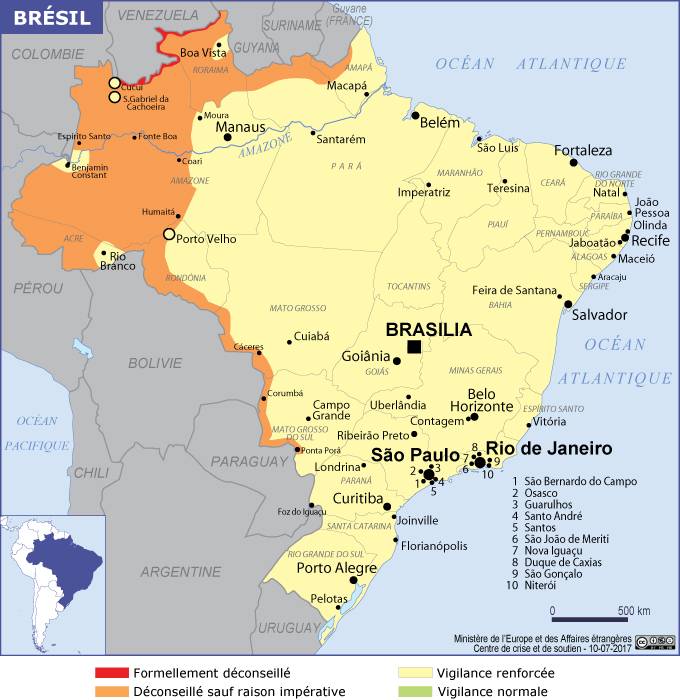
Map of Brazilian cities – Credit: Ministry of Foreign Affairs
Today, the country’s interior is now served by a major road network, and new industries have developed across the territory. Television has also largely helped to break the isolation of many communities.
This modernization does, however, have a few drawbacks, including a rise in crime and air pollution in urban areas. Nevertheless, thanks to the vastness of its territory and its low population density, Brazil remains a country famous for the hospitality of its people and the beauty of its landscapes.
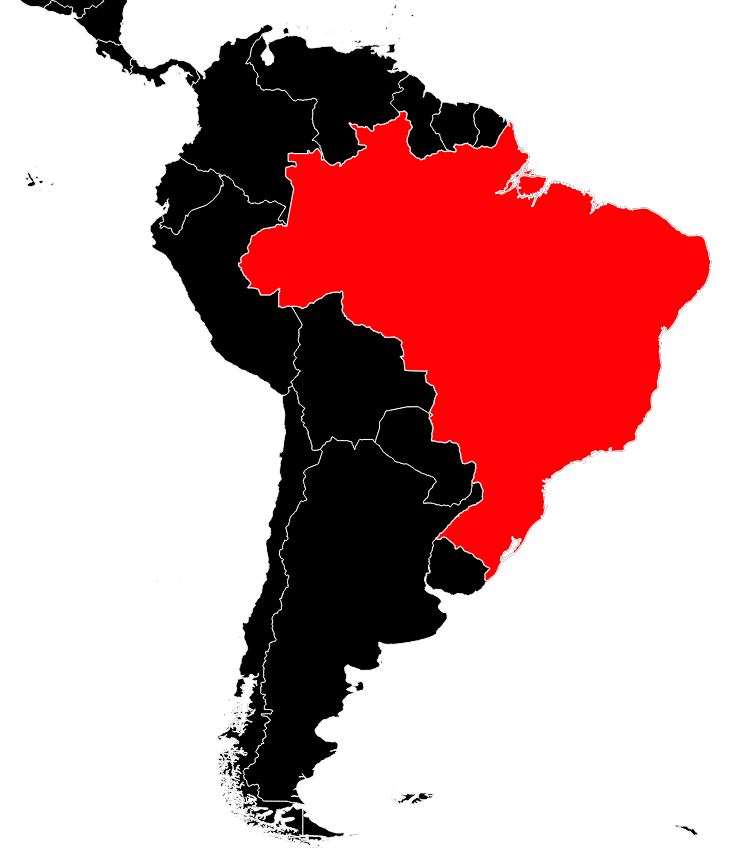
Brazil on a map of South America – Credit Actualitix
Geography on the map of Brazil
The country’s coastline is 7,200 kilometers long (as you can see on the map of Brazil). It is characterized by alternating fine sandy beaches and fertile-soil coastal plains dotted with low hills. In the south, these then give way to the rocky escarpments of the Serra do Mar, which border the Brazilian Plateau. This plateau, with its rolling surface, stretches from São Paulo to Porto Alegre. It is made up of lava flows that slope gently down toward the plains, which explains why its altitude then decreases steadily as you move westward, to meet the Paraguay river plains.
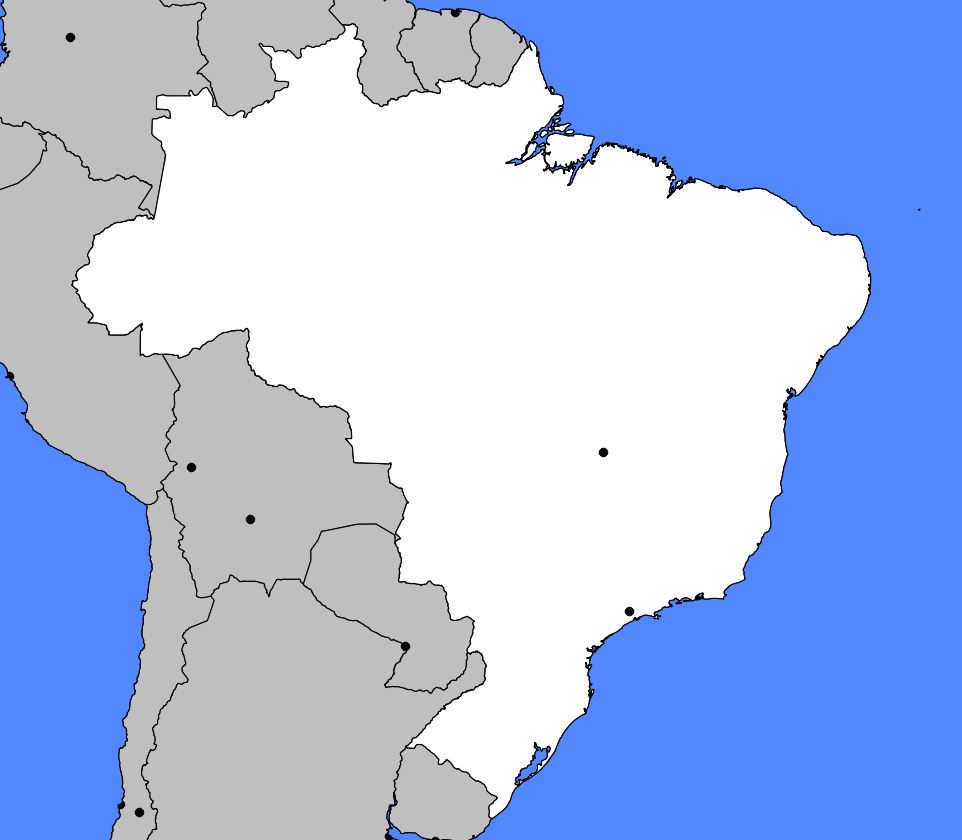
Blank map of Brazil
Southern Brazil is mainly shaped by the Central Plateau of Brazil, which stretches from the sources of the Paraguay River to the mountains of Minas Gerais. It is an ancient peneplain—that is, a surface bearing residual soils uplifted by tectonic movements after being worn down by erosion to sea level. This peneplain has a gently rolling relief and reaches, in the Brasília region, approximately 1,200 meters in altitude.
Halfway between Brasília and the coast, the landscape changes abruptly, giving way to folded mountain ranges that are not very high. The Serra do Espinhaço, west of Brazil’s most productive mining region, is undoubtedly the highest of them. The mineral resources of this region are highly varied: iron, manganese, lead, zinc, aluminum, quartz, mica, diamonds, gold, as well as 90% of the world’s production of semi-precious stones.
Since 1834, it is estimated that the exploitation of the gold vein at the Morro Velho mine, located 32 kilometers east of Belo Horizonte, has brought in more than 250 million dollars. In the early 1980s, the tunnels of this mine formed a true labyrinth leading to a vast shaft 2,700 meters deep (see the map of Brazil with relief), undoubtedly one of the deepest in the world.
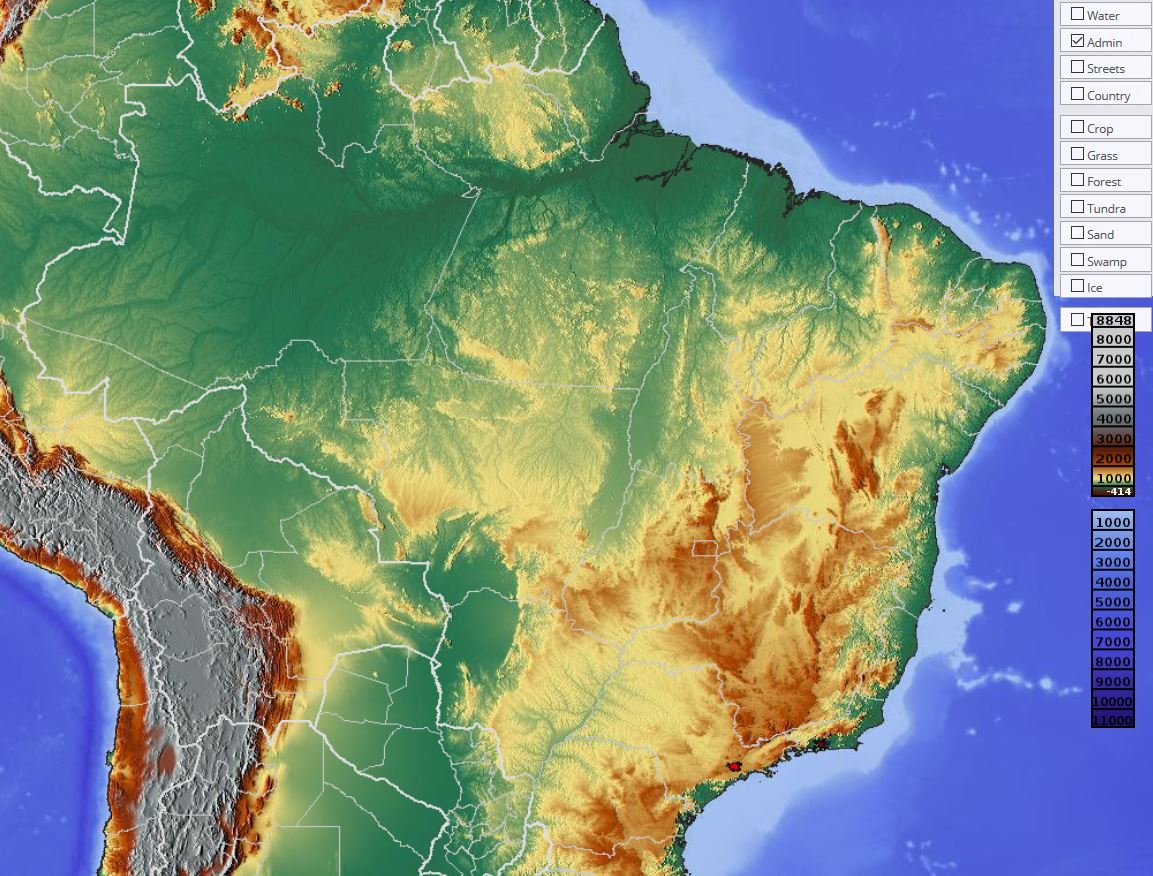
Relief map of Brazil – Image extracted from maps-for-free
Division of the country
The mining industry extends as far as the beaches of Espírito Santo and southern Bahia. The mines mainly exploit deposits of zirconium, titanium and monazite (used in the manufacture of cerium oxide and thorium).
These minerals were carried by runoff waters which, little by little, eroded the ancient rocks of the Serra do Mar, whose highest peaks dominate this region. One of its highest peaks, Pico do Itatiaia, rises to 2,787 meters. On its slopes lies a very picturesque natural park straddling the border between the states of Rio de Janeiro and Minas Gerais.
From central Bahia, the altitude of the Serra do Mar decreases steadily and eventually reaches the city of Salvador, where it is reduced to a simple promontory that divides the city in two. From that point, the landscape changes again. As you move inland and toward the northeast along the coastline, you encounter in turn granite mountain escarpments, mountain chains made of sedimentary rocks, and mesas that contrast sharply with the gently rolling landscape of the basins that precede them.
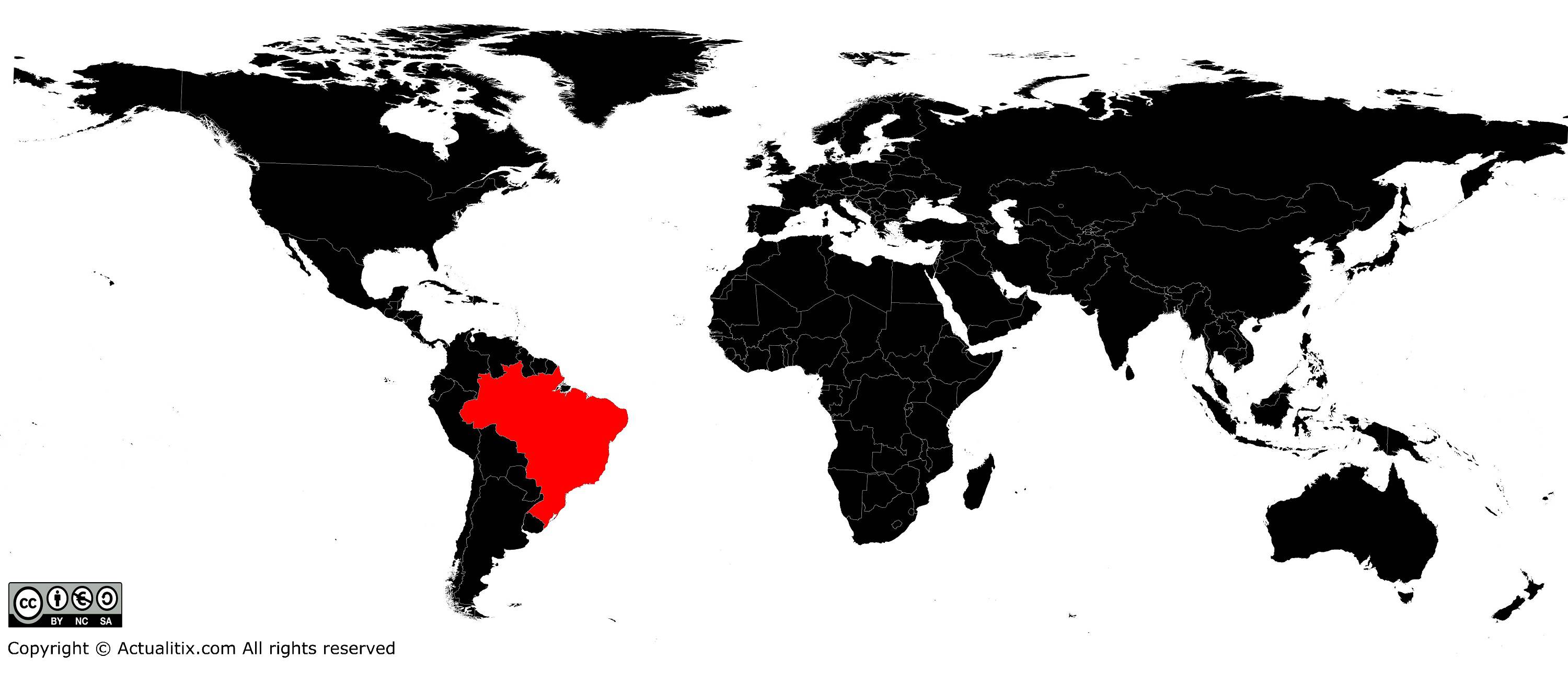
Brazil on the world map – Credit Actualitix.com
As you can see on the map of Brazil, the country’s northern border, along Guyana and Venezuela, is characterized by the presence of a second peneplain relatively similar to that of the Central Plateau. These two peneplains, now separated by a graben (a trench caused by the collapse of a section of the Earth’s crust), originally extended as a continuation of one another.
The Amazon (easy to identify on the map of Brazil) crosses this trench before emptying into the Atlantic Ocean. The Amazon river plains then widen upstream, 1,600 kilometers from there, to form an immense basin that once contained a lake whose waters were drained southward along the Paraguay. The lake bottom was covered with sediments through which the Amazon and its tributaries then had to carve their way. The soils of the Amazon floodplain are not very fertile, because all the nutrients (chemical and organic) they contained were leached out by the torrential tropical rains that affect this part of the territory.
Indeed, the very abundant rains that water the Plateau region swell waterways whose level then rises considerably and floods nearby valleys. As the water recedes, it deposits a very fertile silt on the soils, which explains their very early cultivation dating back several thousand years.
You can discover all the maps available for the different countries of the world on this page.