
Discover a map of China. This is a vast country whose population exceeds one billion inhabitants. It can boast one of the oldest civilizations in the world. Its area of 9,596,000 square kilometers places it just behind Russia and Canada.
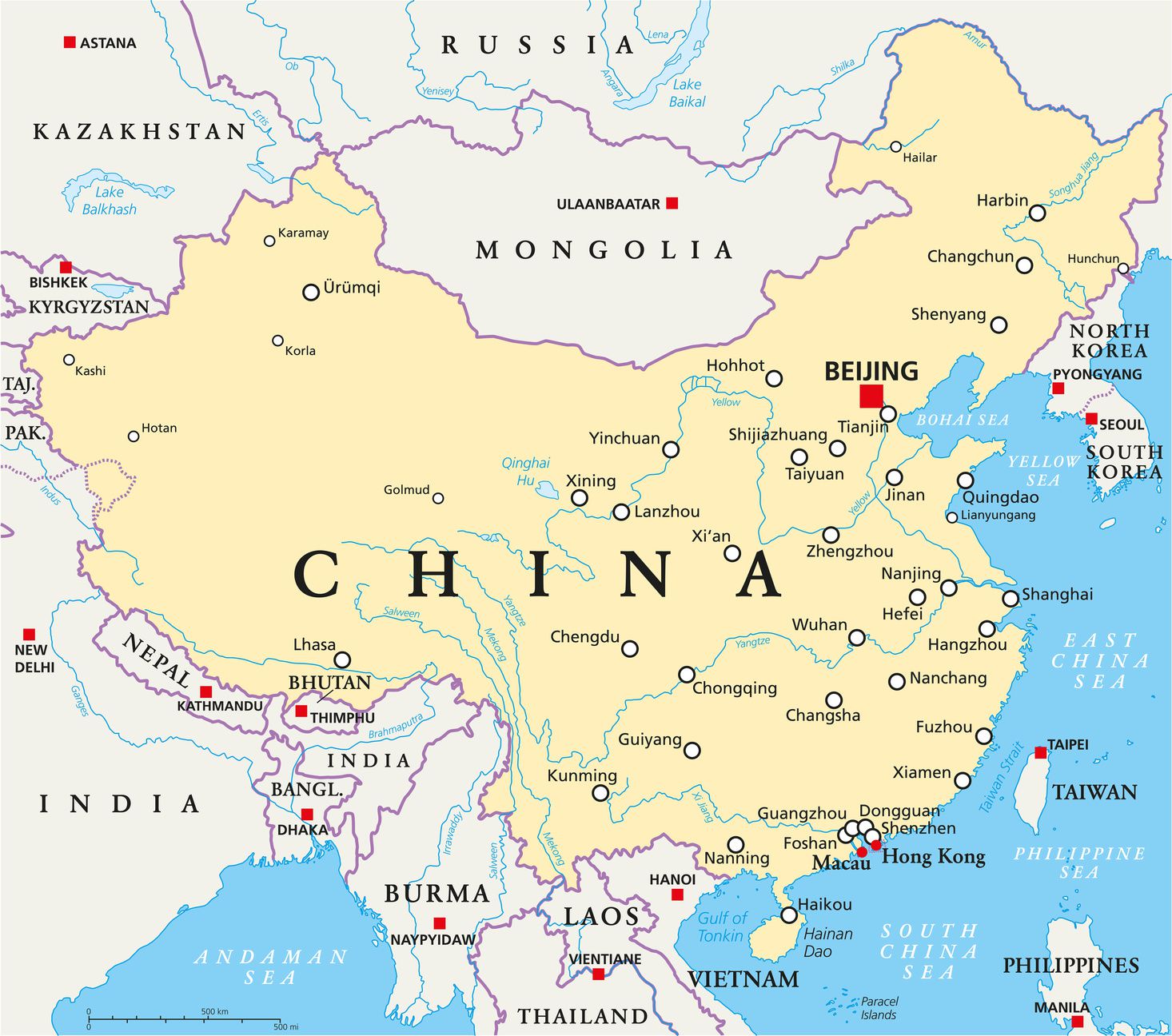
Map of China – © Peter Hermes Furian – stock.adobe.com
In the south-east of the country, the Himalayas—the highest mountain range on Earth—separate China from India (see the relief map of China). The Yangtze River, the longest river in China, is also the fourth-longest river in the world. The Taklamakan Desert, located in the Xinjiang Uyghur Autonomous Region, is one of the most arid places on the planet. You will find the map of China below.
China’s mining potential and natural resources are considerable. Across the territory, many deposits of coal, oil, iron ore, tungsten, tin, bauxite, copper and limestone have been identified. Their exploitation supplies Chinese industry and helps finance, in part, China’s rapid economic development. The surplus is exported abroad.
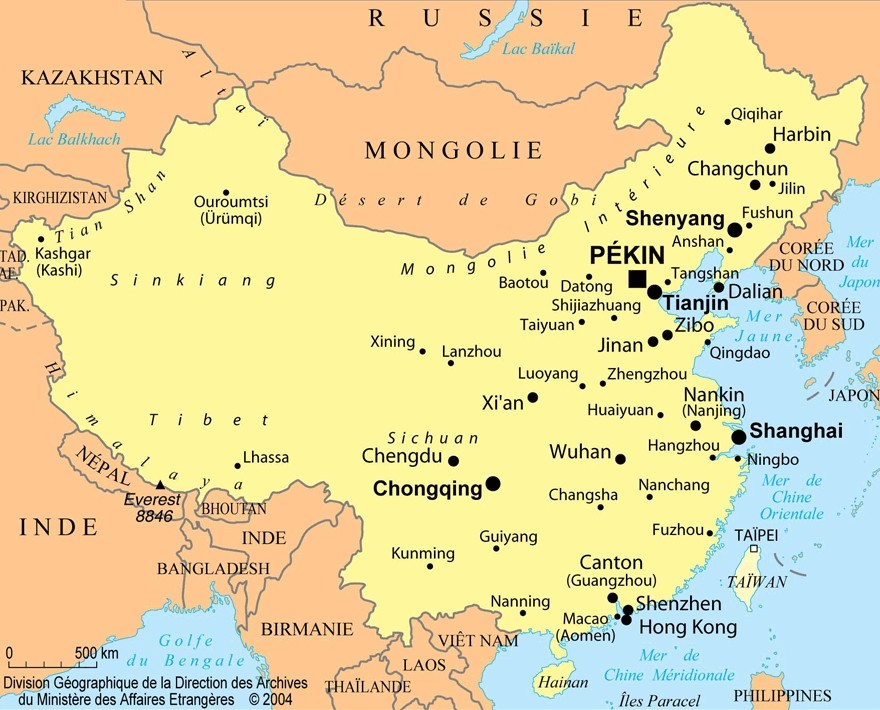
Another map of China – Credit: Ministry of Foreign Affairs
Article outline
Map of China: country overview
It is bordered to the south and east by the South China Sea and the East China Sea, which are major marginal seas of the Pacific Ocean. Eastern China, and in particular the south-eastern coastline, therefore has a humid climate characterized by winters that are much milder than in the rest of the country. As you can see on the map of China, to the west, high mountain ranges form a natural barrier that isolates nearly two thirds of western China, whose climate is relatively dry. Only a few ethnic minorities such as Tibetans, Uyghurs and Mongols live in this rather hostile environment.
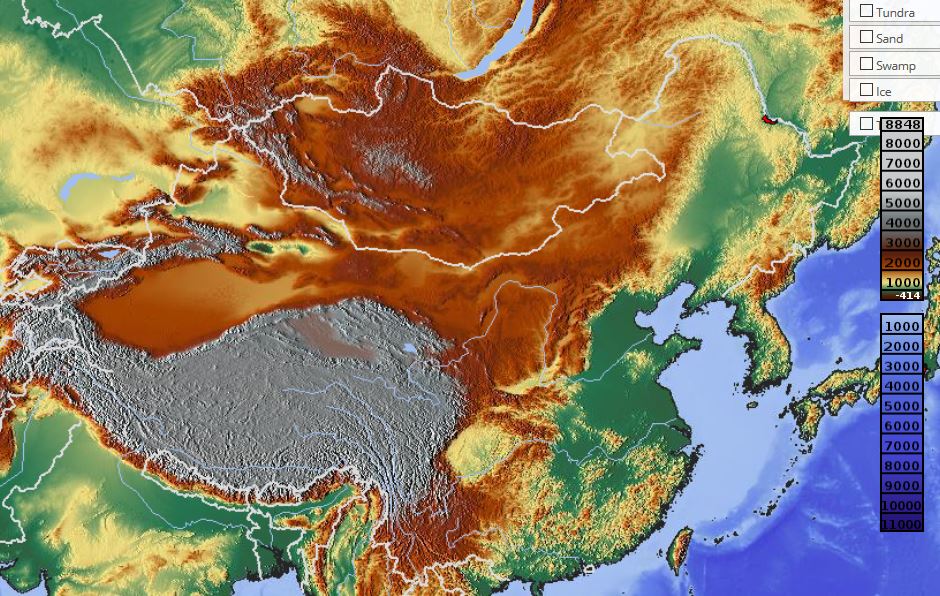
Relief map of China – Image extracted from maps-for-free
Relief on the map of China
The relief is often rugged and irregular. Mountains and hills cover nearly one third of the total area. It is difficult to move from the coastline to the interior as you head west. Transport is hampered by the presence of a whole series of mountain ranges, hills, plateaus and uplifted basins. This difficult ascent ends at the Tibetan Plateau, located on the southern flank of the Himalayas.
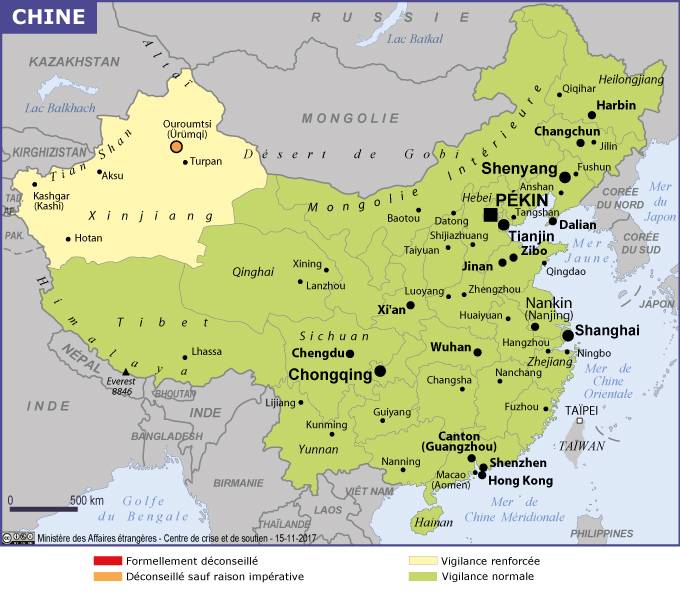
Map of cities in China – Credit: Ministry of Foreign Affairs
The mountain ranges, plateaus and basins found in western China are all oriented toward the east. These include the Himalayas, the Kunlun Mountains, the Tian Shan, the Altai, the Tibetan Plateau, the Tarim Basin and the Junggar Basin. The mountain systems that rise in eastern China, on the other hand, are mostly oriented north–south. You can observe all these elements on the map of China showing relief. By intersecting, these mountain massifs form a kind of characteristic grid that is particularly visible in southern China.
In south-western China, these mountain systems become very steep and are cut by many rivers. In this part of the territory, the subsoil is mainly limestone. The relief has been shaped by erosion, giving rise to spectacular landscapes where natural towers alternate with rounded peaks. These surprising and very picturesque landscapes have greatly inspired Chinese painters.
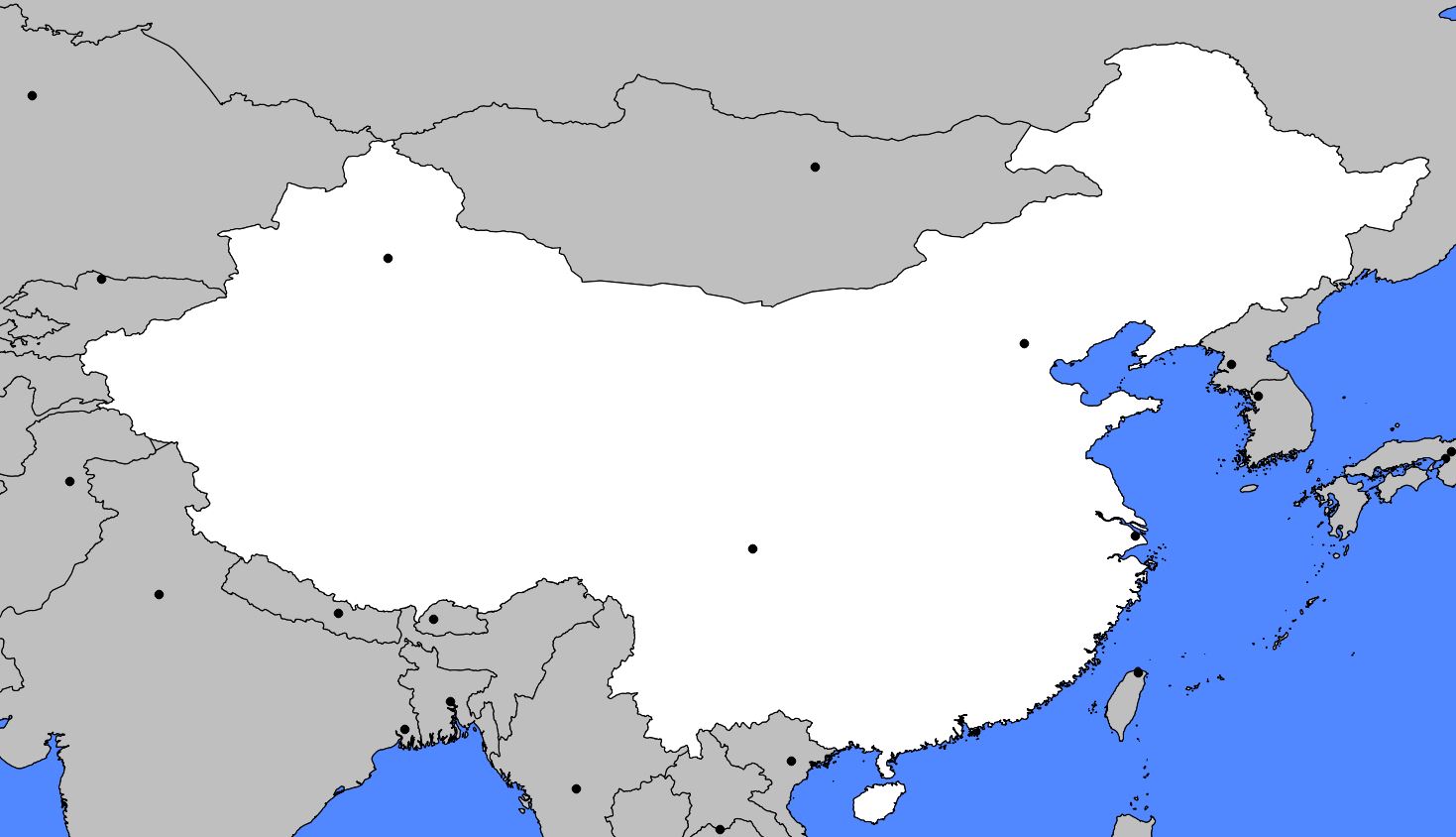
Blank map of China – Credit Actualitix
Main rivers in China
The Huang He (also nicknamed the Yellow River) rises in the eastern part of the Tibetan Plateau and flows east before emptying into the Bohai Gulf. The Mekong, the Brahmaputra and the Salween rise in eastern Tibet and then flow through India and South-East Asia. In the north-east, the Amur marks the border between China and Russia. The Xi Jiang, the longest river in southern China, empties into the Zhu Jiang Delta where the city of Guangzhou is located. You can find the largest rivers on the map of China.
Hostile environments
On the Loess Plateau, the natural environment is quite unique, as loess extends over tens of thousands of square kilometers. This windblown calcareous silt, made up of extremely fine particles, formed over thousands of years thanks to dry winds from the Ordos, Alxa and Gobi deserts. In some places, loess ended up covering the various landforms. In areas where vegetation cover has thinned, soil erosion is particularly severe. During the rainy season in summer, the soil becomes completely gullied.
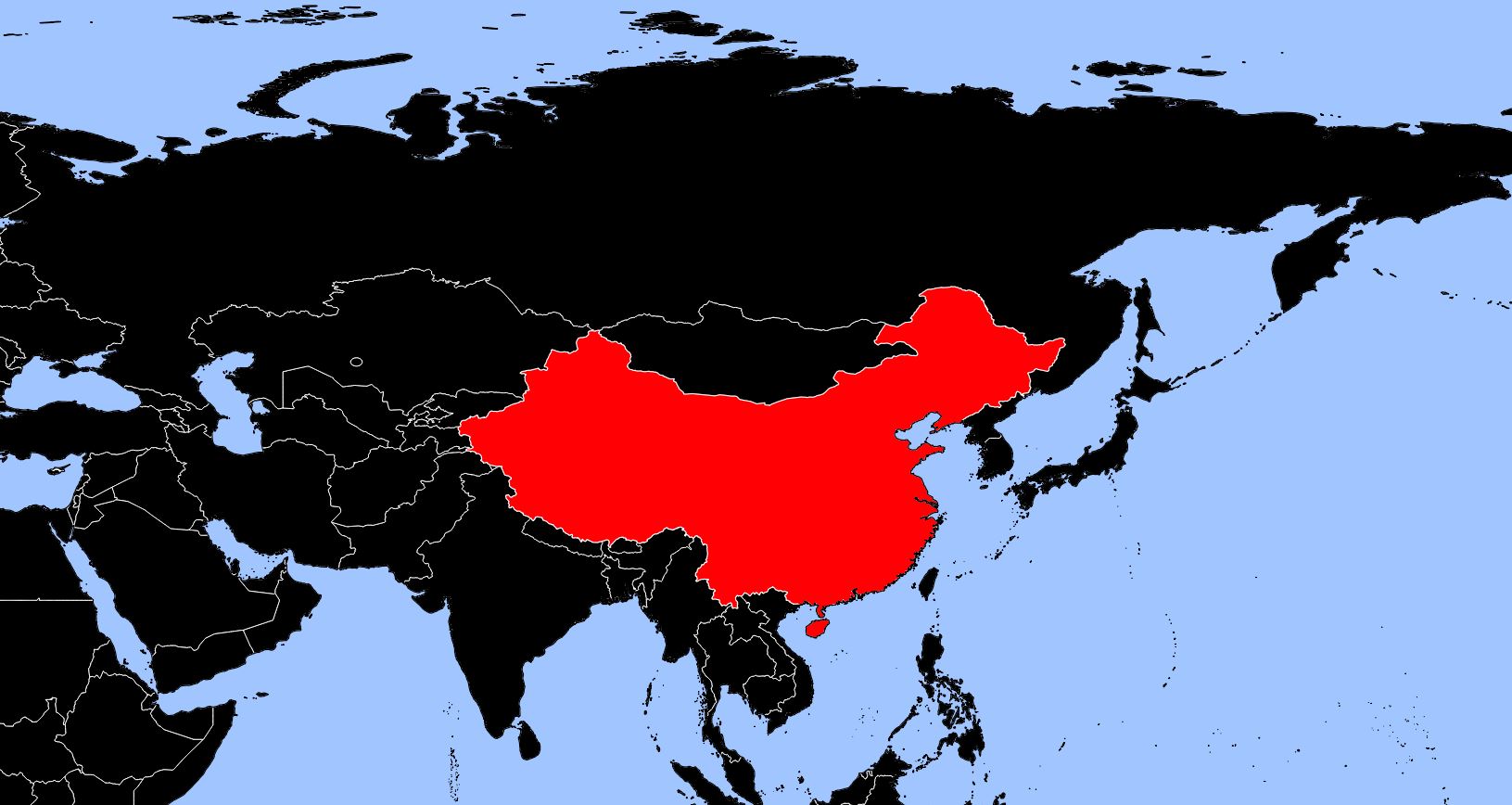
China on a map of Asia – Credit Actualitix
The region where the Wei He meets the Huang He has been nicknamed the “cradle of Chinese civilization”. This part of the territory has been populated since the end of the Stone Age. The progressive cultivation of the land was accompanied by deforestation, which accelerated soil erosion. The soils were then cut by rain, and landslides frequently added to the already muddy bed of the Huang He, also nicknamed the “Yellow River” because of its muddy waters, or the “Scourge of China” because of its frequent and often devastating floods. Several dikes and canals were therefore built to contain its flow.
The south-west of the country, characterized by immense limestone deposits and an extremely complex river drainage system, presents other difficulties. It is difficult to keep water on the surface for use in irrigating fields. In addition, large expanses of arable land are rare. Bringing land under cultivation faces many problems throughout the territory. Soil improvement, the construction of irrigation systems and transport routes are very costly. The economic development of certain regions has therefore often been hampered by their geographic isolation.
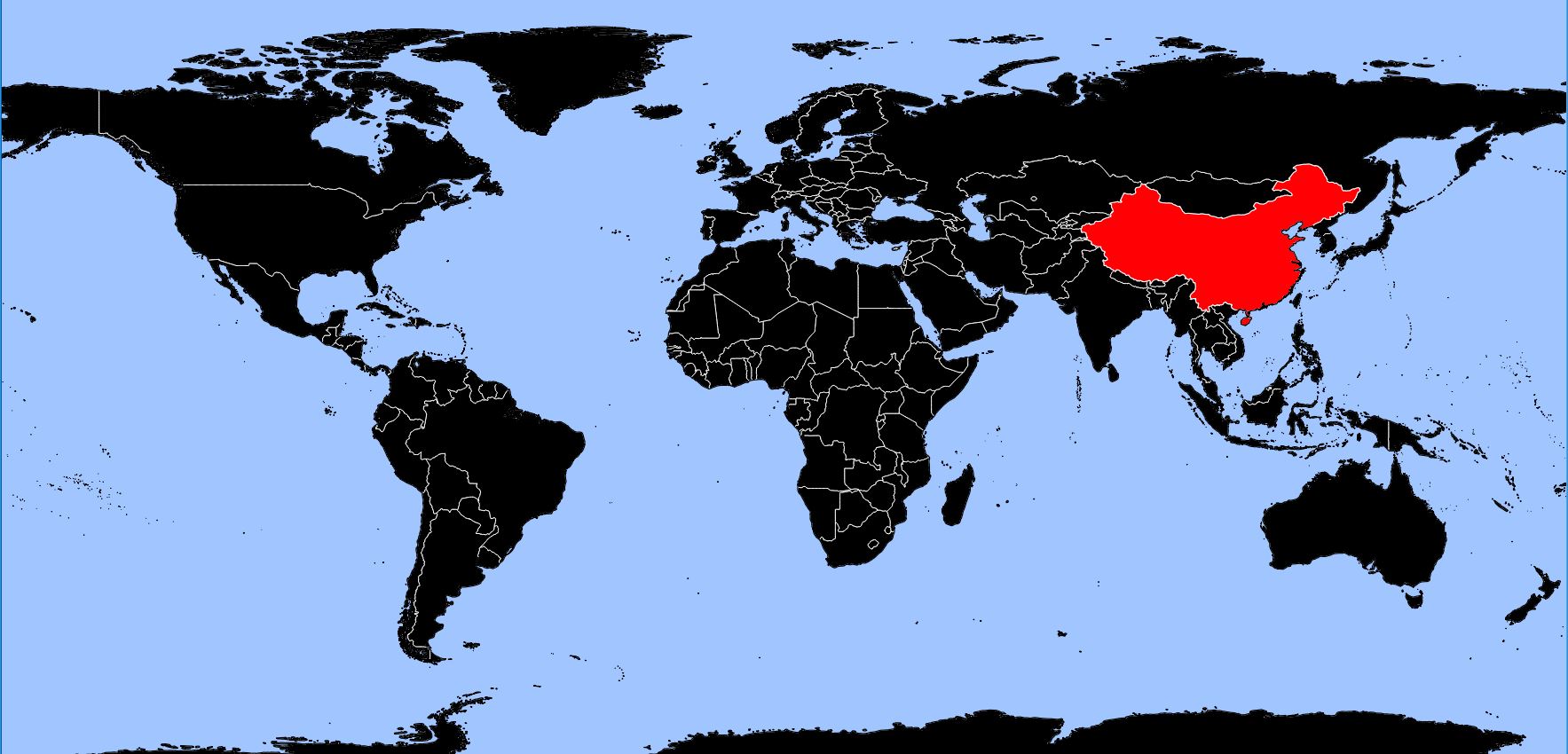
China on a map of the world – Credit Actualitix
Map of China: climate
Climatically, China can be divided into two. We distinguish humid eastern China from southern China with a much drier climate. The humid east of the country is then subdivided into several sub-regions: the south, hot and humid; the temperate south-east; the humid north and north-east. The north-east is affected by monsoon winds; the rainy season therefore occurs in summer. The map of China below presents the different climates found in the country.
Precipitation in the country
Only southern and south-eastern China have sufficient rainfall to encourage the development of agriculture. In the north and north-east of the country, annual precipitation ranges between 500 and 600 millimeters. These climatic conditions are not favorable to rice cultivation and only allow farmers to produce a single harvest per year. Irrigation therefore proves indispensable.
In western China, precipitation is scarce. This mountainous region is largely desert. In Kashgar, in the Tarim Basin, in the far west of the Xinjiang Uyghur Autonomous Region, and in the Junggar Basin a little further north-east, annual precipitation barely reaches 100 millimeters. However, in Lhasa, on the Tibetan Plateau, annual rainfall is slightly higher, around 280 millimeters.
The development of agriculture is greatly penalized by this climatic dryness and is mainly limited to the cultivation of plants capable of withstanding drought, such as Chinese sorghum (gaoliang) and millet. Irrigation is absolutely indispensable throughout this portion of the territory, which explains why settlement in western China mainly took place around oases, near water points. In Tibet, the water problem is less acute, because temperatures are much cooler. Irrigation is nevertheless increasingly used in order to guarantee more regular harvests.
You cannot see it on the map of China, but in summer or autumn, China is often swept by devastating typhoons that form in the western Pacific Ocean. They are relatively similar to Atlantic hurricanes and come with violent winds and torrential rain that usually lasts only a few hours.
These typhoons mainly affect the south-eastern coastline of China, although they sometimes move north toward Japan. Flooding caused by these typhoons is often disastrous, especially in plains and flood basins.
Temperatures in China
With the exception of a few regional variations, temperatures vary notably between the north and the south of the country. South of the Qinling massif, which forms the eastern extension of the Kunlun mountain system, annual temperatures remain high throughout the year and winters are relatively mild (see the climate map of China).
Thus, in the Yangtze basin in south-eastern China, winters are mild and summers particularly hot. Average annual temperatures gradually increase as one moves south toward the tropical coastal regions. They fall abruptly, however, as one approaches the Qinling massif in northern China. This portion of the territory has a continental-type climate characterized by harsh winters. This climate is typical of the regions of Beijing, Xi’an and Harbin.
The length of the growing season varies from one region to another. It is the period during which the temperature remains above 6°C during the day. South of the Yangtze, the growing season lasts at least 300 days, allowing farmers to produce two harvests per year. Along the southern coastline and the south-eastern coasts of China, it lasts all year. Frosts are extremely rare and not severe enough to harm vegetation. In the north of the Yangtze basin, temperatures drop sharply and the growing season decreases rapidly as one moves north, where it ends up being less than 180 days per year.
Cities in China
Cities and their suburbs are home to more than 500 million people. Among the largest cities are: Shanghai (23 million inhabitants), Beijing (21 million inhabitants) and Tianjin (more than 15 million inhabitants). Many cities also have populations exceeding 1 million. Urban population, however, accounted for only 26.2% of the total population in 1990. Below, find the map of China showing the country’s major cities.
Chinese cities are still expanding rapidly. The government is therefore forced to control urban development in order to avoid overpopulation and unemployment issues. Control of urban immigration is strict: it requires obtaining a residence permit and permanent employment. Rural exodus therefore remains under control. Progressive urbanization in China nevertheless remains one of the key factors in the country’s economic development and modernization.
Languages and ethnic groups
More than a question of race, being Chinese is a cultural concept. Being Chinese above all means speaking and behaving like a Chinese person—in other words, conforming in every respect to the country’s value system. The Chinese readily refer to themselves as the “Sons of Han”, in reference to the famous Han dynasty whose reign marked China’s history. Most ethnic groups that came into contact with the Chinese eventually adopted their culture. This process of cultural integration continues to this day, although some measures have been implemented by the government to protect the rights and cultures of ethnic minorities.
Traditionally, minorities are defined by the Chinese authorities as groups of people speaking the same language, sharing the same social values and living in the same region. You can observe the different language groups on the map of China dedicated to languages.
Members of these communities do not consider themselves Chinese and do not claim the cultural heritage of the Han. There are 55 national minorities; 27 of them include at least 100,000 people, and the other 13 each represent at least 1 million people.
Although these minorities are numerically small compared to the rest of the population, they nevertheless play a fundamental role in Chinese society. They occupy strategic territories, generally located along borders. They also maintain close relations with the inhabitants of neighboring countries such as Kazakhstan, Kyrgyzstan, Russia, North Korea, Mongolia, Thailand and Myanmar. These communities are therefore often considered a threat by the Chinese government.
The rights of these minorities are nevertheless partly protected by the structure of the Chinese administrative system. China includes 22 provinces, but also 5 autonomous regions corresponding to the 5 most important national minorities: the Zhuang (42 million), the Muslim Hui (4 million), the Turkic Uyghurs (15 million), the Tibetan Zang (2.2 million) and the Mongols (21 million). These communities live respectively in the autonomous regions of Guangxi Zhuangzu, Ningxia Huizu, Xinjiang, Qinghai (Tibet) and Inner Mongolia (between Mongolia and northern China). There are also autonomous prefectures and counties occupied by smaller minorities.
This administrative system attempts to grant ethnic minorities political rights comparable to those of the Han (Chinese). Mandarin (based on a dialect spoken in the Beijing region) has become the official language of China. Minorities generally coexist without major issues with the Chinese, and the government seeks to encourage them to develop their economy so they can catch up with the Chinese economy.
Religion
Before the communist revolution, many religions were practiced throughout China. Taoism and Confucianism were by far the most widespread. These two philosophical systems both originated in China, during the Golden Age of Chinese philosophy, several centuries before the beginning of the Christian era. You can consult the map of China on religions to learn more.
Buddhism, after developing in India, then spread into China around the 1st century AD. It is a more conventional and less elitist religion professed by nearly 68 million Chinese, who are however rarely practicing. Before 1949, so-called traditional beliefs were also very numerous. Their worship was addressed to local gods and their rites were relatively close to Buddhism and Taoism.
Christian missionaries entered China from the 17th century, followed in the 19th century by Protestant missionaries. Conversions nevertheless remained few, because Christianity was associated in the Chinese mind with Western imperialism. Islam, originating in Central Asia, is today practiced by around 4 million Chinese. It is also the predominant religion in the Ningxia Huizu Autonomous Region.
The communists discouraged the practice of religion, which was considered anti-socialist by the government. During the communist revolution, many temples and churches were destroyed and their lands confiscated. During the Cultural Revolution, from 1966 to 1977, Chinese people practicing a religion were systematically persecuted. This situation ended in 1977 with the reopening of several Buddhist temples. Christians were again allowed to attend mass from the same period. Today, it is estimated that only 2 million Chinese are practicing. The government nevertheless remains extremely reserved regarding religious practices, especially when they involve the participation of foreign representatives.