
Discover a (or several) map(s) of Germany. The country is located in northern Central Europe. The Franco-German border, to the west, has undergone only minor changes over the past two centuries. The same is true of the borders separating Germany from Belgium and the Netherlands.
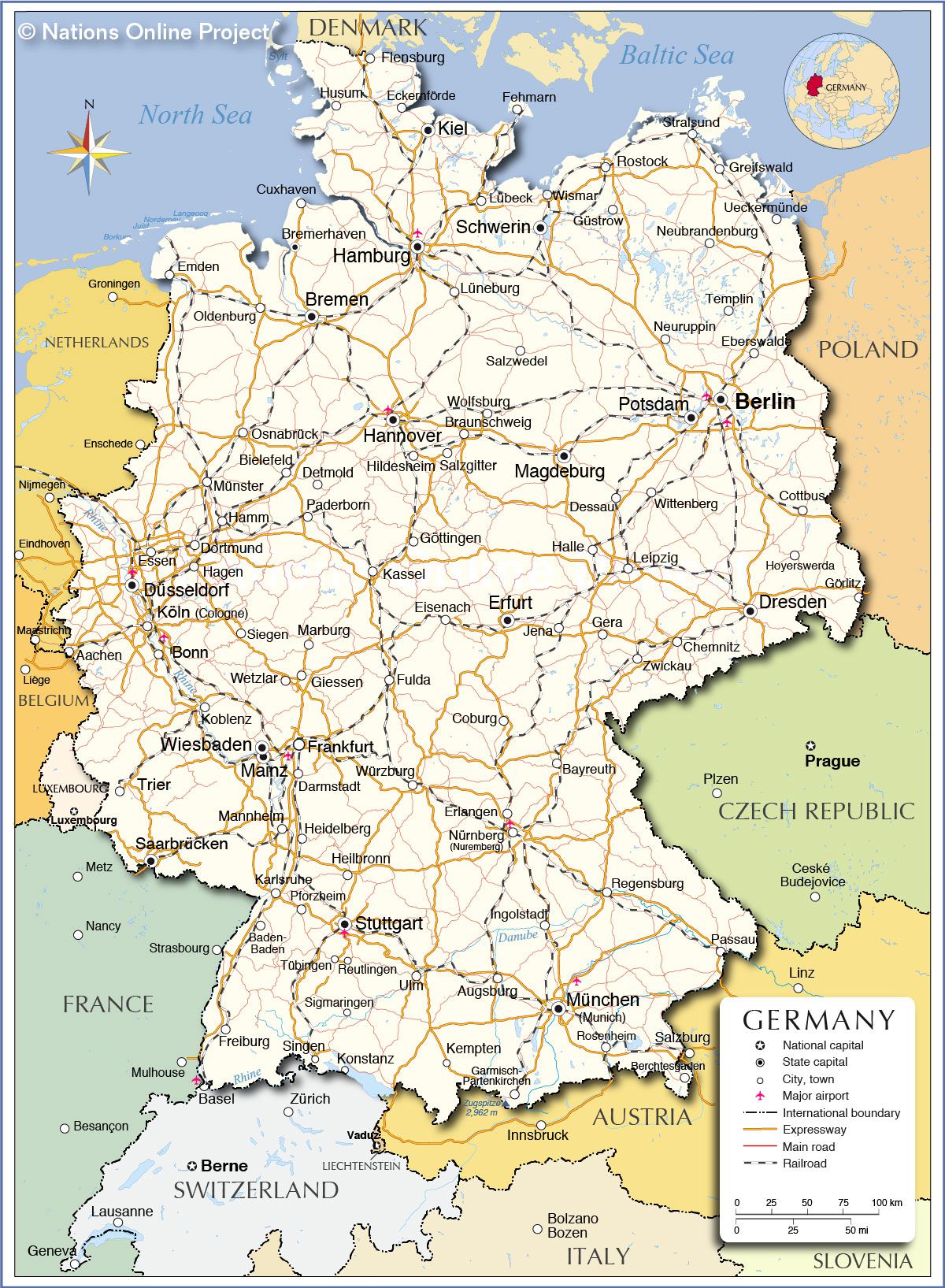
Germany map – Credit Nations Online
The border between Germany and Poland, on the other hand, was modified several times during this period and now follows the course of the Oder and the Neisse. To the east, Germany is bordered by the Czech Republic. To the south, the Alps and Lake Constance mark the Swiss and Austrian borders.
Germany’s total area covers 356,910 square kilometers. It stretches 800 kilometers from north to south, and 640 kilometers from east to west.
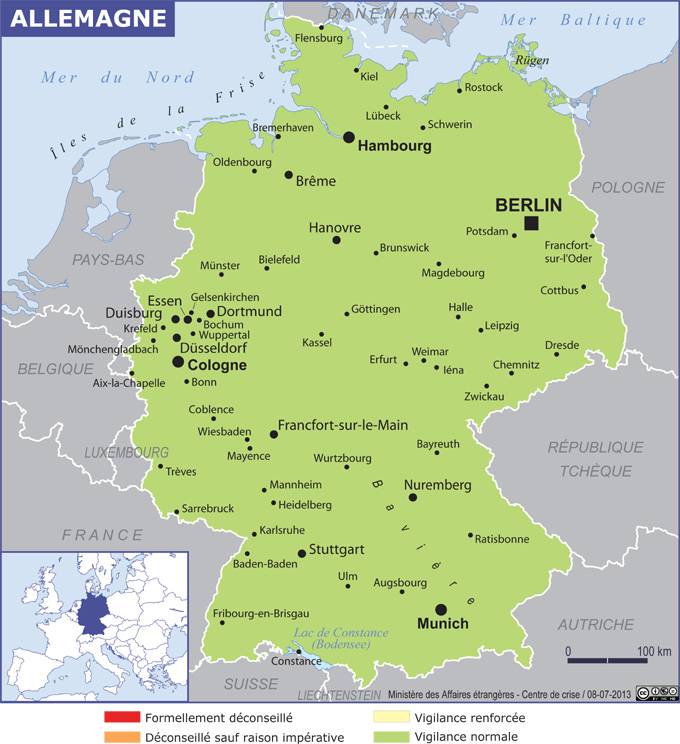
Map of Germany – Credit: Ministry of Foreign Affairs
Regions on the map of Germany
Germany can be divided into four major regions. The largest encompasses much of the immense plain that stretches from the Netherlands to the Ural Mountains in Russia. With the exception of the mountain range occupying its eastern part, the great plain in northern Germany has relatively gentle relief.
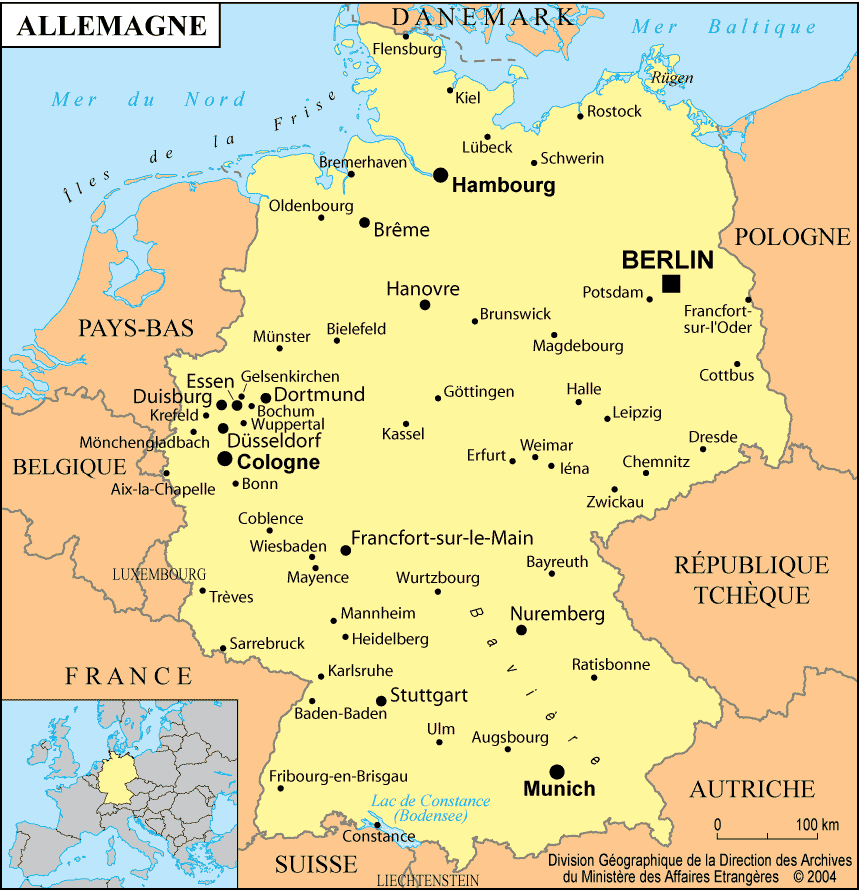
Map of cities in Germany – Credit: Ministry of Foreign Affairs
In the west of the country, the coastline is fringed with heaths, peat bogs and marshes.
A little further south, the topography is more complex and the landscape is marked by a succession of small massifs. Of volcanic origin, they are cut through by a multitude of valleys. To the west, the Eifel massifs (north-western part of the Rhenish Slate Mountains), Hunsrück, Westerwald, Taunus and Hardt rise on either side of the Rhine. The Harz and Thuringian massifs, for their part, occupy the center of the country. The Erzgebirge massif forms most of the border between Germany and the Czech Republic.
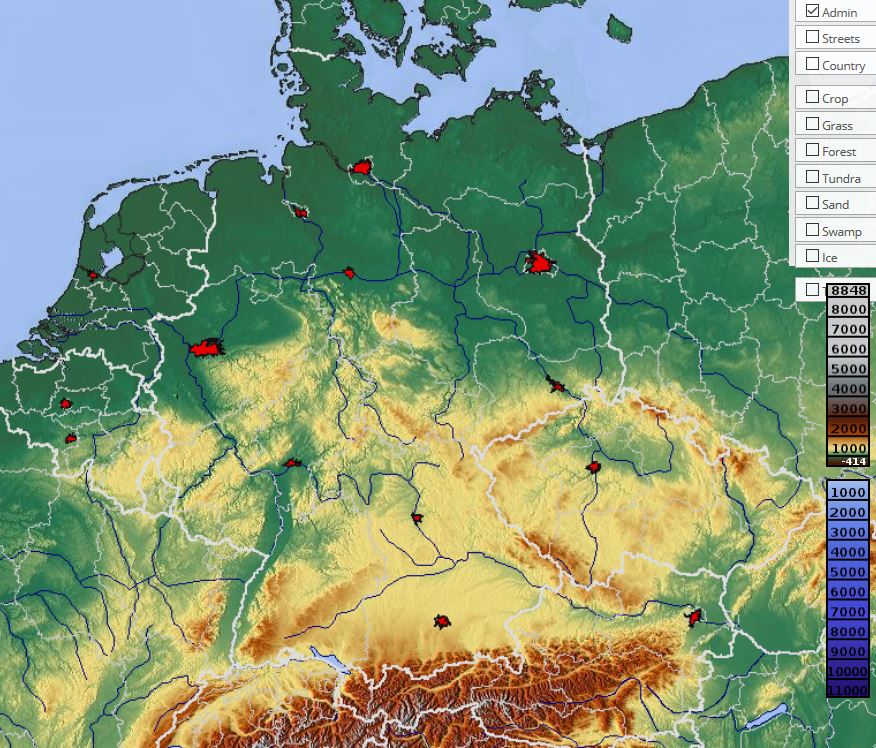
Map of relief in Germany – Image extracted from maps-for-free
The western massifs are generally not very high, but the Brocken and Fichtelberg peaks rise to altitudes of 1,142 and 1,213 meters respectively.
The mountain ranges of central Germany then give way, further south, to a succession of plains and plateaus. This region also includes the Swabian Jura and the Franconian Jura, which stretch from the south-west to the north-east.
These limestone mountain systems have, to the north, very steep slopes. Generally not very high, they are above all famous for their very picturesque landscapes.
To the west, the Black Forest massif stretches north and south. Its highest peak, the Feldberg, rises to an altitude of 1,493 meters. As its name indicates, this massif is covered by a very dense forest famous for its beauty. The Rhine flows westward through a deeply incised valley.
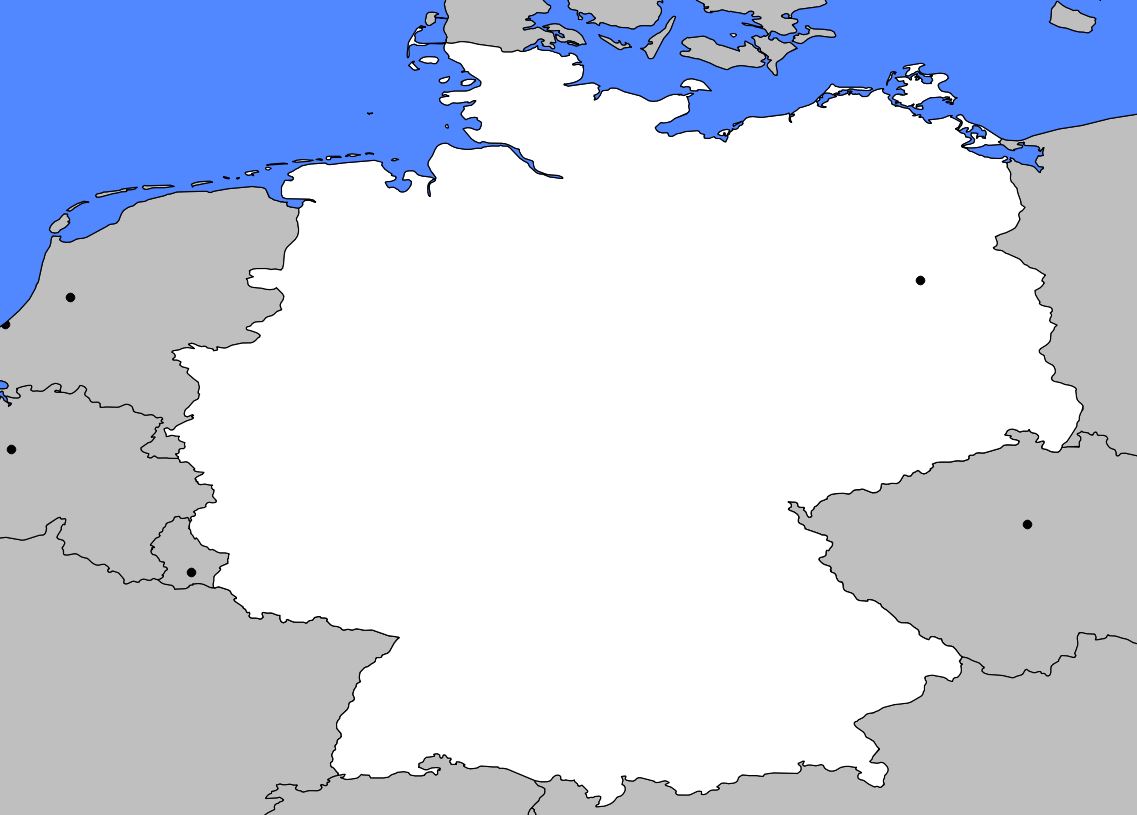
Blank map of Germany – Credit Actualitix
This region of southern Germany also has vast plains and low hills crossed by the Neckar and the Main, two tributaries of the Rhine. To the east, the Bohemian Forest massif forms the border with the Czech Republic.
Its altitude is around 1,430 meters. The Bavarian Alps and the Bavarian Plateau occupy the south of the region. The latter is marked by an alternation of hills and river valleys carved by the tributaries of the Danube, which runs along the north of the plateau. The highest peak in all of Germany, the Zugspitze, is located in the Bavarian Alps and rises to an altitude of 2,963 meters.
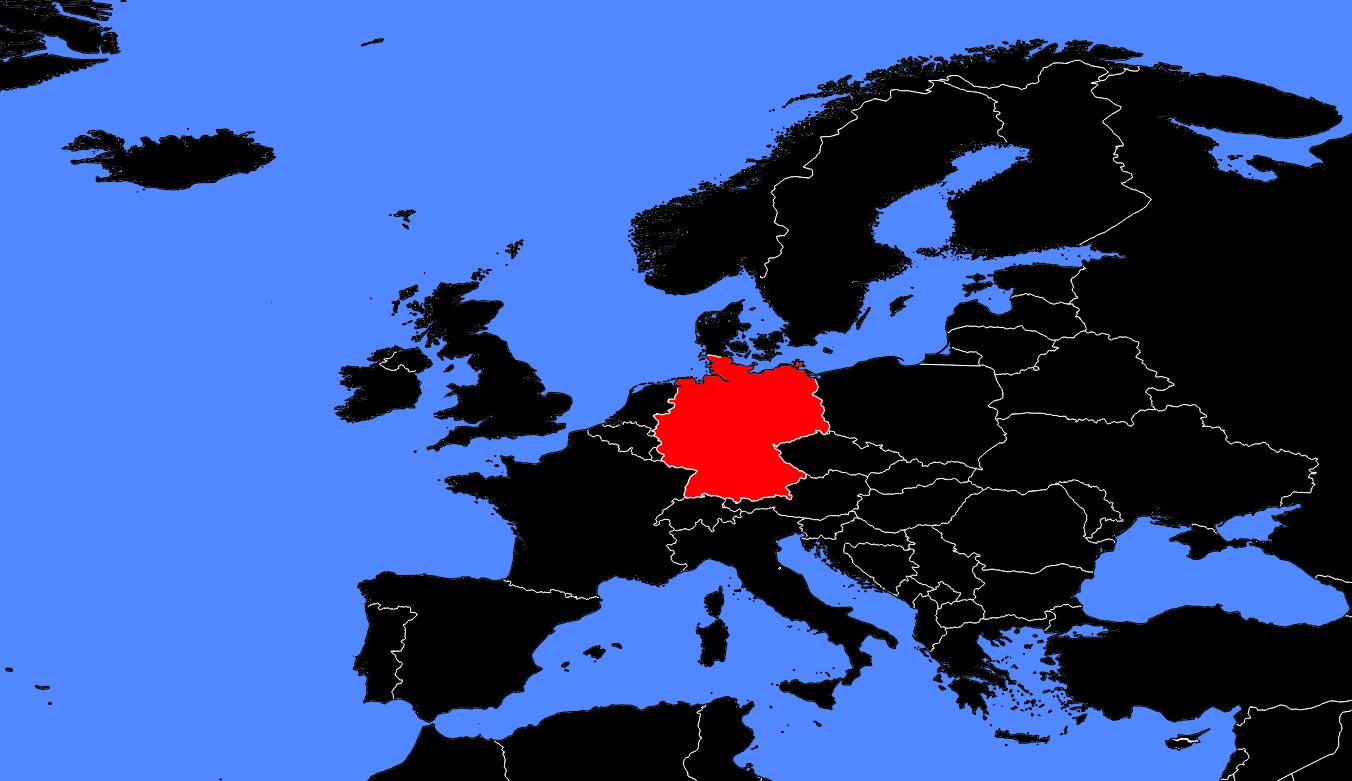
Germany on a map of Europe – Credit Actualitix
Rivers, lakes and waterways in Germany
Most German rivers flow north before emptying into the North Sea. The longest of them, the Rhine, is 1,320 kilometers long. Its main tributaries are: the Main, the Neckar, the Moselle, the Elbe, the Weser and the Ems. The Oder flows into the Baltic Sea and the Danube receives the Iller, the Lech and the Isar before flowing into the Black Sea.
German waterways, generally navigable, are linked by many canals.
Lakes are relatively few in number and vary in size. Lake Constance, the largest, forms the border with Switzerland and Austria. The northern edge of the Alps is fringed by a succession of small lakes, including the Chiemsee, the Ammersee and Lake Starnberg.
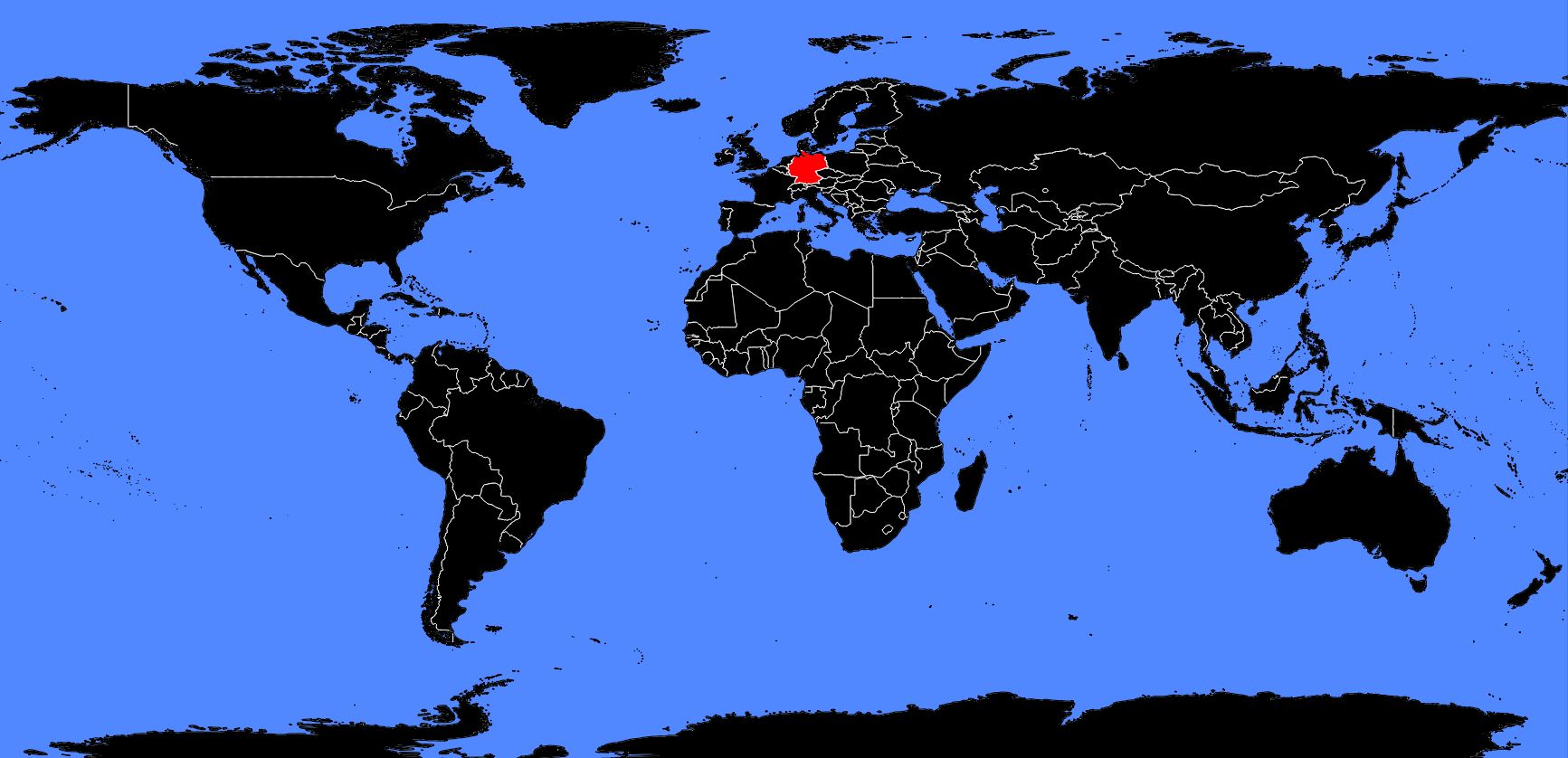
Germany on a map of the world – Credit Actualitix
In the north of the country, the most important lakes are Lake Müritz and Lake Schwerin. They are located between the Elbe and the Oder. To the south of Berlin, the region is dotted with small lakes formed by the Spree and the Havel.
The country’s islands
Off the North Sea coast, several islands follow one another. The East Frisian Islands are the continuation of the North Frisian Islands, which line the coast of the Netherlands and the Danish coasts.
The island of Sylt, the largest of these islands, is connected to the mainland by a bridge. These two archipelagos frame the rocky island of Helgoland. Off the Baltic Sea coast, there are few islands. The largest is without doubt Rügen.