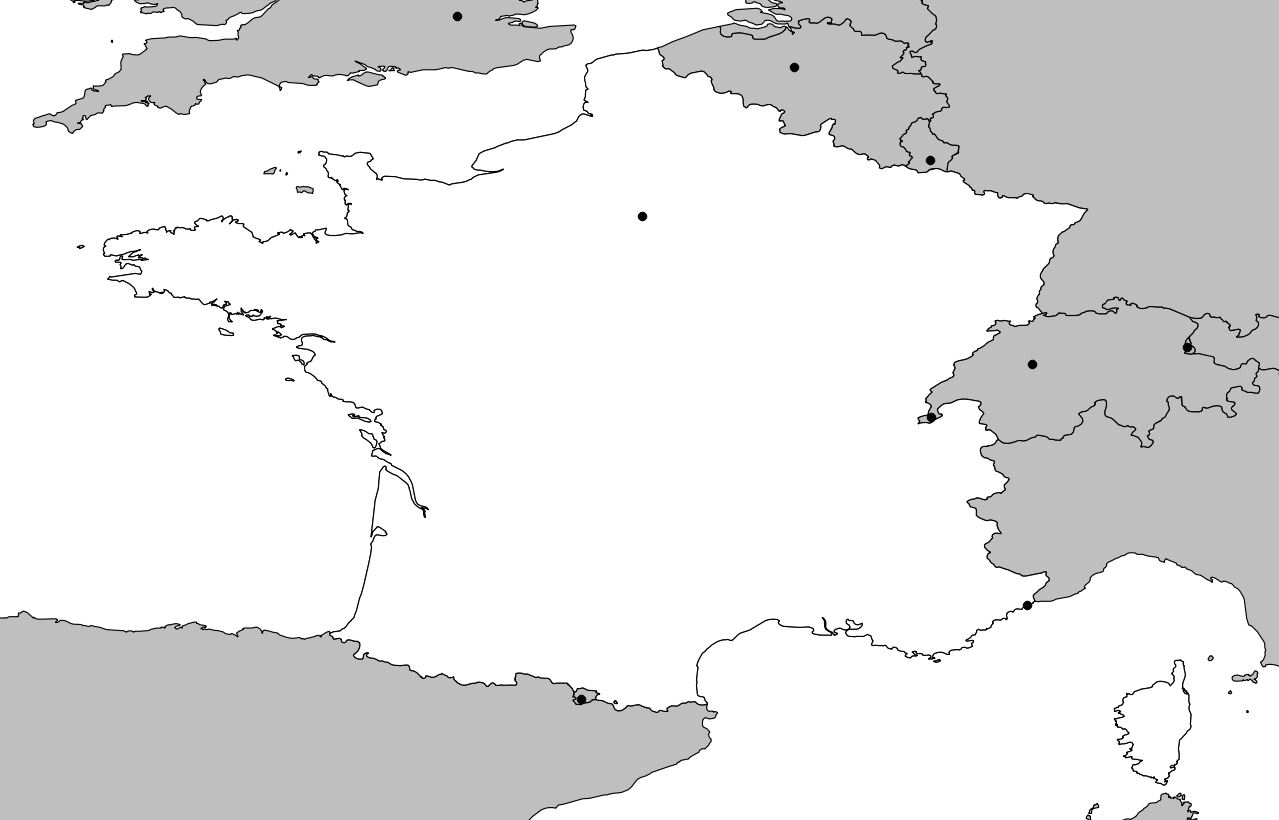
Discover a map of France, one of the largest countries in Europe, immediately after Russia and Ukraine. Famous for the variety of its landscapes, the richness of its cultural heritage and the breadth of its economic activities, this complex nation exerts an undeniable fascination on travelers from all over the world.
The natural environment itself is constantly renewed. It is indeed marked by the harmonious alternation of plains, fertile valleys and mountain ranges, including the Alps and their highest peak, Mont Blanc. Its area is more than 547,030 square kilometers and includes the island of Corsica, in the Mediterranean, in the south of the country on the map of France.
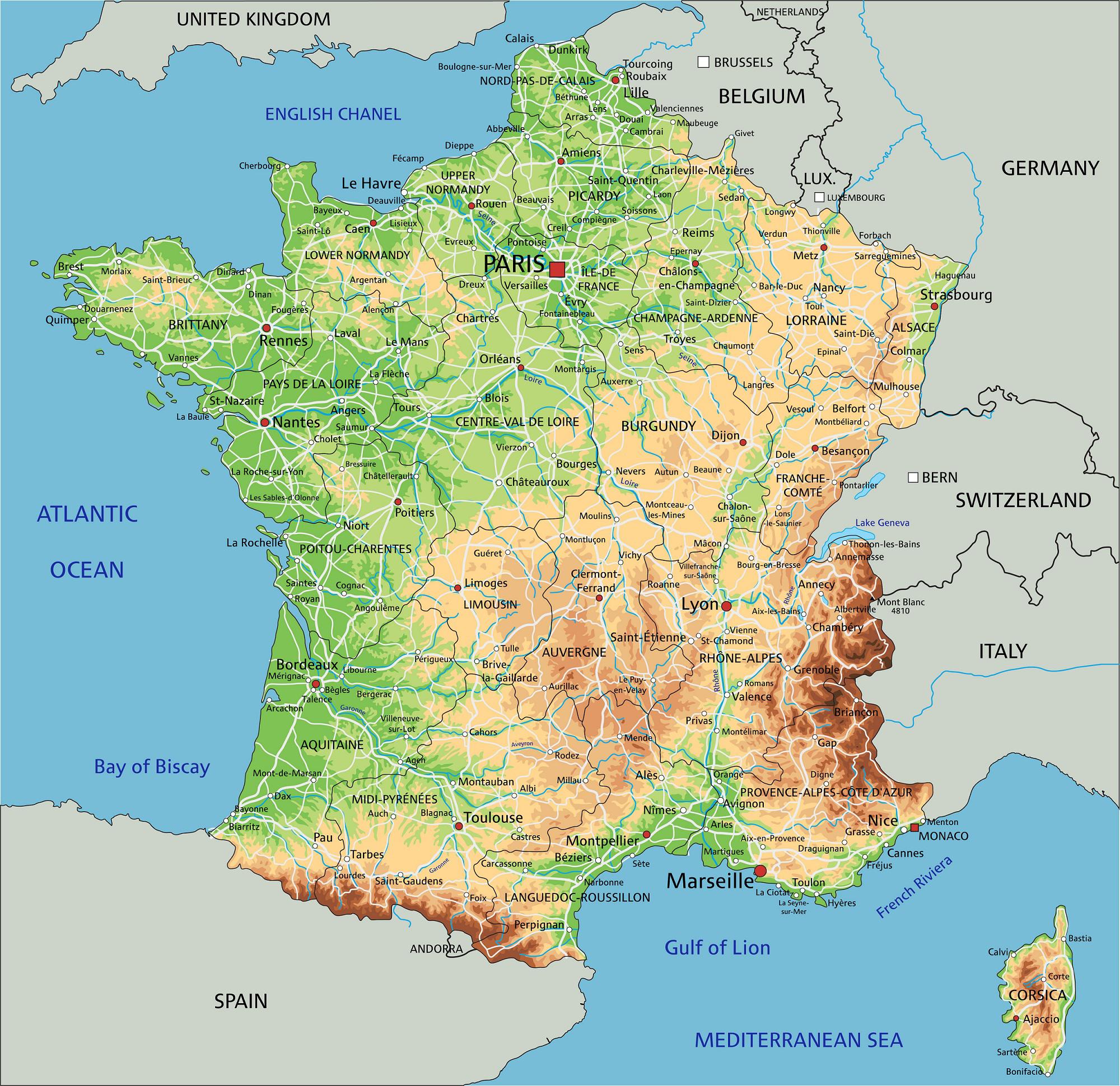
Map of France – © pbardocz – stock.adobe.com
The French coastline is washed by the English Channel, but also by Europe’s main seas: the North Sea, the Atlantic Ocean and the Mediterranean. France is also bordered by Belgium, Luxembourg, Germany, Switzerland, Italy, the Principality of Andorra and Spain (see the map of France). Because of its particular geographical position, its history has been shaped by invasions, immigration and the free circulation of ideas. Its culture, philosophy, gastronomy and craftsmanship are also renowned worldwide.
France, a powerful industrial nation, is also the most important agricultural nation in all of Europe. Its production is exported worldwide and includes, among other things, wine and meat. French is the language most used by international organizations, just after English. France’s cultural influence extends far beyond the narrow boundaries of its territory. It also owes its pre-eminent place in the business world to a traditionally liberal policy, emphasizing human rights and national independence.
Learn more with the map of France
France has several different geographical units whose geological history is often complex. The landscape is marked by the alternation of plains and mountains. The most famous is certainly Mont Blanc, which rises to 4,807 meters in the French Alps, near the Italian border. Find below a map of France.
The north of France and, in particular, the Île-de-France region are characterized by the presence of a huge basin with gentle relief: the Paris Basin. It is made up of layers arranged in roughly concentric rings and sloping toward the center of the basin where Paris is located. They generally end in the form of cuestas. To the north, the Paris Basin then gives way to the plains of Flanders and north-western Europe. The Ardennes and the Vosges, which rise in the north-east and east of the country, are part of the Hercynian massifs that continue beyond the Rhine, as far as central Germany.
In the west, the Armorican Massif and the Cotentin Peninsula in Normandy are made up of ancient rocks, mainly granitic and schistose. In the south-west, the Paris Basin is linked via Poitou to the Aquitaine Basin. Aquitaine has one of the flattest reliefs in the country and its soils are often sandy. The southern part of central France is dominated by the Massif Central, a vast mountain range of volcanic origin rising in Auvergne and Limousin. The peaks are high. Consult the map of France showing relief a little further on in the article.
Their altitude ranges between 1,200 and 1,800 meters. Transport links and economic development in this region are therefore largely hindered by this rugged terrain.
Mountains in France
Southern France is home to some of the most imposing mountain ranges in Europe. To the east of the Massif Central, the parallel chains of the Jura give way to the Alps. These rise on the edge of the Mediterranean, where they are known as the Maritime Alps, continue northward and then turn east before extending into Switzerland and northern Italy. In the north, the French Alps have undergone intense glacial erosion, leading to the formation of broad valleys that provide relatively easy access to the steepest areas. Below, the map of France showing relief will help you better understand this diversity. You can also consult the article on the relief of France.
The Pyrenees separate France from Spain. Although their altitude is lower than that of the Alps, they are in some ways much more impressive. They result from the uplift and fracturing of a rigid rocky core. Little marked by glacial erosion, they are therefore much less accessible than the Alps, because mountain passes are rare and difficult to cross.
Pic de Vignemale, their highest peak, rises to 3,298 meters. Altitudes are, however, much higher on the Spanish side of the border, where they can exceed 3,350 meters. To the east of the Rhône, the Alps run along a particularly jagged coastline. To the west of the Rhône, the fertile plain of Languedoc stretches south from the mountain foothills of the Massif Central.
Rivers in France
France is drained by five major rivers. The most famous is undoubtedly the Seine, which rises in Burgundy, crosses Paris and then flows into the English Channel near Le Havre. Its main tributaries are the Marne, the Oise and the Eure. It drains most of the Paris Basin and Upper Normandy. It is also one of the main navigable waterways serving Paris. The map of France below shows the main rivers in France.
The Loire has the largest drainage basin in the country. Its main tributaries are the Cher, the Vienne and the Sarthe. Born in the Massif Central, it first crosses the Pays de la Loire before flowing into the Atlantic via a long estuary not far from Nantes.
The Rhine rises in the Swiss Alps. It crosses the Netherlands and then forms the Franco-German border before draining, with its main tributaries—the Moselle and the Meuse—most of Alsace and Lorraine. The river is easy to spot on the map of France.
The source of the Rhône, the largest river in south-eastern France, is also in Switzerland. Fed, among others, by the Saône and the Isère, the Rhône crosses southern Burgundy, the French Jura and most of the French Alps before flowing into the Mediterranean, forming a vast delta west of Marseille.
The Garonne drains the regions of south-western France. Born in the Pyrenees, it flows north before being fed by the Lot and the Dordogne in the Massif Central, then by the Ariège in the Pyrenees. It then crosses a large part of the Aquitaine Basin before flowing into the Atlantic, forming a shared estuary with the Gironde.
Climate in France
France’s climate is rich in nuances, since oceanic, Mediterranean and continental climates are all represented. It is nevertheless fairly moderate, as climatic extremes, droughts and storms are relatively rare. Below is the map of France showing climate; you can also consult the article on this topic.
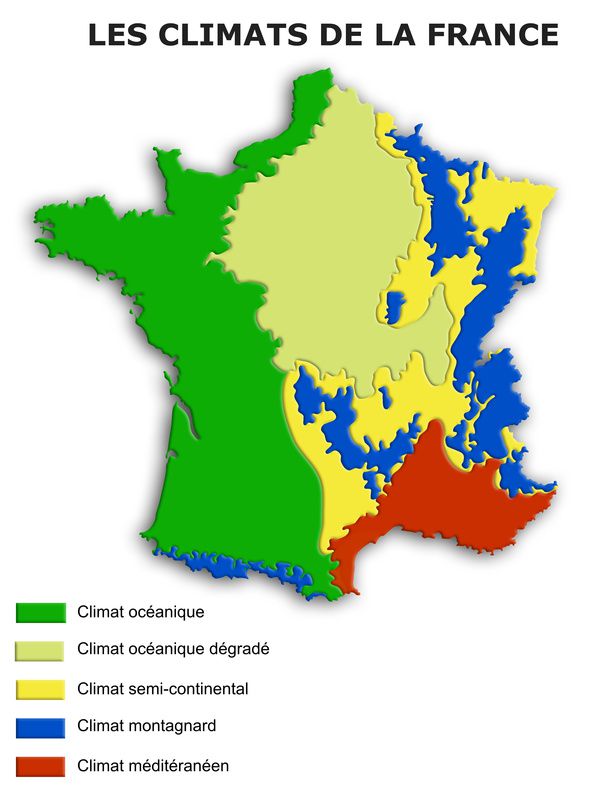
Map of France’s climate – © Aurélien Antoine – stock.adobe.com
The oceanic climate affects most of the territory. It essentially characterizes the coastline exposed to westerly winds, but also extends inland.
Thermal contrasts are not very significant: winters are mild and temperatures rarely fall below zero, while summers are relatively cool. In Brest, Brittany, average temperatures in January and July are 7°C and 17°C respectively.
The Mediterranean climate predominates along the entire southern coastline up to the mountain foothills of the Alps. This climate, which takes its name from the Mediterranean Basin, affects the western coastline of all countries located between 30° and 40° north and south latitude. It is characterized mainly by hot, dry summers and mild winters. In Nice, for example, the average January temperature is around 8°C. Thanks to the presence of the Alps, the Pyrenees and the Massif Central, temperatures remain higher than in northern France and sunshine is much more abundant.
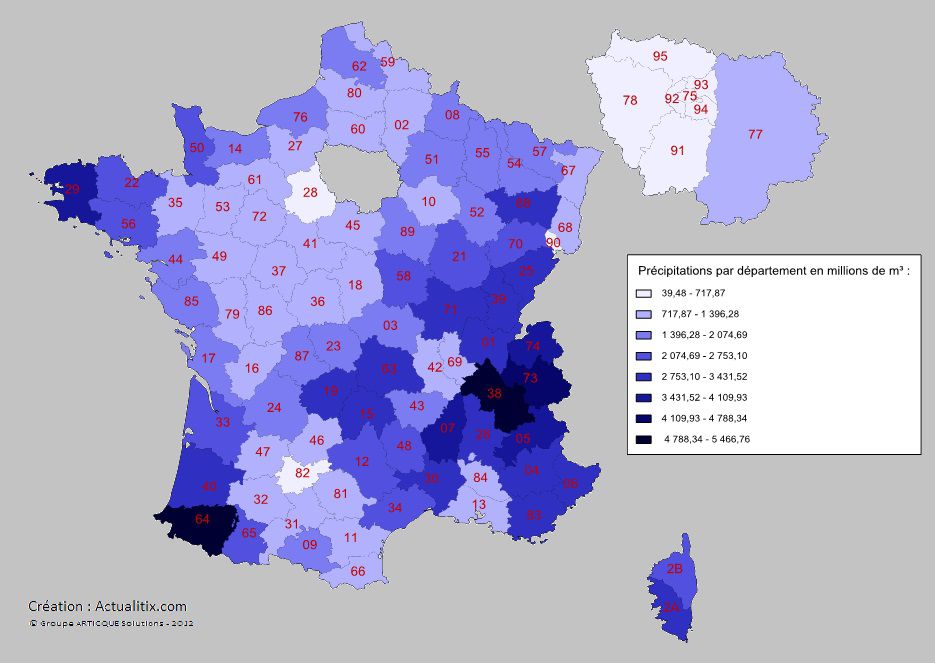
Map of precipitation in France
In summer, this whole area is influenced by warm currents from North Africa that generate dry, subtropical weather. During this season, although temperatures are generally very high inland, rainfall is scarce, or even completely absent. Below is another map of France about climate, and more specifically about precipitation in the country. (You can also consult precipitation by department.)
The continental climate mainly affects the east of the country and, in particular, inland areas and mountainous regions. It is characterized by harsh, snowy winters and relatively warm summers. In winter, moisture-laden winds circulate easily throughout the territory, which is why snowfall is particularly abundant in the Alps and the Jura. However, the coldest temperatures are mainly recorded on the highest peaks.
Forests in France
In the past, forests covered almost the entire territory. The natural environment has, however, been shaped by humans over the centuries. Plant life also depends closely on the climate and soil characteristics. In regions benefiting from an oceanic climate, vegetation is dominated by ancient deciduous forests composed of oaks, beeches, maples, chestnut trees and ash trees. See the map of France showing forest areas.
The north and east of the country as well as mountainous regions, where winters are particularly harsh, are home to immense coniferous forests. You mainly encounter pines, spruces and fir trees. These trees also grow on the sandy soils that characterize a large part of the coastline.
In regions where granite outcrops are numerous and winds are strong, climatic and geological conditions have hindered forest development. This is especially true of Brittany and certain areas of the Atlantic coast. Vegetation is therefore dominated by frost-resistant annual plants such as gorse, heather and furze. In the higher regions of the Alps and the Pyrenees, forests then give way to shrubs typical of alpine tundra.
Mediterranean regions have vegetation made up of drought-resistant plants that form what is known as the maquis. This is especially characteristic of Corsican landscapes.
Garrigue, for its part, grows on the limestone hills of Provence. The vegetation of the Mediterranean coastline includes many species of drought-resistant trees such as pines, olive trees and holm oaks.
The only natural meadows in France are found in the Rhône delta, in the Camargue.
Tourism and its importance
Tourism is a particularly prosperous economic sector. France is indeed famous worldwide for the variety of its landscapes and its contrasted climate. Its cultural, artistic and architectural heritage is among the richest on the planet, and the reputation of its gastronomy and wines needs no introduction. It therefore attracts many tourists from Asia, Latin America, the Middle East, North America and Europe. Below is the map of France showing the main tourist sites; you can consult the article for more information.
French people themselves like to visit their own country. The first paid holidays were introduced in the early 1930s and were accompanied by a considerable boom in family tourism in the years that followed. Nowadays, French people generally have five weeks of paid vacation per year. Paris remains one of the main tourist destinations, both for foreign travelers and for the French.
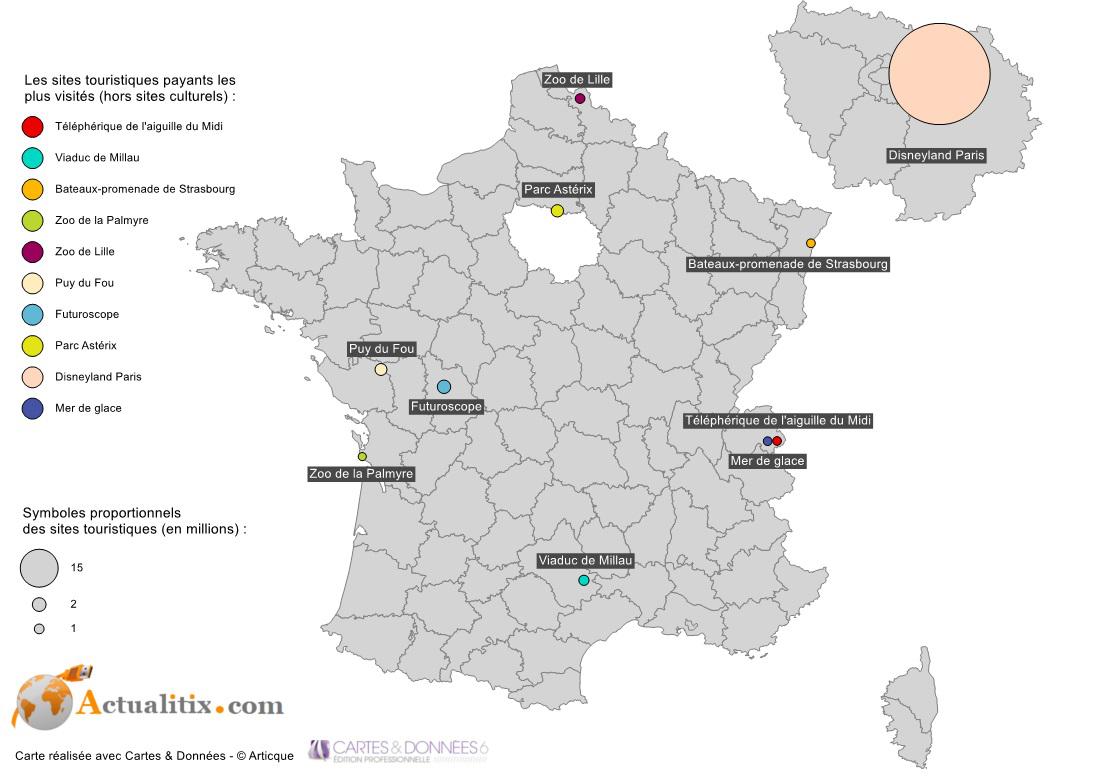
Map of tourist sites in France
This city, one of the most visited places in the world, is home to a multitude of restaurants and shops. The lively Latin Quarter, the presence of numerous monuments and museums such as the Eiffel Tower, the Louvre Museum, the Arc de Triomphe, Notre-Dame Cathedral or the Georges Pompidou Center make it a very picturesque city.
The Mediterranean coast is also one of the most sought-after destinations. Provence and the French Riviera attract a considerable number of tourists. Sheltered by the Alps, the French Riviera became popular in the early 1860s. Wealthy tourists would come to spend the winter there in complete tranquility. This craze was originally started by the British. The region’s reputation then crossed borders, and the Riviera eventually became a highly prized seaside resort.
Recent years have been marked by the development of tourism in high mountain regions, which have benefited greatly from the popularity of winter sports.
In the past, mountain stays mainly took place in summer, for medical reasons.
Now, the tourist season lasts almost all year and certain ski resorts, such as Chamonix and Morzine, enjoy an international reputation.
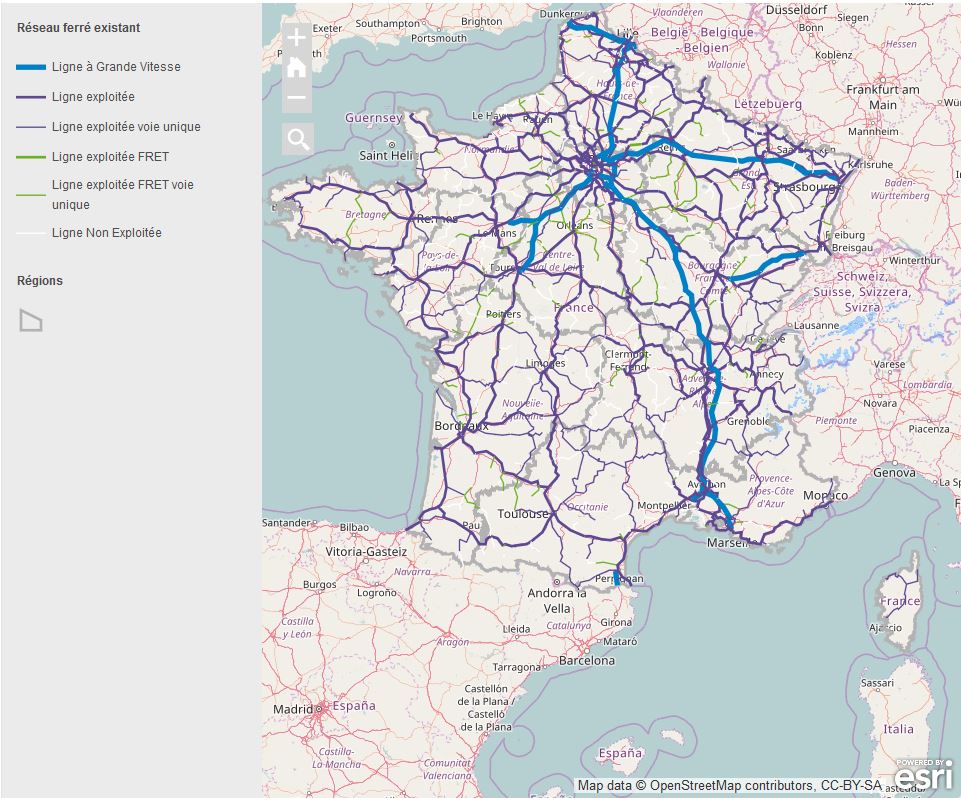
Map of the rail network in France
Transportation in the country
Transportation has played an essential role in the nation’s administrative unification and has helped foster the economic growth of many regions. It also efficiently connects France to the rest of Europe and the world. The main routes of communication all converge on Paris. The Industrial Revolution was accompanied by many innovations in transportation, and in particular by the construction of a relatively complex canal system linking the main waterways and making it possible to transport, at low cost, the output of factories and mines. In this part of the article, you will find different maps of France relating to transportation (highways, railways, airports, etc.).
The construction of the first railway lines coincided with the peak of river transport. The first railway line was inaugurated in 1827 and the rail network then quickly expanded to the rest of the country. Most railway lines radiated from Paris, thereby reinforcing the importance of the capital. Railways also channeled rural exodus toward the capital, since it was one of the most accessible necessary transit points.
The invention of the automobile at the beginning of the 20th century, followed closely by that of the airplane, had considerable repercussions in the field of transportation. The road network that gradually developed was, however, built on the same model as the rail network, with Paris as its central core. The first air links were established in 1919, from the airport located at Le Bourget.
Today, French transportation faces the rapid pace of technological change and the obsolescence of many vehicles. It must also try to limit the capital’s overwhelming dominance. Since the early 1960s, several ambitious projects have helped modernize the road network by building new highways. While these still largely radiate from Paris, engineers have nevertheless made immense efforts to try to bypass the capital as much as possible. Below is the map of France showing the rail network.
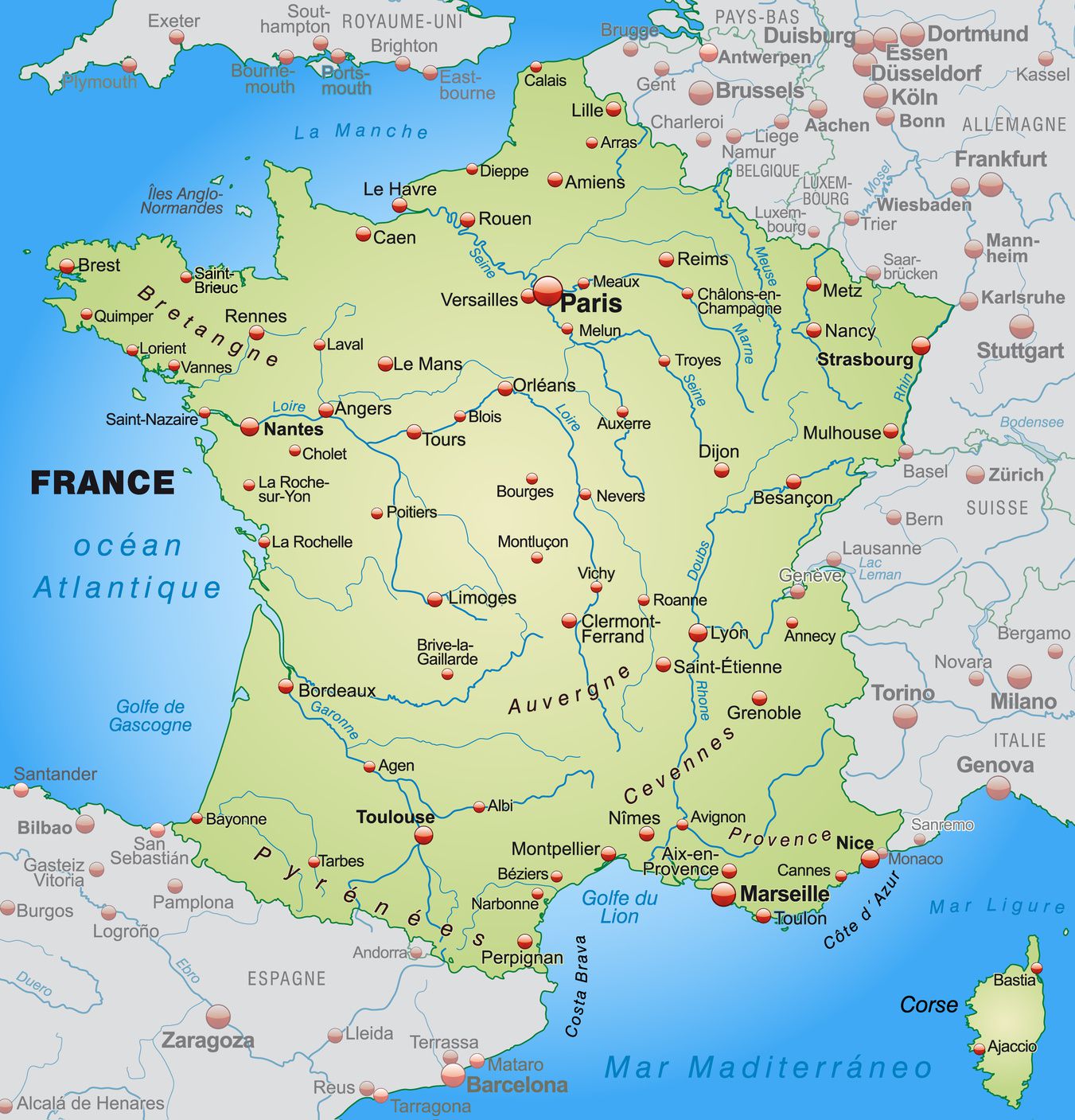
Map of cities in France – © Artalis-Kartographie – stock.adobe.com
Despite a clear decline, the rail network nevertheless remains relatively efficient. The TGV makes it possible to connect Paris and Lyon in two hours instead of four and should serve many other cities in the coming years. Air traffic has, for its part, grown remarkably. Paris has two airports: Orly, to the south, and Charles de Gaulle, to the north-east. With Le Bourget, they handle traffic of nearly 30 million passengers per year, making Paris one of the main air hubs, immediately after London. The country also has several international airports located, among others, in Marseille, Lyon, Nice, Lille and Strasbourg.
Administrative divisions of France
France is divided into 95 departments in metropolitan France. They were often named in reference to the rivers that run through them or the mountains they contain. Their creation dates back to the French Revolution, when they replaced the old provinces that divided the country under the monarchy. Executive power is exercised at regional and departmental level by regional assemblies and departmental councils. Below is a map of France showing the division into departments, but also the division into regions. Consult the corresponding articles by clicking the links above.
The departments themselves are subdivided into arrondissements, cantons and communes. Across the territory as a whole, there are around 36,400 communes.
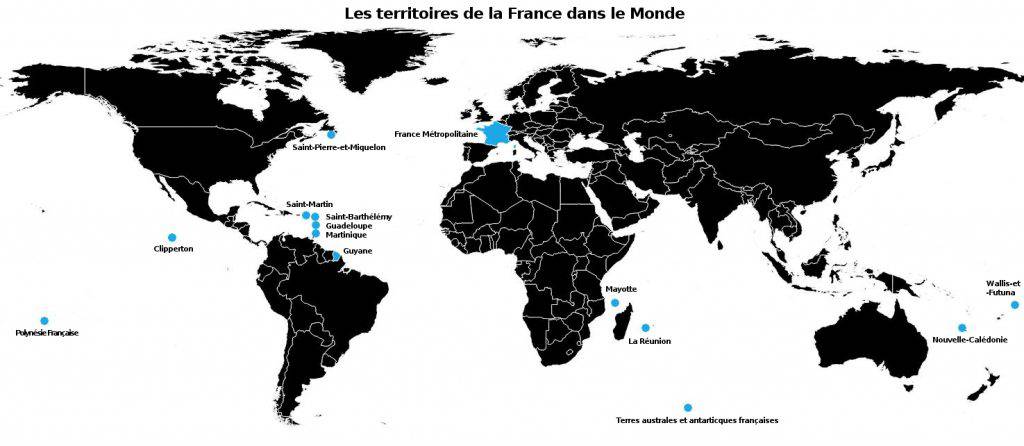
Map of France’s territories in the world
The French Republic also includes 5 overseas departments: French Guiana, Guadeloupe, Martinique, Mayotte and Réunion, as well as four overseas territories: French Polynesia, the French Southern and Antarctic Lands, New Caledonia and the Wallis and Futuna Islands. Mayotte and Saint Pierre and Miquelon have the status of territorial collectivities. They can be seen on the map of France showing the country’s full territory.
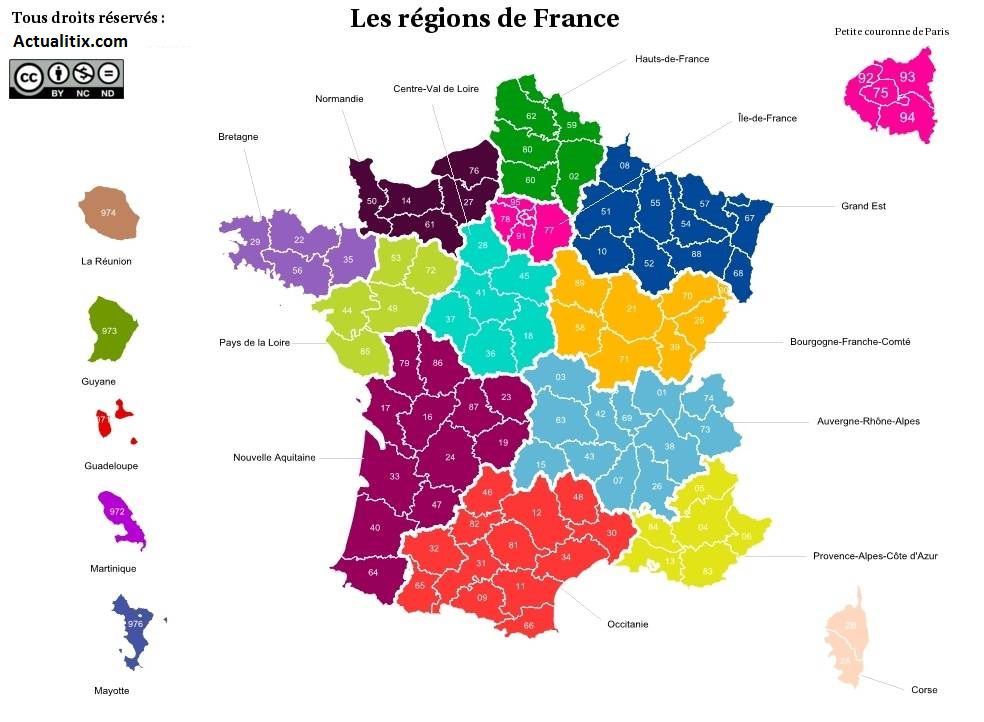
Map of the regions of France
Regional policy
For centuries, the French government emphasized the centralization of power. This policy corresponded to specific historical facts. Under the monarchy, the sovereign had to contend with the ambitions of many members of the nobility. He therefore had to base his strength on the centralization of military power and economic power. You can see the map of France showing the regions.
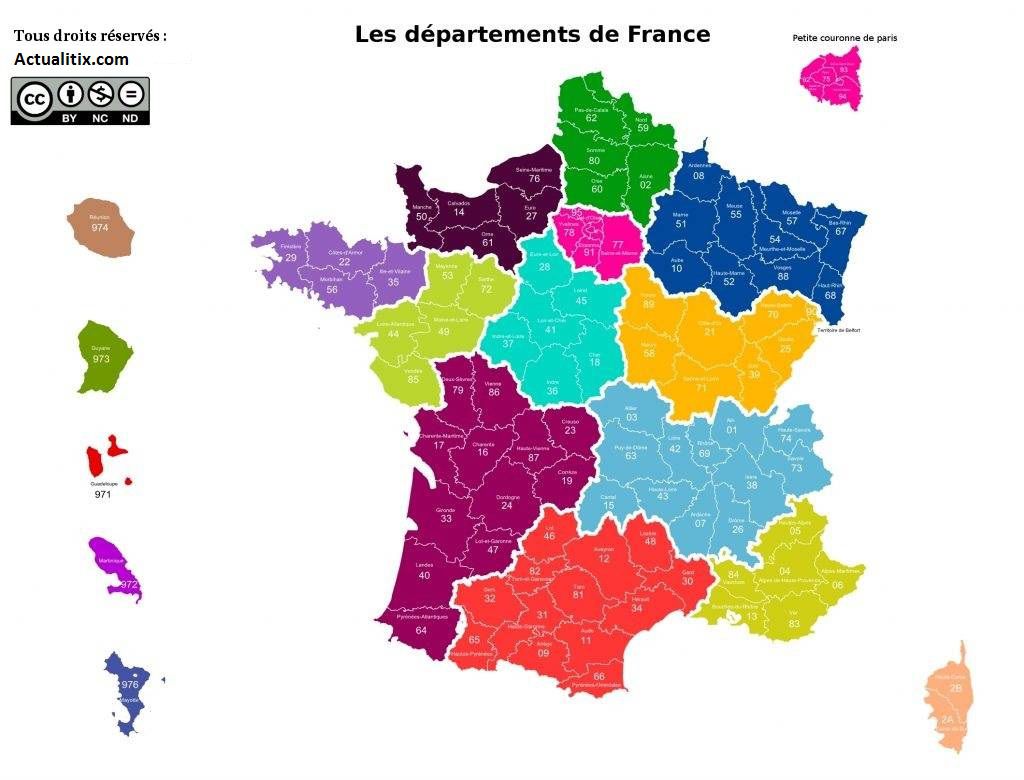
Map of the departments of France (numbers)
Paris has been the country’s capital since the 13th century. It benefited greatly from this policy of centralization, which contributed significantly to its enrichment at the expense of other regions.
Although the French Revolution abolished the old system of provinces, it nevertheless retained the principle of a strongly centralized administration. France was therefore divided at that time into departments run by a prefect and controlled by Paris.
Paris thus became an immense city, home to nearly 20% of the total population.
In 1970, the government nevertheless created 27 administrative regions in order to meet the wishes for autonomy of the various regions. They can now manage their budgets with a degree of independence. A reform took place in 2015; there are now 18.