
In this article you’ll find a map of Taiwan. After retreating, at the end of 1949, to Taiwan (formerly known as Formosa), the government of the Republic of China, or Nationalist China, went into permanent exile on this island. The Nationalist government fled China after the Chinese Communists defeated the Nationalists at the end of a long civil war.
Since that time, the island of Taiwan has become an independent nation. For several decades, the Taiwanese government and the communist government established in Beijing argued over the status of the sole legal government of all of China. But from 1950 onward, the island of Taiwan had to give up its claims because of the instability of its own political situation, especially after its expulsion from the United Nations and the entry, in 1971, of the Beijing government into that same organization.
Table of contents
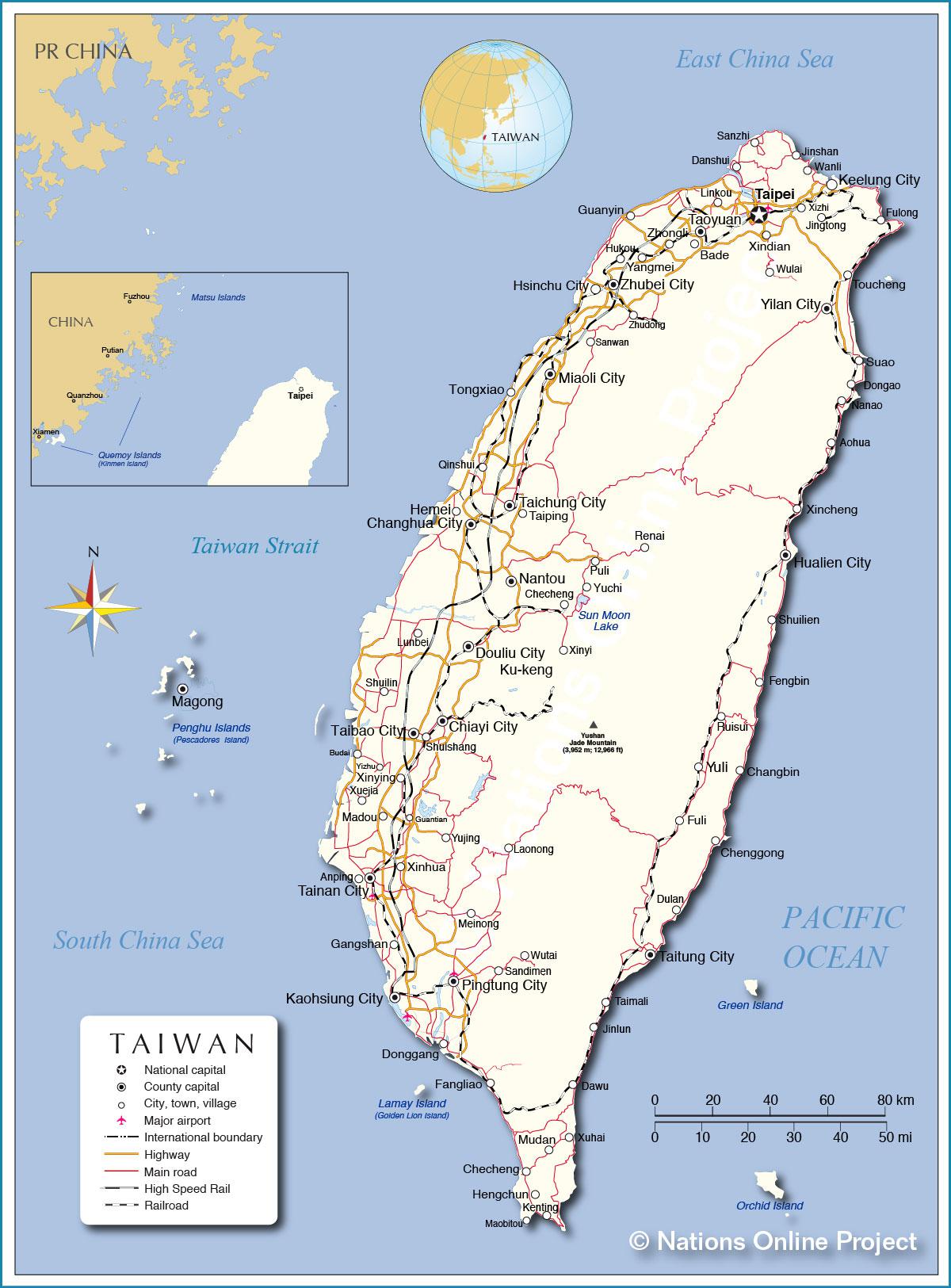
Taiwan map – Credit Nations Online
After a remarkable economic development, the island of Taiwan eventually became one of the most industrialized and wealthiest nations in all of Asia (see the map of Taiwan for its location on the continent). Its population density is also among the highest in the world.
Geography with the map of Taiwan
Taiwan is located in the South China Sea about 160 kilometers off the southeast coast of China. Very rugged mountain ranges occupy more than two thirds of the country. Thanks to the proximity of the Tropic of Cancer, the plains enjoy a largely subtropical climate that allows land to be farmed all year round. Taiwanese farmers’ harvests are therefore very abundant and largely meet the nation’s needs (you can consult the map of Taiwan to explore its geography).
Annual precipitation reaches 259 centimeters and is sufficient to support hydroelectric production and ensure agricultural prosperity. Most plains run along the southern coastline of the island, where the bulk of Taiwan’s population is concentrated.
Taiwan’s wildlife has suffered greatly from the island’s overpopulation, which has led to the disappearance of many wild animals. The dense subtropical forests that cover the interior are threatened by the expansion of the lumber industry as well as by the many clearings carried out by farmers to extend their crops. Natural vegetation in the plains survives only in rare places.
Every square kilometer of the territory has been divided into farms, then crisscrossed by roads and railways serving hundreds of villages, towns and large cities.
The Taiwanese government also controls several islands located not far from the main island (see the map of Taiwan). The most important are the P’eng-hu Islands, or Pescadores, off Taiwan’s western coast. Next come the islands of Quemoy (or Kinmen) and Matsu (or Meizhou), located close to the coast of China’s Fujian province. These two islands have major fortifications intended to protect them from possible attacks by the Chinese Communists.

Taiwan’s mineral resources are limited. The island does have some deposits of coal and natural gas, but it must import most raw materials for industry and national energy production. The shortage of oil resources is critical, and Taiwan’s main imports include crude oil.
The history of Taiwan
In addition to the map of Taiwan, let’s explore its history. At first, the island of Taiwan—China’s last region to be colonized by the Chinese—became famous mainly thanks to foreigners. At the end of the 15th century, Portuguese sailors who had sailed off its coasts called it “Ilha Formosa” (“Beautiful Island”) in tribute to its beauty. Foreigners continued to use that name until it eventually fell completely out of use.
The Chinese were therefore the first to call it the island of Taiwan.
In 1624, the southwest of the island fell into Dutch hands, and they then continued to exercise their authority over the whole island until 1661. The Dutch took advantage of this brief period to introduce the most modern agricultural techniques of their time to Taiwan and to bring many Chinese from mainland China to the island.
The Dutch were expelled from the island by Cheng Cheng-kung, also known as Coxinga. He was a Chinese adventurer and a fervent supporter of the Ming dynasty, whose authority was beginning to weaken on the Chinese mainland at that time. Coxinga’s army planned to turn Taiwan into a military base. From there, they intended to attack mainland China and defeat the Manchus, who had just founded the Qing (Ts’ing) dynasty in Beijing.
The Manchus seized Taiwan in 1683 and ruled the island for nearly two centuries, considering it a remote and unimportant part of the prefecture of Fujian province. This period was marked by the settlement of many Chinese in Taiwan. In the mid-19th century, foreign nations became interested in Taiwan again because sailors shipwrecked on its coasts were often mistreated by the local population.
France and Japan both retaliated by sending expeditions to Taiwan. These moves prompted the Qing government to strengthen its control over Taiwan and to reform the island’s administration. But the response came too late. When China and Japan went to war in 1895, China was defeated and had to cede the island of Taiwan to Japan.
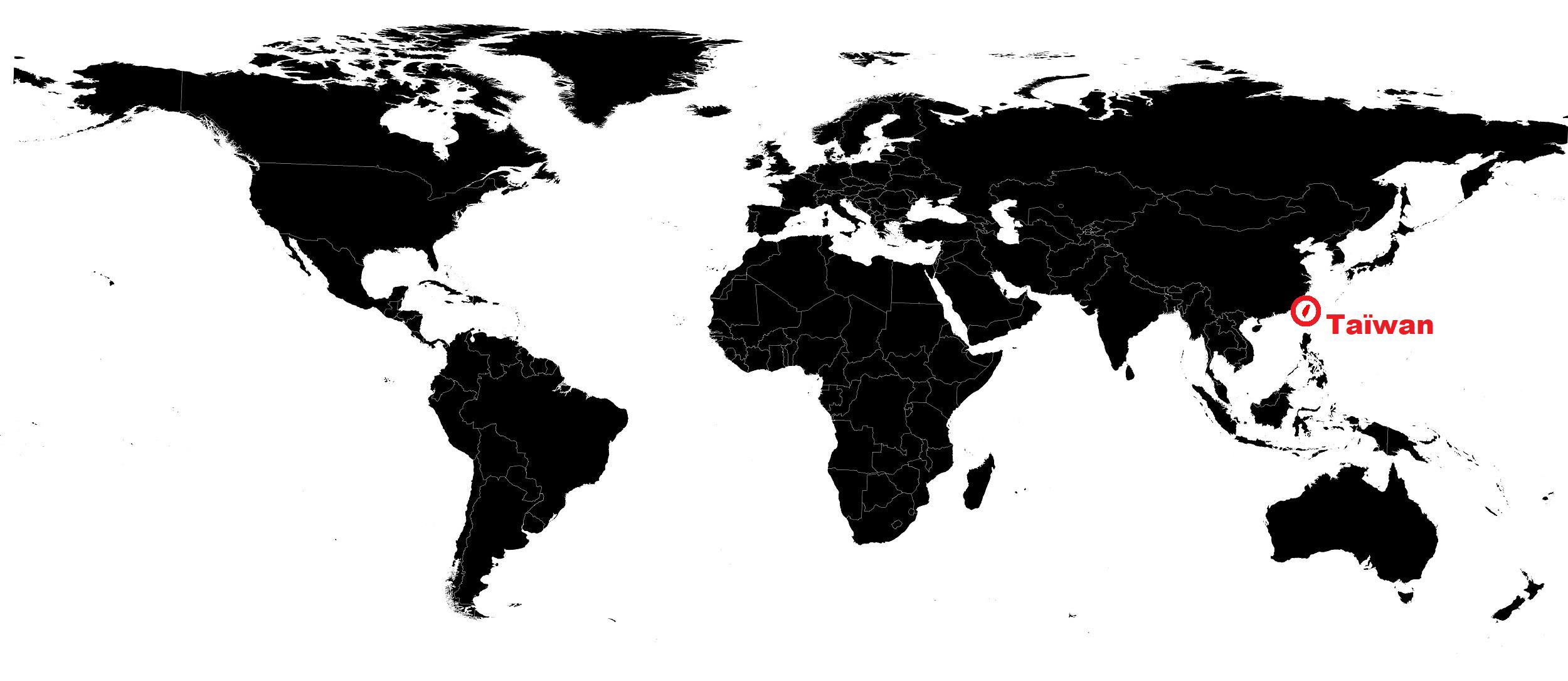
Taiwan on a world map
The 20th century
The fifty years that followed were decisive for Taiwan. The Japanese had two main plans for the island. First, they wanted to develop its agriculture so that its production could help meet Japan’s needs. With this in mind, they developed, among other things, the cultivation of rice, sugarcane and bananas. Second, they wanted to turn Taiwan into an “immobile aircraft carrier”, as they put it.
They therefore made the island a true air relay that they used during their invasion of the Philippines and Southeast Asia in 1941, then in 1942, during World War II. Although the Japanese were very repressive toward the population, they considerably modernized Taiwan’s transport system and health services. They also began to set up a public education system.
After World War II, the island of Taiwan was returned to China. The Chinese regarded the island as conquered territory and treated Taiwanese people as collaborators who had sided with the Japanese enemy. Relations between China and Taiwan deteriorated rapidly from that time, and Taiwanese people eventually revolted in 1947. The Chinese managed to suppress the uprising, but then faced the difficulty of regaining the population’s trust and support—especially after Communist forces won on the mainland after 1949.
At first, the United States stopped supporting the Chinese Nationalist government after it fled the mainland to take refuge in Taiwan. But after North Korea’s invasion of South Korea in 1950, the U.S. changed policy and decided to provide military support to the Republic of China. This was formalized by the signing of a treaty by both parties in 1954.
After the People’s Republic of China was admitted to the United Nations and Taiwan was expelled from that same organization, most countries reconsidered their policies toward the two governments and preferred to support the People’s Republic of China. On January 1, 1979, the United States ended its diplomatic relations with Taiwan and officially recognized the legitimacy of the People’s Republic of China by establishing diplomatic relations with it.
The year 1987 marked the end of 38 years of martial law. For the first time since 1949, political parties were legally recognized. President Teng-hui was re-elected in 1990. The 1990 reforms were followed by the election of the popular Taiwanese president as well as municipal elections in the island’s two main cities. The radical political movement—still relatively small but campaigning for Taiwan’s independence—was the big loser of these elections. This article about the map of Taiwan is now finished. One last piece of information: in 2016, the population of the island of Taiwan was estimated at 23 million inhabitants.