
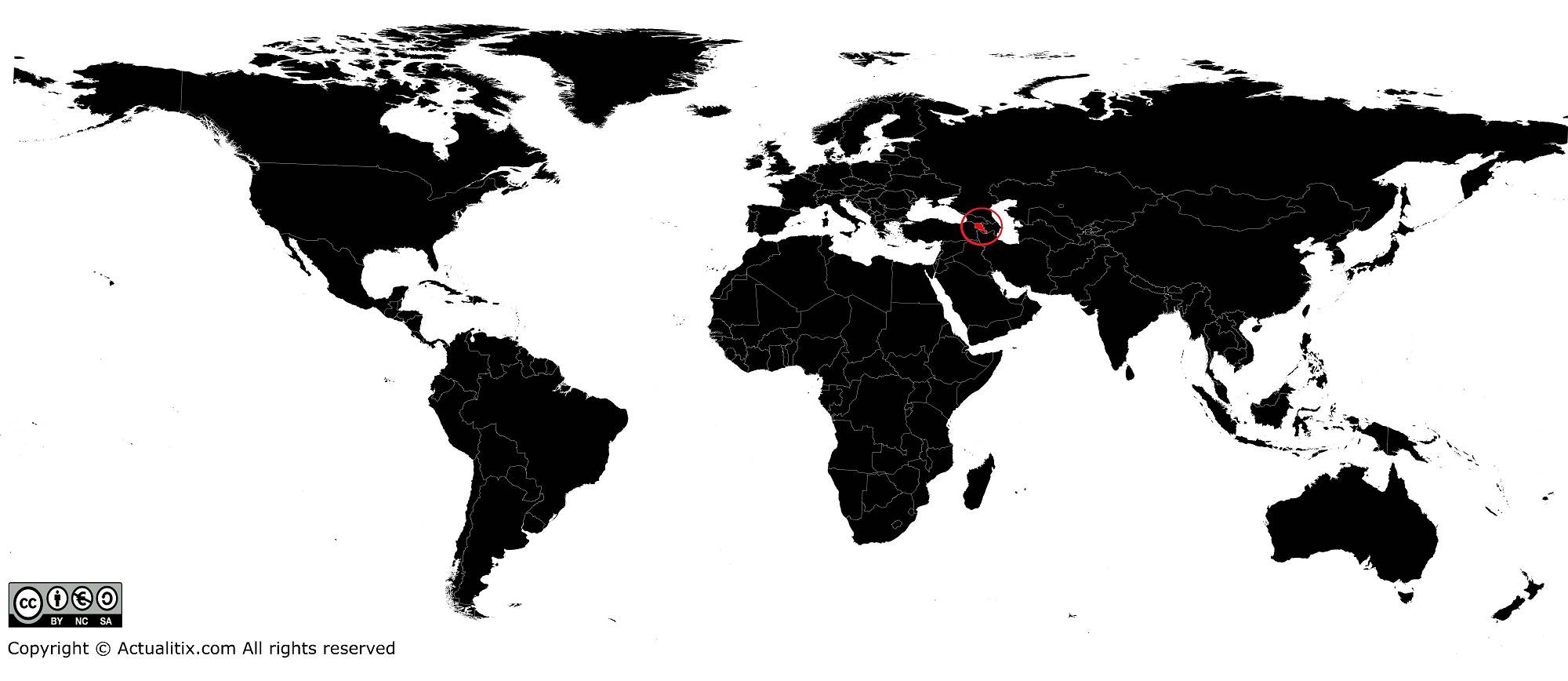
In this article, you will find a map of Armenia. The country is one of the cradles of our civilization and is an independent republic of the Caucasus.
Geography with the map of Armenia
Covering 29,800 square kilometers, it is one of the smallest republics of the former Soviet Union. Located in the southern Caucasus, between the Black Sea and the Caspian Sea, it is bordered by Azerbaijan, Georgia, Turkey and Iran. Its capital, Yerevan (which can be seen on the map of Armenia), located near the Turkish border, has about 1.1 million inhabitants in the city proper and around 2.9 million in the metropolitan area.
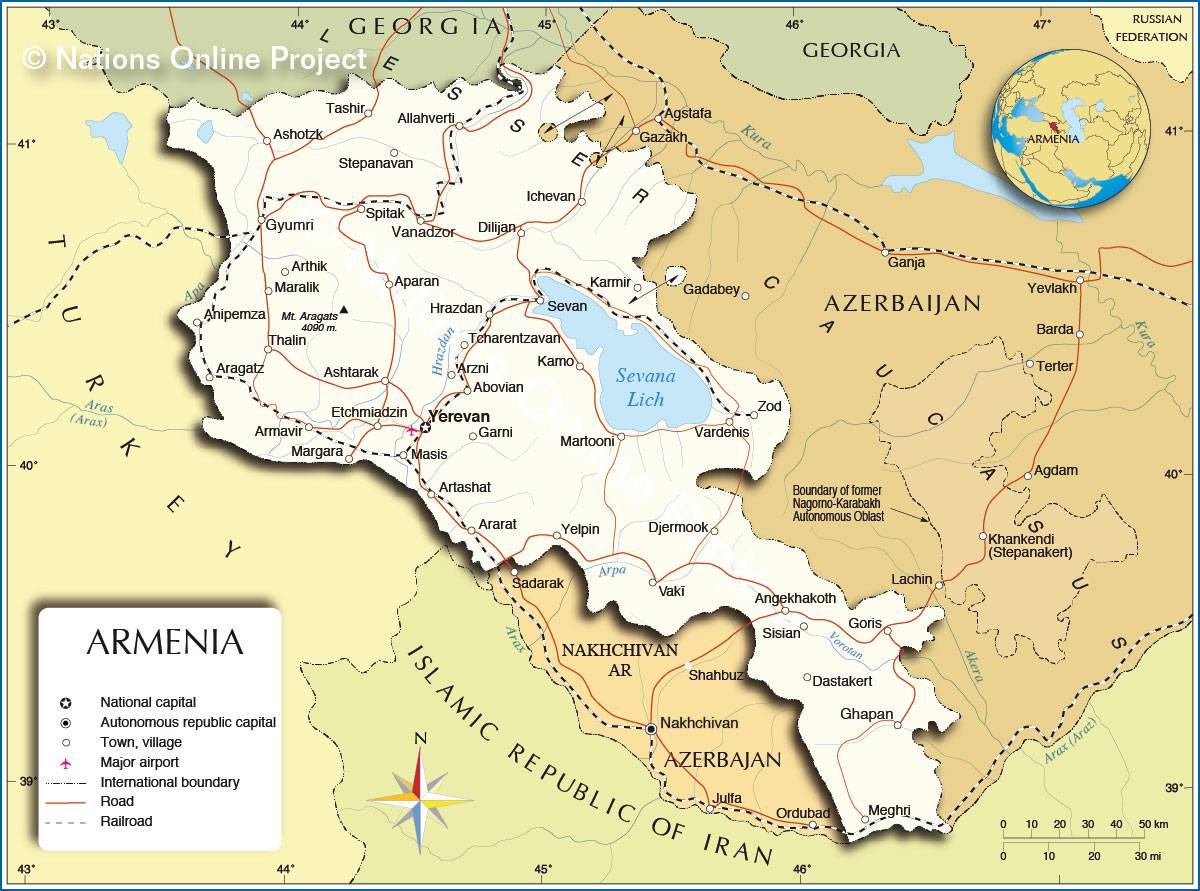
The country is a high plateau crossed by mountain ranges and cut by valleys. The highest point associated with Armenian national geography is Mount Ararat, an extinct volcano rising to 5,137 meters, located just across the border in Turkey (see the map of Armenia for the relief). The climate is mild in the highlands and warmer in the plains.
Learn more
The population, mainly Armenian, also includes Azerbaijanis, Russians (about 5%), as well as Kurds and Ukrainians. Armenians belong primarily to the Armenian Apostolic Church or the Armenian Catholic Church.
The richest agricultural and industrial region is the Araks Valley. Irrigation allows significant production of grapes, figs, olives, pomegranates, cotton and fruit. At higher altitudes, cereals, sugar beets, tobacco and potatoes are cultivated. Livestock such as sheep and goats are also raised.
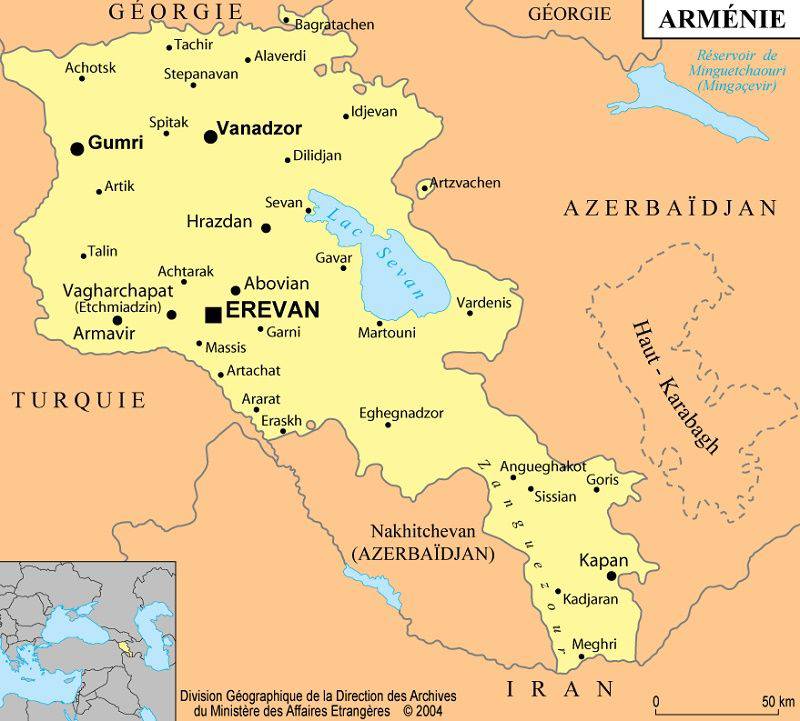
The development of hydroelectric power transformed Yerevan into a major industrial center. Factories producing chemicals, clothing and precision instruments were established there. The country also has textile and food-processing industries.
History
In addition to the map of Armenia, let us review some key historical milestones. In ancient times, although occupied by the Assyrians and Persians, Armenia was always ruled by Armenian kings. Conquered by Alexander the Great, it was later placed under the authority of a Hellenistic dynasty.
In AD 301, the Armenian king Tiridates III converted to Christianity. He then proclaimed Christianity as the state religion and took measures to abolish the old Persian religion, Zoroastrianism.
In the 5th century, a separate Armenian Church was established. In 653, Armenia fell under Arab rule. Persia regained control in 1502, but the Turks captured most of the territory and annexed it to the Ottoman Empire. Under Persian and Turkish domination, Christians were oppressed, and Armenians emigrated and dispersed across Africa and Asia.
In 1828, Russia took from Persia the region later known as Russian Armenia. In 1878, at the Congress of Berlin following the Russo-Turkish War, Russia obtained part of Turkish Armenia.
The Treaty of Sèvres in 1920 between Turkey and the victorious Allies recognized the independence of Armenian territories in Turkey and the Soviet sphere. However, in December 1920, Soviet forces entered Yerevan and established a government in Russian Armenia. In 1922, it became a member of the Transcaucasian Soviet Federative Socialist Republic. In 1936, the Armenian Soviet Socialist Republic was created and became part of the Soviet Union.
Armenia was one of the six republics that boycotted the March 17, 1991 referendum on the continuation of the Union. Armenia, Georgia, Moldova, Latvia, Lithuania and Estonia declared their intention to secede from the Soviet Union and refused in May 1991 to sign a new union treaty.
This union treaty collapsed after the failed coup attempt to remove Mikhail Gorbachev from power. Armenia declared its sovereignty and independence at the end of August 1991 and formally proclaimed independence in September. On December 21, 1991, Armenia joined ten other former Soviet republics in forming the Commonwealth of Independent States (CIS), an alliance of independent states. The population was estimated at about 2.9 million inhabitants in 2016.