
Discover a map of Asia. A land of extremes and contrasts, Asia is the largest and most populous continent on the planet. It is home to the world’s highest mountains as well as some of the longest rivers, the highest plateaus, and the largest deserts and plains on Earth. Some of the oldest civilizations also emerged here. It includes both the poorest countries and the richest nations in the world. Although it is home to many of the world’s largest cities, most of the population lives in rural areas.
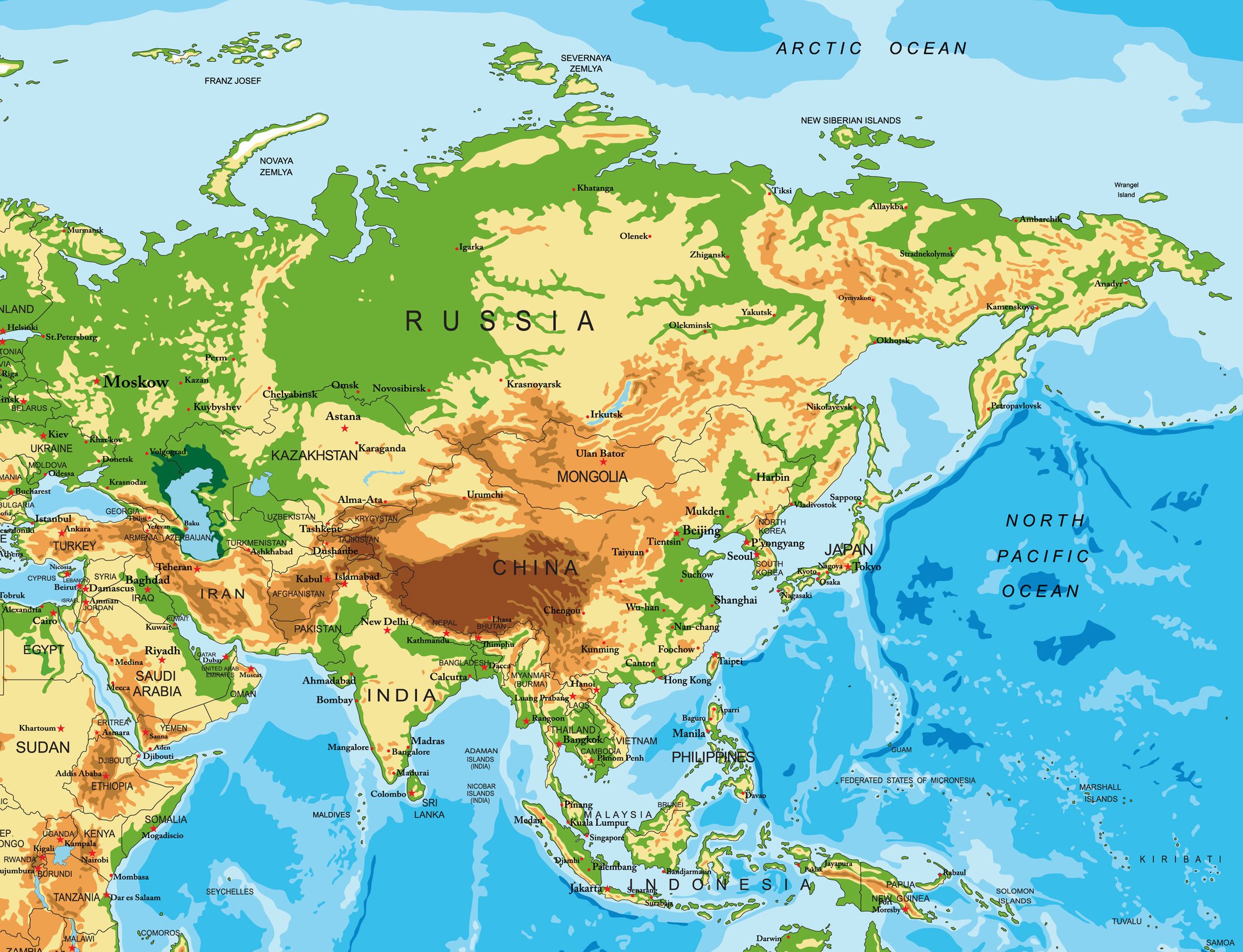
Map of Asia – Fotolia licence
The Asian continent fascinates the whole world thanks to its size, its ancient history, the importance of its population, and the richness of its resources. Throughout its history, Asia has had to face the greed of other nations and, in particular, that of European countries, which sought to control and exploit both its population and its territory.
Modern map of Asia
Nowadays, Asia is considered part of the Eurasian continent. This represents the largest landmass on the planet. Over the centuries, geographers generally agreed to divide it into two distinct parts, separating Europe on one side and Asia on the other. By convention, they are separated by a line that starts in the Ural Mountains (easily identifiable on the map of Asia) in Russia, then crosses the Caspian Sea before shifting west to follow the current borders of Iran, Turkey, Georgia, Armenia and Azerbaijan.
Turkey therefore lies in the westernmost part on the map of Asia.
The boundaries of Asia, in the classical sense, are quite different. Under this definition, they extend east to the Pacific Ocean, north to the Arctic Ocean, and south to the Indian Ocean and the islands of Southeast Asia. In the past, Europeans distinguished the Orient, meaning “the east” and referring to Asia, and the Occident, or “the west”, referring to the Western world.
These two terms have now fallen completely out of use.
According to some geographers, the limits of Asia are in fact much narrower. Their definition takes into account recent political, cultural and economic changes that have affected this part of the world. Under this definition, Russia’s Asian territories (Siberia) and Southwest Asia are no longer part of what they call “modern Asia”.
Nevertheless, it continues to be divided into three distinct sub-regions: South Asia, Southeast Asia and East Asia (the Far East). This article favors the use of the classical and relatively broad definition of Asia that refers to the Asian continent. As for the other, more modern definition, it appears only in the rare passages where its use was relevant.
Countries and regions of Asia
Asia, even under the newer and much narrower definition we have just mentioned, remains the largest and most populous continent on the planet. Its area is even greater if we refer to the geographic limits set by its classical definition.
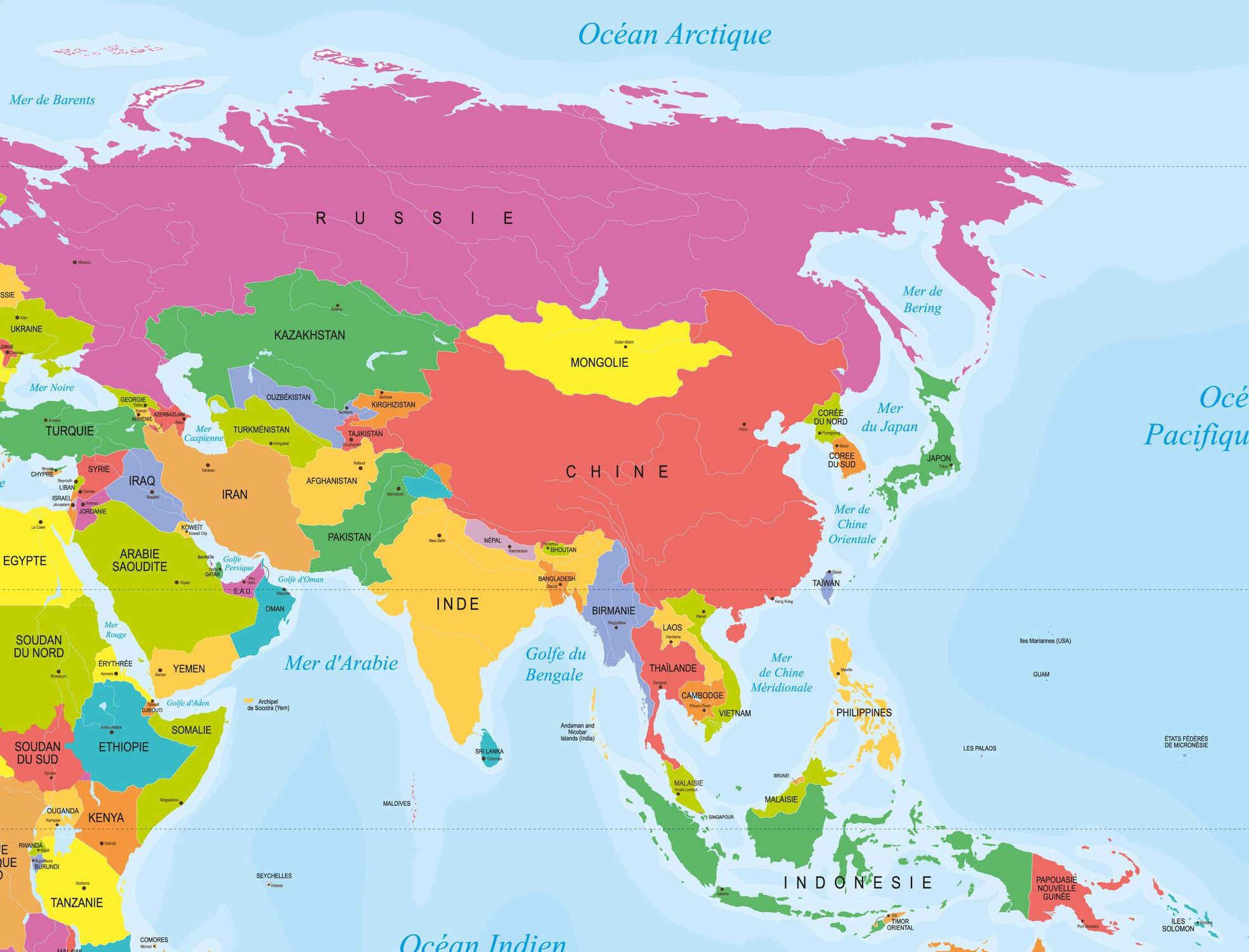
Map of countries in Asia – Fotolia licence
Its area—larger than that of the two Americas, or even Europe and Africa combined, even if it is hard to grasp on the map of Asia—is more than 44 million square kilometers and represents almost a third of the Earth’s land surface. Its population includes about 2.6 billion inhabitants, i.e., 60% of the world’s population.
It should not be forgotten that Asia’s population is distributed very unevenly, which means population densities are far higher than this figure in the most densely populated Asian countries. In Japan, for example, the population density is 330 people per square kilometer.
Russia’s Asian territories
These territories, mainly located in Siberia, represent approximately three quarters of the territory of the former Soviet Union. These include Kazakhstan, Kyrgyzstan, Tajikistan, Turkmenistan and Uzbekistan, which were controlled by imperial Russia from the 17th to the 19th century.
This immense territory of arid lands has always been relatively sparsely populated because of the harsh climate in the north and the dryness in the south. Nowadays, despite the vastness of this region, only a few Russian peoples live there permanently. Along the narrow strip that runs along the south of this region, just north of Iran, Afghanistan, Pakistan, Mongolia, China and North Korea, population density is higher. This area follows the Trans-Siberian Railway.
Russia’s Asian territories border the Bering Strait, which separates them from North America (see the map of Asia). Most of their heavy industry relies on logging the taiga—the largest forest in the world—and on rich coal deposits. However, the economic development of this whole region is hindered by the harsh climate and the immense size of the territory.
Southwest Asia
Southwest Asia, like Russia’s Asian territories, is no longer part of what is called “modern Asia”. It included, on the one hand, the Asian territories of Turkey and Iran to the north, and, on the other hand, Iraq, Syria, Lebanon, Israel, Jordan, Saudi Arabia and certain states of the Arabian Peninsula to the south. Its population is relatively small because of the arid climate.
From a cultural point of view, Southwest Asia is considered the easternmost extension of the Arab and Islamic civilizations of the Middle East and North Africa. Despite the long-standing historical ties with the rest of East Asia, Southwest Asia maintains close economic and political relations with Western countries, and in particular with North Africa and Europe. Its proximity can also be seen on the map of Asia.
Although its economy is limited by climate aridity, Southwest Asia experienced real economic growth during the 20th century due to the discovery of immense oil reserves mainly concentrated along the Persian Gulf. The prosperity generated by oil exports radically transformed the economy of a large part of these territories. Some of these nations are now among the richest countries in the world. Thanks to oil, Southwest Asia has gained strategic importance for other industrialized countries.
South Asia
South Asia, also known as the Indian subcontinent, includes: modern India; the smaller nations of Pakistan and Afghanistan to the west; Bangladesh to the east; Nepal and Bhutan to the north; and the islands of Sri Lanka and the Maldives to the south. The northern boundary of South Asia is marked by the Himalayan mountain range, which forms the southern border of China as well as part of India’s border. The area of South Asia is about half that of the United States. These territories are characterized by great topographical and climatic diversity.
To the east, the river valleys of the Ganges and the Brahmaputra are shared between India and Bangladesh. They form the heart of South Asia and enjoy the wettest climate and the most favorable conditions for agriculture (see the map of Asia on climate). It is estimated that more than half of the total population of South Asia, which includes 1 billion inhabitants, lives in these valleys.
Southeast Asia
It can be divided into two parts: one mainland and the other insular. The mainland part includes all the river valleys and parallel mountain ranges that extend south and southeast of the Tibetan Plateau and the surrounding mountains. It therefore includes: Myanmar (formerly Burma), Thailand, Laos, Cambodia (Kampuchea) and Vietnam.
These countries, which form mainland Southeast Asia, are mainly made up of large river valleys where most of the population is concentrated. These are surrounded by mountainous regions that are less densely populated. In Myanmar (Burma), the heart of the country lies in the Irrawaddy river valley.
In Thailand, the main river valley is that of the Chao Phraya. In Laos, Cambodia, and southern Vietnam, the large river valleys line up along the Mekong. In northern Vietnam, the highest population densities are recorded in the Red River valley. The insular part of Southeast Asia includes the Malay Peninsula as well as many islands, including: Malaysia, the island state of Singapore, Indonesia, the state of Brunei and, finally, the Philippines.
Indonesia alone includes approximately 13,000 islands where the population is concentrated mainly on coastal plains and in small river valleys cutting through mountain ranges inland. These islands are, for the most part, mountainous and some of them are of volcanic origin. The most famous and largest of the Indonesian islands is Java.
The population of Southeast Asia is much smaller than that of South Asia and East Asia.
The population is distributed very unevenly. In places, population densities are among the highest in the world, particularly in Indonesia. It is also interesting to see the map of Asia on population density.
East Asia or the Far East
East Asia includes Japan, North and South Korea, China, the island of Taiwan, Mongolia, as well as the colonies of Macau and Hong Kong. This region was once called “the Far East”. This term used to allow Europeans to designate the lands they considered—by distance and travel—as the most remote and farthest east from Europe.
This part, which can be found on the map of Asia, lies largely within the temperate zone. Its climatic characteristics and natural environment are therefore relatively similar to those of Europe and North America.
China dominates East Asia both by its vast size and by the importance of its population. The other countries are much smaller and follow one another along the eastern border of East Asia, which includes the Korean Peninsula, today divided into South Korea and North Korea. The island of Japan is also part of it. The island of Taiwan (formerly known as Formosa) comes next to the southeast. It still hosts the former government of the Republic of China, which took refuge there at the time of the Chinese revolution.
However, the People’s Republic of China also claims administration of the island of Taiwan. The former British colony of Hong Kong extends along China’s northeast coast. And Macau, the former tiny Portuguese colony, is located in Hong Kong Bay.
From a cultural point of view, the Republic of Mongolia is also part of East Asia.
With a population of more than 1.4 billion inhabitants, or about a quarter of the world’s population, East Asia is one of the most populated regions in the world. China alone includes more than 1 billion inhabitants who live mainly in its eastern part, where the plains are the most extensive and the climate is most pleasant. The population densities recorded there are among the highest in the world.
Chinese civilization, probably the oldest civilization in all of East Asia, strongly influenced the cultural development of other peoples in this part of the world. For this reason, East Asia has sometimes been called the Kingdom of Siam (Siam meaning Chinese).
Population and culture
The peoples living in Asia are as diverse as their continent. Among them, three major groups are often distinguished: Caucasoids, Mongoloids and Negroids. Caucasoids live mainly in South Asia and Southwest Asia. Mongoloids settled in East Asia, Southeast Asia as well as in Siberia. As for Negroids, who are fewer in number, they live mainly in South Asia.
The different racial groups we have just mentioned are also divided by many linguistic or cultural cleavages.
Religions
Most of the major religions practiced in the world originated in Asia, such as Christianity, Judaism, Islam, Hinduism and, finally, Buddhism. The most widely practiced religion across the Asian continent today is Islam (see the map of Asia on religion). Muslims form the main religious faction in Southwest Asian countries as well as in many South Asian and Southeast Asian countries.
Hinduism and Buddhism, for their part, mainly developed in South Asia. Buddhism, however, managed to spread into East Asia and Southeast Asia where it still has many followers. It has nevertheless ceased to be considered one of the main religions in South Asia, where Sikhism also originated, combining certain Islamic and Hindu beliefs.
Confucianism, moreover, was born in China more than 2,000 years ago. It is more a doctrine based on an ethical and social system than a true religion. It deeply influenced the development of China and still plays an important role in Chinese society today despite the communist regime that seeks to limit the influence of religion. Among the other religions practiced in East Asia, we can mention: Taoism in China, and Shintoism in Japan, which can be found on the map of Asia (religions). These are philosophical doctrines rather than religions in the strict sense.
Transport
Industrial development relies largely on the establishment of efficient transport and communication systems. It is necessary for goods, people and ideas to circulate quickly across the country. However, situations are extremely contrasted across the Asian continent and reflect faithfully the greater or lesser industrialization of Asian countries. On the one hand, we can distinguish Japan, which has an extremely sophisticated railway network served by many highways and airlines. You will find many details about this on the map of Asia.
Its very modern telecommunications system has nothing to envy those of Western countries. But, on the other hand, some territories of the Asian continent live in almost complete isolation. To remedy this situation, we are witnessing the deployment across the Asian continent of much broader and more efficient transport and communication networks.
The vastness of the territory and the many natural obstacles have considerably slowed the construction of new communication routes. The road network and the rail network continue to modernize, but progress is slow. The development of air transport throughout the 20th century played an essential role in opening up countries such as Afghanistan, Nepal and Laos.
In some countries, river routes play an essential role, particularly in South Asia, Southeast Asia and South Asia. Bangladesh, the countries of Indochina and China also have a particularly developed river transport network.