
Discover a map of South America. A triangular-shaped continent, South America is bordered by the Atlantic Ocean to the east, the Pacific Ocean to the west, and the Caribbean Sea to the north. Connected to North America by the Isthmus of Panama, South America is the fourth-largest continent. Its area covers 17,818,000 square kilometers, or about one eighth of the Earth’s land surface. In 1995, its population was estimated at 334 million inhabitants.
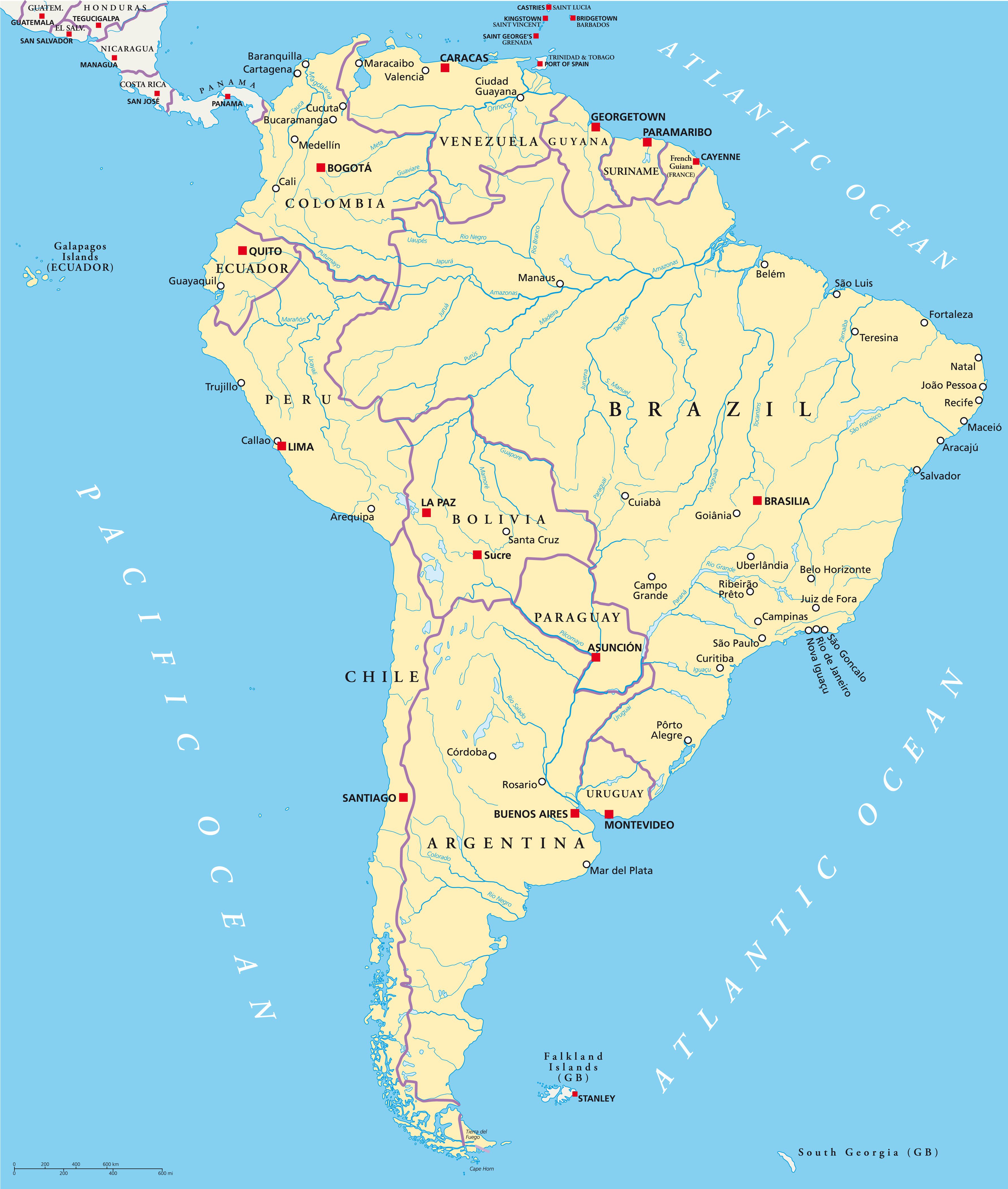
Map of South America – © Peter Hermes Furian – stock.adobe.com
Article summary
- The natural environment on the map of South America
- Climates in South America
- Vegetation and soils
- People and culture
The natural environment on the map of South America
The outline of South America is determined mainly by the position of three mountain regions: the Andes, the Guiana Highlands, and the Brazilian Highlands. Between these regions lie vast plains formed by the continent’s main river systems: the Amazon Basin, the Orinoco Basin, and the Paraná Basin.
About 80% of South America’s surface lies between the Tropics, but Tierra del Fuego, located at the southern tip of the continent, extends farther south than any other continent. Because the southernmost parts of the continent are narrow, they do not experience the same climatic severity as the northern regions of North America and northern Asia. In addition, ocean currents moderate the climate of southern Chile and Argentina. It is warmer in winter and cooler in summer compared with other parts of the world at the same latitude. Elsewhere, however, major differences in altitude create a wide range of climates. You can find this on the map of South America showing climate.
In most of South America, elevation above sea level determines climatic conditions.
The land
Long ago, South America was part of the ancient landmass known as Pangaea (Gondwanaland). Around 150 million years ago, the South American continent broke away from what is now Africa and began drifting westward until it reached its current position. This movement was accompanied by the formation of the Andes Mountains along the western edge of the continent. Geologically, the oldest rocks are found in the Brazilian Highlands, where strata dating from the Precambrian era can be seen. Lowland regions are generally made up of more recent sedimentary deposits.
The Andes on the map of South America
Stretching for more than 8,000 kilometers (5,000 miles) from Venezuela to Chile, as can be seen on the relief map of South America, the Andes occupy the western edge of South America. They are the longest mountain range in the world and also one of the highest. The highest peak is Aconcagua, located on the border between Chile and Argentina.
Its altitude is 6,959 m. Several other summits in this range rise above 6,000 m. This mountain chain is part of the Ring of Fire, a belt of volcanoes surrounding the Pacific Basin.
The Andes are not made up only of high peaks, but rather of several smaller subdivisions. Some are called cordilleras (from the Spanish “cordilleras,” meaning mountain range), others are known as “nudos” (knots or clusters of peaks), and still others as “altiplanos” (high plateaus).
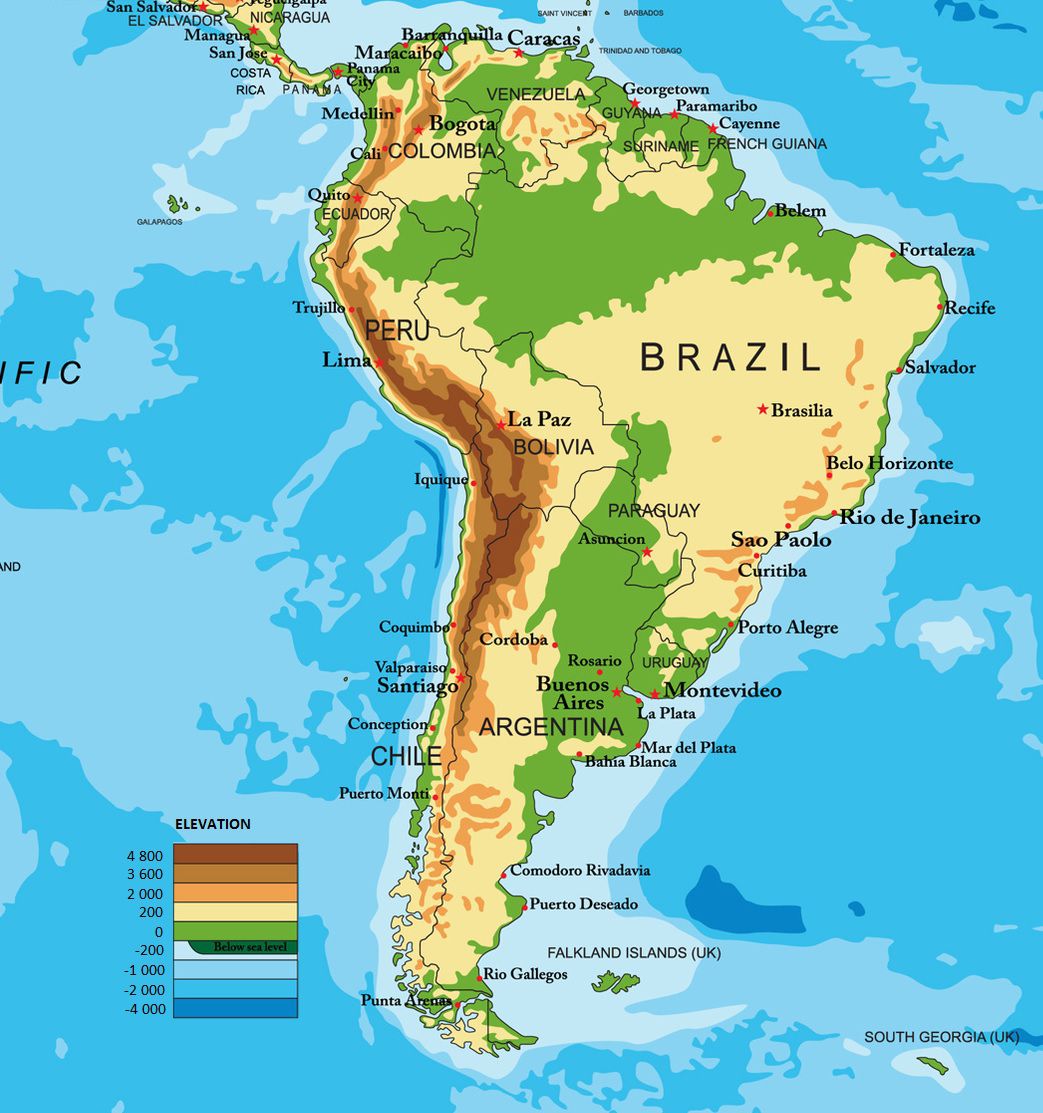
Relief map of South America – © bogdanserban – stock.adobe.com
North of the border between Colombia and Ecuador lies the Nudo de Pasto, a complex concentration of volcanic peaks from which the three main ranges of the Colombian Andes branch out. They form the dominant physical features of western Colombia.
The Western Cordillera runs parallel to the Pacific Ocean and has a moderate elevation, with most peaks not exceeding 3,700 m.
The Central Cordillera, which extends northward from the 9th degree of north latitude, is a high and rugged chain. Many of its peaks are volcanic.
Tolima Peak and Ruiz Peak, which rise above 5,180 m (see the map of South America showing relief), are the most impressive summits in this part of the Andes. The Central Cordillera is a difficult barrier to cross and creates transportation challenges in Colombia.
The Eastern Cordillera is broader and longer than the other two. It extends from the 12th degree north latitude near the Guajira Peninsula and reaches the Caribbean Sea. This cordillera contains many high plateaus where one third of Colombia’s population lives. It is also where the country’s capital, Bogotá, is located. It has several snow-covered peaks, the highest being Bolívar Peak at 5,007 m, and its terrain is very rugged.
In Ecuador, the Andes consist of two parallel ranges and a series of basins. Both ranges are volcanic. The western range, the Western Cordillera, is on average lower than the eastern one, the Eastern Cordillera. Nevertheless, Ecuador’s highest summit, Chimborazo, at 6,272 m, is located in the Western Cordillera, as can be seen on the map of South America.
In Peru, the Andes are formed by many separate ranges surrounding several high plateaus. Unlike the northern Andes of Colombia and Ecuador, much of the Peruvian Andes are not volcanic in origin. In Peru, several cordilleras have sharp peaks well known to experienced mountaineers around the world. The Cordillera Blanca north of Lima and the Vilcabamba Range near Cuzco feature magnificent summits. Peru’s highest mountain, Huascarán, at 6,768 m, is part of the Cordillera Blanca.
In southern Peru, western Bolivia, and northern Chile and Argentina, a high plateau characterizes the Andes. This high plain is called the Altiplano. One of the most remarkable sites of the Altiplano is Lake Titicaca, located on the border between Peru and Bolivia. Titicaca is the highest navigable lake in the world. It is also the largest lake in South America. It drains southward through the Río Desaguadero to Lake Poopó and then into a series of salt marshes in southwestern Bolivia.
The Brazilian Highlands
The largest area of mountains and hills in eastern South America is in Brazil. The Brazilian Highlands stretch from the mouth of the Amazon to central Uruguay and include parts of eastern Paraguay and Bolivia. Along the Atlantic coast, the escarpments are steep, but inland these highlands consist of a series of plateaus and hills. The highest mountain in the Brazilian Highlands, Pico da Bandeira, reaches only 2,890 m.
In the north, near the Amazon, the land is heavily eroded and deeply worn down. The soils, very poor in quality, are covered with scrub vegetation. Across the whole region, abundant mineral deposits can be found, helping make Brazil a wealthy country.
The Guiana Highlands
North of the Amazon River are the Guiana Highlands, an ancient mountain chain whose geological origins are linked to those of the Brazilian Highlands. In general, these mountains are high in the south, where the highest peak, Mount Roraima, rises to 2,772 m, and they gradually decrease in altitude toward the north.
Patagonia
East of the Andes, in southern Argentina, lies the region of Patagonia, which you can locate on the map of South America. It consists of broad plateaus separated by deep valleys carved by rivers. It is a flat region, although it includes some low mountains and a few volcanic ash cones. Lava sheets also cover part of Patagonia. The region is characterized by great dryness and the absence of trees. There are few settlements, and sheep farming is the main economic activity.
Orinoco Basin
The Orinoco River flows between the Guiana Highlands and the Andes Mountains. Its river basin covers 570,000 square kilometers. It is a lowland plain called the Orinoco Basin, or Llanos. Its average altitude is less than 244 m. The plain slopes gradually eastward. The gentle gradient of the rivers produces the classic pattern of slow-moving meanders, and floods overflow the rivers during the rainy season. Most of the Llanos are covered with vegetation. Along the riverbanks, some palms and other trees can be found.
Amazon Basin
The Amazon is one of the most remarkable rivers in the world and is easily identifiable on the map of South America. It is estimated that about one fifth of the world’s fresh water originates in the Amazon Valley.
The shape of the Amazon Basin resembles a spoon. This broad, flat basin is bordered by the Guiana Highlands to the north, the Andes to the west, and the Brazilian Highlands to the south and east. The source of the river lies in Peru, only 160 kilometers (100 miles) from the Pacific. It flows through the Andes and then meanders across the Amazonian plains. The river stretches for about 6,400 kilometers (4,000 miles) and empties into the Atlantic.
Paraná Basin
Several rivers join to form the basin located southwest of the Brazilian Highlands and east of the Andes, if you wish to locate it on the map of South America. The largest of these rivers is the Paraná, but the Paraguay and Uruguay rivers are also important. The mouth of these rivers is called the Río de la Plata. It is a flooded estuary, although it is sometimes referred to as a gulf. The Río de la Plata river system extends over about 4.1 million square kilometers. In Argentina, a broad plain region called the Pampas forms part of this basin, although few rivers actually cross the Pampas themselves.
The largest river flowing through the Río de la Plata Basin is the Paraná, which rises in central Brazil and flows southwest for about 4,025 kilometers (2,500 miles) before reaching its mouth. Many of its tributaries create spectacular waterfalls as they cascade down from the Brazilian Highlands.
Climates in South America
South America can be divided into four distinct climate zones: tropical, temperate, dry, and cold, according to the continent’s main climatic characteristics. Variations in relief, especially altitude, and factors such as rainfall, bodies of water, and prevailing winds, however, create a multitude of microclimates. See the map of South America showing climate.
Tropical climate
The climate of the Orinoco Basin and almost the entire Amazon Basin is characterized by high temperatures and abundant rainfall. Humidity is high. Temperature variations are small because of proximity to the Equator. Average temperatures are rarely below 18°C. The savanna climate is marked by a dry season.
Temperate climate
South of the Tropic of Capricorn (around 23° S), the climate is one of the coolest in South America, and winter is pronounced. Southern Brazil, most of Paraguay, all of Uruguay, and northeastern Argentina share a humid subtropical climate.
The climate of central Chile resembles that of Mediterranean regions, with hot summers and wet winters. Southern Chile has a marine climate characterized by cool temperatures and rainfall throughout the year. Although the proximity of the ocean tends to moderate extreme temperatures, some regions of southern Chile experience very low temperatures and very heavy rainfall.
Dry climate
Four regions of South America have climates mainly characterized by a lack of rainfall. The two main desert regions are on the western coast of the continent and in Argentina. There are also smaller arid zones in northeastern Brazil and along the Venezuelan coast.
The whole coastal region of Peru and northern Chile is one of the driest regions on Earth. This desert is cool but humid. For people not bothered by the lack of rain, it can be a pleasant place to live.
Argentina is crossed by an arid belt running from the northwest to the southeast. The temperature ranges in the northern part of this region, around San Miguel de Tucumán and Mendoza, are among the greatest on the continent. Summers are hot and winters are cold. Further south, in Patagonia, oceanic influence produces lower average temperatures, though not the extremes normally recorded farther inland. The dryness of these Argentine regions is explained by the fact that they lie in rain shadow and receive little precipitation.
Cold climate
Average annual temperatures below 10°C are found in southern Argentina and Chile and at high elevations throughout the Andes. The Tierra del Fuego region is characterized by a cold and humid climate. Constant cold winds make the southern tip of the continent particularly inhospitable to humans.
At low altitude, around 900 m above sea level, lies the tierra caliente, or hot zone, characterized by tropical climatic conditions. Between 900 and 2,100 m lies the tierra templada, or temperate zone, whose climate resembles that of temperate regions in the subtropics. Between 2,100 and 3,000 m, the tierra fría resembles the climatic conditions found in cold regions, especially at the far south of the continent. Above the tierra fría lies the puna, or the páramo zone, where cold prevails throughout the year.
Vegetation and soils
The distribution of vegetation and soils in South America is closely linked to the distribution of geological formations and climate zones. In other words, tropical forest plant species and soils are found mainly in the Amazon Basin. Desert species develop along the Peruvian coast and in northern Chile. Savanna is found in the Llanos and in part of the Brazilian Highlands. See a map of South America showing vegetation.
The Amazon Basin contains the largest area of tropical rainforest in the world. This type of vegetation also covers the Guiana Highlands, the northwestern edge of the Brazilian Highlands, the eastern slopes of the Andes up to 1,800 m in altitude and to about 25° S latitude, as well as parts of the Pacific coastal regions in Colombia and Ecuador. This vegetation occurs only where temperatures are high and rainfall abundant. The tropical rainforest is made up of several layers with different kinds of plant life.
More than 2,000 tree species can be found in the Amazon Basin. Hundreds of different species often grow in close association with one another. The soils of most tropical regions are poor and not very fertile, except in areas subject to annual flooding.
Some parts of southern Brazil and Paraguay, as well as southern Chile and Argentina, are covered by mid-latitude forests. These are often coniferous forests associated with relatively rich soils.
The arid regions of South America have varied vegetation. In Argentina, semi-arid areas are covered with grasses and a diverse range of plant life.
By contrast, the deserts of Chile and Peru are almost devoid of vegetation.
Most of the Brazilian Highlands and the Llanos of Venezuela are covered by savanna. This is an intermediate type of vegetation between forest and grassland. Only a few scattered trees are found.
In the tropical regions of the Andes, different kinds of grasslands can be found above the tree line.
Wildlife
If South America’s wildlife is compared with that of other continents, it is not as rich and varied as one might imagine. The continent’s long geographic isolation, which lasted for thousands of years, together with its relatively recent connection to North America through the Isthmus of Panama, meant that many species widespread elsewhere in the world are absent from South America. The only exception concerns birds, which migrate every year from one continent to another.
Among the mammals found in South America, two were domesticated before the arrival of the Spanish conquistadors: the llama and the alpaca. There are also some big cats, especially the jaguar. South of 12° S latitude along the Pacific coast, and from 30° S along the Atlantic coast, many marine mammals can still be found, such as sea lions and seals.
In the Amazon, river dolphins can also be seen.
There are probably more species of birds in South America than on any other continent. Estimates suggest there may be 2,700 different species.
There is also a large number of fish, reptiles, and insects. All these creatures are more numerous in the Amazon Basin, although they can also be found across the continent.
People and culture
The current population of South America comes from an old heritage: Indigenous peoples, Spaniards and Portuguese, Africans, as well as a number of more recent European and Asian immigrants. Some regions are still populated mainly by Indigenous peoples, while others are inhabited by descendants of Africans or by white European settlers. Below is a map of South America showing the main cities.
The population growth rate of the continent as a whole has been high because of a high birth rate and a low death rate. The countries of the far south, Chile and Argentina, have done much to reduce these growth rates.
Languages
After almost five centuries of Iberian domination on the continent, Spanish and Portuguese are the two most widely spoken languages in South America. About half of the population speaks Portuguese, mainly in Brazil, and almost all the rest speaks Spanish. The inhabitants of Guyana speak English, and those of Dutch Suriname speak Dutch. English and French are often chosen as second languages. Here is the map of South America showing the languages of the continent.
Some Indigenous languages still survive. In Brazil and Venezuela, for example, 10% of the population is probably able to understand one of the dialects spoken by tribes living in the tropical rainforest. But fewer people are thought to use them regularly. In much of Peru, Quechua, the language of the Incas, is widely spoken. Many Indigenous farmers never learned Spanish. On the Altiplano, near Lake Titicaca, Aymara is the Indigenous language spoken in both the countryside and the towns.