
Discover a map of North and Central America. The third-largest continent by area, North America stretches from Alaska and Greenland down to the eastern border of Panama with Colombia. Canada, the United States, Mexico, the republics of Central America, the Bahamas, the Greater Antilles and the Lesser Antilles all belong to the North American continent. Its surface area is 24,100,000 square kilometers, which represents 16% of the Earth’s landmass.
Article contents
- Natural environment of the map of North and Central America
- Climate in North and Central America
- Culture
Natural environment of the map of North and Central America
The continent’s topography is oriented north–south, as you can see on the map of North and Central America. The old Appalachian Mountains form a highland belt in the east of the continent, while the younger, higher Rocky Mountains create a more rugged framework in the west. Between the two lie flatter, lower provinces: the Canadian Shield, the Interior Plains and the Great Plains.
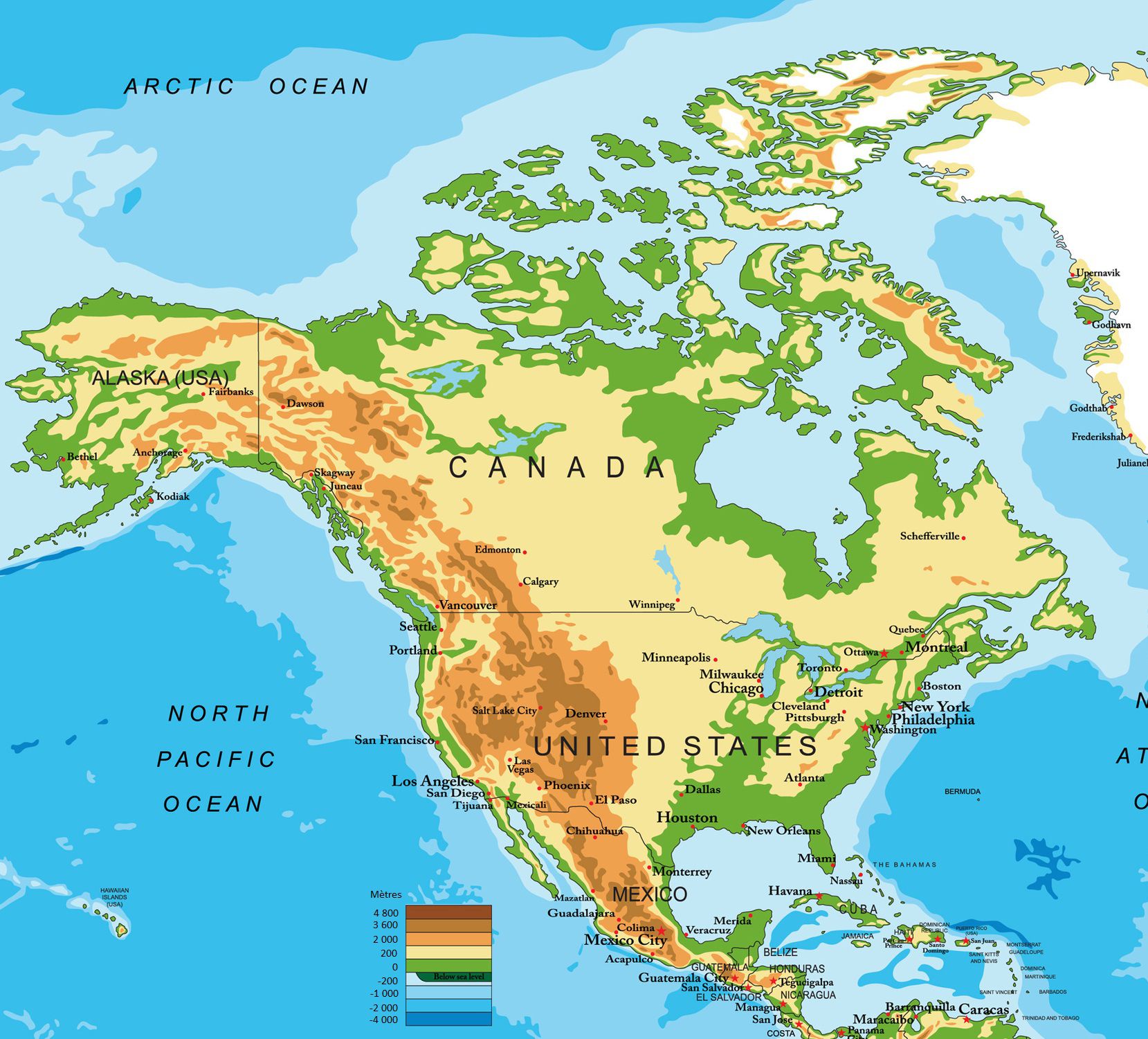
Map of North and Central America – Fotolia licence
To the east and south of the Appalachians are the Atlantic coastal plains (from Yucatán to New England), and to the west you can discover basins and plateaus including the Great Basin, the Colorado Plateau and the Pacific ranges. The width of the Rockies continues to broaden toward the south, forming the Western and Eastern Sierra Madre, which border the Mexican Plateau. South of the Mexican highlands, the physiographic orientation changes abruptly, shifting from a north–south link to an east–west direction.
South of the Isthmus of Tehuantepec, a branch of the Central America and Antilles mountain system extends from Mexico’s Pacific coastline to the Dominican Republic, passing through Chiapas, Oaxaca, the Cayman Islands, southeastern Cuba and Haiti (see the map of North and Central America).
A second branch stretches from Guatemala and Honduras to the Dominican Republic via Jamaica and Haiti. The two branches join to form the mountains of Puerto Rico and the Virgin Islands. A small chain of volcanic mountains (the Lesser Antilles) continues southward. Other volcanic ranges cross Costa Rica and Panama.
The river system
The continent’s physiographic framework (visible on the map of North and Central America) has a major influence on water flow. The waters of the Great Lakes cascade over Niagara Falls before flowing into the Saint Lawrence River and then out to sea. Rivers from the Canadian Shield empty into Hudson Bay.
From the Appalachians, rivers flow eastward to the sea and westward into the Mississippi river system. The continental divide formed by the Rockies separates waters that flow east from those that flow west. Mexico’s rivers, except for the Rio Grande, are relatively short, as are those flowing through Central America and the Greater and Lesser Antilles.
Climate in North and Central America
Latitude, topography, the position of air masses and land–sea interactions all tend to influence the continent’s climate. In the northwest, prevailing westerly winds from the Pacific Ocean bring abundant rainfall to the western slopes of mountains, while the eastern slopes are drier. In the interior, the climate is influenced by air masses descending from the Arctic that meet those coming from the Gulf of Mexico. The islands of the Antilles and the continental coastline have a warm, humid climate. Surface temperatures exceed 27°C throughout the year. See the map of North and Central America for climate patterns.
In general, North America is more humid east of the 100th meridian than to the west. In California and the Northwest, precipitation is concentrated in winter, while summer months are dry. Hurricanes are frequent in the Antilles and the Gulf of Mexico. They often pass through the Greater Antilles before going on to devastate the continent’s coastline between Texas and Florida, North Carolina and New England.
Flora
Temperature and rainfall affect natural vegetation. In the well-watered eastern United States, this results in forested regions. In Ohio, Indiana and Illinois, you’ll find tallgrass prairie, and farther west, a grassy steppe. The extreme Southeast is dominated by a tropical conifer forest, while the even drier West features desert vegetation zones. Most of the Canadian Shield is covered by taiga (conifer forest), while lands along the Arctic coast have vegetation similar to tundra. Shrublands and steppe dominate northern Mexico.
Along Mexico’s eastern coast, and in parts of Yucatán, Belize and Honduras, you’ll find mixed forest or tropical rainforest. The rest of Central America is crossed by mountain ranges. The Greater Antilles are covered with forests in humid zones, and with woodland and scrub in drier areas. The Lesser Antilles are mountainous, while the lowest islands are surrounded by atolls.
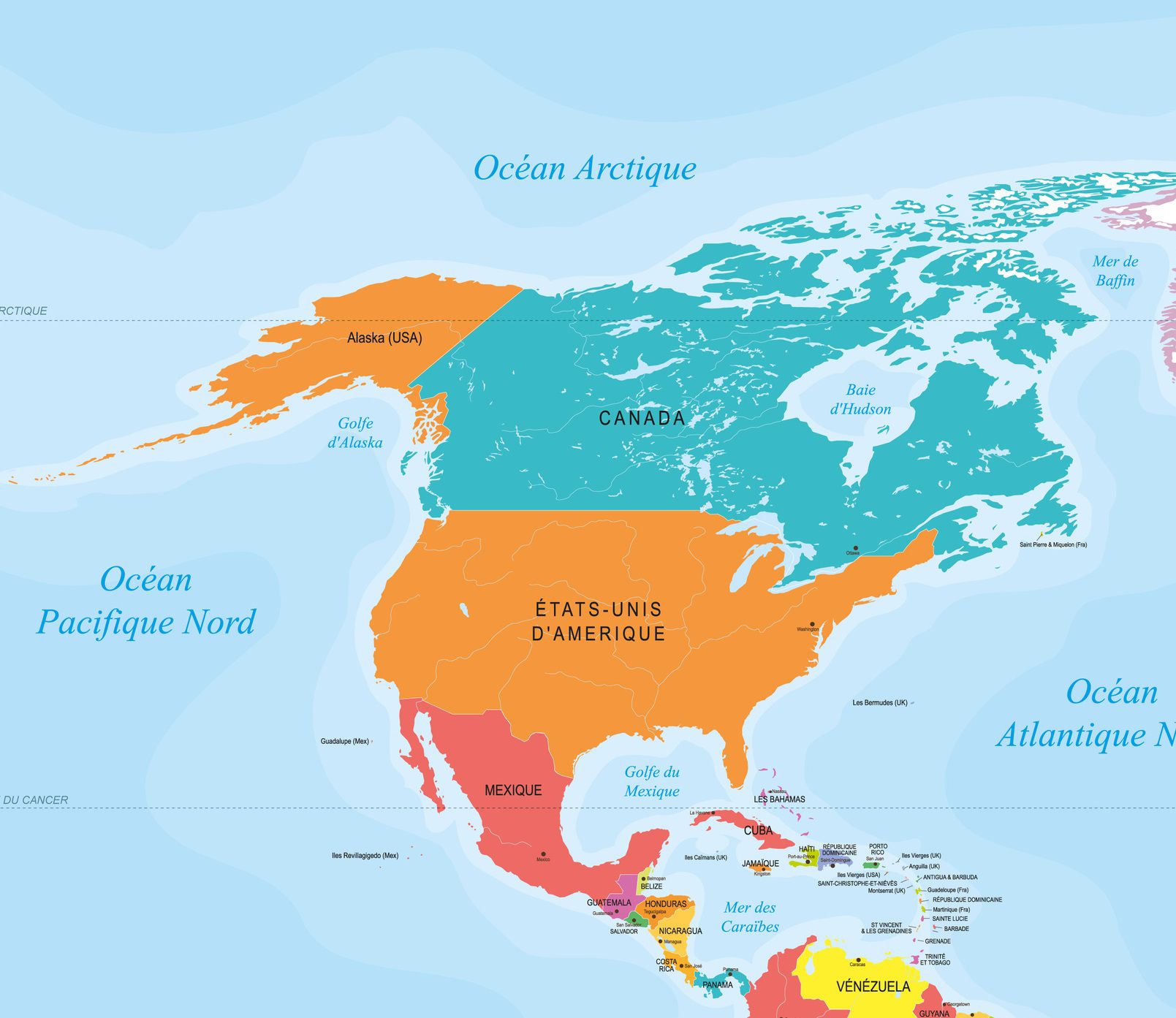
Map of countries in North and Central America
The Northern Lands
The Northern Lands are formed by the Canadian Shield, the Arctic coasts and the islands. The population is very scattered, and the environment is harsh. The main economic activities are forestry, mining and oil operations.
The Saint Lawrence Valley
The Saint Lawrence Valley (southern Ontario and southern Quebec) is Canada’s industrial heartland. Half of Canada’s population lives in this region, and 80% of inhabitants live in urban areas, as you can see on the map of North and Central America regarding population density.
The New England maritime region
This coastal region first attracted industries relying on hydropower. Boston, Massachusetts, and other New England cities are now high-tech centers. The people of Newfoundland have always been sailors. More recently, oil and natural gas deposits have been discovered offshore. The largest Canadian city in the region is Halifax.
The Atlantic coastal region
This region includes the states of New York, New Jersey, Pennsylvania, Maryland and Delaware. It is very diverse. New York City is the largest urban center in the region and in the United States. It is also a financial, tourist and industrial hub, as well as a very active port and a major center for trade and transportation. New York City is part of a megalopolis stretching from Boston to Washington, D.C. The city is easy to spot on the map of North and Central America.
The Middle West, the Great Plains and the Prairie Provinces
This region is the country’s agricultural center. A grain belt (mainly corn) stretches from Ohio to Nebraska. From northern Texas to the prairie provinces of Canada, summer and winter wheat are the main cereals. The steppe also contains oil deposits. The heart of America is also densely populated.
The South
The South is one of the best-defined regions of the United States. It extends from Virginia and Kentucky to the Gulf of Mexico and includes most of Arkansas and eastern Texas. Originally, plantations dominated (tobacco, rice and indigo).
The Southwest
This region is sunny and hot. Its population is made up of Anglo-Americans, Hispanics and Native Americans. It stretches from the Rio Grande Valley in Texas to Southern California and includes most of New Mexico and Arizona.
The Western mountains
This region extends from southwestern Alaska and includes the Rockies and the plateau between the Rockies and the far-west mountain range (the Sierra Nevada and the Cascades).
A large part of this arid region belongs to the state. It is sparsely populated. Brigham Young brought the Mormons in 1846. They founded Salt Lake City as well as other prosperous communities. Much of Utah and Idaho is still populated by Mormons. Tourism is an important source of income for the region.
California
California lies along the middle of the western coast between the Sierra Nevada and the Pacific Ocean. You can find it on the map of North and Central America with its famous cities such as Los Angeles and San Francisco. California is becoming increasingly urbanized, and apartment blocks are gradually replacing the Californian countryside.
The Northwest
This region stretches along the Pacific coast from California to Alaska. It includes western Oregon, a large part of Washington state, British Columbia, the Yukon and the southern Alaskan coast. It is largely a wet region, although the Cascades and coastal mountains have drier areas.
Mexico
This country lies between North America’s border states (Texas, New Mexico, Arizona and California) and Central America. Most Mexicans live in the temperate zone of the central plateau. Mexico is easy to identify on the map of North and Central America, as it is one of the continent’s main countries.
Americans and Europeans visit many Mexican regions. But poverty is still present, and many Mexicans try to cross the border into the United States to find work and better living conditions.
Central America
This region is dominated by the chain of high mountains that crosses it from east to west. Most inhabitants live in the highlands. They are mainly of Indigenous, Spanish and mixed origins. A significant Black population lives along the very humid Caribbean coastline. Guatemala is renowned for coffee, sugar and cotton. El Salvador is known for coffee and cotton; Nicaragua for coffee, cotton and bananas; Costa Rica for coffee and sugarcane; and Panama for its canal. You can see on the map of North and Central America that there are many small countries in this part of the continent.
The West Indies
The West Indies are made up of the Greater Antilles (Cuba, Hispaniola, Puerto Rico and Jamaica) and the Lesser Antilles (the Windward Islands and the Leeward Islands). The West Indies lie opposite Mexico on the map of North and Central America.
Culture
Today, more than a quarter of immigrants come from Asian countries, a quarter from Europe, and the rest from Central America and Latin America. North America is therefore made up of a wide variety of races and ethnicities.
Languages
The United States and Canada are largely English-speaking countries. But Spanish is widely spoken in the American Southwest, southern Florida and major urban centers. French is the main language of Quebec. You can explore a map of North and Central America.
This language is also spoken in some areas of New England and Louisiana. In addition, European and Asian immigrants continue to speak different languages in the United States and Canada. In Mexico, Spanish clearly dominates, and in the West Indies, Spanish, French and English are spoken in certain areas.
Religions
Christianity has the largest number of followers. Catholics are the most numerous. There are many Methodists in the region between New York and Nebraska, Lutherans between Wisconsin and Montana, Baptists in the South and Mormons in Utah. Catholics are the majority in New England, the Southwest and in urban areas. The Jewish population is mainly urban. You can explore the map of North and Central America with religions.
There are also some Russian Orthodox believers, Old Catholics, Polish Catholics, Armenians, Buddhists and Muslims. In Canada, Catholics are the most numerous, especially in Quebec, but Protestants dominate elsewhere. Catholics are the majority in Mexico, Central America and the West Indies.
Transportation
The vast distances of the North American continent are linked by impressive road, rail and air networks. Inland waterways and pipelines also play an important role in transportation.
In the United States, a dense rail network covers the Middle West, the states in the middle of the Atlantic coast and southern New England. A less dense network extends across the rest of the country.
Most of the road network runs parallel to rail lines. The Pan-American Highway connects the United States to Mexico and Central America. Air services also link major cities to each other as well as more remote destinations. Internal waterways are mainly used to transport goods. Pipelines connect oil and natural gas production areas with commercial hubs.