
In this article you will find a map of Ghana. The country, a former British colony of the Gold Coast, proclaimed its independence on March 6, 1957. The first British African colony to gain independence, Ghana served as a model for other colonized nations. Its name refers to a powerful African empire located in the Upper Niger region, whose civilization reached its peak between the 4th and 13th centuries.
Geography with the map of Ghana
The coastline stretches along the Gulf of Guinea for about 500 kilometers, between Togo and Côte d’Ivoire. Burkina Faso (formerly Upper Volta) forms Ghana’s northern border.
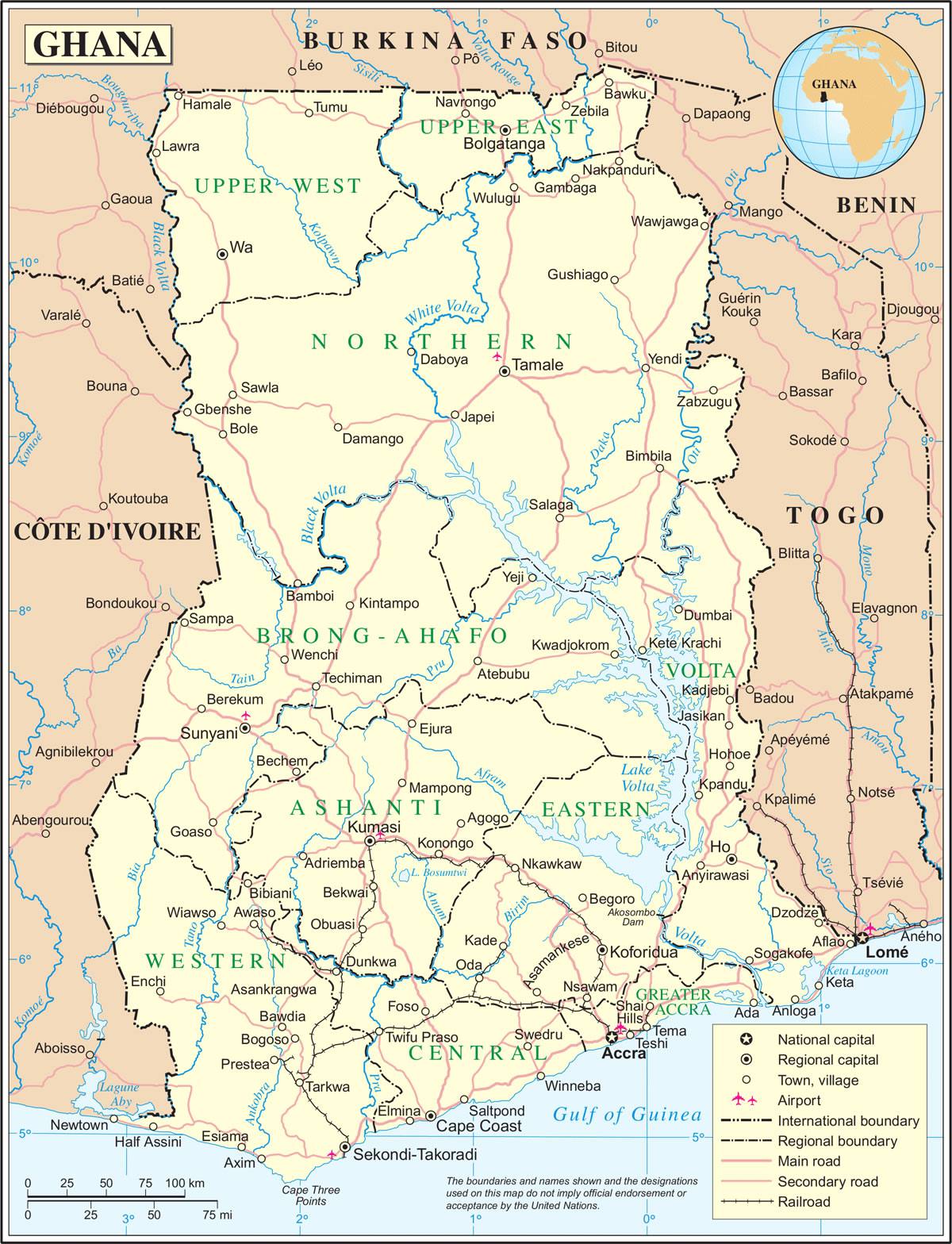
Geographical map of Ghana – Credit: Nations Online
Ghana covers an area of 238,540 square kilometers. The Volta Basin forms a circular plateau, with an elevation ranging from 300 to 600 meters, occupying the north and center of the country. The Gambaga Escarpment rises in the far north of the country (see the map of Ghana).
The Kwahu Plateau and the Akwapim-Togo Range respectively border the southern and eastern edges of the Volta Basin. Mount Afadjato, Ghana’s highest peak, rises to 885 meters above sea level. The Volta forms the Accra plains in the southeast of the country.
This long river drains three-quarters of the territory (you can see it on the map of Ghana). The Black Volta and the White Volta originate in Burkina Faso and then flow south before joining to form the Volta in central Ghana. The Volta and its main tributary, the Oti, feed the vast Lake Volta, whose area reaches 8,480 square kilometers.
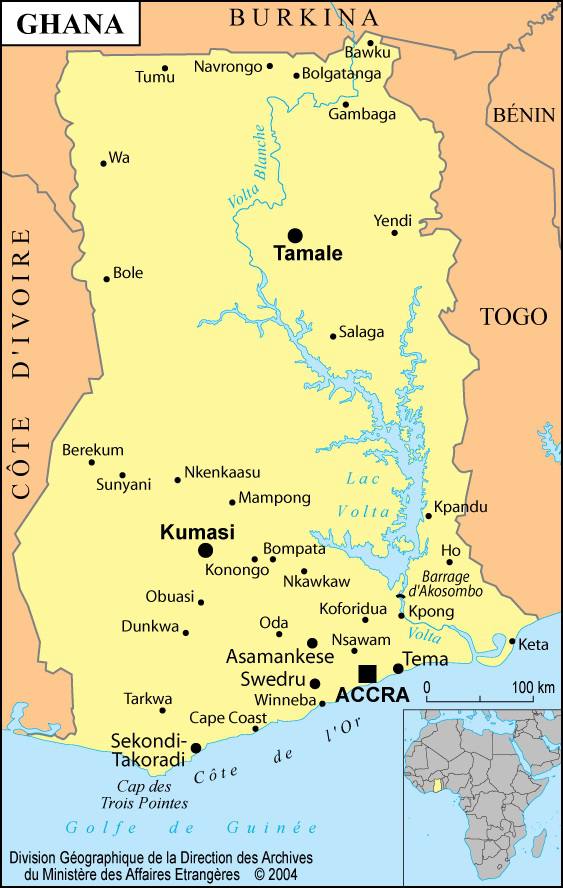
Ghana map
This artificial lake was created in 1966 with the construction of the large Akosombo Dam, which supplies Ghana with hydroelectric power. In the southwest of the country, the Pra, the Tano, and several other rivers cross the Kwahu Plateau before flowing into the Gulf of Guinea.
Learn more about the country
In the south of the country, annual rainfall averages between 127 and 211 centimeters. The heaviest rains occur in spring and autumn. Tropical forests dominate the vegetation of southwestern Ghana and the Akwapim-Togo mountains, consisting mainly of mahogany and ebony trees. In the north, rainfall is lower, with an annual average between 109 and 127 centimeters.
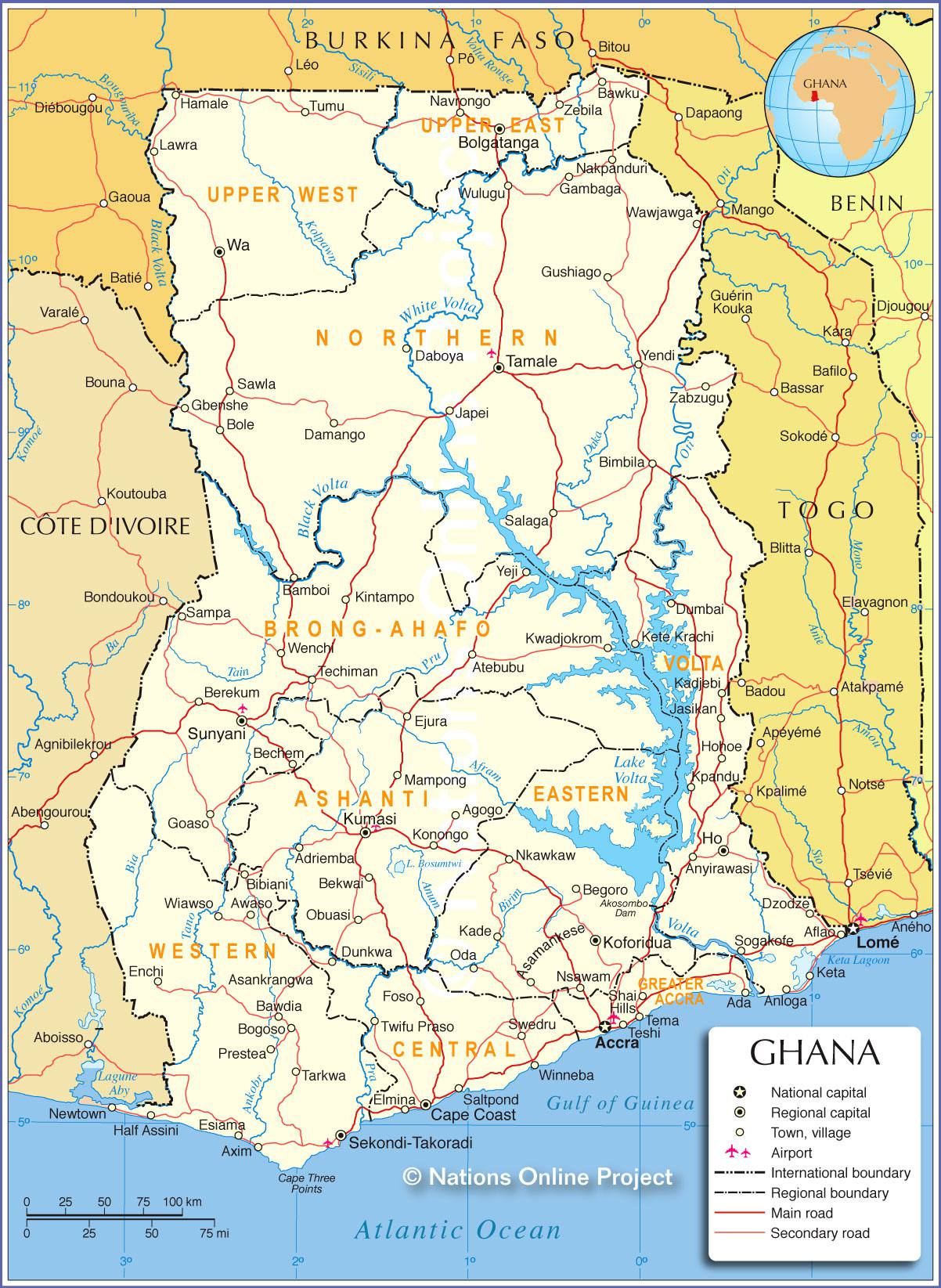
Map of Ghana – Credit: Nations Map
The heaviest rains are recorded in summer and winter. Ghana experienced several severe drought periods in 1976, 1977, and 1982. The Volta Basin and northern Ghana are characterized by vegetation dominated by scrub, shrubs, and bushes. Minimum annual temperatures range between 27°C in Accra and 28°C in Tamale.
The natural environment has suffered greatly from intensive land clearing linked to the need for fuel and for bringing new land into cultivation to meet population needs. Forests have almost disappeared in both the south and north of the country.

Grasslands and shrubs that make up most of the vegetation are burned to promote agricultural development. Droughts in recent years have caused severe famines, particularly in already overcrowded urban areas. In 1984, the level of Lake Volta dropped dramatically, resulting in a significant reduction in electricity produced by the Akosombo Dam.
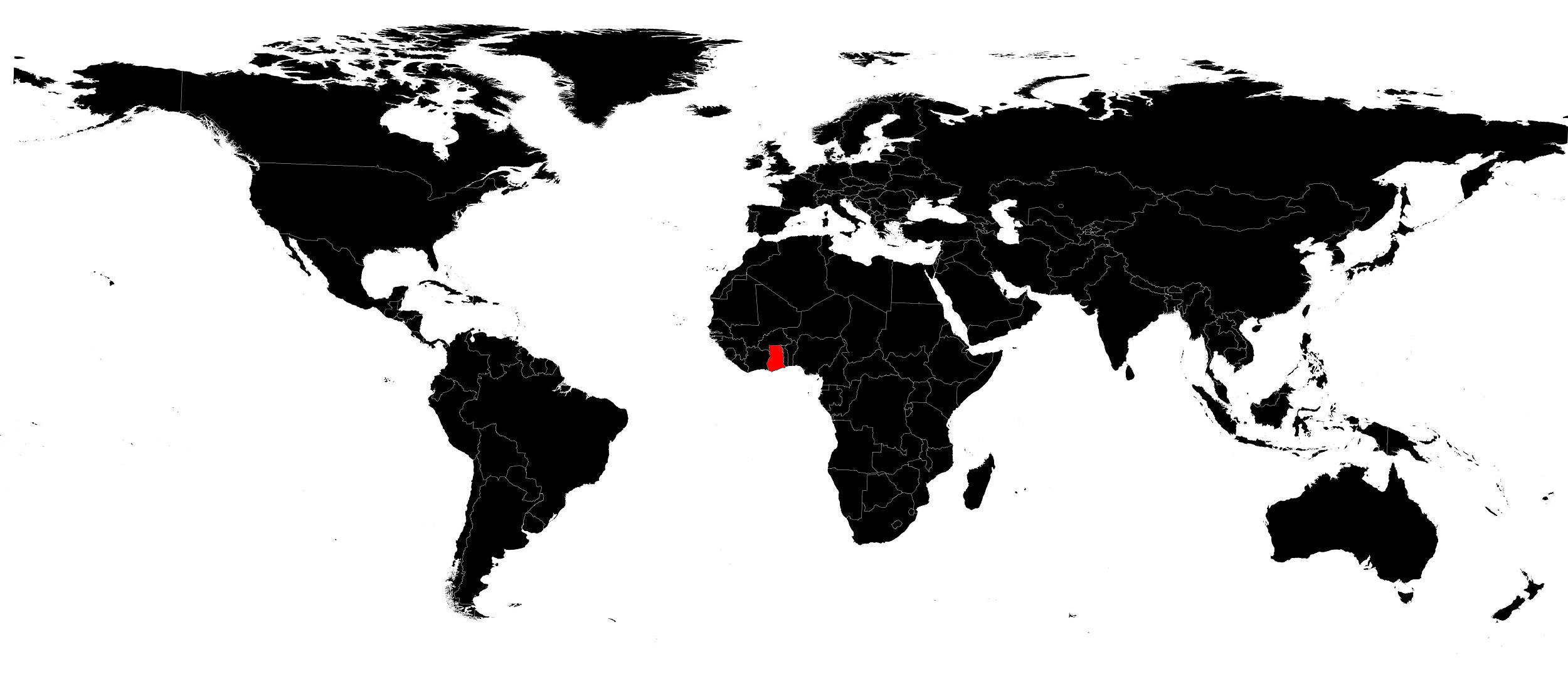
Ghana on a world map