
In this article you will find a map of Madagascar. The country is also the fourth largest island in the world. It is located in the Indian Ocean, off the southeastern coast of Africa. Its area is 587,040 square kilometers and it is separated from Africa by the Mozambique Channel. Its coastline stretches for nearly 3,990 kilometers.
Geography with the map of Madagascar
The island extends over 1,580 kilometers from north to south and is about 580 kilometers wide. The Republic of Madagascar, which includes the island of Madagascar as well as several adjacent islands, has its capital in the city of Antananarivo (which can be seen on the map of Madagascar).
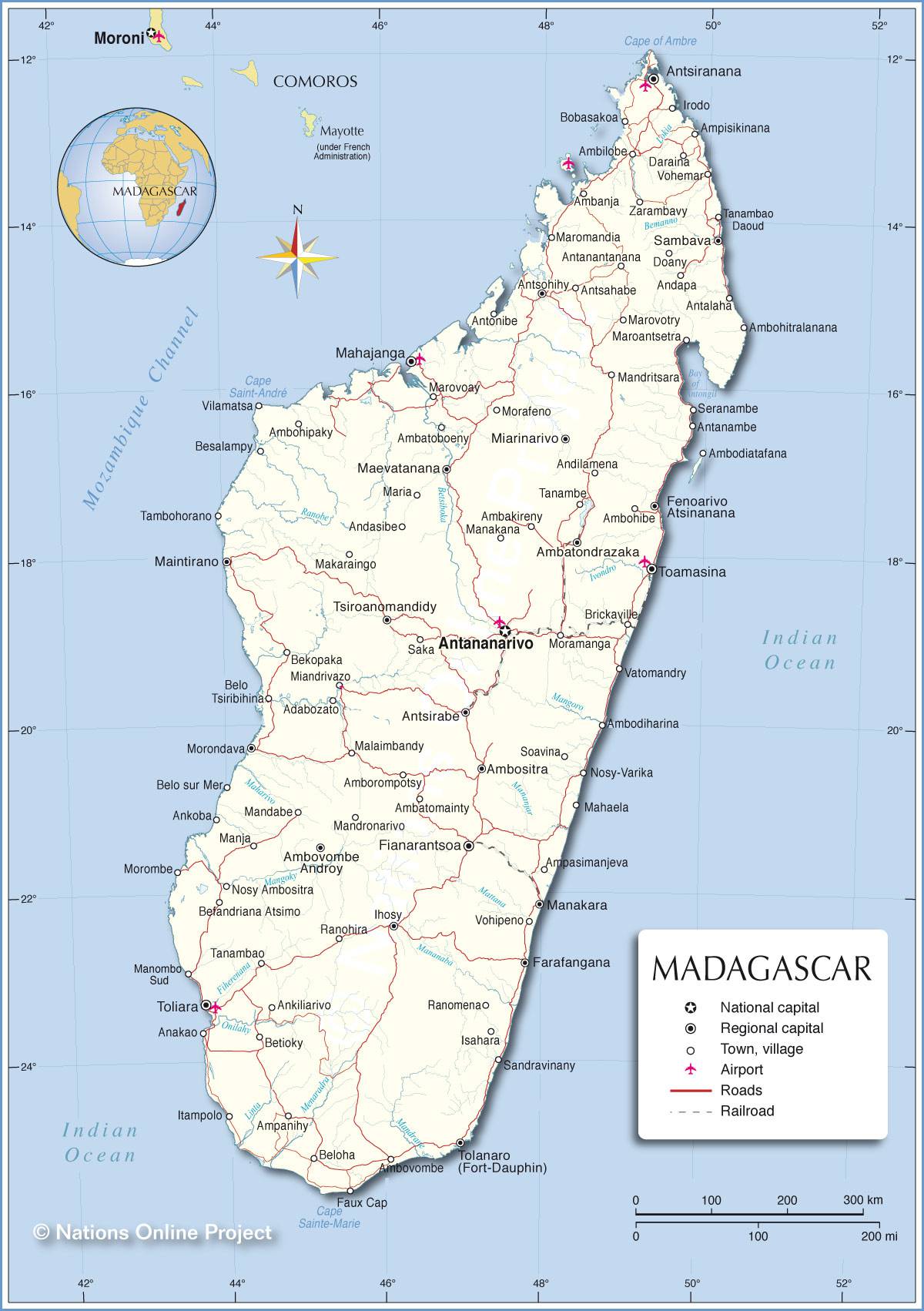
Madagascar map – Credit Nations Online
The island is cut by a multitude of valleys, mountain ranges, rivers, and tropical forests. The climate and topography vary from one region to another. The central plateau is characterized by tall-grass prairies and groves of trees. It then gives way (to the east) to a narrow coastal plain and to low plateaus or plains (to the west).
Mount Maromokotro, the highest peak on the island, rises to 2,876 meters above sea level (it can be spotted on the relief on the map of Madagascar) in the north of the country. In the east, the rivers are short and their flow is fast.
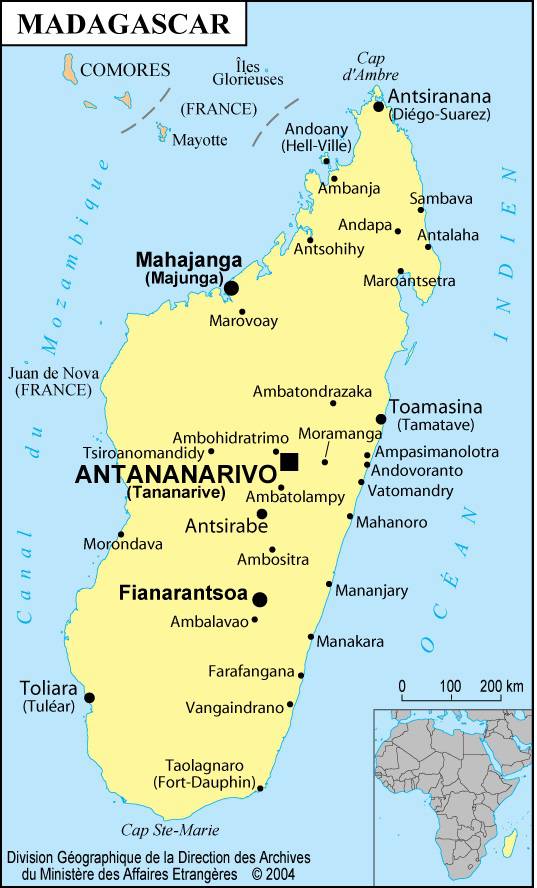
Map of Madagascar cities
In the west, however, they are much longer, and their alluvium makes the soils very fertile. The coral beaches that stretch along the eastern coastline are fringed by a whole series of lagoons connected to the Pangalanes Canal.
Island climate
The island of Madagascar has a tropical climate characterized by rainfall ranging from 211 centimeters in the northwest to 36 centimeters in the southwest. The south of the country is extremely arid, while the west is rather warm and humid.
Cyclones that form in the Indian Ocean come with heavy rainfall and devastating floods. The forests that once covered a large part of the territory have almost completely disappeared and have eventually given way to steppe and a few rare forested areas made up of deciduous trees in the west and evergreen trees in the east. The eastern coastline is bordered by marshes and vast tropical forests.

Blank map of Madagascar
Despite its proximity to Africa, which can be seen on the map of Madagascar, the island has wildlife different from that of the continent. There are more than 50 species of lemurs (a tree-dwelling animal related to monkeys) and nearly 800 species of butterflies. Crocodiles and pufferfish are also found there. Part of the flora is similar to that of eastern India.
Population
The Malagasy represent about 99% of the total population. This people differs in many ways from the peoples of Africa and shows closer similarities with the Indonesian population.
Indonesians likely visited the island of Madagascar during the first century AD. Several waves of immigration then followed, explaining the current diversity of the island’s ethnic groups.
The Malagasy include: the Merina, the Betsimisaraka, the Betsileo, and the Tsimihety. Among foreign minorities, one can also mention: Indians, Chinese, French, and Comorians.
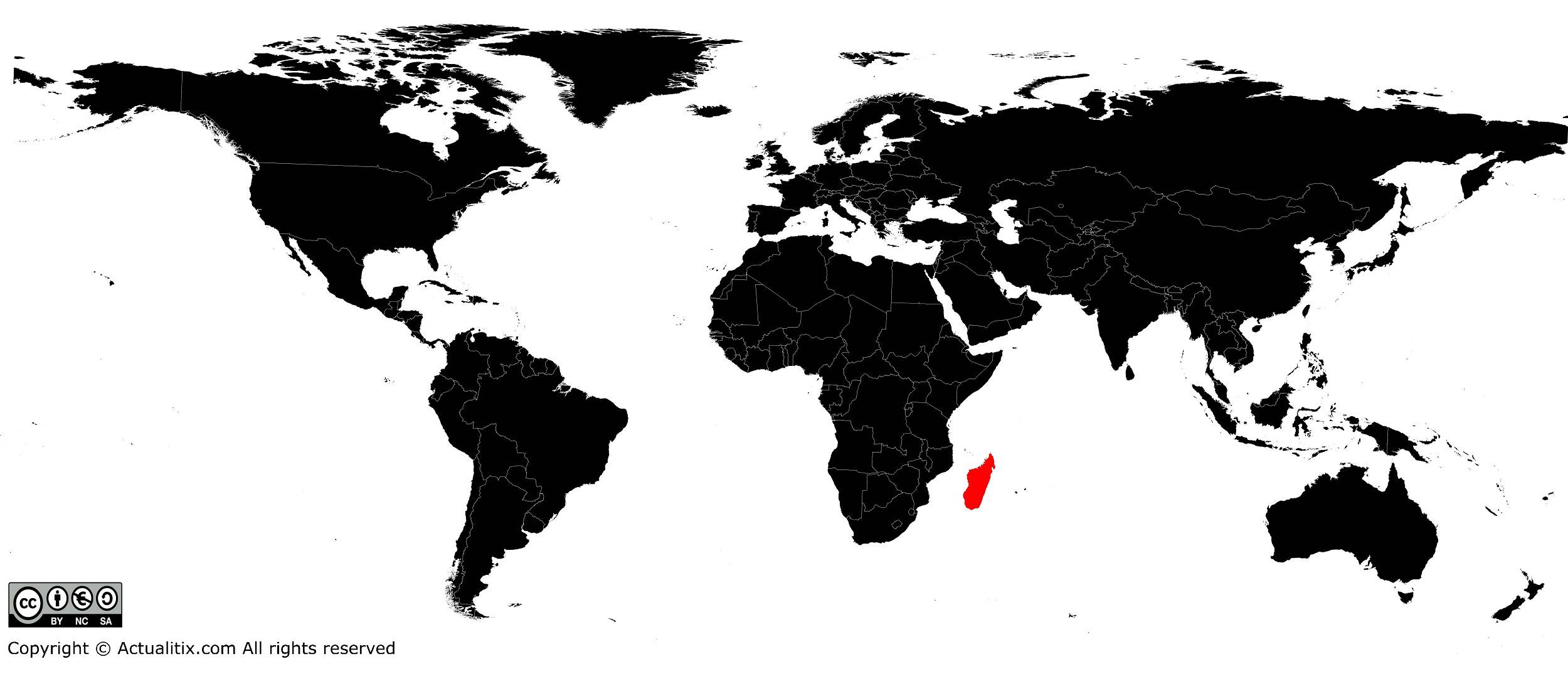
Madagascar on a world map
The island’s population has more than doubled since 1950. The rural population represents nearly 80% of the total population. The highest population densities are recorded on the central plateau, which is also home to Antananarivo (you can see it on the cities map of Madagascar), the capital and the largest city on the island.
The city has several archaeological museums and a university. It is served by two airports, a railway line, and also by the port of Toamasina (on the east coast).