Discover a map of Algeria. The country is located on the northern coast of Africa; with an area of 2,381,741 square kilometers, Algeria is the largest country on the continent.
Two thirds of its land lies in the Sahara Desert. The country has more than 1,000 km of Mediterranean coastline. Algeria is bordered by Tunisia, Libya, Niger, Mali, Mauritania, Western Sahara, and Morocco.
The Tell region in the north of the country is home to 80% of Algerians. An independent republic since it freed itself from French rule in 1962, Algeria maintains ties with Europe. Its history, its language, and Islam mean that it fully belongs to the Arab world.
Article outline
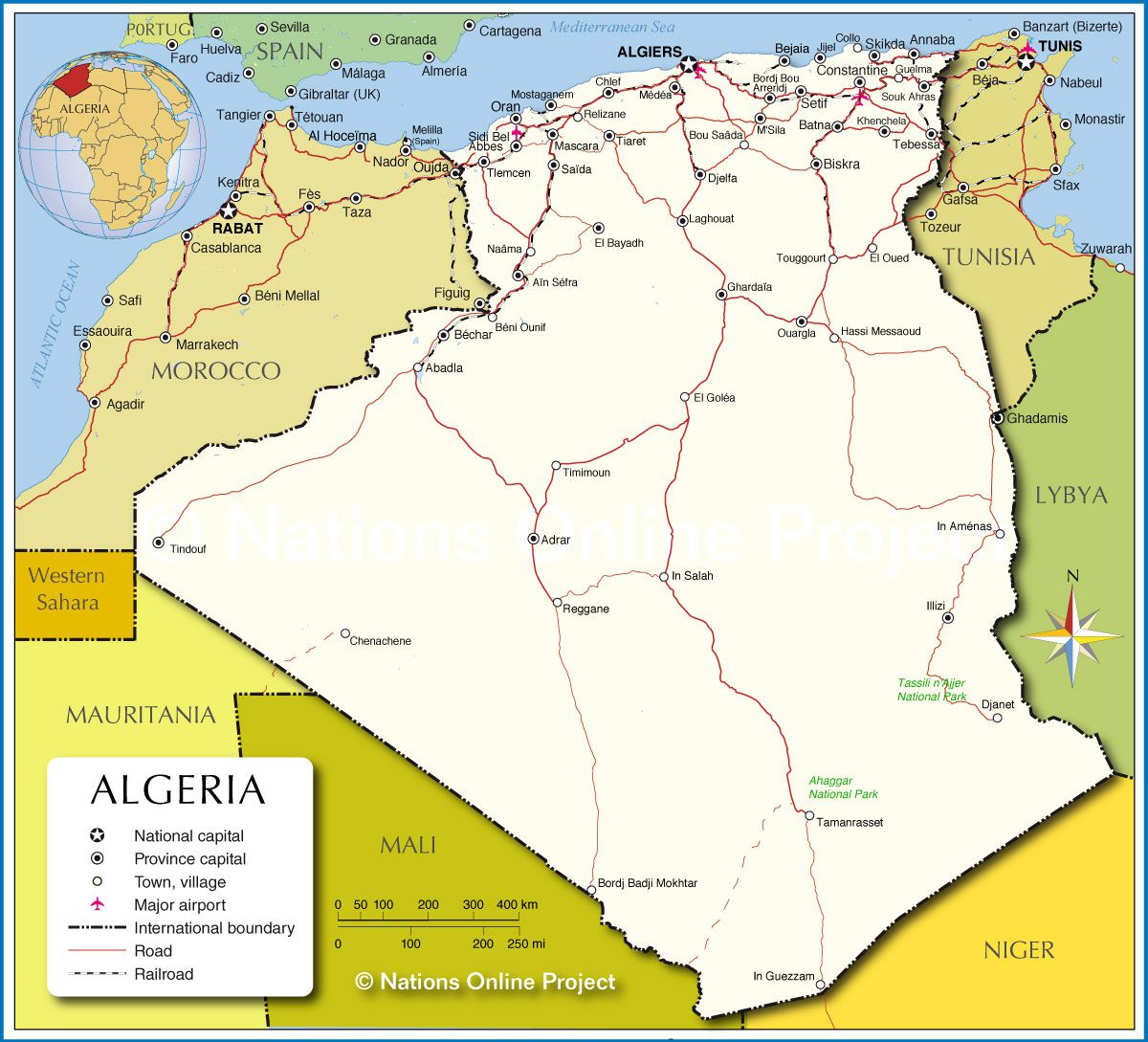
Algeria map – Credit: Nations Online
Discovering the Map of Algeria
As we can see on the map of Algeria, the north of the country is divided into five distinct regions: the arable coastal strip, the plains and the Tell range in the north, the high plateaus farther south, and the Saharan Atlas.
The Tell range region is prone to earthquakes. Its climate is Mediterranean, with warm, rainy winters and hot, dry summers. Rainfall is around 71 cm, and average temperatures are about 10°C in January and 27°C in July. Hot, dry Sahara winds intensify summer drought and sometimes damage crops.
The semi-arid lands of the high plateaus form a broad plain in the south of the country. Rainfall reaches 41 cm per year in the north and 20 cm in the south. Temperatures range from 9°C in January to 27°C in July.
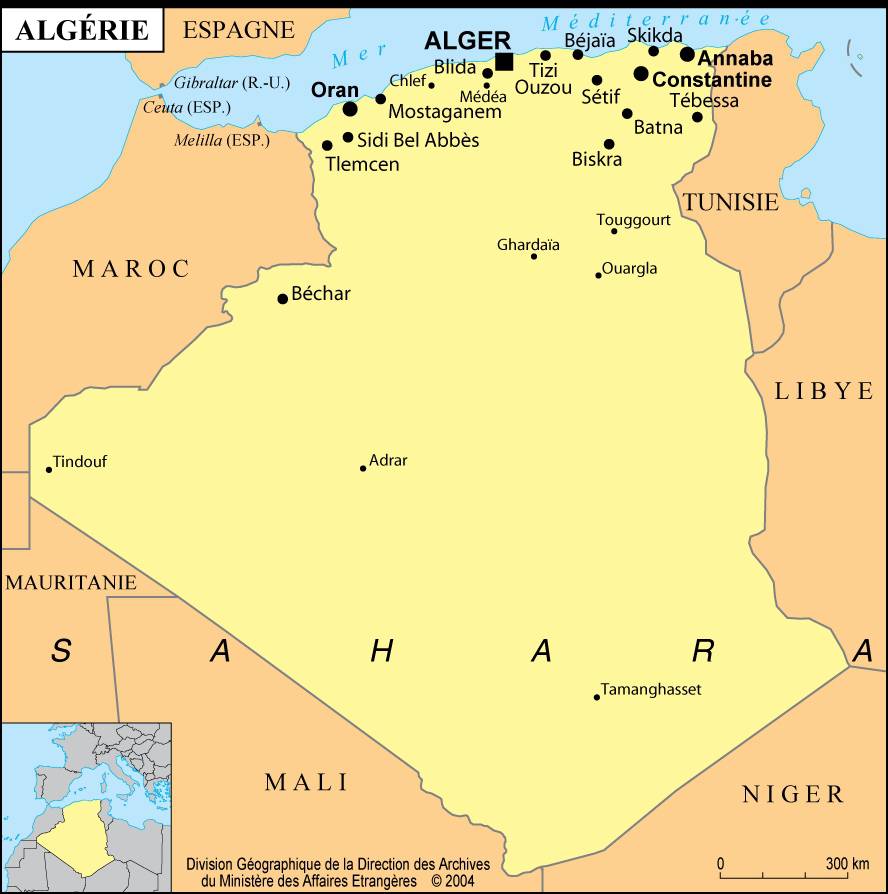
Map of Algeria – Credit: Ministry of Foreign Affairs
The rugged Saharan Atlas has sparse vegetation. The northern face of the mountains receives about 20 cm of water per year, and farther south precipitation decreases even more.
The Sahara region is made up of large basins, plateaus, and mountains. Some basins contain expanses of sand known as ergs. In the southern part of the desert, there are heavily eroded volcanic massifs. In the Hoggar, Mount Tahat reaches 2,918 meters. In the north of the desert, annual precipitation is around 18 cm. Temperatures average between 7°C in January and 29°C in July. Less than 2.5 cm of rain falls per year in the central Sahara, where average temperatures are 14°C in January and 37°C in July.
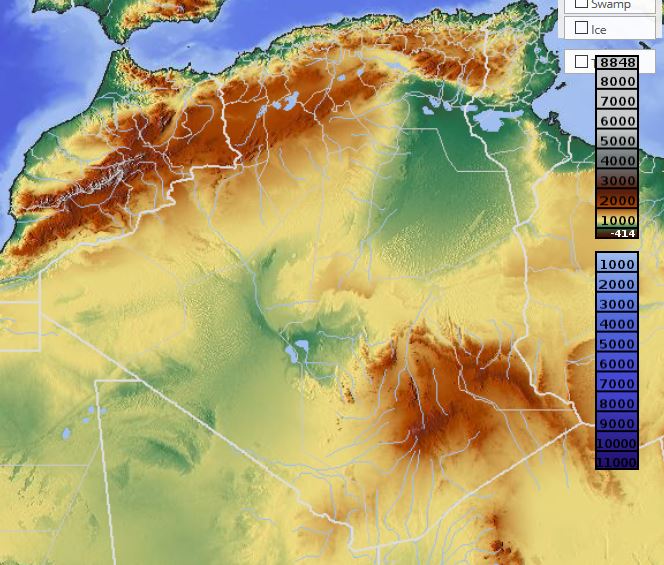
Relief map of Algeria – Image extracted from maps-for-free
Wildlife and Plant Life in Algeria
Wildlife and plant life vary depending on precipitation. As shown on the map of Algeria, the Saharan Atlas roughly divides the country into two agricultural zones. North of the mountains, farming without irrigation is possible; the region is wooded and rich in vegetation.
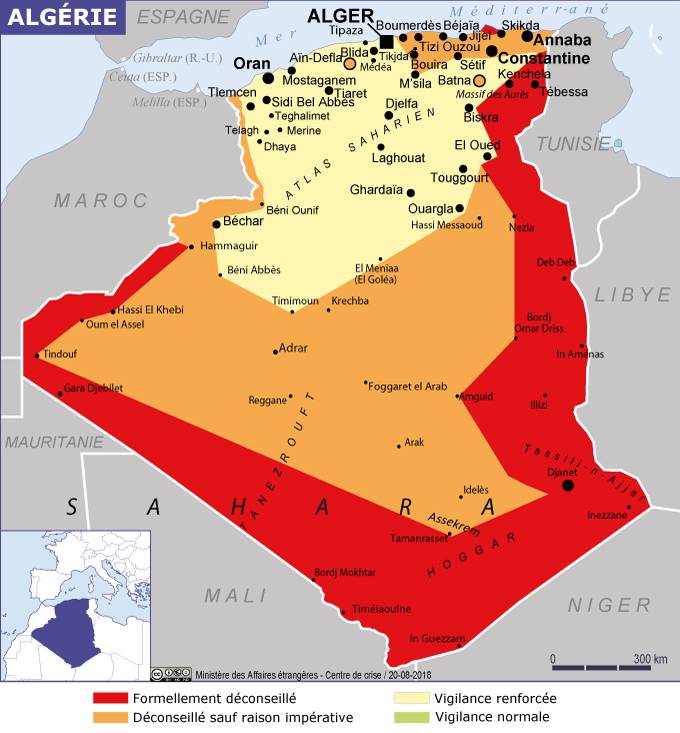
Map of the cities of Algeria – Credit: Ministry of Foreign Affairs
Cork oaks, grapes, olives, citrus fruits, cereals, tobacco, and cotton grow there, along with Aleppo pines, holm oaks, and thuyas. Alfa grass and wormwood grow farther south where the vegetation is steppe-like. Some grasses grow very quickly after rain and then almost immediately disappear. Stunted shrubs, acacias, jujube trees, and other plants survive despite the low precipitation.
Vegetation on the high plateaus mainly consists of bushes and tufts of grass scattered here and there. Livestock is raised on seasonal pastures. Cereal farming depends on the amount of rainfall. In 1975, the government began planting trees along a 1,500 km strip south of the Saharan Atlas to prevent the desert from advancing northward.
Blank map of Algeria – Credit: Actualitix
Elephants, hippopotamuses, and crocodiles once lived in Algeria. Today, few species remain, as vegetation is too sparse to support them. Hyenas, jackals, monkeys, falcons, desert snakes, antelopes, gazelles, hares, jerboas, and wild boars are native to the region.
Population in Algeria
This is not visible on the map of Algeria, but two ethnic groups predominate in Algeria: Arabs and Berbers. Most Algerians descend from these two groups. The Berbers were the first inhabitants of this region and were only joined by the Arabs at the beginning of the 7th century.
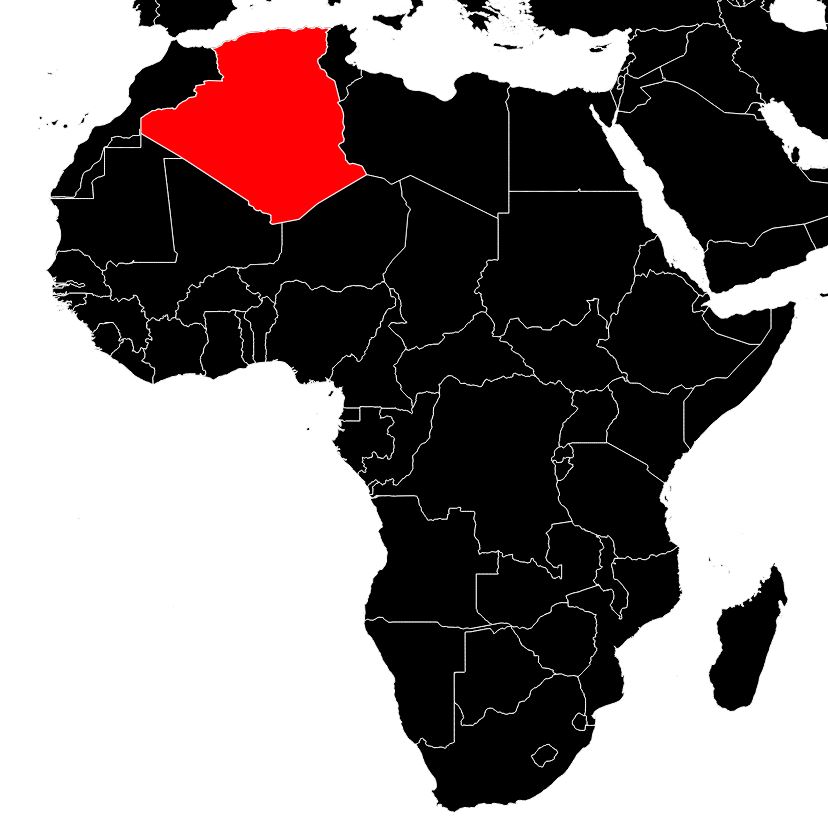
Algeria on a map of Africa – Credit: Actualitix
Islam, the religion of Muslims, unifies the Algerian people. Nearly 99% of the population is Sunni Muslim. The rest is Catholic of French origin.
Berber and Arabic are spoken in Algeria, but most Berbers speak Arabic, the official language. Even though most French residents left the country in 1962, French remains the second most widely spoken language. Efforts have been made to promote greater use of Arabic. Berbers have fought to preserve their own culture and their own language.
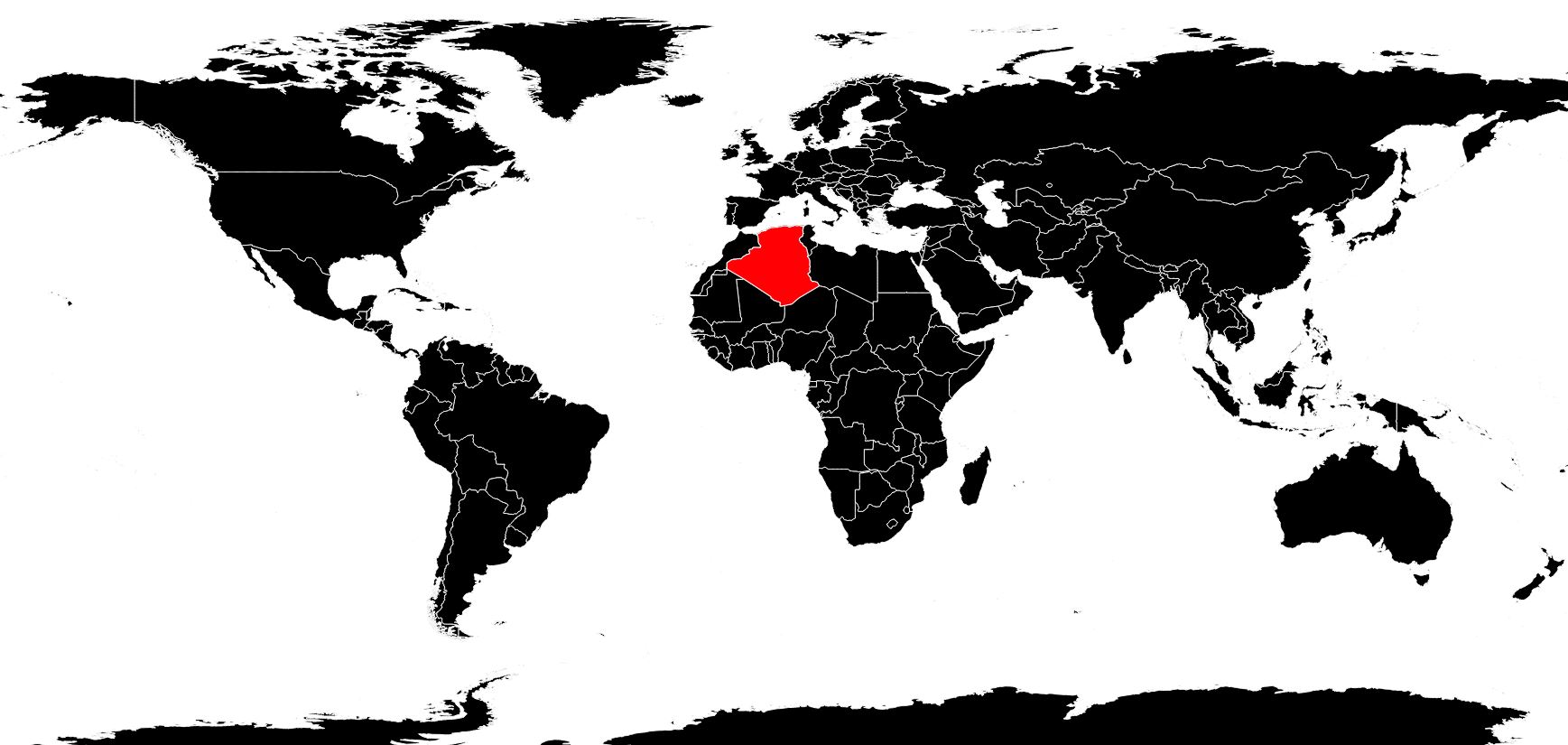
Algeria on a world map – Credit: Actualitix
The Algerian way of life differs by region. In the capital, Algiers, and in major cities, it is decidedly modern. In the northern plains, farmers lead a simple life, while nomadic or semi-nomadic peoples travel through the highlands and deserts.