
Discover the map of Venezuela. When explorer Alonso de Ojeda first saw the Indian villages built on stilts along the marshy shores of Lake Maracaibo in 1499, he named this region “Venezuela” (Little Venice).
Today, the country is famous for the scale of its crude oil production—about 4% of global output. Outside the Middle East, its oil reserves are among the largest in the developing world.
Table of contents
Geography with the map of Venezuela
Venezuela is a coastal republic whose territory is marked by plains and mountains. Its coastline, made up of beaches popular with tourists, stretches for 2,813 kilometers and connects the country to nearby islands. In the 1960s and 1970s, some of these islands visible on the map of Venezuela—Trinidad and Tobago, Costa Rica, Honduras, and Puerto Rico—were major beneficiaries of economic assistance provided by Venezuela as part of its industrial development programs.
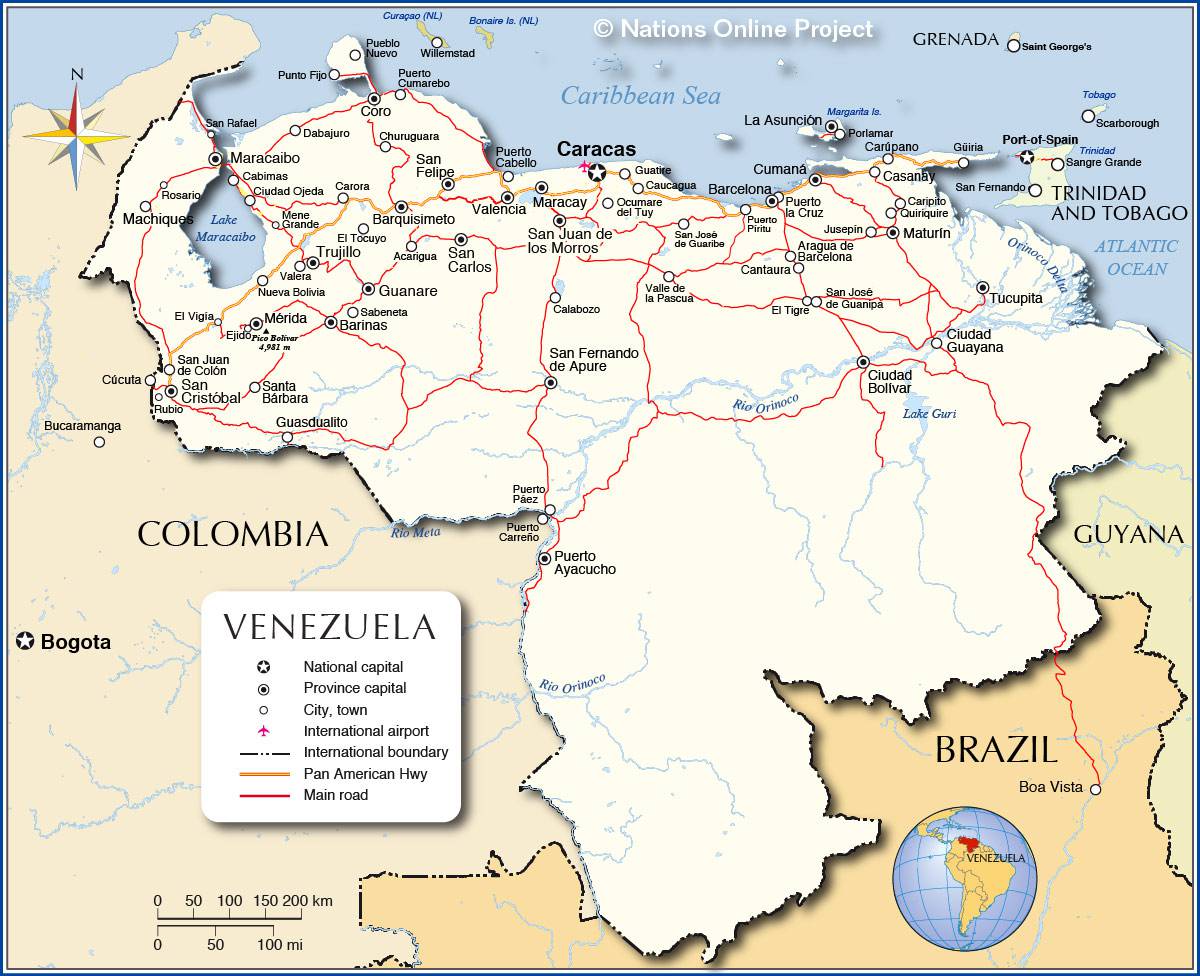
Venezuela map – Credit: Nation Online
The Andes mountain range, visible on the map of Venezuela, begins in the northeast of the country and stretches 1,210 kilometers westward into Colombia. As it rises in altitude and width, it then curves southward through Colombia, Ecuador, Peru, and Bolivia. It reaches 5,007 meters at Pico Bolívar in the western Andes. The states located in the Andes include nearly two-thirds of the population, reflecting the Spanish settlers’ preference for highlands with a temperate climate. Venezuela is a member of the Andean Pact, through which it supports neighboring countries with less prosperous economies.
Venezuela also consists of tropical plateaus and plains extending southward and covering more than half of the national territory. The population in this region is unevenly distributed.
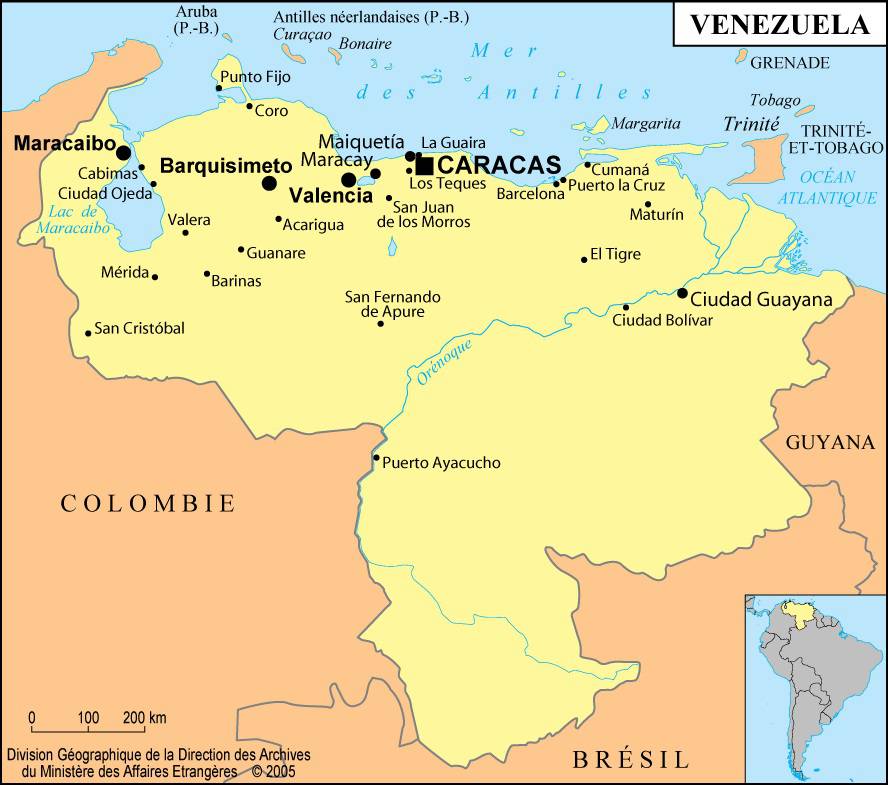
Map of the cities of Venezuela
Venezuela is located east of the United States. The longitude of Caracas, the capital (see its location on the map of Venezuela), is 67° west. Miami, Florida, is the closest major U.S. city. Venezuela extends across 14 degrees of longitude and 11 degrees of latitude. However, its wide latitudinal span results in only minor winter temperature differences due to its proximity to the Equator.
Population
The population density of the Amazonas state is about one-seventh that of Alaska. Venezuela’s population, estimated at around 30 million in 2016, makes it one of the most populous countries in Latin America. With an area of 912,050 square kilometers, the population density is about 33 inhabitants per square kilometer.
Population growth in Venezuela is also influenced by immigration. Along its western border, illegal immigration brings between 25,000 and 50,000 Colombians into the country each year.
Learn more
Before 1959, Venezuela was ruled by a series of military dictatorships. Although many government projects benefited from the oil boom beginning in the 1920s, economic development remained highly concentrated around the capital, and much of the rural population lived in poverty.

Blank map of Venezuela
In 1959, a civilian was elected president, and in the following years a political system with two main parties was established. Under this system, each party alternately presented candidates in presidential elections for five-year terms. Despite economic setbacks, this representative system of government remained stable.
The different geographical regions
Venezuela can be divided into four major regions with distinct altitudes and topographical features, as shown on the map of Venezuela: the Andes, the Guiana Plateau, the Orinoco Llanos region, and the Maracaibo Basin.
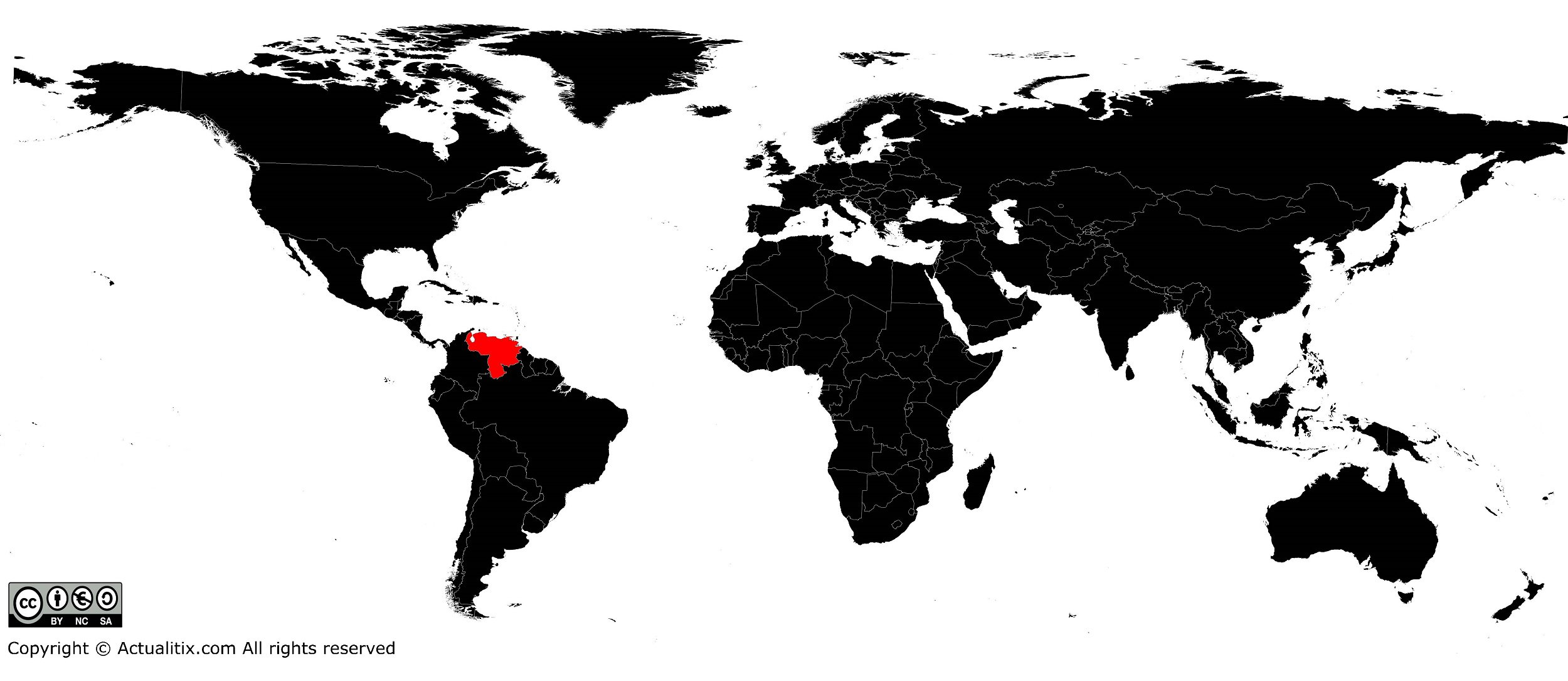
Venezuela on a world map
You can discover all the available maps for the different countries of the world on this page.