
In this article, you will find a map of Japan. It is one of the major industrialized countries in Asia and in the non-Western world; Japan can, without embarrassment, be compared to the most powerful Western economies. Rebuilt in the aftermath of its defeat during World War II, the country experienced one of the most spectacular revivals of the post-war period.
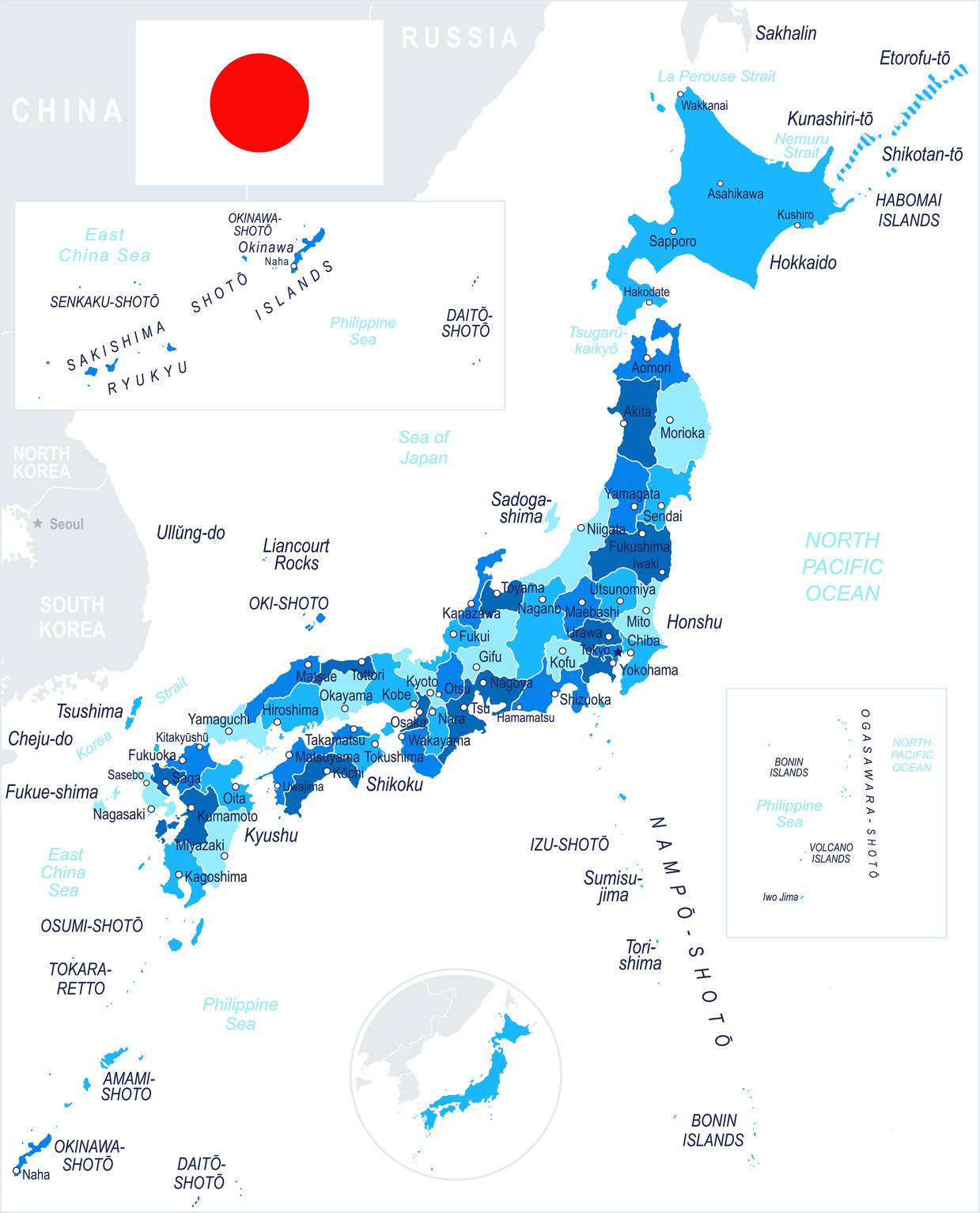
Japan map – © dikobrazik – stock.adobe.com
Article outline
The evolution of Japan
The Meiji Restoration of 1868 marks the beginning of the modern era in Japan. Step by step, the Japanese succeeded in developing the technological foundations of a modern industry that enabled the country to become one of the world’s leading economic powers.
The Japanese population has access to an impressive variety of goods. The metropolises, led by Tokyo (which can be seen on the map of Japan), are the showcase of what an urban center can represent today. Japan is also characterized by its contrast between new and old, modernity and tradition. Urbanization, industrialization, and the development of transport and communications have profoundly changed the Japanese way of life, both in the city and in the countryside.
Japan’s population density is very high. Japan’s total population ranks 8th in the world. Its capital, Tokyo, is one of the largest metropolises in the world. From 1955 to 1990, Japan’s economic growth was unprecedented. It also enabled the country to become one of the hubs of the global economy. Given the devastation of World War II, this rapid expansion is often described as an “economic miracle.” Since the early 1990s, growth has nevertheless slowed somewhat, and other Far Eastern countries have entered the race.
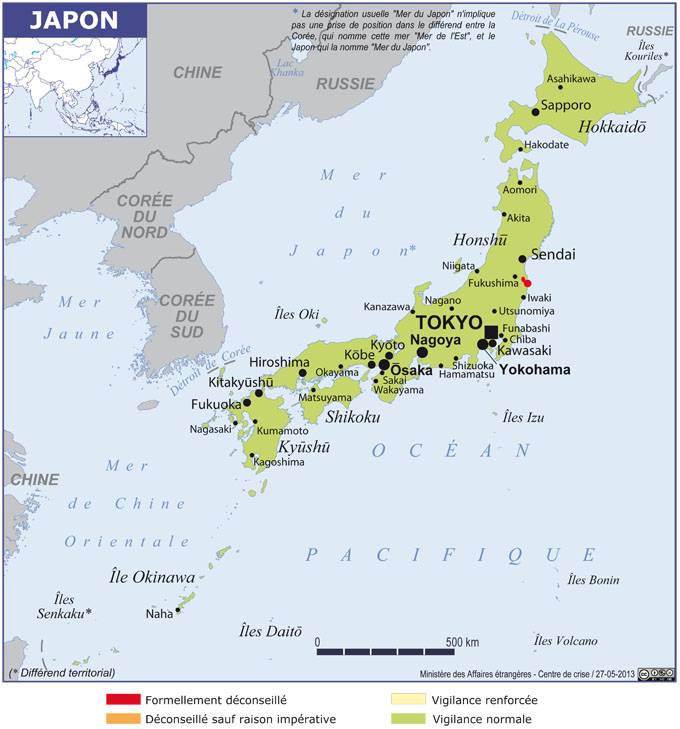
Japan map – Credit: Ministry of Foreign Affairs
Geography with the map of Japan
Located off the Asian continent, Japan is made up of a mountainous chain. On the map of Japan, you can see that it is divided into four main islands—Hokkaidō, Honshū, Shikoku and Kyūshū—and the country stretches from northeast to southwest for nearly 1,900 km. If we also consider the roughly 3,900 islands that belong to the country, Japan’s length is then 2,900 km. Its maximum width reaches 320 km.
Additional information:
You may notice the name “Sea of Japan.” This is worth qualifying, as it is disputed with South Korea, which uses the name “East Sea” to refer to it.
Japan uses the name “Sea of Japan” with reference to an IHO conference that took place in Monaco in 1929. But South Korea has never shared that decision. At the time of the conference, it was under Japanese rule and could not express its position on the matter. Since then, the South Korean government has been trying to find a solution to this issue since its independence in 1945. Learn more about the Sea of Japan / East Sea: https://fr.wikipedia.org/wiki/Mer_du_Japon
The same applies to the Liancourt Rocks, which may be called Dokdo in Korean or Takeshima in Japanese. Learn more about these islands: https://fr.wikipedia.org/wiki/Rochers_Liancourt
The borders of Japan
Japan has no land borders. To the west, off the Sea of Japan (Japan’s name) / East Sea (South Korea’s name), lie North Korea and South Korea. To the northwest of the Sea of Japan (Japan’s name) / East Sea (South Korea’s name) and off the Sea of Okhotsk lies Russia. China is to the west, on the other side of the East China Sea. Taiwan and the Philippines are southwest of the Ryūkyū Islands. The eastern and southeastern coasts border the Pacific Ocean.
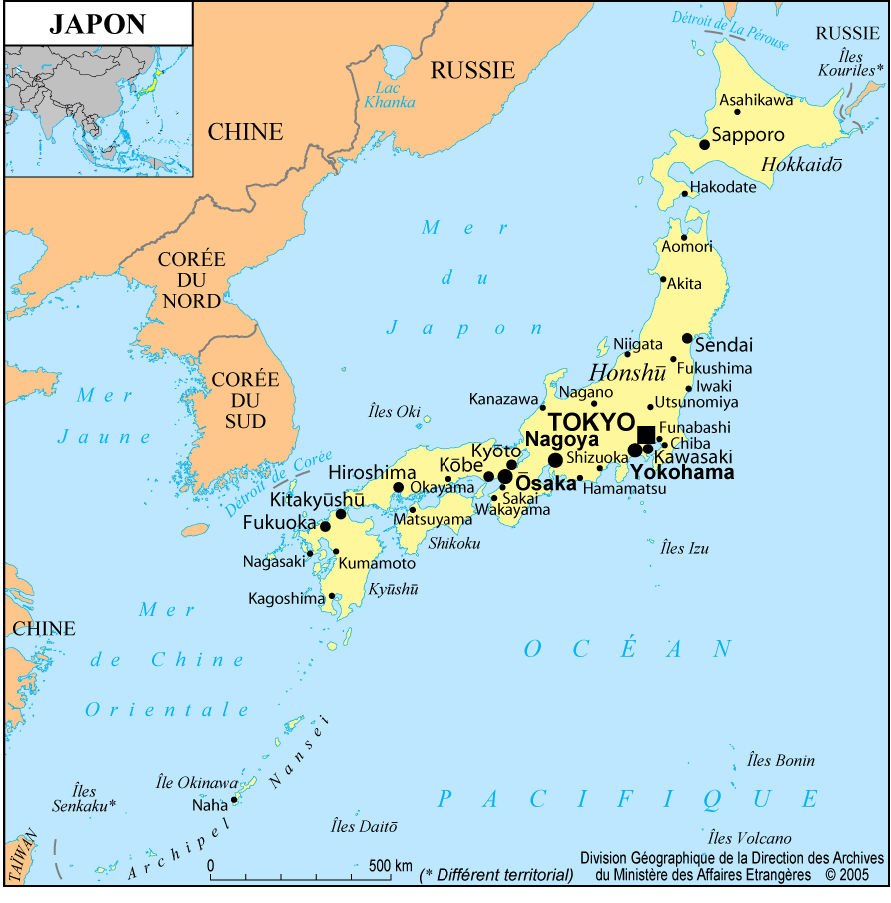
Map of cities in Japan – Credit: Ministry of Foreign Affairs
Japan’s area is 377,835 square kilometers. The main island is Honshū, as you can see on the map of Japan: it represents three-fifths of the total area.
The Japanese islands are geologically young and unstable. They have been shaped by considerable geological movements and intense volcanic activity. The country’s topography is therefore rugged and dominated by mountains and hills that cover more than 80% of the territory. This also explains the division of the islands into hundreds of units. The landscapes are very diverse.
Only a quarter of the country has a slope of less than 15 degrees. Most plains were formed by the sediment deposits of rivers and lie along the coastline. The Kantō Plain, the largest in Japan, is located in the east of Honshū. Situated in the middle of this island, it covers 15,500 square kilometers. This is where the city of Tokyo was built. On a smaller scale, the Nōbi Plain is home to Nagoya, while the Kansai Plain is occupied by Osaka, Kyoto and Kobe.
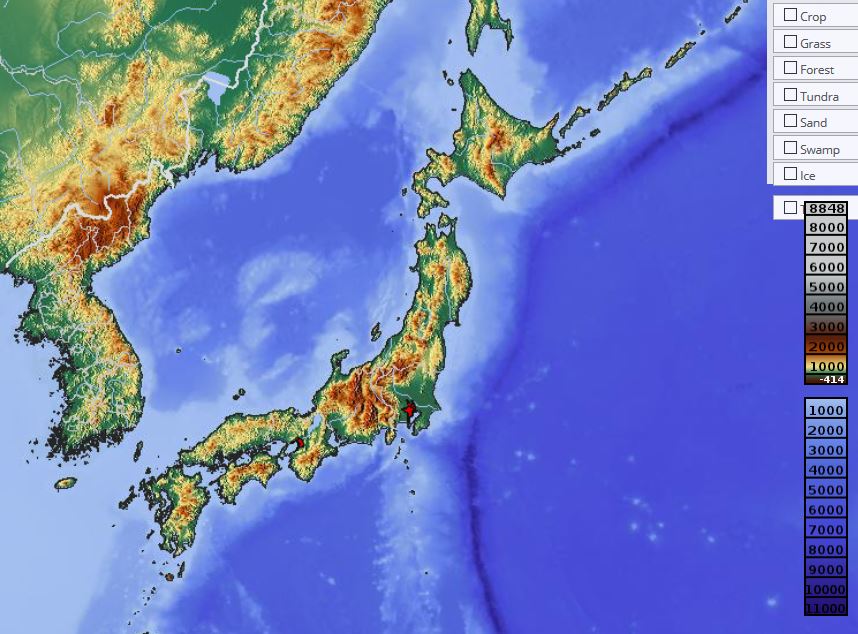
Relief map of Japan – Image extracted from maps-for-free
Japan and water areas
Japan’s many rivers are generally short and their basins are low in sediment. Only two of them, the Shinano and the Tone, exceed 310 km in length as shown on the map of Japan. They are located on the island of Honshū. At 367 km long, the Shinano is the longest. But the Tone covers a larger area (18,400 square kilometers).
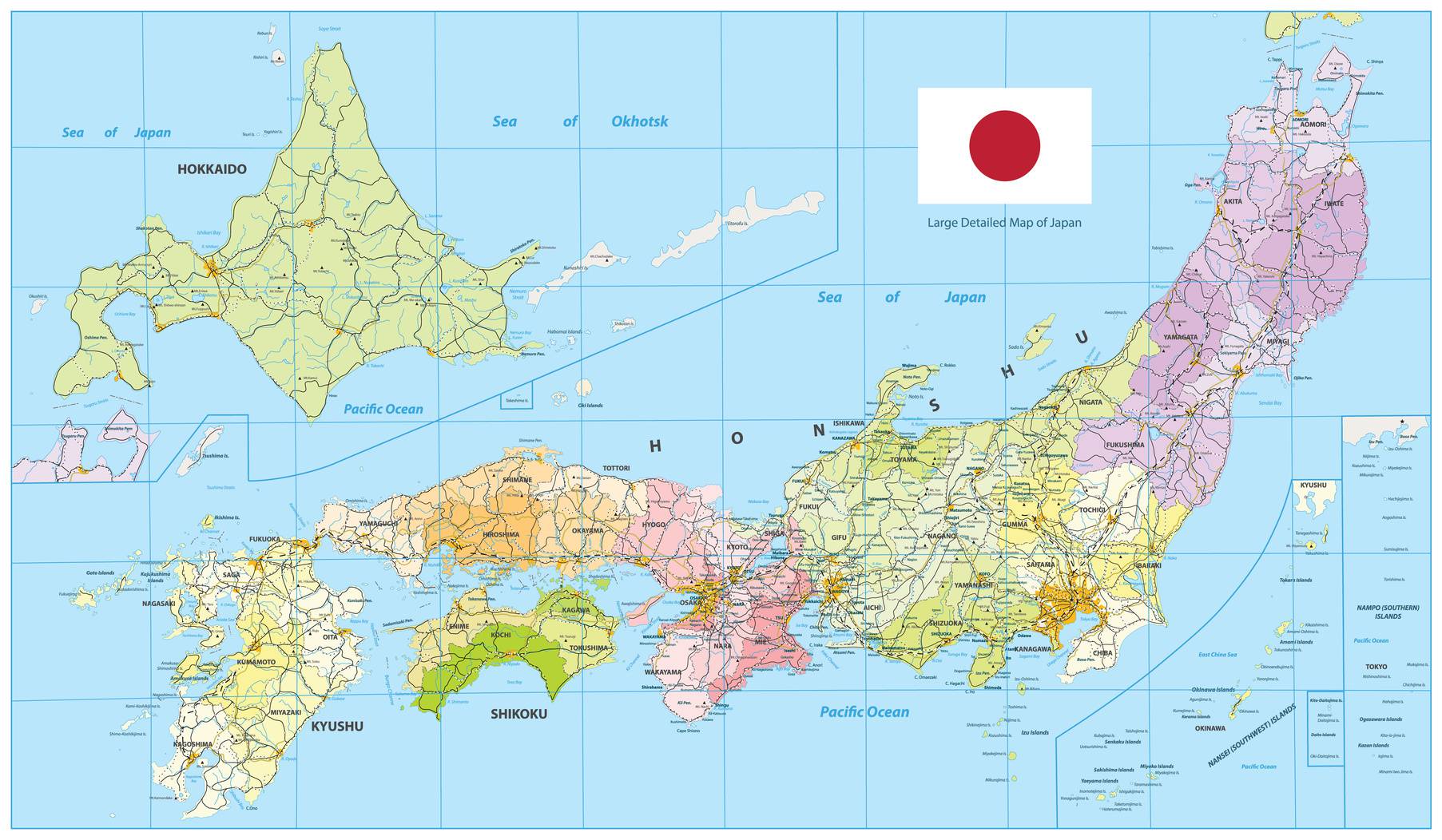
Detailed map of Japan – © cartarium – stock.adobe.com
Inaccessible to inland navigation, rivers are used mainly for irrigation, drinking water supply and electricity generation. Floods are common, especially during typhoon season, and cause significant damage in plains and valleys with high population densities. Japan has a few lakes. The most important is Lake Biwa, located in the center-west of Honshū.
Compared to its area, Japan’s coastline is very long—this is easy to see on the map of Japan. The coast along the Pacific is deeply indented. This is where Tokyo Bay, Suruga Bay and Ise Bay are found, as well as the Inland Sea located between the islands of Honshū and Shikoku.
A varied relief
The many volcanoes and seismic shocks that Japan often experiences illustrate the country’s geological instability. Japan has more than 200 volcanoes, about 60 of which are still active. Some volcanoes are needle-shaped and reach high altitudes; others, calderas, have no external edifice—meaning they are composed only of a crater.
Perched at 3,776 meters above sea level, Mount Fuji—the famous needle-shaped volcano—is the highest point in the country; you can find its location on the map of Japan. The last activity of this volcano was recorded in 1707. Mount Asama in the middle of Honshū and Mount Sakurajima in the south of Kyūshū are famous volcanoes still active. Mount Aso on Kyūshū and Mount Akan on Hokkaidō are the most interesting examples of calderas. Hot springs exist in volcanic areas.
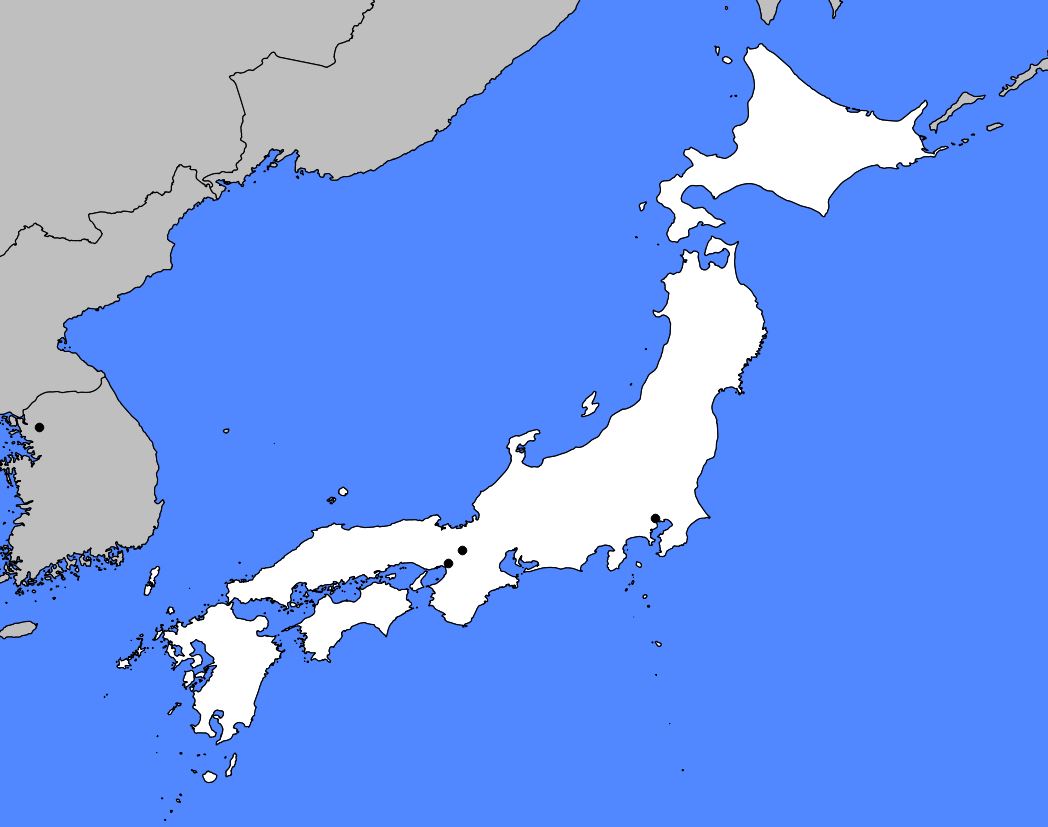
Blank map of Japan
Undersea earthquakes in the northern Pacific Ocean cause huge tidal waves called “tsunamis.” The damage caused by these phenomena is very significant. Every five or six years, Japan suffers a medium-intensity earthquake. One of the most terrible earthquakes in the country’s history occurred in 1923. Tokyo and Yokohama were practically wiped off the map. More than 140,000 people died there.
Climate in Japan
Despite the country’s modest size, Japan experiences a wide variety of climates. Indeed, looking at the map of Japan, you can see that its islands stretch across a wide latitude and lie in a zone where different air masses from the Asian continent and the Pacific Ocean collide. Continental air masses mean that the difference between winter and summer temperatures is greater. But this is offset by the influence of air masses from the sea, which bring high humidity and increased precipitation. The country’s rugged topography also causes notable climatic variations.
During winter, Japan is mainly crossed by cold air masses coming from Siberia and the interior of the Asian continent.
In summer, on the contrary, Japan is influenced by air masses coming from the Pacific Ocean. Japan’s climate—and especially its coastline—is affected by ocean currents: to the south, the warm Japan Current called the Kuroshio, and to the north, the cold Okhotsk Current called the Oyashio.
Precipitation across the Japanese territory, except for eastern Hokkaidō, averages 100 cm per year. Some parts of the mountainous coastline of Honshū record up to 300 cm per year.
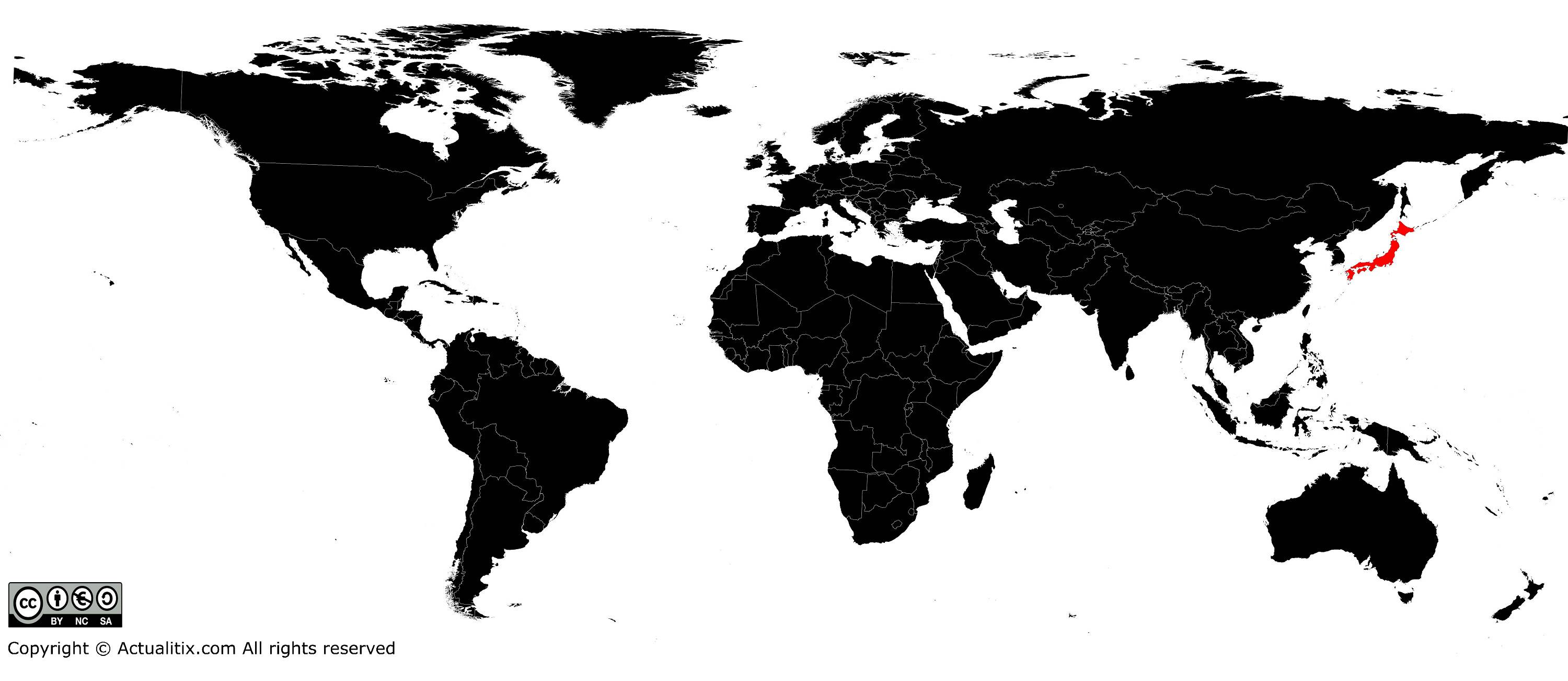
Japan on a world map – Credit Actualitix.com
The rainy season runs from June to September. This does not, however, eliminate the risk of other precipitation during the rest of the year. The rains occurring in June are called baiu or tsuyu.
Seasonal temperatures vary from north to south. In January, the average is between -9° and -7°C on the island of Hokkaidō, between 2°C and 4°C on the island of Honshū, and around 7°C in the south of the island of Kyūshū.