
Discover a map of Oceania. The continent of Oceania refers to the whole formed by tens of thousands of islands, spread over a vast area of the Pacific Ocean, from Belau to Easter Island (12,500 km) and from Midway to New Zealand (7,500 km). Only three thousand of these islands are large enough to have a name. The term Oceania may also include Australia, New Zealand and New Guinea (a whole also known as Australasia).
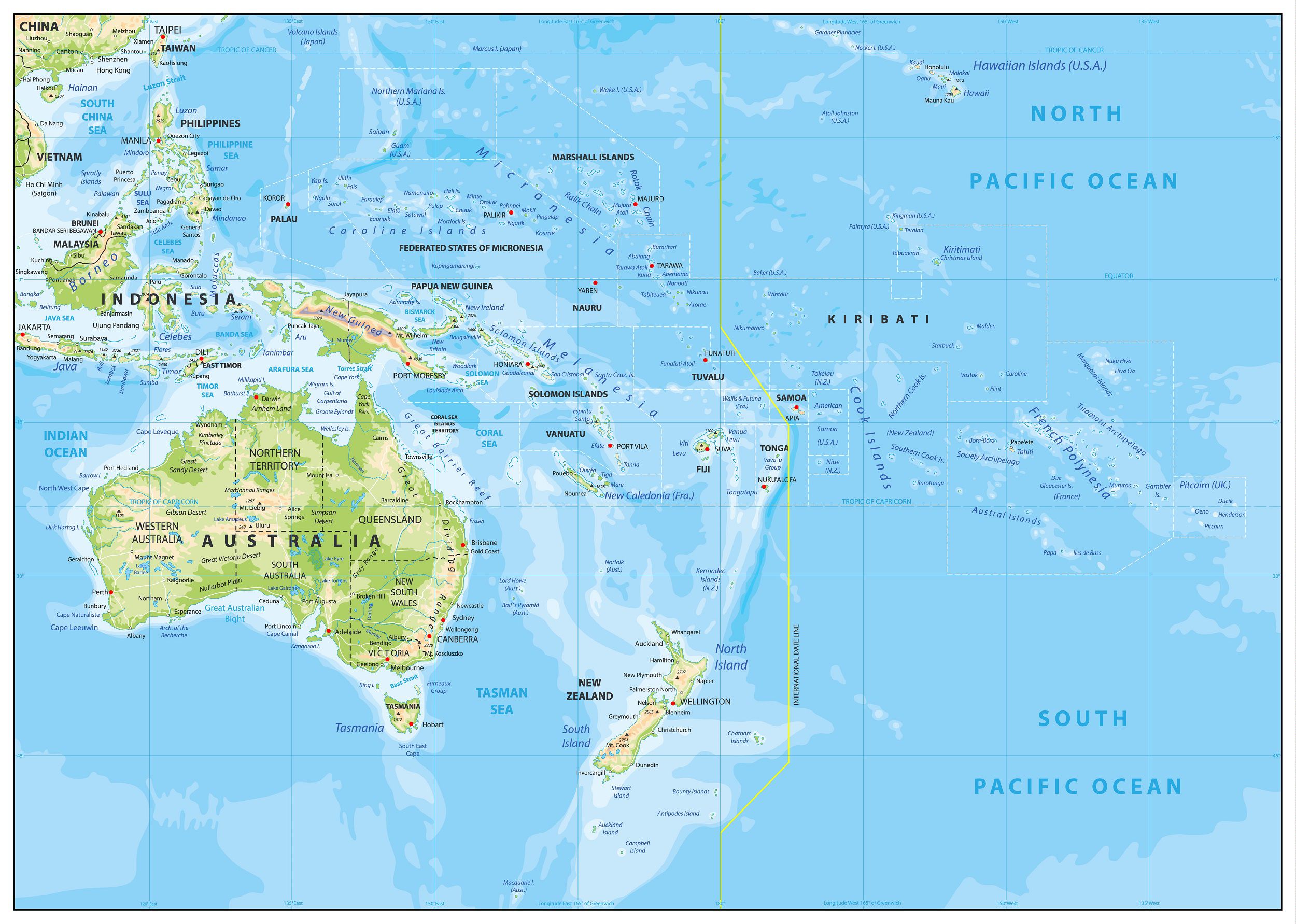
Map of Oceania – © pomogayev – stock.adobe.com
The geography on the map of Oceania
Three major island groups are unquestionably part of it: Melanesia (the “black islands”, named after the inhabitants’ skin color), an island arc to the south-east of New Guinea, where the Solomon Islands, Vanuatu and Fiji are located. Micronesia (“small islands”), small coral islands including the Mariana Islands, Marshall Islands, Caroline Islands, Kiribati (Gilbert), Nauru and Guam. Finally, in the center, the large triangle formed by the islands of Polynesia (“many islands”), with New Zealand, Hawaii and Easter Island as its limits, and including the islands of Samoa, Tonga and Tahiti (the Society Islands). You can find these on the map of Oceania.
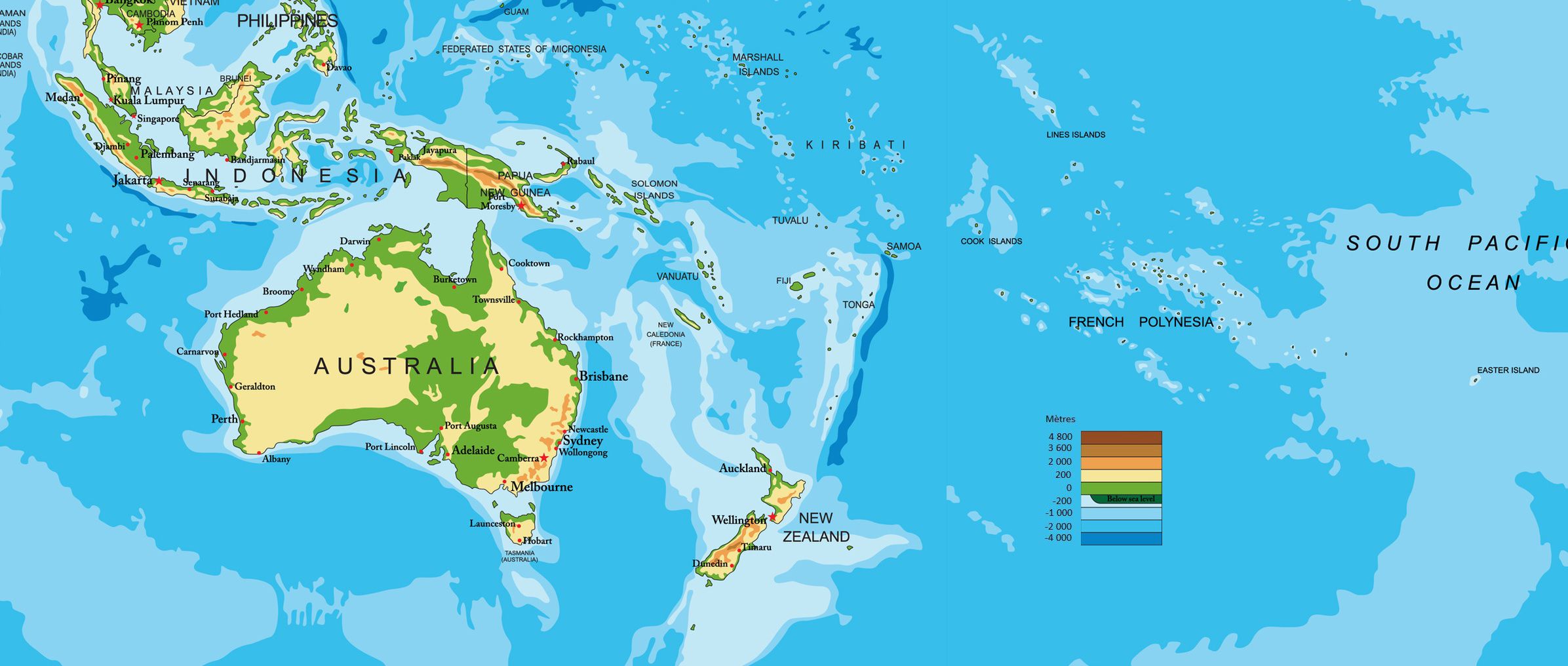
Map of Oceania’s relief – © bogdanserban – stock.adobe.com
Several of these islands were born from volcanoes rising from the Pacific, at the point where two tectonic plates meet. The phenomenon still occurs today: in Tonga, two volcanoes periodically emerge above the surface and are then eroded by the waves. Several islands are subject to eruptions and earthquakes. Most are surrounded by coral reefs, built up from the skeletons of small organisms.
History of Oceania
Many European explorers reached it in the 16th and 17th centuries, but real links with Europe did not develop until the 18th century, after the voyages of English explorers Samuel Wallis, who discovered Tahiti in 1767, and James Cook. Around 1850, several island groups became French, British, American and Dutch colonies, while many missionaries deeply established the Christian faith there (whose staying power remains surprising). The distances explain (see the map of Oceania) why each island group was able to develop different civilizations, often replaced today by European culture.
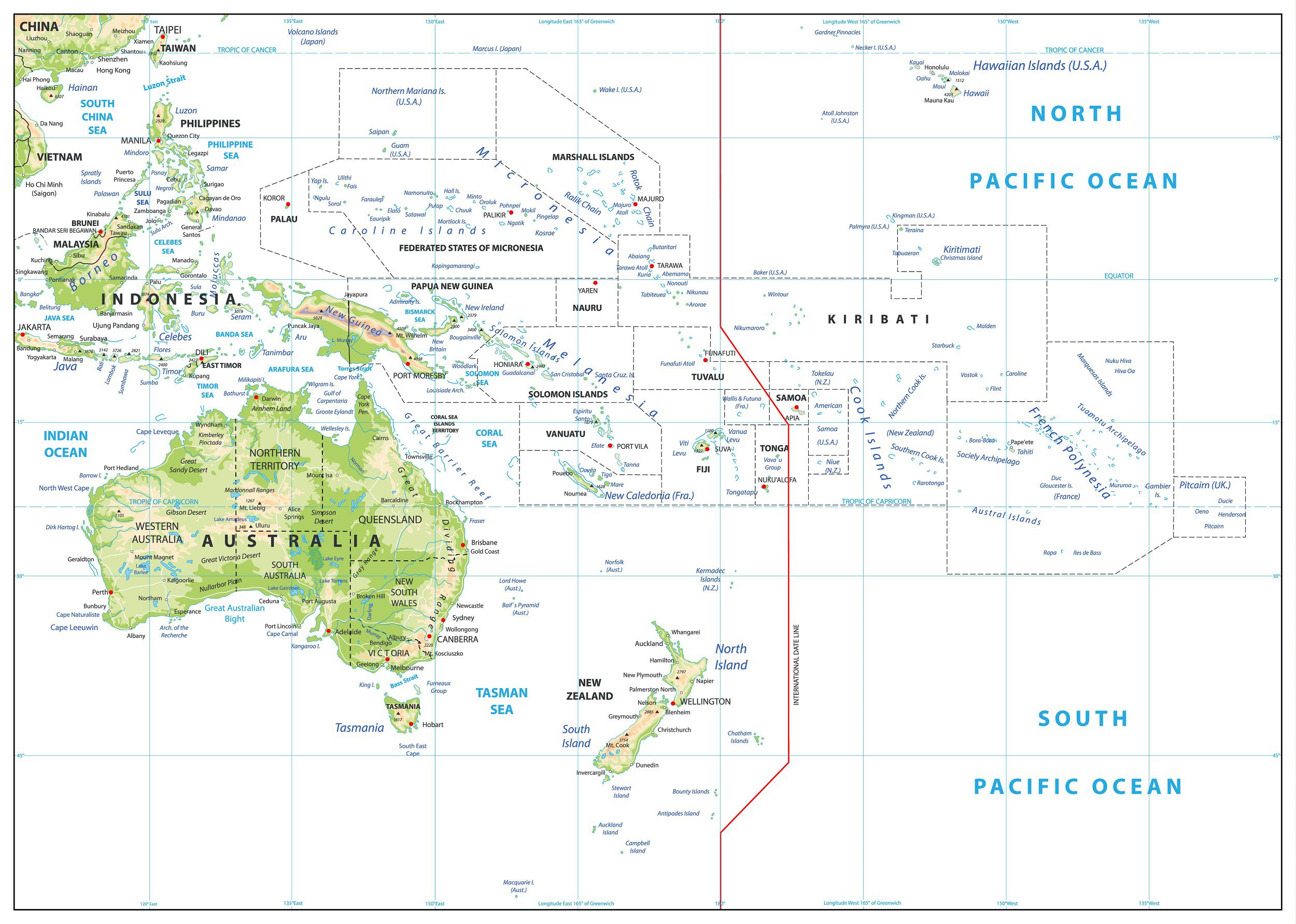
Oceania map – © pomogayev – stock.adobe.com
Tahiti and New Caledonia (you can locate it on the map of Oceania) seem thoroughly French, and Hawaii— the fiftieth state of the United States — is unquestionably American. While New Zealand and Japan have a growing commercial position in Oceania, Australia has had a predominant economic influence: most of the region’s goods are transported by Australian companies.
Many Australians are still settled on the islands on behalf of these firms or for insurance or banking companies, although local employment regulations, enacted by island governments, have greatly reduced their numbers.
Copra (dried coconut pulp) and tourism are the backbone of the economy of several small states, while larger islands have other resources: Fiji exports timber to Australia and New Zealand, and sugar to Great Britain; New Caledonia mines nickel, and Nauru phosphates (used in fertilizers).
The population of Oceania
Low production and remoteness from the main markets are a problem for small developing nations. You can’t really see it on the map of Oceania, but tourism offers them a partial solution, with the downside of some damage to culture and the environment.
A South Pacific Forum was created to promote economic cooperation between the islands. Recently, there have been considerable changes in economic life in many states thanks to the exploitation of fishing resources.
The majority of the indigenous population continues to live from agriculture, although recent years have revealed a trend toward rural exodus. The gradual loss of village traditions has led to the disappearance of the system of assistance for the sick and the elderly, and few states have sufficient infrastructure or resources to make up for it.
European and Asian immigrants living in cities make up a significant share of the population. In Fiji, nearly half of the inhabitants are of Indian origin; in French Polynesia, there are nearly 30,000 French people out of a total population of 270,000, while in New Caledonia, more than half of the population is non-Melanesian.