
You will find a map of Chile in this article. The country is famous for the great diversity of its territory and is located in South America. The north of the country is occupied by the Atacama Desert, one of the driest places in the world. In this region, rainfall is almost nonexistent, whereas it is extremely abundant in the Strait of Magellan, at the extreme south of Chile.
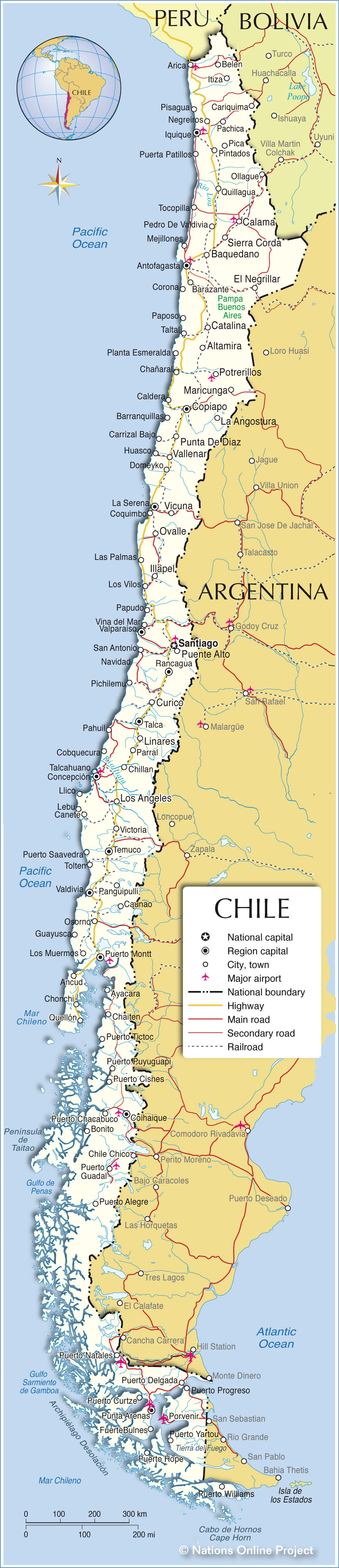
Map of Chile – Credit: Nations Online
The center of the country is by far the most hospitable region. It is in fact a transition zone between the desert north and the humid south.
Geography with the map of Chile
The topography also varies from region to region. The relatively flat valleys of central Chile give way to the Andes Mountains (easily identifiable on the map of Chile) to the east, and to the coastal ranges to the west. These often continue into submarine ridges, which explains the scarcity of coastal plains.
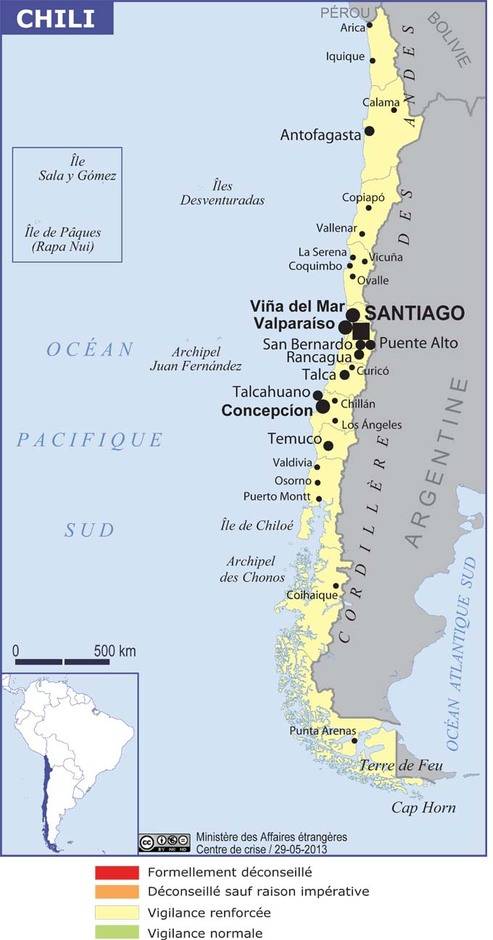
Chile map – Credit: Ministry of Foreign Affairs
The country can be geographically and economically divided into three main regions: the mineral-rich desert in the north; central Chile, the country’s economic, political, and agricultural center; and southern Chile, a sparsely populated region whose economy is based on sheep farming.
Climates in the country
The country stretches enormously from north to south as shown on the map of Chile, which partly explains the climatic contrasts affecting the entire territory. The climate is also influenced by the Humboldt Current, which carries icy waters from Antarctica and cools the Chilean coast. Thus, while the average temperature in Valparaiso does not exceed 14°C, it reaches 18°C on the eastern coast of South America, in Rio Grande, Brazil.
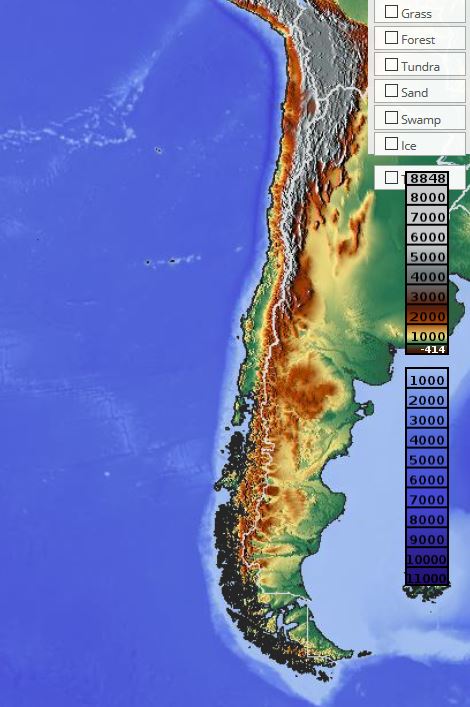
Relief map of Chile – Image extracted from maps-for-free
The low rainfall in the desert north of Chile is also due to the proximity of this ocean current. It significantly cools the offshore winds, which only warm up after sweeping along the Chilean coast.
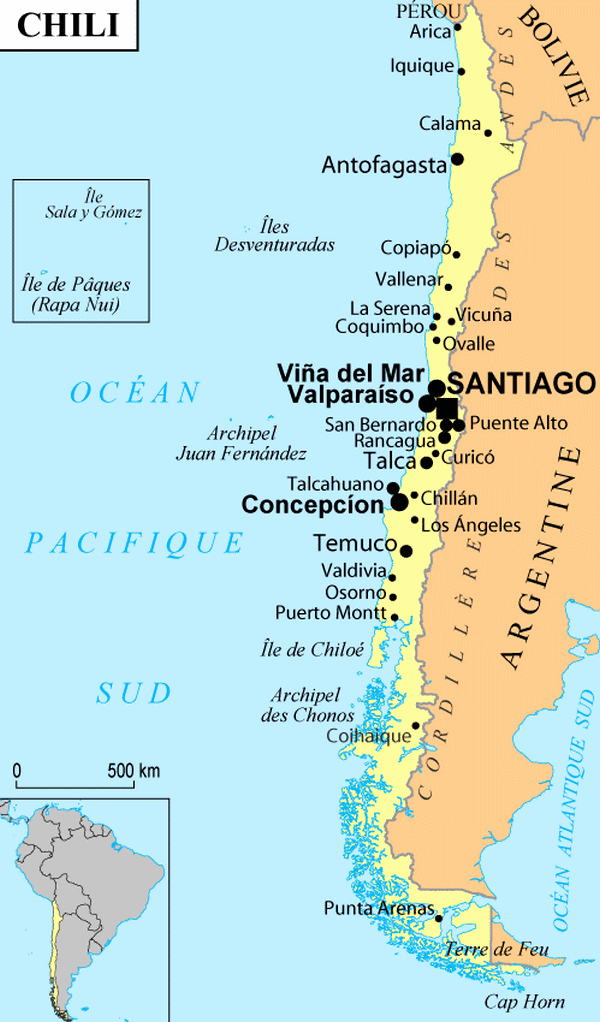
Map of cities in Chile
This warming allows them to remain loaded with water vapor and therefore limits precipitation over the continent. The high Andes mountain range to the east of the country also acts as a natural barrier and prevents trade winds from the Atlantic and inland winds from sweeping across northern and central Chile.
Central Chile lies between Coquimbo and Concepcion (see the map of Chile). Its climate is characterized by hot, dry summers and cold, wet winters. Temperatures are generally moderate.
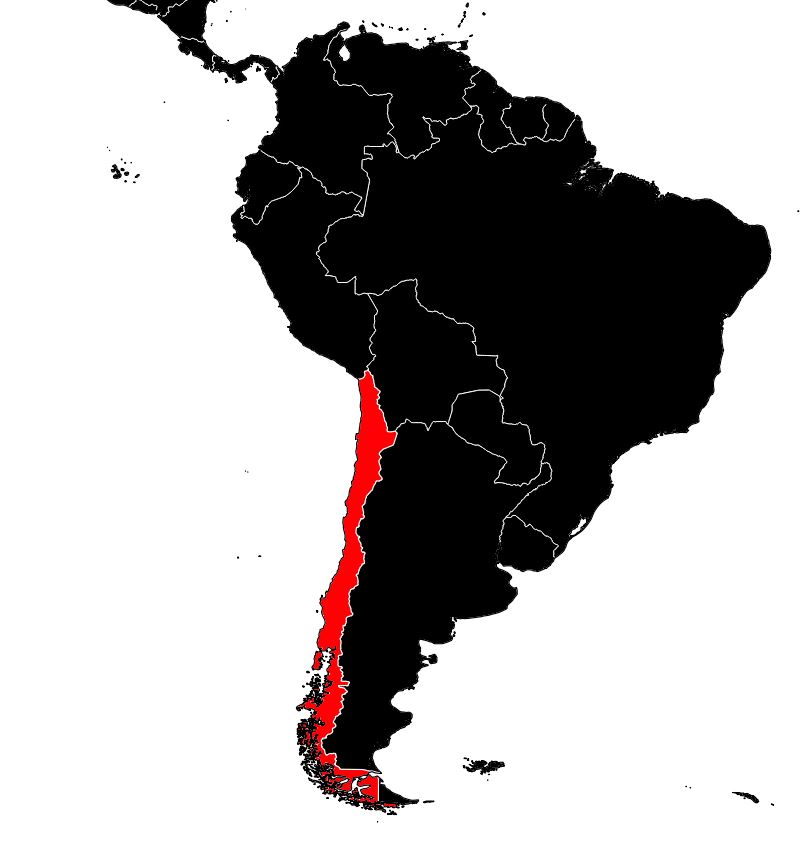
Chile on a map of South America – Credit Actualitix
In Valparaiso, during the coldest months (June and July), the average temperature is 11.3°C, while during the warmest month (January) it does not exceed 17.6°C. In the Central Valley, where the climate is cooler due to higher elevations, temperatures are relatively similar but extremes are more frequent.
As one moves south in Chile, rainfall becomes increasingly abundant and the dry season shorter. South of Concepcion, the rainy season lasts almost all year. In some places, annual rainfall can exceed 500 centimeters.

Blank map of Chile
Learn more about the country
Chile stretches along a particularly long and narrow strip of land. It therefore has one of the longest coastlines in the world, extending over more than 4,200 kilometers from north to south and not exceeding 445 kilometers in width from east to west, as clearly shown on the map of Chile. Its authority also extends over certain territories in Antarctica and Easter Island (Rapa Nui). Its total area is 756,621 square kilometers.
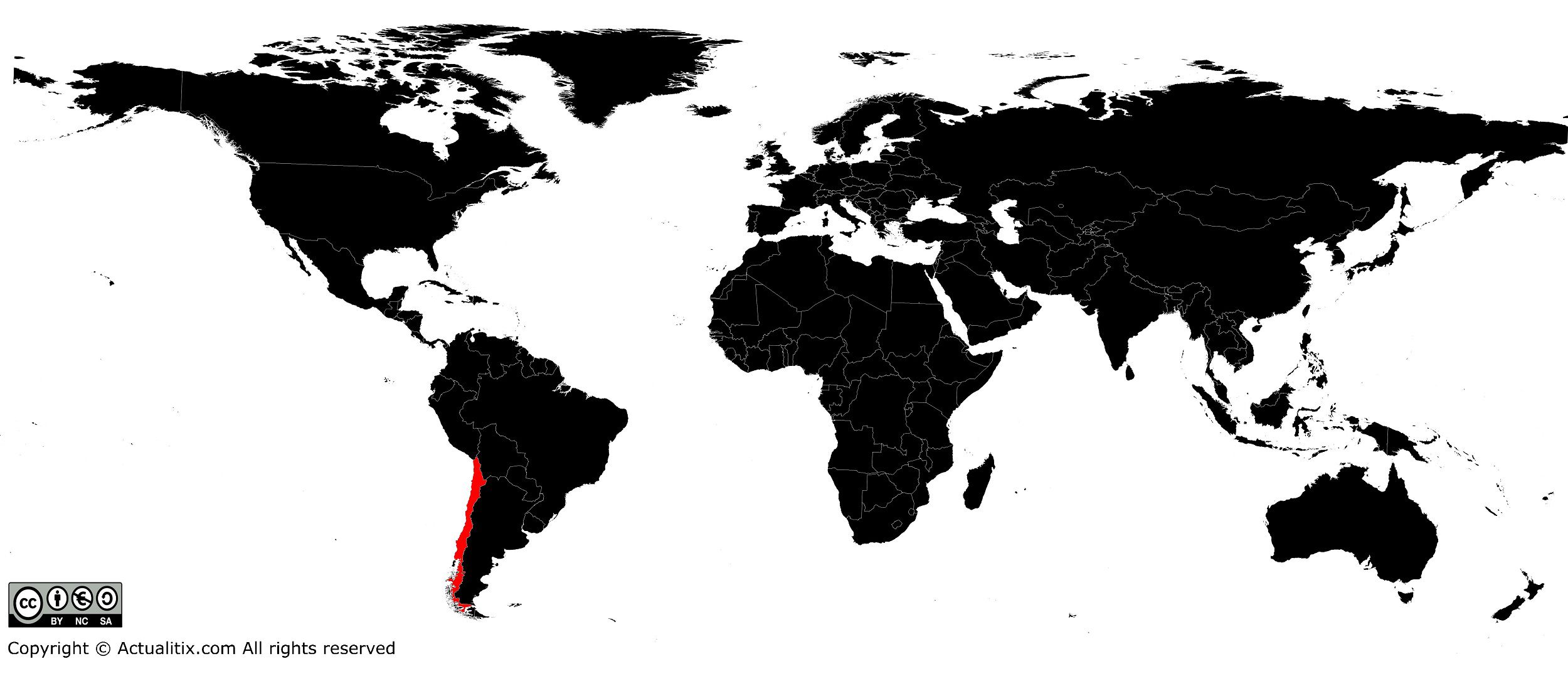
Chile on a world map
Mountainous areas represent approximately 70% of the territory, and the Andes mountain range (see the map of Chile) runs the entire length of the country, forming a natural barrier separating Chile from Argentina and Bolivia. The mountains exceed 6,000 meters in the north, then gradually decrease in altitude toward the southern coast of Chile. The Andes contain several volcanoes, but most of them are extinct.
The coastal ranges along the Pacific coast are lower and roughly parallel to the Andes. They extend between 30° and 40° south latitude and are intersected by the Central Valley or Chilean Valley. This valley is divided by low transverse hills and stretches s