
You will find in this article a map of Senegal. The country is one of the most economically developed in West Africa. It is the republic located furthest west on the African continent. The Cape Verde Peninsula is the westernmost point of Africa. Senegal covers an area of 196,190 square kilometers.
Article Summary
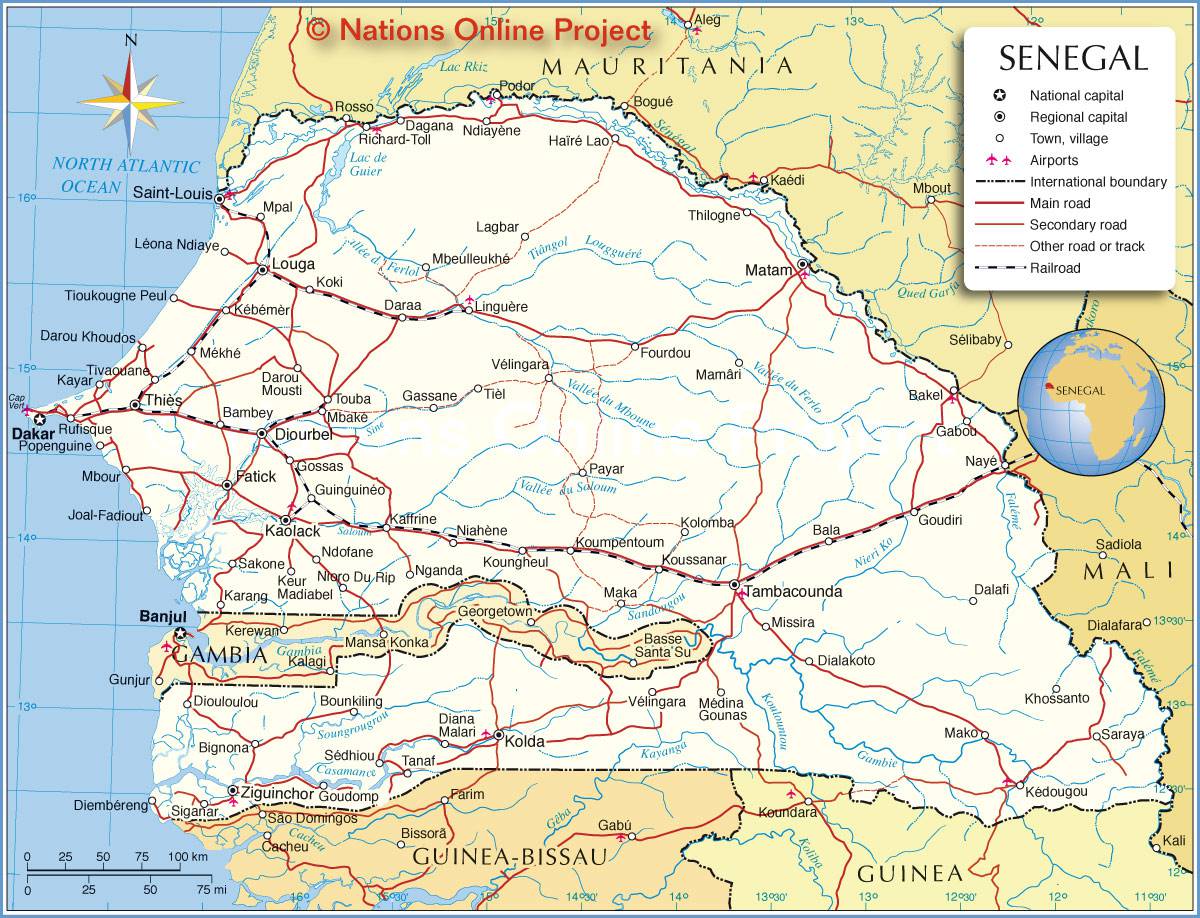
Geographical map of Senegal
As can be seen on the map of Senegal, the country is bordered to the west by the Atlantic Ocean, to the northeast by Mauritania, to the east by Mali, and to the south by Guinea. The Gambia pushes into the southwest of Senegal from the Atlantic, following the Gambia River. It therefore forms an enclave about 480 kilometers long and around 32 kilometers wide. Dakar is the capital and the largest city in Senegal.
Geography with the map of Senegal
Most of Senegal is made up of a broad plain that rises towards the southwest to form hills and plateaus. The country lies in a depression. The three main landform types (which can be found on the map of Senegal) are: the Cape Verde region, made up of small plateaus and volcanic rocks; the high massif on the border with Guinea, reaching about 500 m in altitude and forming the foothills of the Fouta Djallon; and a wide basin between Cape Verde in the west and the edges of the massif to the west.
The Casamance region, south of The Gambia, is almost isolated from the rest of the country. The Atlantic coastline in the south is bordered by marshes. A broad belt of sand dunes stretches along the coast between Saint-Louis and Dakar. Senegal is watered by four major rivers. These rivers are navigable up to a certain point inland. The large flood basin of the Senegal River contains fertile land for agriculture.
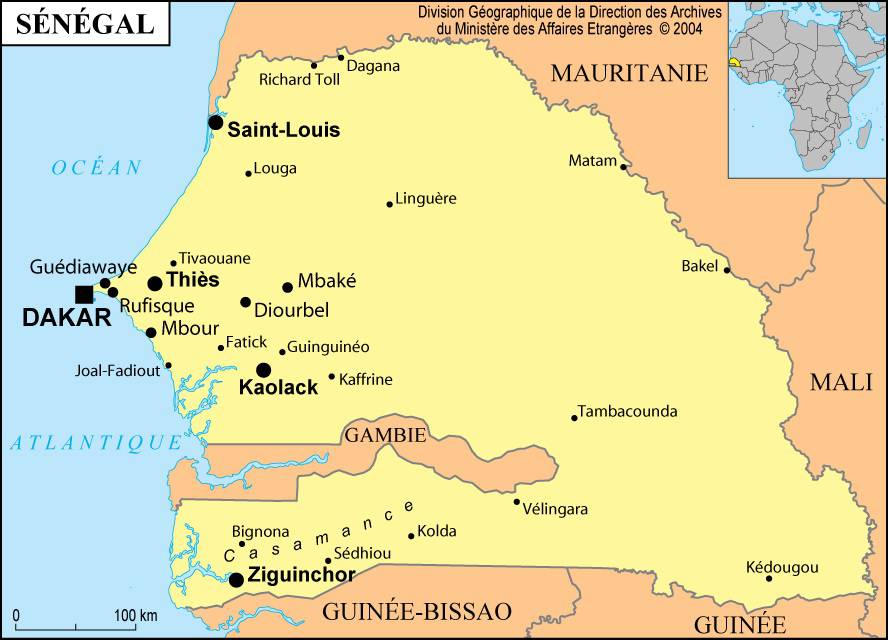
Map of cities in Senegal
Climate
Senegal’s climate combines dry desert influences with humid tropical ones. There are distinct dry and wet seasons. The rainy season runs from June to October. Annual temperatures range between 14° and 40° C, but rarely fall below 16° C.
The natural vegetation consists mainly of savanna-type grasses with a few scattered trees. Forest covers nearly one-third of the country’s area. Wildlife is protected in the Niokolo-Koba National Park (see the map of Senegal). Many species of fish and crustaceans can be found in the rivers.
The country’s economy
Senegal is прежде всего an agricultural country. Agriculture, livestock farming and fishing are the main sectors of the economy. Peanuts cover 40% of cultivated land and represent a significant share of export income. The cultivation of cotton, rice, sugar cane and vegetables is developing and helps reduce the country’s dependence. Other crops such as millet, sorghum and beans are intended for domestic consumption. Livestock farming is widespread throughout the country, particularly in the north. Cattle, sheep, goats and pigs are raised. The fishing industry is also an important activity.
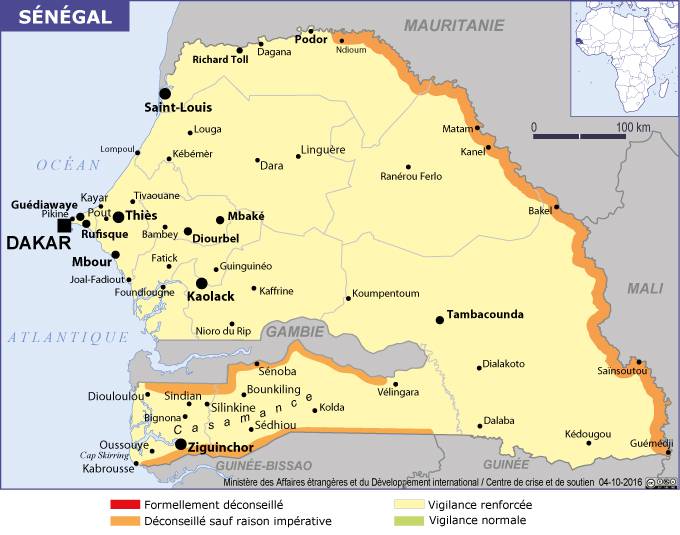
Phosphate production is very important to Senegal’s economy. There are oil deposits offshore of Casamance. Coastal sands contain titanium ore and aluminum phosphates, as well as calcium phosphate.

Blank map of Senegal
Imports are generally greater than exports. They include crude oil, machinery, cereals, chemicals and transport equipment. Petroleum products, calcium phosphate, peanut oil and fresh, canned and frozen fish are the main exports.
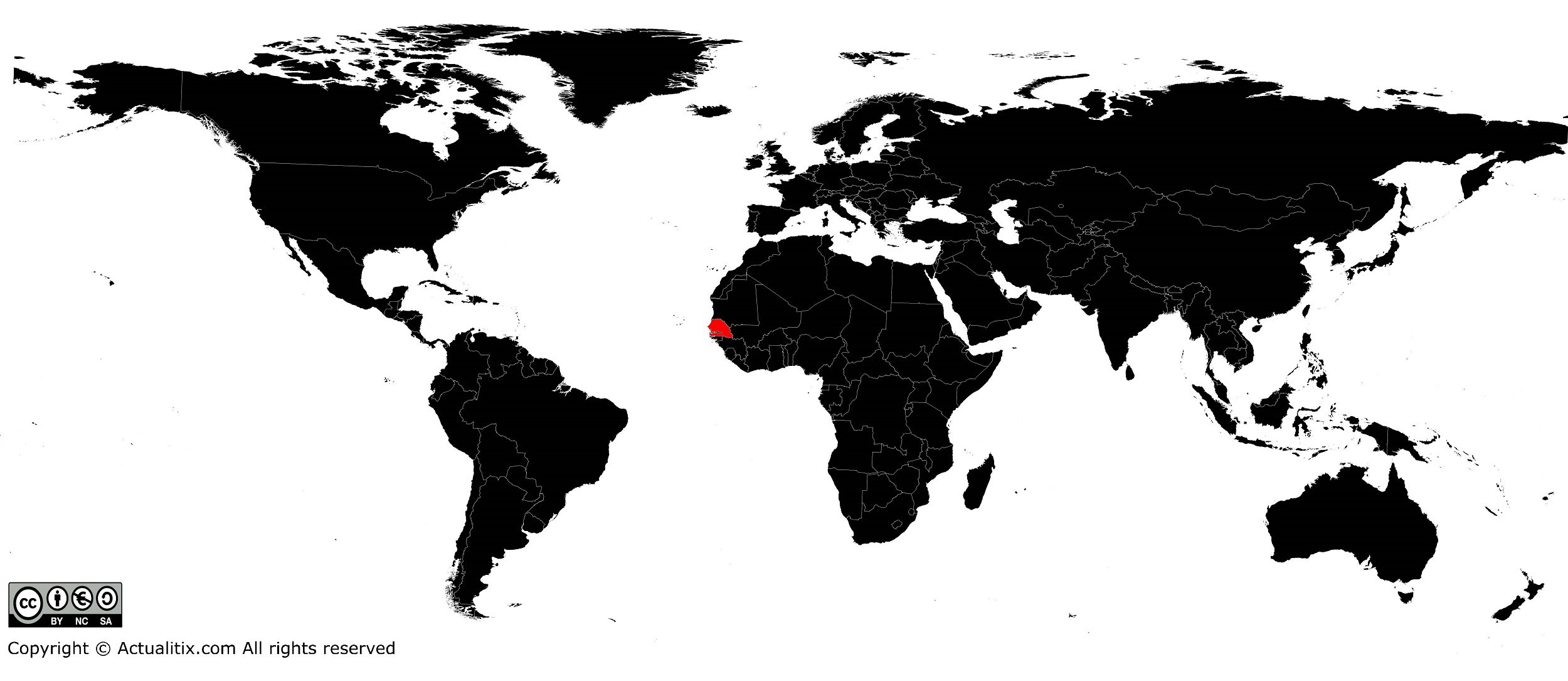
Senegal on a world map
More than three quarters of the country’s industrial output comes from the Dakar region (which can be seen on the map of Senegal). Textiles, cement, soft drinks, etc. are produced there. The creation of a free trade zone in 1981 enabled Senegal to double the number of industrial companies. Tourism has also become an important source of foreign currency. Traditional crafts include leatherwork, wood carving, basketry and weaving, pottery and jewelry making.
Dakar is an important seaport in West Africa. It is also the terminus of Senegal’s railway system. Dakar-Yoff International Airport is served by many airlines. It is one of the largest in Africa.
You can discover all the available maps for the different countries of the world on this page.