
Discover the map of Greece. The country covers an area of 132,000 square kilometers and includes many islands. Its very complex topography is characterized by a tight interweaving of the sea, island territories, and the mainland, whose highly indented coastline is cut by a multitude of bays and gulfs.
The coasts are marked by the presence of hundreds of inlets separated from one another by rocky peninsulas. Only a small portion of the territory lies more than 80 kilometers from the sea. The contrast between the blue of the sea and sky, against which stand out limestone cliffs and houses with dazzling white walls, creates colorful landscapes whose beauty is famous worldwide. The quality of the light is unique and has inspired many artists.
Discover other maps of Greece:
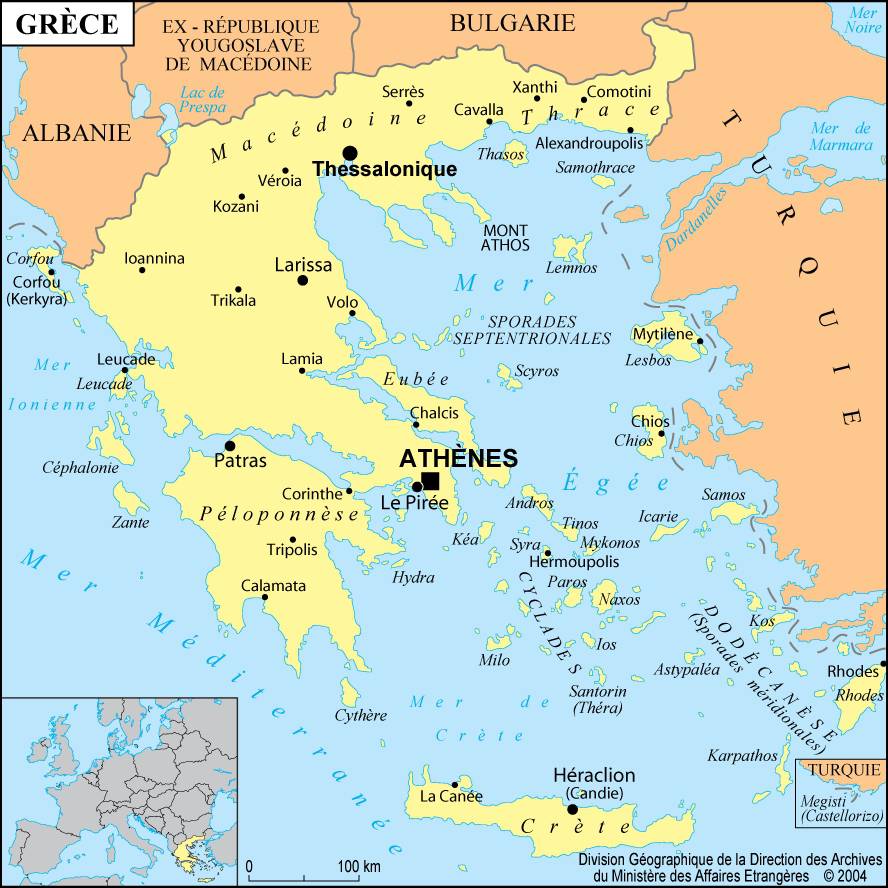
Greece map
Since Antiquity, Greece has been divided into several regions. The provinces of Macedonia and Thrace extend over a narrow portion of the territory, along the northern coastline of the Aegean Sea. They then give way further west to the province of Epirus, which forms part of the border with Albania. Thessaly lies to the east of Epirus and to the south of Macedonia.
Southern Greece includes the provinces of Central Greece and the Peloponnese. On the map of Greece, you can see that the Greek islands include the Aegean islands, the Northern Sporades, the Cyclades, the Dodecanese archipelago, Crete, and the Ionian Islands off the western coast.
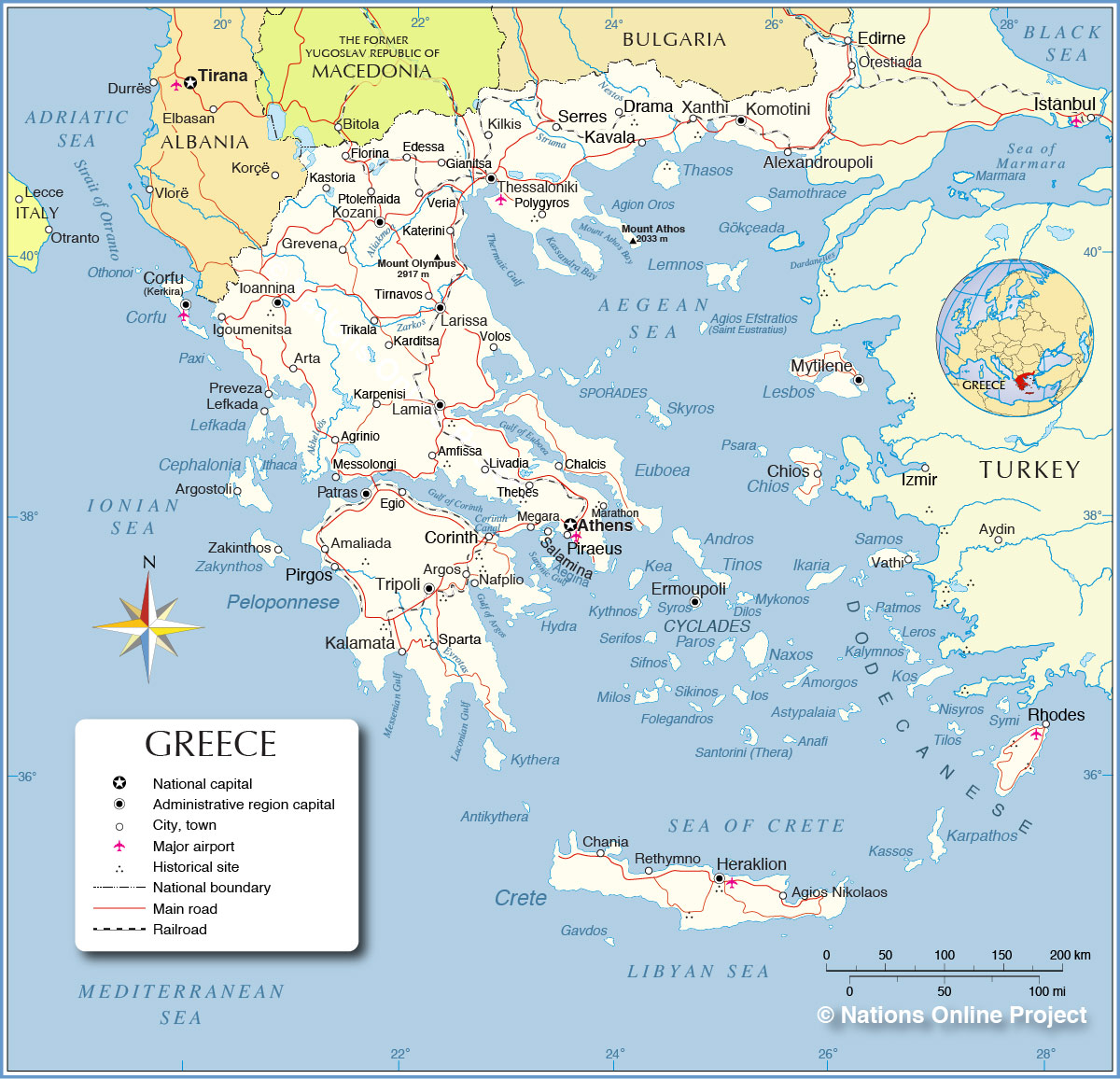
Map of Greece – Credit: Nations Online
Table of contents
Map of Greece: relief
As you can see on the map of Greece, the terrain is varied. Mountain areas cover around 70% of the territory, and Greece’s highest peak, Mount Olympus, rises to 2,917 meters in Thessaly. Several mountain ranges run from northwest to southeast. The Pindus is by far the most important of them. It forms the backbone of the peninsula and separates Epirus from Thessaly. It then extends a little further south into the Peloponnese peninsula, and continues as an underwater range that resurfaces in Crete, Rhodes, and Karpathos.
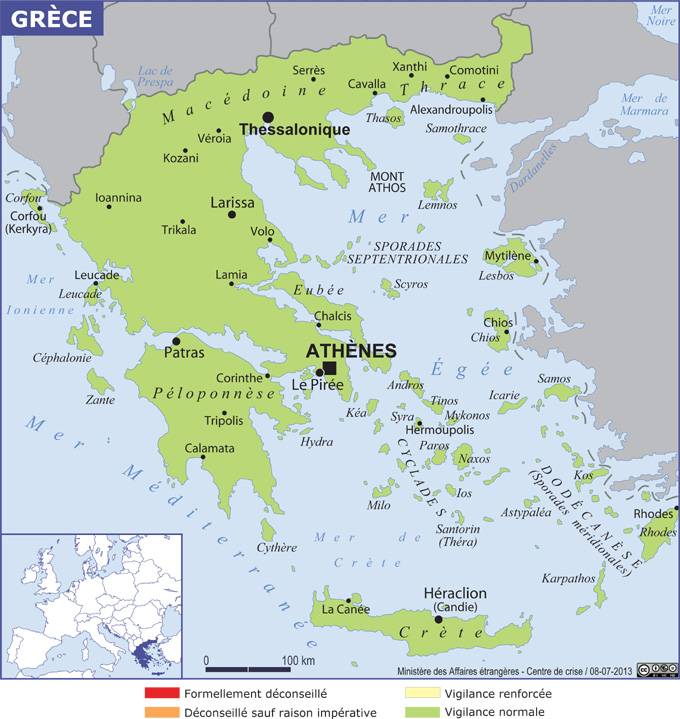
Map of the cities of Greece – Credit: Ministry of Foreign Affairs
The major mountain chains are separated from one another by broad valleys. Macedonia and Thrace contain vast plains that were once occupied by lakes and marshes. The plains of Thessaly, in eastern Greece, are also extensive, while coastal plains are often small and narrow.
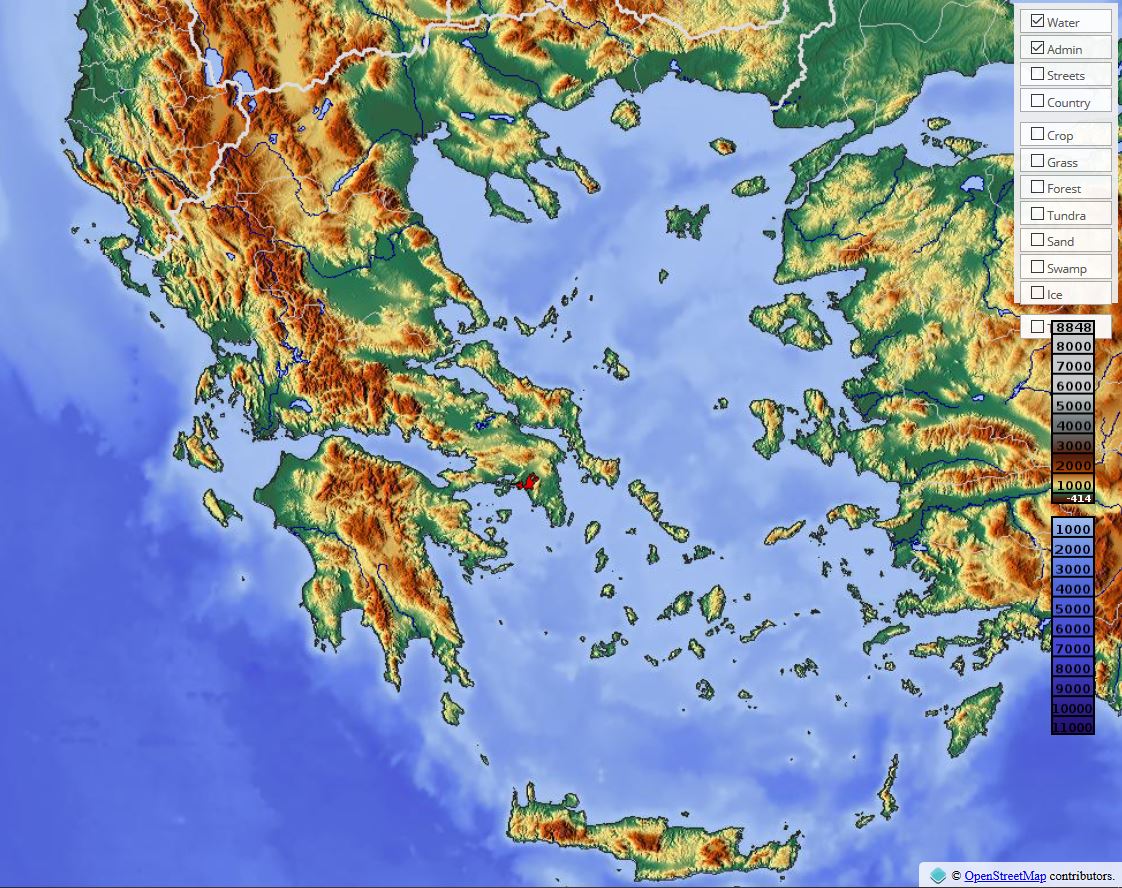
Relief map of Greece – Image extracted from maps-for-free
The islands represent 20% of the country’s total area, as is visible on the map of Greece. They generally lie in the continuation of the mainland mountain ranges. The Ionian Islands (from Corfu to Zakynthos) follow one another along the western coast. The island of Euboea and the Northern Sporades are located in the Aegean Sea.
They then give way, to the east, to the islands of Lemnos, Lesbos, and Chios, which lie close to the Turkish coast. They were once part of the Asia Minor mainland. To the southeast, the Cyclades are of volcanic origin and are still affected from time to time by earthquakes. Further east, the Dodecanese archipelago runs along the coast of Turkey. The island of Rhodes lies a little further south. Crete, for its part, occupies a somewhat special position off the Greek mainland and away from the other islands. Its terrain is very mountainous, and its highest peak, Mount Ida, reaches 2,456 meters.
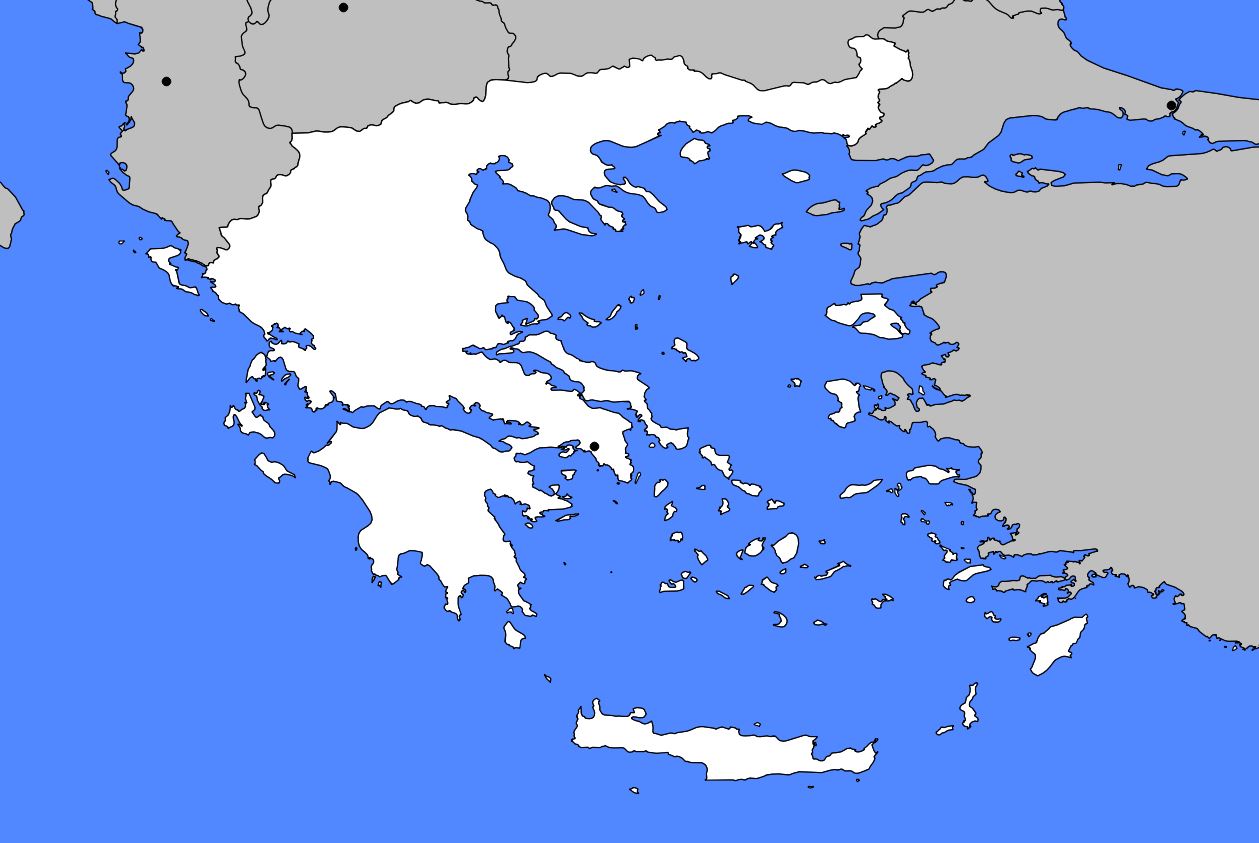
Blank map of Greece – Credit Actualitix
Greece’s mountain systems are relatively recent and continue to be devastated by violent earthquakes. Seismic activity, very significant throughout the territory, becomes particularly intense in the Ionian Islands.
Map of Greece: hydrographic network
The map of Greece shows the country’s hydrographic network, which is very complex. Rivers flowing in the north of the country, such as the Axios and the Strymon, rise in Bulgaria and North Macedonia and then flow into the Aegean Sea. Greece’s longest river, the Aliakmonas, rises in the Pindus massif and flows east for 298 kilometers before emptying into the Aegean Sea, like the two main rivers of Central Greece and Thessaly: the Pineios and the Spercheios.
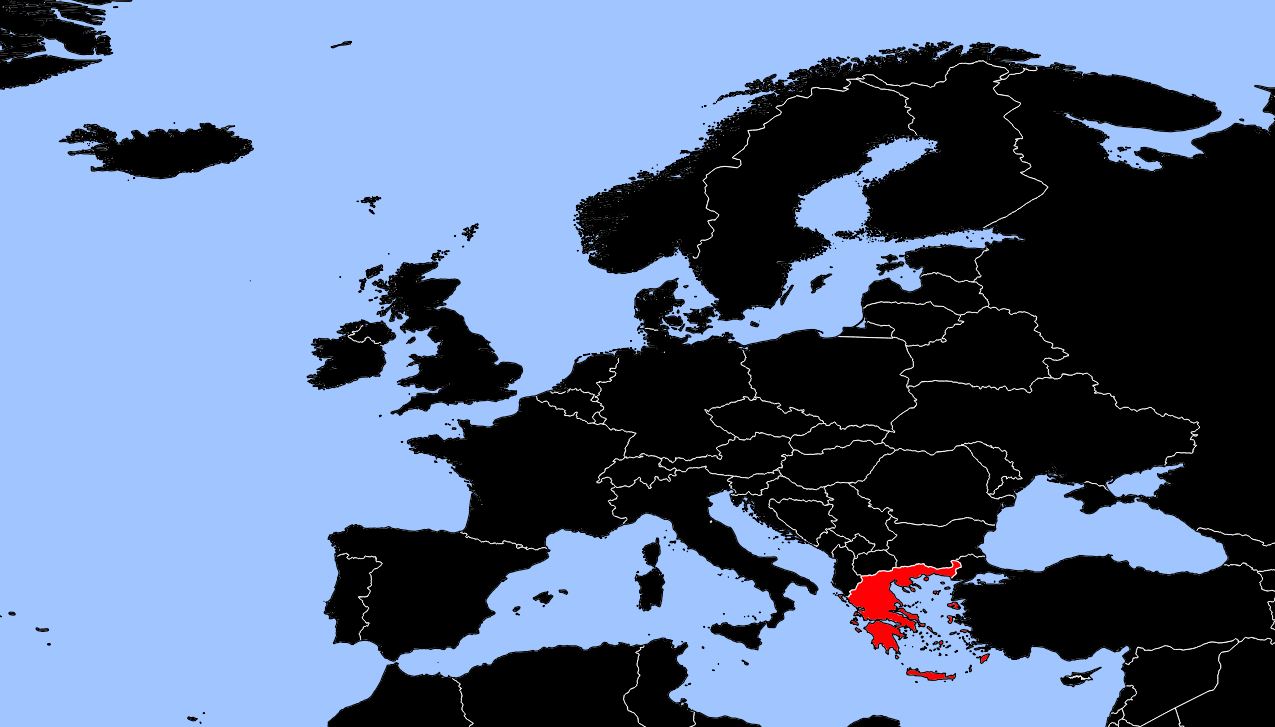
Greece on a map of Europe – Credit Actualitix
Several small rivers flow west of the Pindus to the Ionian Sea. The rivers of the Peloponnese, on the other hand, flow from the coast toward the central mountains. Greece also has a significant underground hydrographic network. Lakes are few and vary in size. Lake Trichonis, in western Greece, is by far the largest. Soil types and the dryness of the climate cause frequent water shortages.
Soil fertility varies from one region to another. In mountainous areas and places dominated by limestone, soils are generally not very fertile. In valleys, reddish soils are more common and favor agricultural development. In river plains and coastal plains, soils are very fertile but often require substantial irrigation.
Greece on a world map – Credit Actualitix
Climate in Greece
Greece has a typically Mediterranean climate characterized by hot, dry summers and mild, rainy winters. Discover the map of Greece (the climate map to learn more). In coastal and island regions, summer temperatures rarely fall below 27°C on average, and winter temperatures do not drop below 10°C. In summer, rainfall is scarce and is concentrated rather between November and December. During this period, monthly rainfall can exceed 20 centimeters in some regions.
In inland areas and in the Peloponnese province, winters are harsher than on the coast, and mountain peaks are often covered with snow for several consecutive months. Northern Greece is affected by a more continental climate defined by lower winter temperatures and wetter summers.
Weather varies depending on the winds. In summer, winds blow northward with great force and often make navigation impossible. In winter, icy winds cool the climate of northern Greece. At the same time of year, winds from Africa sweep over Crete and keep temperatures relatively high.
Vegetation and wildlife in Greece
Vegetation is very diverse. Holm oaks, cypresses, and pines are the most widespread species. The mountainous regions of northern Greece are mainly made up of deciduous trees such as oaks, chestnuts, ash trees, and beeches. Original forests have almost all disappeared due to intensive clearing of the territory. Today, they represent only 20% of the total area. In grazing areas, they have been replaced by maquis where shrubs and small bushes grow in abundance.
Forests on the mountain slopes of central Greece are home to bears, wolves, wildcats, martens, lynx, and deer. In the south and coastal regions, you are more likely to encounter jackals, wild boars, and porcupines. Among the most common bird species are herons and pelicans. Reptiles are numerous (snakes, turtles, and lizards). The subtropical climate explains the presence of many insects. These can be dangerous, as they may transmit malaria.
Discover other articles about Greece.